Poems List

Sonnet 22 - When our two souls stand up erect and strong

Sonnet 22 - When our two souls stand up erect and strong

XXII

When our two souls stand up erect and strong,
Face to face, silent, drawing nigh and nigher,
Until the lengthening wings break into fire
At either curved point,-what bitter wrong
Can the earth do to us, that we should not long
Be here contented? Think. In mounting higher,
The angels would press on us and aspire
To drop some golden orb of perfect song
Into our deep, dear silence. Let us stay
Rather on earth, Beloved,-where the unfit
Contrarious moods of men recoil away
And isolate pure spirits, and permit
A place to stand and love in for a day,
With darkness and the death-hour rounding it.
430

Sonnet 24 - Let the world's sharpness, like a clasping knife

Sonnet 24 - Let the world's sharpness, like a clasping knife

XXIV

Let the world's sharpness, like a clasping knife,
Shut in upon itself and do no harm
In this close hand of Love, now soft and warm,
And let us hear no sound of human strife
After the click of the shutting. Life to life-
I lean upon thee, Dear, without alarm,
And feel as safe as guarded by a charm
Against the stab of worldlings, who if rife
Are weak to injure. Very whitely still
The lilies of our lives may reassure
Their blossoms from their roots, accessible
Alone to heavenly dews that drop not fewer,
Growing straight, out of man's reach, on the hill.
God only, who made us rich, can make us poor.
390

Sonnet 20 - Beloved, my Beloved, when I think

Sonnet 20 - Beloved, my Beloved, when I think

XX

Beloved, my Beloved, when I think
That thou wast in the world a year ago,
What time I sat alone here in the snow
And saw no footprint, heard the silence sink
No moment at thy voice, but, link by link,
Went counting all my chains as if that so
They never could fall off at any blow
Struck by thy possible hand,-why, thus I drink
Of life's great cup of wonder ! Wonderful,
Never to feel thee thrill the day or night
With personal act or speech,-nor ever cull
Some prescience of thee with the blossoms white
Thou sawest growing! Atheists are as dull,
Who cannot guess God's presence out of sight.
357

Sonnet 18 - I never gave a lock of hair away

Sonnet 18 - I never gave a lock of hair away

XVIII

I never gave a lock of hair away
To a man, Dearest, except this to thee,
Which now upon my fingers thoughtfully,
I ring out to the full brown length and say
'Take it.' My day of youth went yesterday;
My hair no longer bounds to my foot's glee,
Nor plant I it from rose or myrtle-tree,
As girls do, any more: it only may
Now shade on two pale cheeks the mark of tears,
Taught drooping from the head that hangs aside
Through sorrow's trick. I thought the funeral-shears
Would take this first, but Love is justified,-
Take it thou,-finding pure, from all those years,
The kiss my mother left here when she died.
377

Sonnet 16 - And yet, because thou overcomest so

Sonnet 16 - And yet, because thou overcomest so

XVI

And yet, because thou overcomest so,
Because thou art more noble and like a king,
Thou canst prevail against my fears and fling
Thy purple round me, till my heart shall grow
Too close against thine heart henceforth to know
How it shook when alone. Why, conquering
May prove as lordly and complete a thing
In lifting upward, as in crushing low!
And as a vanquished soldier yields his sword
To one who lifts him from the bloody earth,
Even so, Beloved, I at last record,
Here ends my strife. If thou invite me forth,
I rise above abasement at the word.
Make thy love larger to enlarge my worth.
448

Sonnet 14 - If thou must love me, let it be for nought

Sonnet 14 - If thou must love me, let it be for nought

XIV

If thou must love me, let it be for nought
Except for love's sake only. Do not say
'I love her for her smile-her look-her way
Of speaking gently,-for a trick of thought
That falls in well with mine, and certes brought
A sense of pleasant ease on such a day'-
For these things in themselves, Beloved, may
Be changed, or change for thee,-and love, so wrought,
May be unwrought so. Neither love me for
Thine own dear pity's wiping my cheeks dry,-
A creature might forget to weep, who bore
Thy comfort long, and lose thy love thereby!
But love me for love's sake, that evermore
Thou mayst love on, through love's eternity.
655

Sonnet 12 - Indeed this very love which is my boast

Sonnet 12 - Indeed this very love which is my boast

XII

Indeed this very love which is my boast,
And which, when rising up from breast to brow,
Doth crown me with a ruby large enow
To draw men's eyes and prove the inner cost,-
This love even, all my worth, to the uttermost,
I should not love withal, unless that thou
Hadst set me an example, shown me how,
When first thine earnest eyes with mine were crossed,
And love called love. And thus, I cannot speak
Of love even, as a good thing of my own:
Thy soul hath snatched up mine all faint and weak,
And placed it by thee on a golden throne,-
And that I love (O soul, we must be meek!)
Is by thee only, whom I love alone.
460

Sonnet 10 - Yet, love, mere love, is beautiful indeed

Sonnet 10 - Yet, love, mere love, is beautiful indeed

X

Yet, love, mere love, is beautiful indeed
And worthy of acceptation. Fire is bright,
Let temple burn, or flax; an equal light
Leaps in the flame from cedar-plank or weed:
And love is fire. And when I say at need
I love thee . . . mark! . . . I love thee-in thy sight
I stand transfigured, glorified aright,
With conscience of the new rays that proceed
Out of my face toward thine. There's nothing low
In love, when love the lowest: meanest creatures
Who love God, God accepts while loving so.
And what I feel, across the inferior features
Of what I am, doth flash itself, and show
How that great work of Love enhances Nature's.
461

Sonnet 08 - What can I give thee back, O liberal

Sonnet 08 - What can I give thee back, O liberal

VIII

What can I give thee back, O liberal
And princely giver, who hast brought the gold
And purple of thine heart, unstained, untold,
And laid them on the outside of the-wall
For such as I to take or leave withal,
In unexpected largesse? am I cold,
Ungrateful, that for these most manifold
High gifts, I render nothing back at all?
Not so; not cold,-but very poor instead.
Ask God who knows. For frequent tears have run
The colors from my life, and left so dead
And pale a stuff, it were not fitly done
To give the same as pillow to thy head.
Go farther! let it serve to trample on.
404

Sonnet 06 - Go from me. Yet I feel that I shall stand

Sonnet 06 - Go from me. Yet I feel that I shall stand

VI

Go from me. Yet I feel that I shall stand
Henceforward in thy shadow. Nevermore
Alone upon the threshold of my door
Of individual life, I shall command
The uses of my soul, nor lift my hand
Serenely in the sunshine as before,
Without the sense of that which I forbore-
Thy touch upon the palm. The widest land
Doom takes to part us, leaves thy heart in mine
With pulses that beat double. What I do
And what I dream include thee, as the wine
Must taste of its own grapes. And when I sue
God for myself, He hears that name of thine,
And sees within my eyes the tears of two.
413

Comments (0)

Log in to post a comment.

NoComments

Identification and basic context

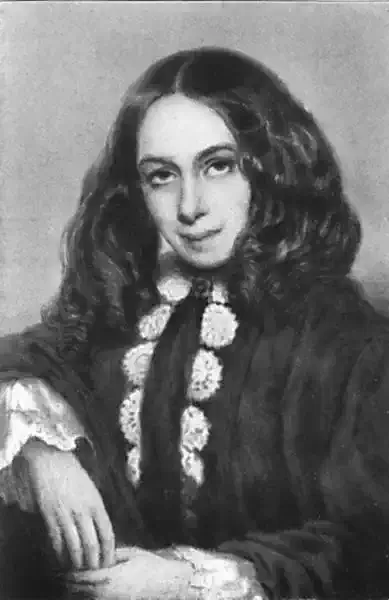
Elizabeth Barrett Browning was an influential English poet of the Victorian era. She is best known for her collection 'Sonnets from the Portuguese' and her long poem 'Aurora Leigh'.

Childhood and education

Born into a wealthy family, Elizabeth received an extensive education, including classical languages, which was unusual for women at the time. She was a precocious reader and writer from a young age, though her health was often delicate.

Literary trajectory

Barrett Browning began publishing poetry in her youth. Her 'Poems' (1844) brought her considerable attention. Her marriage to Robert Browning in 1846 marked a new phase, and they moved to Italy. Her masterpiece, 'Aurora Leigh', a novel in verse, was published in 1857, solidifying her reputation.

Works, style, and literary characteristics

Her major works include 'Sonnets from the Portuguese', 'Aurora Leigh', 'A Drama of Exile', and 'Casa Guidi Windows'. Her poetry often explored themes of love, religion, social justice, and politics. Her style is characterized by intellectual depth, emotional intensity, and a rich, often complex, use of language and imagery. She engaged with contemporary social issues, such as slavery and child labor.

Cultural and historical context

She lived during a period of significant social and political change in Britain, the height of the Victorian era. She was part of a literary circle that included figures like Alfred Tennyson and John Ruskin. Her sympathetic views towards Italian unification (Risorgimento) are evident in some of her works.

Personal life

Her relationship with her father was strained, particularly after he disapproved of her engagement to Robert Browning. Their clandestine marriage and subsequent move to Italy were significant events. Her health issues, including chronic respiratory problems, profoundly impacted her life and possibly her poetry.

Recognition and reception

Barrett Browning was one of the most famous and respected poets of her time, even considered by some as a contender for the Poet Laureateship. Her work was widely read and admired by critics and the public alike.

Influences and legacy

She was influenced by poets like John Milton and William Wordsworth. Her 'Sonnets from the Portuguese' are considered among the greatest love poems in the English language. 'Aurora Leigh' was groundbreaking for its blend of social commentary and poetic narrative, influencing later female writers.

Interpretation and critical analysis

Her work is often studied for its feminist undertones, its engagement with political issues, and its exploration of personal and spiritual themes.

Curiosities and lesser-known aspects

She was addicted to laudanum for much of her adult life, initially prescribed for her health problems.

Death and memory

She died in Florence, Italy, and is buried in the English Cemetery there. Her legacy is cemented as one of the most important poets of the 19th century.