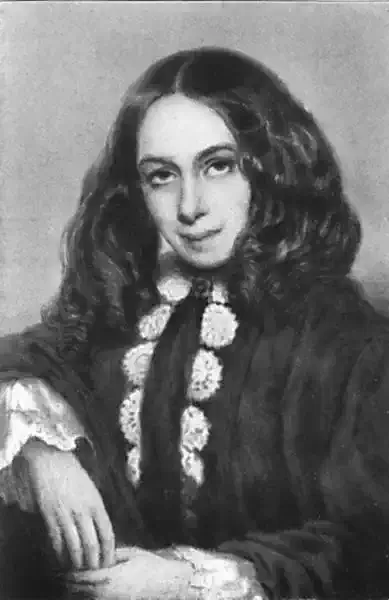
Pain In Pleasure
Pain In Pleasure
A THOUGHT ay like a flower upon mine heart,
And drew around it other thoughts like bees
For multitude and thirst of sweetnesses;
Whereat rejoicing, I desired the art
Of the Greek whistler, who to wharf and mart
Could lure those insect swarms from orange-trees
That I might hive with me such thoughts and please
My soul so, always. foolish counterpart
Of a weak man's vain wishes ! While I spoke,
The thought I called a flower grew nettle-rough
The thoughts, called bees, stung me to festering:
Oh, entertain (cried Reason as she woke)
Your best and gladdest thoughts but long enough,
And they will all prove sad enough to sting !
Patience Taught By Nature
Patience Taught By Nature
'O DREARY life,' we cry, ' O dreary life ! '
And still the generations of the birds
Sing through our sighing, and the flocks and herds
Serenely live while we are keeping strife
With Heaven's true purpose in us, as a knife
Against which we may struggle ! Ocean girds
Unslackened the dry land, savannah-swards
Unweary sweep, hills watch unworn, and rife
Meek leaves drop year]y from the forest-trees
To show, above, the unwasted stars that pass
In their old glory: O thou God of old,
Grant me some smaller grace than comes to these !--
But so much patience as a blade of grass
Grows by, contented through the heat and cold.
My Heart and I
My Heart and I
I.
ENOUGH ! we're tired, my heart and I.
We sit beside the headstone thus,
And wish that name were carved for us.
The moss reprints more tenderly
The hard types of the mason's knife,
As heaven's sweet life renews earth's life
With which we're tired, my heart and I.
II.
You see we're tired, my heart and I.
We dealt with books, we trusted men,
And in our own blood drenched the pen,
As if such colours could not fly.
We walked too straight for fortune's end,
We loved too true to keep a friend ;
At last we're tired, my heart and I.
III.
How tired we feel, my heart and I !
We seem of no use in the world ;
Our fancies hang grey and uncurled
About men's eyes indifferently ;
Our voice which thrilled you so, will let
You sleep; our tears are only wet :
What do we here, my heart and I ?
IV.
So tired, so tired, my heart and I !
It was not thus in that old time
When Ralph sat with me 'neath the lime
To watch the sunset from the sky.
`Dear love, you're looking tired,' he said;
I, smiling at him, shook my head :
'Tis now we're tired, my heart and I.
V.
So tired, so tired, my heart and I !
Though now none takes me on his arm
To fold me close and kiss me warm
Till each quick breath end in a sigh
Of happy languor. Now, alone,
We lean upon this graveyard stone,
Uncheered, unkissed, my heart and I.
VI.
Tired out we are, my heart and I.
Suppose the world brought diadems
To tempt us, crusted with loose gems
Of powers and pleasures ? Let it try.
We scarcely care to look at even
A pretty child, or God's blue heaven,
We feel so tired, my heart and I.
VII.
Yet who complains ? My heart and I ?
In this abundant earth no doubt
Is little room for things worn out :
Disdain them, break them, throw them by
And if before the days grew rough
We once were loved, used, -- well enough,
I think, we've fared, my heart and I.
On A Portrait Of Wordsworth
On A Portrait Of Wordsworth
WORDSWORTH upon Helvellyn ! Let the cloud
Ebb audibly along the mountain-wind,
Then break against the rock, and show behind
The lowland valleys floating up to crowd
The sense with beauty. He with forehead bowed
And humble-lidded eyes, as one inclined
Before the sovran thought of his own mind,
And very meek with inspirations proud,
Takes here his rightful place as poet-priest
By the high altar, singing prayer and prayer
To the higher Heavens. A noble vision free
Our Haydon's hand has flung out from the mist:
No portrait this, with Academic air !
This is the poet and his poetry.
IX
IX
Can it be right to give what I can give ?
To let thee sit beneath the fall of tears
As salt as mine, and hear the sighing years
Re-sighing on my lips renunciative
Through those infrequent smiles which fail to live
For all thy adjurations ? O my fears,
That this can scarce be right ! We are not peers,
So to be lovers; and I own, and grieve,
That givers of such gifts as mine are, must
Be counted with the ungenerous. Out, alas !
I will not soil thy purple with my dust,
Nor breathe my poison on thy Venice-glass,
Nor give thee any love--which were unjust.
Beloved, I only love thee ! let it pass.
Minstrelsy
Minstrelsy
For ever, since my childish looks
Could rest on Nature's pictured books;
For ever, since my childish tongue
Could name the themes our bards have sung;
So long, the sweetness of their singing
Hath been to me a rapture bringing!
Yet ask me not the reason why
I have delight in minstrelsy.
I know that much whereof I sing,
Is shapen but for vanishing;
I know that summer's flower and leaf
And shine and shade are very brief,
And that the heart they brighten, may,
Before them all, be sheathed in clay! --
I do not know the reason why
I have delight in minstrelsy.
A few there are, whose smile and praise
My minstrel hope, would kindly raise:
But, of those few -- Death may impress
The lips of some with silentness;
While some may friendship's faith resign,
And heed no more a song of mine. --
Ask not, ask not the reason why
I have delight in minstrelsy.
The sweetest song that minstrels sing,
Will charm not Joy to tarrying;
The greenest bay that earth can grow,
Will shelter not in burning woe;
A thousand voices will not cheer,
When one is mute that aye is dear! --
Is there, alas! no reason why
I have delight in minstrelsy.
I do not know! The turf is green
Beneath the rain's fast-dropping sheen,
Yet asks not why that deeper hue
Doth all its tender leaves renew; --
And I, like-minded, am content,
While music to my soul is sent,
To question not the reason why
I have delight in minstrelsy.
Years pass -- my life with them shall pass:
And soon, the cricket in the grass
And summer bird, shall louder sing
Than she who owns a minstrel's string.
Oh then may some, the dear and few,
Recall her love, whose truth they knew;
When all forget to question why
She had delight in minstrelsy!
III
III
Unlike are we, unlike, O princely Heart !
Unlike our uses and our destinies.
Our ministering two angels look surprise
On one another, as they strike athwart
Their wings in passing. Thou, bethink thee, art
A guest for queens to social pageantries,
With gages from a hundred brighter eyes
Than tears even can make mine, to play thy part
Of chief musician. What hast thou to do
With looking from the lattice-lights at me,
A poor, tired, wandering singer, singing through
The dark, and leaning up a cypress tree ?
The chrism is on thine head,--on mine, the dew,--
And Death must dig the level where these agree.
Irreparableness
Irreparableness
I HAVE been in the meadows all the day
And gathered there the nosegay that you see
Singing within myself as bird or bee
When such do field-work on a morn of May.
But, now I look upon my flowers, decay
Has met them in my hands more fatally
Because more warmly clasped,--and sobs are free
To come instead of songs. What do you say,
Sweet counsellors, dear friends ? that I should go
Back straightway to the fields and gather more ?
Another, sooth, may do it, but not I !
My heart is very tired, my strength is low,
My hands are full of blossoms plucked before,
Held dead within them till myself shall die.
How Do I Love Thee?
How Do I Love Thee?
How do I love thee? Let me count the ways.
I love thee to the depth and breadth and height
My soul can reach, when feeling out of sight
For the ends of Being and ideal Grace.
I love thee to the level of every day's
Most quiet need, by sun and candlelight.
I love thee freely, as men strive for Right;
I love thee purely, as they turn from Praise.
I love with a passion put to use
In my old griefs, and with my childhood's faith.
I love thee with a love I seemed to lose
With my lost saints, -- I love thee with the breath,
Smiles, tears, of all my life! -- and, if God choose,
I shall but love thee better after death.
I
I
I thought once how Theocritus had sung
Of the sweet years, the dear and wished-for years,
Who each one in a gracious hand appears
To bear a gift for mortals, old or young:
And, as I mused it in his antique tongue,
I saw, in gradual vision through my tears,
The sweet, sad years, the melancholy years,
Those of my own life, who by turns had flung
A shadow across me. Straightway I was 'ware,
So weeping, how a mystic Shape did move
Behind me, and drew me backward by the hair:
And a voice said in mastery, while I strove,-'
Guess now who holds thee ? '--' Death,' I said. But, there,
The silver answer rang,--' Not Death, but Love.'