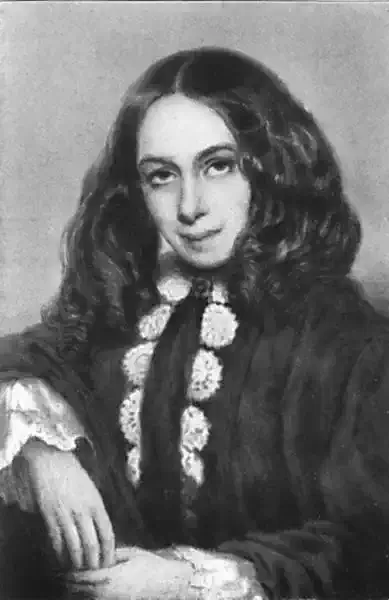
Sonnet 38 - First time he kissed me, he but only kissed
Sonnet 38 - First time he kissed me, he but only kissed
XXXVIII
First time he kissed me, he but only kissed
The fingers of this hand wherewith I write;
And ever since, it grew more clean and white,
Slow to world-greetings, quick with its 'Oh, list,'
When the angels speak. A ring of amethyst
I could not wear here, plainer to my sight,
Than that first kiss. The second passed in height
The first, and sought the forehead, and half missed,
Half falling on the hair. O beyond meed!
That was the chrism of love, which love's own crown,
With sanctifying sweetness, did precede.
The third upon my lips was folded down
In perfect, purple state; since when, indeed,
I have been proud and said, 'My love, my own.'
Sonnet 36 - When we met first and loved, I did not build
Sonnet 36 - When we met first and loved, I did not build
XXXVI
When we met first and loved, I did not build
Upon the event with marble. Could it mean
To last, a love set pendulous between
Sorrow and sorrow? Nay, I rather thrilled,
Distrusting every light that seemed to gild
The onward path, and feared to overlean
A finger even. And, though I have grown serene
And strong since then, I think that God has willed
A still renewable fear . . . O love, O troth . . .
Lest these enclasped hands should never hold,
This mutual kiss drop down between us both
As an unowned thing, once the lips being cold.
And Love, be false! if he, to keep one oath,
Must lose one joy, by his life's star foretold.
Sonnet 34 - With the same heart, I said, I'll answer thee
Sonnet 34 - With the same heart, I said, I'll answer thee
XXXIV
With the same heart, I said, I'll answer thee
As those, when thou shalt call me by my name-
Lo, the vain promise! is the same, the same,
Perplexed and ruffled by life's strategy?
When called before, I told how hastily
I dropped my flowers or brake off from a game,
To run and answer with the smile that came
At play last moment, and went on with me
Through my obedience. When I answer now,
I drop a grave thought, break from solitude;
Yet still my heart goes to thee-ponder how-
Not as to a single good, but all my good!
Lay thy hand on it, best one, and allow
That no child's foot could run fast as this blood.
Sonnet 32 - The first time that the sun rose on thine oath
Sonnet 32 - The first time that the sun rose on thine oath
XXXII
The first time that the sun rose on thine oath
To love me, I looked forward to the moon
To slacken all those bonds which seemed too soon
And quickly tied to make a lasting troth.
Quick-loving hearts, I thought, may quickly loathe;
And, looking on myself, I seemed not one
For such man's love!-more like an out-of-tune
Worn viol, a good singer would be wroth
To spoil his song with, and which, snatched in haste,
Is laid down at the first ill-sounding note.
I did not wrong myself so, but I placed
A wrong on thee. For perfect strains may float
'Neath master-hands, from instruments defaced,-
And great souls, at one stroke, may do and doat.
Sonnet 28 - My letters! all dead paper, mute and white!
Sonnet 28 - My letters! all dead paper, mute and white!
XXVIII
My letters! all dead paper, mute and white!
And yet they seem alive and quivering
Against my tremulous hands which loose the string
And let them drop down on my knee to-night.
This said,-he wished to have me in his sight
Once, as a friend: this fixed a day in spring
To come and touch my hand . . . a simple thing,
Yet I wept for it!-this, . . . the paper's light . . .
Said, Dear, I love thee; and I sank and quailed
As if God's future thundered on my past.
This said, I am thine-and so its ink has paled
With Iying at my heart that beat too fast.
And this . . . O Love, thy words have ill availed
If, what this said, I dared repeat at last!
Sonnet 30 - I see thine image through my tears to-night
Sonnet 30 - I see thine image through my tears to-night
XXX
I see thine image through my tears to-night,
And yet to-day I saw thee smiling. How
Refer the cause?-Beloved, is it thou
Or I, who makes me sad? The acolyte
Amid the chanted joy and thankful rite
May so fall flat, with pale insensate brow,
On the altar-stair. I hear thy voice and vow,
Perplexed, uncertain, since thou art out of sight,
As he, in his swooning ears, the choir's Amen.
Beloved, dost thou love? or did I see all
The glory as I dreamed, and fainted when
Too vehement light dilated my ideal,
For my soul's eyes? Will that light come again,
As now these tears come-falling hot and real?
Sonnet 24 - Let the world's sharpness, like a clasping knife
Sonnet 24 - Let the world's sharpness, like a clasping knife
XXIV
Let the world's sharpness, like a clasping knife,
Shut in upon itself and do no harm
In this close hand of Love, now soft and warm,
And let us hear no sound of human strife
After the click of the shutting. Life to life-
I lean upon thee, Dear, without alarm,
And feel as safe as guarded by a charm
Against the stab of worldlings, who if rife
Are weak to injure. Very whitely still
The lilies of our lives may reassure
Their blossoms from their roots, accessible
Alone to heavenly dews that drop not fewer,
Growing straight, out of man's reach, on the hill.
God only, who made us rich, can make us poor.
Sonnet 26 - I lived with visions for my company
Sonnet 26 - I lived with visions for my company
XXVI
I lived with visions for my company
Instead of men and women, years ago,
And found them gentle mates, nor thought to know
A sweeter music than they played to me.
But soon their trailing purple was not free
Of this world's dust, their lutes did silent grow,
And I myself grew faint and blind below
Their vanishing eyes. Then THOU didst come-to be,
Beloved, what they seemed. Their shining fronts,
Their songs, their splendors (better, yet the same,
As river-water hallowed into fonts),
Met in thee, and from out thee overcame
My soul with satisfaction of all wants:
Because God's gifts put man's best dreams to shame.
Sonnet 20 - Beloved, my Beloved, when I think
Sonnet 20 - Beloved, my Beloved, when I think
XX
Beloved, my Beloved, when I think
That thou wast in the world a year ago,
What time I sat alone here in the snow
And saw no footprint, heard the silence sink
No moment at thy voice, but, link by link,
Went counting all my chains as if that so
They never could fall off at any blow
Struck by thy possible hand,-why, thus I drink
Of life's great cup of wonder ! Wonderful,
Never to feel thee thrill the day or night
With personal act or speech,-nor ever cull
Some prescience of thee with the blossoms white
Thou sawest growing! Atheists are as dull,
Who cannot guess God's presence out of sight.
Sonnet 22 - When our two souls stand up erect and strong
Sonnet 22 - When our two souls stand up erect and strong
XXII
When our two souls stand up erect and strong,
Face to face, silent, drawing nigh and nigher,
Until the lengthening wings break into fire
At either curved point,-what bitter wrong
Can the earth do to us, that we should not long
Be here contented? Think. In mounting higher,
The angels would press on us and aspire
To drop some golden orb of perfect song
Into our deep, dear silence. Let us stay
Rather on earth, Beloved,-where the unfit
Contrarious moods of men recoil away
And isolate pure spirits, and permit
A place to stand and love in for a day,
With darkness and the death-hour rounding it.