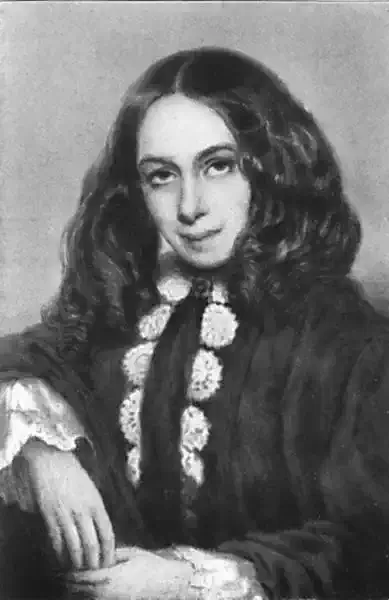
Sonnet 18 - I never gave a lock of hair away
Sonnet 18 - I never gave a lock of hair away
XVIII
I never gave a lock of hair away
To a man, Dearest, except this to thee,
Which now upon my fingers thoughtfully,
I ring out to the full brown length and say
'Take it.' My day of youth went yesterday;
My hair no longer bounds to my foot's glee,
Nor plant I it from rose or myrtle-tree,
As girls do, any more: it only may
Now shade on two pale cheeks the mark of tears,
Taught drooping from the head that hangs aside
Through sorrow's trick. I thought the funeral-shears
Would take this first, but Love is justified,-
Take it thou,-finding pure, from all those years,
The kiss my mother left here when she died.
Sonnet 16 - And yet, because thou overcomest so
Sonnet 16 - And yet, because thou overcomest so
XVI
And yet, because thou overcomest so,
Because thou art more noble and like a king,
Thou canst prevail against my fears and fling
Thy purple round me, till my heart shall grow
Too close against thine heart henceforth to know
How it shook when alone. Why, conquering
May prove as lordly and complete a thing
In lifting upward, as in crushing low!
And as a vanquished soldier yields his sword
To one who lifts him from the bloody earth,
Even so, Beloved, I at last record,
Here ends my strife. If thou invite me forth,
I rise above abasement at the word.
Make thy love larger to enlarge my worth.
Sonnet 14 - If thou must love me, let it be for nought
Sonnet 14 - If thou must love me, let it be for nought
XIV
If thou must love me, let it be for nought
Except for love's sake only. Do not say
'I love her for her smile-her look-her way
Of speaking gently,-for a trick of thought
That falls in well with mine, and certes brought
A sense of pleasant ease on such a day'-
For these things in themselves, Beloved, may
Be changed, or change for thee,-and love, so wrought,
May be unwrought so. Neither love me for
Thine own dear pity's wiping my cheeks dry,-
A creature might forget to weep, who bore
Thy comfort long, and lose thy love thereby!
But love me for love's sake, that evermore
Thou mayst love on, through love's eternity.
Sonnet 12 - Indeed this very love which is my boast
Sonnet 12 - Indeed this very love which is my boast
XII
Indeed this very love which is my boast,
And which, when rising up from breast to brow,
Doth crown me with a ruby large enow
To draw men's eyes and prove the inner cost,-
This love even, all my worth, to the uttermost,
I should not love withal, unless that thou
Hadst set me an example, shown me how,
When first thine earnest eyes with mine were crossed,
And love called love. And thus, I cannot speak
Of love even, as a good thing of my own:
Thy soul hath snatched up mine all faint and weak,
And placed it by thee on a golden throne,-
And that I love (O soul, we must be meek!)
Is by thee only, whom I love alone.
Sonnet 08 - What can I give thee back, O liberal
Sonnet 08 - What can I give thee back, O liberal
VIII
What can I give thee back, O liberal
And princely giver, who hast brought the gold
And purple of thine heart, unstained, untold,
And laid them on the outside of the-wall
For such as I to take or leave withal,
In unexpected largesse? am I cold,
Ungrateful, that for these most manifold
High gifts, I render nothing back at all?
Not so; not cold,-but very poor instead.
Ask God who knows. For frequent tears have run
The colors from my life, and left so dead
And pale a stuff, it were not fitly done
To give the same as pillow to thy head.
Go farther! let it serve to trample on.
Sonnet 10 - Yet, love, mere love, is beautiful indeed
Sonnet 10 - Yet, love, mere love, is beautiful indeed
X
Yet, love, mere love, is beautiful indeed
And worthy of acceptation. Fire is bright,
Let temple burn, or flax; an equal light
Leaps in the flame from cedar-plank or weed:
And love is fire. And when I say at need
I love thee . . . mark! . . . I love thee-in thy sight
I stand transfigured, glorified aright,
With conscience of the new rays that proceed
Out of my face toward thine. There's nothing low
In love, when love the lowest: meanest creatures
Who love God, God accepts while loving so.
And what I feel, across the inferior features
Of what I am, doth flash itself, and show
How that great work of Love enhances Nature's.
Sonnet 04 - Thou hast thy calling to some palace-floor
Sonnet 04 - Thou hast thy calling to some palace-floor
IV
Thou hast thy calling to some palace-floor,
Most gracious singer of high poems! where
The dancers will break footing, from the care
Of watching up thy pregnant lips for more.
And dost thou lift this house's latch too poor
For hand of thine? and canst thou think and bear
To let thy music drop here unaware
In folds of golden fulness at my door?
Look up and see the casement broken in,
The bats and owlets builders in the roof!
My cricket chirps against thy mandolin.
Hush, call no echo up in further proof
Of desolation! there 's a voice within
That weeps . . . as thou must sing . . . alone, aloof
Sonnet 06 - Go from me. Yet I feel that I shall stand
Sonnet 06 - Go from me. Yet I feel that I shall stand
VI
Go from me. Yet I feel that I shall stand
Henceforward in thy shadow. Nevermore
Alone upon the threshold of my door
Of individual life, I shall command
The uses of my soul, nor lift my hand
Serenely in the sunshine as before,
Without the sense of that which I forbore-
Thy touch upon the palm. The widest land
Doom takes to part us, leaves thy heart in mine
With pulses that beat double. What I do
And what I dream include thee, as the wine
Must taste of its own grapes. And when I sue
God for myself, He hears that name of thine,
And sees within my eyes the tears of two.
Rosalind's Scroll
Rosalind's Scroll
I LEFT thee last, a child at heart,
A woman scarce in years:
I come to thee, a solemn corpse
Which neither feels nor fears.
I have no breath to use in sighs;
They laid the dead-weights on mine eyes
To seal them safe from tears.
Look on me with thine own calm look:
I meet it calm as thou.
No look of thine can change this smile,
Or break thy sinful vow:
I tell thee that my poor scorn'd heart
Is of thine earth--thine earth--a part:
It cannot vex thee now.
I have pray'd for thee with bursting sob
When passion's course was free;
I have pray'd for thee with silent lips
In the anguish none could see;
They whisper'd oft, 'She sleepeth soft'-But
I only pray'd for thee.
Go to! I pray for thee no more:
The corpse's tongue is still;
Its folded fingers point to heaven,
But point there stiff and chill:
No farther wrong, no farther woe
Hath licence from the sin below
Its tranquil heart to thrill.
I charge thee, by the living's prayer,
And the dead's silentness,
To wring from out thy soul a cry
Which God shall hear and bless!
Lest Heaven's own palm droop in my hand,
And pale among the saints I stand,
A saint companionless.
Sonnet 02 - But only three in all God's universe
Sonnet 02 - But only three in all God's universe
II
But only three in all God's universe
Have heard this word thou hast said,-Himself, beside
Thee speaking, and me listening! and replied
One of us . . . that was God, . . . and laid the curse
So darkly on my eyelids, as to amerce
My sight from seeing thee,-that if I had died,
The deathweights, placed there, would have signified
Less absolute exclusion. 'Nay' is worse
From God than from all others, O my friend!
Men could not part us with their worldly jars,
Nor the seas change us, nor the tempests bend;
Our hands would touch for all the mountain-bars:
And, heaven being rolled between us at the end,
We should but vow the faster for the stars.