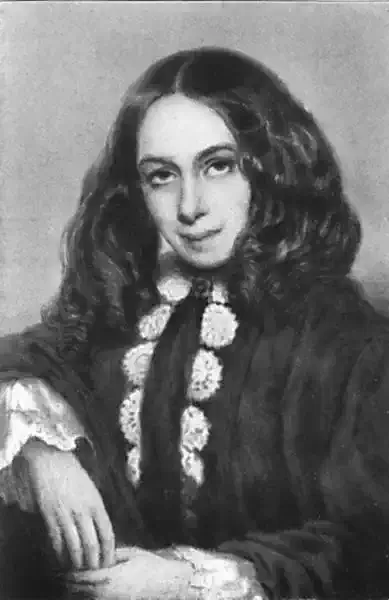
Sonnet VII: The Face of All the World
Sonnet VII: The Face of All the World
The face of all the world is changed, I think,
Since first I heard the footsteps of thy soul
Move still, oh, still, beside me, as they stole
Betwixt me and the dreadful outer brink
Of obvious death, where I, who thought to sink,
Was caught up into love, and taught the whole
Of life in a new rhythm. The cup of dole
God gave for baptism, I am fain to drink,
And praise its sweetness, Sweet, with thee anear.
The names of country, heaven, are changed away
For where thou art or shalt be, there or here;
And this . . . this lute and song . . . loved yesterday,
(The singing angels know) are only dear
Because thy name moves right in what they say.
Sonnet VI: Go From Me
Sonnet VI: Go From Me
Go from me. Yet I feel that I shall stand
Henceforth in thy shadow. Nevermore
Alone upon the threshold of my door
Of individual life, I shall command
The uses of my soul, nor lift my hand
Serenely in the sunshine as before,
Without the sense of that which I forbore--
Thy touch upon the palm. The widest land
Doom takes to part us, leaves thy heart in mine
With pulses that beat double. What I do
And what I dream include thee, as the wine
Must taste of its own grapes. And when I sue
God for myself, He hears that name of thine,
And sees within my eyes the tears of two.
Sonnet V: I Lift My Heavy Heart Up
Sonnet V: I Lift My Heavy Heart Up
I lift my heavy heart up solemnly,
As once Electra her sepulchral urn,
And, looking in thine eyes, I overturn
The ashes at thy feet. Behold and see
What a great heap of grief lay hid in me,
And how the red wild sparkles dimly burn
Through the ashen greyness. If thy foot in scorn
Could tread them out to darkness utterly,
It might be well perhaps. But if instead
Thou wait beside me for the wind to blow
The grey dust up,...those laurels on thine head,
O my Belovèd, will not shield thee so,
That none of all the fires shall scorch and shred
The hair beneath. Stand farther off then! go.
Sonnet IX
Sonnet IX
Can it be right to give what I can give ?
To let thee sit beneath the fall of tears
As salt as mine, and hear the sighing years
Re-sighing on my lips renunciative
Through those infrequent smiles which fail to live
For all thy adjurations ? O my fears,
That this can scarce be right ! We are not peers,
So to be lovers; and I own, and grieve,
That givers of such gifts as mine are, must
Be counted with the ungenerous. Out, alas !
I will not soil thy purple with my dust,
Nor breathe my poison on thy Venice-glass,
Nor give thee any love--which were unjust.
Beloved, I only love thee ! let it pass.
Sonnet IV
Sonnet IV
Thou hast thy calling to some palace-floor,
Most gracious singer of high poems ! where
The dancers will break footing, from the care
Of watching up thy pregnant lips for more.
And dost thou lift this house's latch too poor
For hand of thine ? and canst thou think and bear
To let thy music drop here unaware
In folds of golden fulness at my door ?
Look up and see the casement broken in,
The bats and owlets builders in the roof !
My cricket chirps against thy mandolin.
Hush, call no echo up in further proof
Of desolation ! there 's a voice within
That weeps . . . as thou must sing . . . alone, aloof
Sonnet III
Sonnet III
Unlike are we, unlike, O princely Heart !
Unlike our uses and our destinies.
Our ministering two angels look surprise
On one another, as they strike athwart
Their wings in passing. Thou, bethink thee, art
A guest for queens to social pageantries,
With gages from a hundred brighter eyes
Than tears even can make mine, to play thy part
Of chief musician. What hast thou to do
With looking from the lattice-lights at me,
A poor, tired, wandering singer, singing through
The dark, and leaning up a cypress tree ?
The chrism is on thine head,--on mine, the dew,--
And Death must dig the level where these agree.
Sonnet II
Sonnet II
But only three in all God's universe
Have heard this word thou hast said,--Himself, beside
Thee speaking, and me listening ! and replied
One of us . . . that was God, . . . and laid the curse
So darkly on my eyelids, as to amerce
My sight from seeing thee,--that if I had died,
The deathweights, placed there, would have signified
Less absolute exclusion. 'Nay' is worse
From God than from all others, O my friend !
Men could not part us with their worldly jars,
Nor the seas change us, nor the tempests bend;
Our hands would touch for all the mountain-bars:
And, heaven being rolled between us at the end,
We should but vow the faster for the stars.
Sonnet 44 - Beloved, thou hast brought me many flowers
Sonnet 44 - Beloved, thou hast brought me many flowers
XLIV
Beloved, thou hast brought me many flowers
Plucked in the garden, all the summer through
And winter, and it seemed as if they grew
In this close room, nor missed the sun and showers.
So, in the like name of that love of ours,
Take back these thoughts which here unfolded too,
And which on warm and cold days I withdrew
From my heart's ground. Indeed, those beds and bowers
Be overgrown with bitter weeds and rue,
And wait thy weeding; yet here's eglantine,
Here 's ivy!-take them, as I used to do
Thy fowers, and keep them where they shall not pine.
Instruct thine eyes to keep their colors true,
And tell thy soul their roots are left in mine.
Sonnet 40 - Oh, yes! they love through all this world of ours!
Sonnet 40 - Oh, yes! they love through all this world of ours!
XL
Oh, yes! they love through all this world of ours!
I will not gainsay love, called love forsooth.
I have heard love talked in my early youth,
And since, not so long back but that the flowers
Then gathered, smell still. Mussulmans and Giaours
Throw kerchiefs at a smile, and have no ruth
For any weeping. Polypheme's white tooth
Slips on the nut if, after frequent showers,
The shell is over-smooth,-and not so much
Will turn the thing called love, aside to hate
Or else to oblivion. But thou art not such
A lover, my Beloved! thou canst wait
Through sorrow and sickness, to bring souls to touch,
And think it soon when others cry 'Too late.'
Sonnet 42 - 'My future will not copy fair my past'
Sonnet 42 - 'My future will not copy fair my past'
XLII
'My future will not copy fair my past'-
I wrote that once; and thinking at my side
My ministering life-angel justified
The word by his appealing look upcast
To the white throne of God, I turned at last,
And there, instead, saw thee, not unallied
To angels in thy soul! Then I, long tried
By natural ills, received the comfort fast,
While budding, at thy sight, my pilgrim's staff
Gave out green leaves with morning dews impearled.
I seek no copy now of life's first half:
Leave here the pages with long musing curled,
And write me new my future's epigraph,
New angel mine, unhoped for in the world!