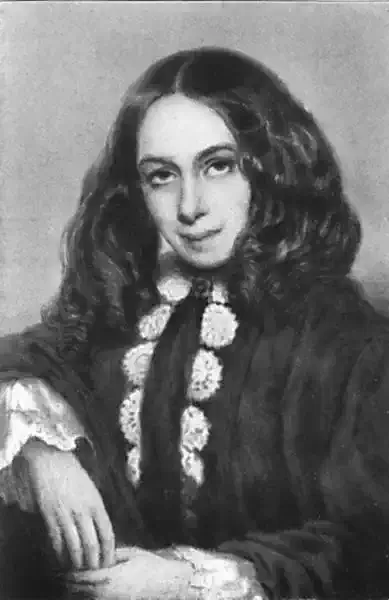
Poems List

VIII

VIII


What can I give thee back, O liberal
And princely giver, who hast brought the gold
And purple of thine heart, unstained, untold,
And laid them on the outside of the-wall
For such as I to take or leave withal,
In unexpected largesse ? am I cold,
Ungrateful, that for these most manifold
High gifts, I render nothing back at all ?
Not so; not cold,--but very poor instead.
Ask God who knows. For frequent tears have run
The colors from my life, and left so dead
And pale a stuff, it were not fitly done
To give the same as pillow to thy head.
Go farther ! let it serve to trample on.
443

Work And Contemplation

Work And Contemplation

The woman singeth at her spinning-wheel
A pleasant chant, ballad or barcarole;
She thinketh of her song, upon the whole,
Far more than of her flax; and yet the reel
Is full, and artfully her fingers feel
With quick adjustment, provident control,
The lines--too subtly twisted to unroll--
Out to a perfect thread. I hence appeal
To the dear Christian Church--that we may do
Our Father's business in these temples mirk,
Thus swift and steadfast, thus intent and strong;
While thus, apart from toil, our souls pursue
Some high calm spheric tune, and prove our work
The better for the sweetness of our song.
419

To George Sand: A Recognition

To George Sand: A Recognition

TRUE genius, but true woman ! dost deny
The woman's nature with a manly scorn
And break away the gauds and armlets worn
By weaker women in captivity?
Ah, vain denial ! that revolted cry
Is sobbed in by a woman's voice forlorn, _
Thy woman's hair, my sister, all unshorn
Floats back dishevelled strength in agony
Disproving thy man's name: and while before
The world thou burnest in a poet-fire,
We see thy woman-heart beat evermore
Through the large flame. Beat purer, heart, and higher,
Till God unsex thee on the heavenly shore
Where unincarnate spirits purely aspire !
476

VI

VI


Go from me. Yet I feel that I shall stand
Henceforward in thy shadow. Nevermore
Alone upon the threshold of my door
Of individual life, I shall command
The uses of my soul, nor lift my hand
Serenely in the sunshine as before,
Without the sense of that which I forbore--
Thy touch upon the palm. The widest land
Doom takes to part us, leaves thy heart in mine
With pulses that beat double. What I do
And what I dream include thee, as the wine
Must taste of its own grapes. And when I sue
God for myself, He hears that name of thine,
And sees within my eyes the tears of two.
427

To Flush, My Dog

To Flush, My Dog

Loving friend, the gift of one
Who her own true faith has run

Through thy lower nature,
Be my benediction said
With my hand upon thy head,

Gentle fellow-creature!

Like a lady's ringlets brown,
Flow thy silken ears adown

Either side demurely
Of thy silver-suited breast
Shining out from all the rest

Of thy body purely.

Darkly brown thy body is,
Till the sunshine striking this

Alchemise its dullness,
When the sleek curls manifold
Flash all over into gold

With a burnished fulness.

Underneath my stroking hand,
Startled eyes of hazel bland

Kindling, growing larger,
Up thou leapest with a spring,
Full of prank and curveting,

Leaping like a charger.

Leap! thy broad tail waves a light,
Leap! thy slender feet are bright,

Canopied in fringes;
Leap! those tasselled ears of thine
Flicker strangely, fair and fine

Down their golden inches

Yet, my pretty, sportive friend,
Little is't to such an end

That I praise thy rareness;
Other dogs may be thy peers
Haply in these drooping ears

And this glossy fairness.

But of thee it shall be said,
This dog watched beside a bed

Day and night unweary,
Watched within a curtained room
Where no sunbeam brake the gloom

Round the sick and dreary.

Roses, gathered for a vase,
In that chamber died apace,

Beam and breeze resigning;


This dog only, waited on,
Knowing that when light is gone

Love remains for shining.

Other dogs in thymy dew
Tracked the hares and followed through

Sunny moor or meadow;
This dog only, crept and crept
Next a languid cheek that slept,

Sharing in the shadow.

Other dogs of loyal cheer
Bounded at the whistle clear,

Up the woodside hieing;
This dog only, watched in reach
Of a faintly uttered speech

Or a louder sighing.

And if one or two quick tears
Dropped upon his glossy ears

Or a sigh came double,
Up he sprang in eager haste,
Fawning, fondling, breathing fast,

In a tender trouble.

And this dog was satisfied
If a pale thin hand would glide

Down his dewlaps sloping, --
Which he pushed his nose within,
After, -- platforming his chin

On the palm left open.

This dog, if a friendly voice
Call him now to blither choice

Than such chamber-keeping,
'Come out!' praying from the door, --
Presseth backward as before,

Up against me leaping.

Therefore to this dog will I,
Tenderly not scornfully,

Render praise and favor:
With my hand upon his head,
Is my benediction said

Therefore and for ever.

And because he loves me so,
Better than his kind will do

Often man or woman,
Give I back more love again
Than dogs often take of men,

Leaning from my Human.


Blessings on thee, dog of mine,
Pretty collars make thee fine,

Sugared milk make fat thee!
Pleasures wag on in thy tail,
Hands of gentle motion fail

Nevermore, to pat thee

Downy pillow take thy head,
Silken coverlid bestead,

Sunshine help thy sleeping!
No fly's buzzing wake thee up,
No man break thy purple cup

Set for drinking deep in.

Whiskered cats arointed flee,
Sturdy stoppers keep from thee

Cologne distillations;
Nuts lie in thy path for stones,
And thy feast-day macaroons

Turn to daily rations!

Mock I thee, in wishing weal? --
Tears are in my eyes to feel

Thou art made so straitly,
Blessing needs must straiten too, --
Little canst thou joy or do,

Thou who lovest greatly.

Yet be blessed to the height
Of all good and all delight

Pervious to thy nature;
Only loved beyond that line,
With a love that answers thine,

Loving fellow-creature!
495

The Weakest Thing

The Weakest Thing

Which is the weakest thing of all
Mine heart can ponder?
The sun, a little cloud can pall
With darkness yonder?
The cloud, a little wind can move
Where'er it listeth?
The wind, a little leaf above,
Though sere, resisteth?


What time that yellow leaf was green,
My days were gladder;
But now, whatever Spring may mean,
I must grow sadder.
Ah me! a leaf with sighs can wring
My lips asunder -
Then is mine heart the weakest thing
Itself can ponder.


Yet, Heart, when sun and cloud are pined
And drop together,
And at a blast, which is not wind,
The forests wither,
Thou, from the darkening deathly curse
To glory breakest, -
The Strongest of the universe
Guarding the weakest!
427

The Soul's Expression

The Soul's Expression

WITH stammering lips and insufficient sound
I strive and struggle to deliver right
That music of my nature, day and night
With dream and thought and feeling interwound
And inly answering all the senses round
With octaves of a mystic depth and height
Which step out grandly to the infinite
From the dark edges of the sensual ground.
This song of soul I struggle to outbear
Through portals of the sense, sublime and whole,
And utter all myself into the air:
But if I did it,--as the thunder-roll
Breaks its own cloud, my flesh would perish there,
Before that dread apocalypse of soul.
335

The Runaway Slave at Pilgrim's Point

The Runaway Slave at Pilgrim's Point

I.
I stand on the mark beside the shore
Of the first white pilgrim's bended knee,
Where exile turned to ancestor,
And God was thanked for liberty.
I have run through the night, my skin is as dark,
I bend my knee down on this mark . . .
I look on the sky and the sea.
II.
O pilgrim-souls, I speak to you!
I see you come out proud and slow
From the land of the spirits pale as dew. . .
And round me and round me ye go!
O pilgrims, I have gasped and run
All night long from the whips of one
Who in your names works sin and woe.
III.
And thus I thought that I would come
And kneel here where I knelt before,
And feel your souls around me hum
In undertone to the ocean's roar;
And lift my black face, my black hand,
Here, in your names, to curse this land
Ye blessed in freedom's evermore.
IV.
I am black, I am black;
And yet God made me, they say.
But if He did so, smiling back
He must have cast His work away
Under the feet of His white creatures,
With a look of scorn,--that the dusky features
Might be trodden again to clay.
V.
And yet He has made dark things
To be glad and merry as light.
There's a little dark bird sits and sings;
There's a dark stream ripples out of sight;
And the dark frogs chant in the safe morass,
And the sweetest stars are made to pass
O'er the face of the darkest night.
VI.
But we who are dark, we are dark!
Ah, God, we have no stars!
About our souls in care and cark
Our blackness shuts like prison bars:
The poor souls crouch so far behind,
That never a comfort can they find

By reaching through the prison-bars.

VII.
Indeed, we live beneath the sky, . . .
That great smooth Hand of God, stretched out
On all His children fatherly,
To bless them from the fear and doubt,
Which would be, if, from this low place,
All opened straight up to His face
Into the grand eternity.
VIII.
And still God's sunshine and His frost,
They make us hot, they make us cold,
As if we were not black and lost:
And the beasts and birds, in wood and fold,
Do fear and take us for very men!
Could the weep-poor-will or the cat of the glen
Look into my eyes and be bold?
IX.
I am black, I am black!--
But, once, I laughed in girlish glee;
For one of my colour stood in the track
Where the drivers drove, and looked at me--
And tender and full was the look he gave:
Could a slave look so at another slave?--
I look at the sky and the sea.
X.
And from that hour our spirits grew
As free as if unsold, unbought:
Oh, strong enough, since we were two
To conquer the world, we thought!
The drivers drove us day by day;
We did not mind, we went one way,
And no better a liberty sought.
XI.
In the sunny ground between the canes,
He said 'I love you' as he passed:
When the shingle-roof rang sharp with the rains,
I heard how he vowed it fast:
While others shook, he smiled in the hut
As he carved me a bowl of the cocoa-nut,
Through the roar of the hurricanes.
XII.
I sang his name instead of a song;
Over and over I sang his name--
Upward and downward I drew it along
My various notes; the same, the same!

I sang it low, that the slave-girls near
Might never guess from aught they could hear,
It was only a name.


XIII.
I look on the sky and the sea--
We were two to love, and two to pray,--
Yes, two, O God, who cried to Thee,
Though nothing didst Thou say.
Coldly Thou sat'st behind the sun!
And now I cry who am but one,
How wilt Thou speak to-day?--
XIV.
We were black, we were black!
We had no claim to love and bliss:
What marvel, if each turned to lack?
They wrung my cold hands out of his,--
They dragged him . . . where ? . . . I crawled to touch
His blood's mark in the dust! . . . not much,
Ye pilgrim-souls, . . . though plain as this!
XV.
Wrong, followed by a deeper wrong!
Mere grief's too good for such as I.
So the white men brought the shame ere long
To strangle the sob of my agony.
They would not leave me for my dull
Wet eyes!--it was too merciful
To let me weep pure tears and die.
XVI.
I am black, I am black!--
I wore a child upon my breast
An amulet that hung too slack,
And, in my unrest, could not rest:
Thus we went moaning, child and mother,
One to another, one to another,
Until all ended for the best:
XVII.
For hark ! I will tell you low . . . Iow . . .
I am black, you see,--
And the babe who lay on my bosom so,
Was far too white . . . too white for me;
As white as the ladies who scorned to pray
Beside me at church but yesterday;
Though my tears had washed a place for my knee.
XVIII.
My own, own child! I could not bear
To look in his face, it was so white.

I covered him up with a kerchief there;
I covered his face in close and tight:
And he moaned and struggled, as well might be,
For the white child wanted his liberty--
Ha, ha! he wanted his master right.


XIX.
He moaned and beat with his head and feet,
His little feet that never grew--
He struck them out, as it was meet,
Against my heart to break it through.
I might have sung and made him mild--
But I dared not sing to the white-faced child
The only song I knew.
XX.
I pulled the kerchief very close:
He could not see the sun, I swear,
More, then, alive, than now he does
From between the roots of the mango . . . where
. . . I know where. Close! a child and mother
Do wrong to look at one another,
When one is black and one is fair.
XXI.
Why, in that single glance I had
Of my child's face, . . . I tell you all,
I saw a look that made me mad . . .
The master's look, that used to fall
On my soul like his lash . . . or worse!
And so, to save it from my curse,
I twisted it round in my shawl.
XXII.
And he moaned and trembled from foot to head,
He shivered from head to foot;
Till, after a time, he lay instead
Too suddenly still and mute.
I felt, beside, a stiffening cold, . . .
I dared to lift up just a fold . . .
As in lifting a leaf of the mango-fruit.
XXIII.
But my fruit . . . ha, ha!--there, had been
(I laugh to think on't at this hour! . . .)
Your fine white angels, who have seen
Nearest the secret of God's power, . . .
And plucked my fruit to make them wine,
And sucked the soul of that child of mine,
As the humming-bird sucks the soul of the flower.
XXIV.

Ha, ha, for the trick of the angels white!
They freed the white child's spirit so.
I said not a word, but, day and night,
I carried the body to and fro;
And it lay on my heart like a stone . . . as chill.
--The sun may shine out as much as he will:
I am cold, though it happened a month ago.


XXV.
From the white man's house, and the black man's hut,
I carried the little body on,
The forest's arms did round us shut,
And silence through the trees did run:
They asked no question as I went,--
They stood too high for astonishment,--
They could see God sit on His throne.
XXVI.
My little body, kerchiefed fast,
I bore it on through the forest . . . on:
And when I felt it was tired at last,
I scooped a hole beneath the moon.
Through the forest-tops the angels far,
With a white sharp finger from every star,
Did point and mock at what was done.
XXVII.
Yet when it was all done aright, . . .
Earth, 'twixt me and my baby, strewed,
All, changed to black earth, . . . nothing white, . . .
A dark child in the dark,--ensued
Some comfort, and my heart grew young:
I sate down smiling there and sung
The song I learnt in my maidenhood.
XXVIII.
And thus we two were reconciled,
The white child and black mother, thus:
For, as I sang it, soft and wild
The same song, more melodious,
Rose from the grave whereon I sate!
It was the dead child singing that,
To join the souls of both of us.
XXIX.
I look on the sea and the sky!
Where the pilgrims' ships first anchored lay,
The free sun rideth gloriously;
But the pilgrim-ghosts have slid away
Through the earliest streaks of the morn.
My face is black, but it glares with a scorn
Which they dare not meet by day.

XXX.
Ah!--in their 'stead, their hunter sons!
Ah, ah! they are on me--they hunt in a ring--
Keep off! I brave you all at once--
I throw off your eyes like snakes that sting!
You have killed the black eagle at nest, I think:
Did you never stand still in your triumph, and shrink
From the stroke of her wounded wing?
XXXI.
(Man, drop that stone you dared to lift!--)
I wish you, who stand there five a-breast,
Each, for his own wife's joy and gift,
A little corpse as safely at rest
As mine in the mangos!--Yes, but she
May keep live babies on her knee,
And sing the song she liketh best.
XXXll.
I am not mad: I am black.
I see you staring in my face--
I know you, staring, shrinking back--
Ye are born of the Washington-race:
And this land is the free America:
And this mark on my wrist . . . (I prove what I say)
Ropes tied me up here to the flogging-place.


XXXIII.
You think I shrieked then? Not a sound!
I hung, as a gourd hangs in the sun.
I only cursed them all around,
As softly as I might have done
My very own child!--From these sands
Up to the mountains, lift your hands,
O slaves, and end what I begun!
XXXIV.
Whips, curses; these must answer those!
For in this UNION, you have set
Two kinds of men in adverse rows,
Each loathing each: and all forget
The seven wounds in Christ's body fair;
While HE sees gaping everywhere
Our countless wounds that pay no debt.
XXXV.
Our wounds are different. Your white men
Are, after all, not gods indeed,
Nor able to make Christs again
Do good with bleeding. We who bleed . . .
(Stand off!) we help not in our loss!

We are too heavy for our cross,
And fall and crush you and your seed.


XXXVI.
I fall, I swoon! I look at the sky:
The clouds are breaking on my brain;
I am floated along, as if I should die
Of liberty's exquisite pain--
In the name of the white child, waiting for me
In the death-dark where we may kiss and agree,
White men, I leave you all curse-free
In my broken heart's disdain!
649

The Look

The Look

The Saviour looked on Peter. Ay, no word,
No gesture of reproach; the Heavens serene
Though heavy with armed justice, did not lean
Their thunders that way: the forsaken Lord
Looked only, on the traitor. None record
What that look was, none guess; for those who have seen
Wronged lovers loving through a death-pang keen,
Or pale-cheeked martyrs smiling to a sword,
Have missed Jehovah at the judgment-call.
And Peter, from the height of blasphemy-'
I never knew this man '--did quail and fall
As knowing straight THAT GOD; and turned free
And went out speechless from the face of all
And filled the silenc, weeping bitterly.
426

The Poet And The Bird

The Poet And The Bird

Said a people to a poet---' Go out from among us straightway!
While we are thinking earthly things, thou singest of divine.
There's a little fair brown nightingale, who, sitting in the gateways
Makes fitter music to our ears than any song of thine!'

The poet went out weeping---the nightingale ceased chanting;
'Now, wherefore, O thou nightingale, is all thy sweetness done?'
I cannot sing my earthly things, the heavenly poet wanting,
Whose highest harmony includes the lowest under sun.'

The poet went out weeping,---and died abroad, bereft there--The
bird flew to his grave and died, amid a thousand wails:---
And, when I last came by the place, I swear the music left there
Was only of the poet's song, and not the nightingale's.
398

Comments (0)

Log in to post a comment.

NoComments

Identification and basic context

Elizabeth Barrett Browning was an influential English poet of the Victorian era. She is best known for her collection 'Sonnets from the Portuguese' and her long poem 'Aurora Leigh'.

Childhood and education

Born into a wealthy family, Elizabeth received an extensive education, including classical languages, which was unusual for women at the time. She was a precocious reader and writer from a young age, though her health was often delicate.

Literary trajectory

Barrett Browning began publishing poetry in her youth. Her 'Poems' (1844) brought her considerable attention. Her marriage to Robert Browning in 1846 marked a new phase, and they moved to Italy. Her masterpiece, 'Aurora Leigh', a novel in verse, was published in 1857, solidifying her reputation.

Works, style, and literary characteristics

Her major works include 'Sonnets from the Portuguese', 'Aurora Leigh', 'A Drama of Exile', and 'Casa Guidi Windows'. Her poetry often explored themes of love, religion, social justice, and politics. Her style is characterized by intellectual depth, emotional intensity, and a rich, often complex, use of language and imagery. She engaged with contemporary social issues, such as slavery and child labor.

Cultural and historical context

She lived during a period of significant social and political change in Britain, the height of the Victorian era. She was part of a literary circle that included figures like Alfred Tennyson and John Ruskin. Her sympathetic views towards Italian unification (Risorgimento) are evident in some of her works.

Personal life

Her relationship with her father was strained, particularly after he disapproved of her engagement to Robert Browning. Their clandestine marriage and subsequent move to Italy were significant events. Her health issues, including chronic respiratory problems, profoundly impacted her life and possibly her poetry.

Recognition and reception

Barrett Browning was one of the most famous and respected poets of her time, even considered by some as a contender for the Poet Laureateship. Her work was widely read and admired by critics and the public alike.

Influences and legacy

She was influenced by poets like John Milton and William Wordsworth. Her 'Sonnets from the Portuguese' are considered among the greatest love poems in the English language. 'Aurora Leigh' was groundbreaking for its blend of social commentary and poetic narrative, influencing later female writers.

Interpretation and critical analysis

Her work is often studied for its feminist undertones, its engagement with political issues, and its exploration of personal and spiritual themes.

Curiosities and lesser-known aspects

She was addicted to laudanum for much of her adult life, initially prescribed for her health problems.

Death and memory

She died in Florence, Italy, and is buried in the English Cemetery there. Her legacy is cemented as one of the most important poets of the 19th century.