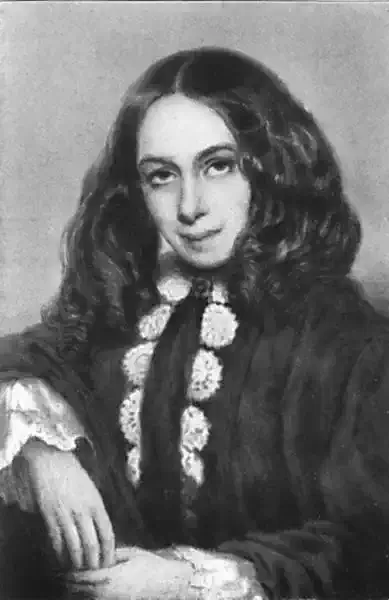
Tears
Tears
THANK God, bless God, all ye who suffer not
More grief than ye can weep for. That is well--
That is light grieving ! lighter, none befell
Since Adam forfeited the primal lot.
Tears ! what are tears ? The babe weeps in its cot,
The mother singing, at her marriage-bell
The bride weeps, and before the oracle
Of high-faned hills the poet has forgot
Such moisture on his cheeks. Thank God for grace,
Ye who weep only ! If, as some have done,
Ye grope tear-blinded in a desert place
And touch but tombs,--look up I those tears will run
Soon in long rivers down the lifted face,
And leave the vision clear for stars and sun
Stanzas on the Death of Lord Byron
Stanzas on the Death of Lord Byron
He was, and is not! Graecia's trembling shore,
Sighing through all her palmy groves, shall tell
That Harold's pilgrimage at last is o'er—
Mute the impassioned tongue, and tuneful shell,
That erst was wont in noblest strains to swell—
Hush'd the proud shouts that rode Aegaea's wave!
For lo! the great Deliv'rer breathes farewell!
Gives to the world his mem'ry and a grave—
Expiring in the land he only lived to save!
Mourn, Hellas, mourn! and o'er thy widow'd brow,
For aye, the cypress wreath of sorrow twine;
And in thy new-form'd beauty, desolate, throw
The fresh-cull'd flowers on his sepulchral shrine.
Yes! let that heart whose fervour was all thine,
In consecrated urn lamented be!
That generous heart where genius thrill'd divine,
Hath spent its last most glorious throb for thee—
Then sank amid the storm that made thy children free!
Britannia's Poet! Graecia's hero, sleeps!
And Freedom, bending o'er the breathless clay,
Lifts up her voice, and in her anguish weeps!
For us, a night hath clouded o'er our day,
And hush'd the lips that breath'd our fairest lay.
Alas! and must the British lyre resound
A requiem, while the spirit wings away
Of him who on its strings such music found,
And taught its startling chords to give so sweet a sound!
The theme grows sadder — but my soul shall find
A language in those tears! No more — no more!
Soon, 'midst the shriekings of the tossing wind,
The 'dark blue depths' he sang of, shall have bore
Our all of Byron to his native shore!
His grave is thick with voices — to the ear
Murm'ring an awful tale of greatness o'er;
But Memory strives with Death, and lingering near,
Shall consecrate the dust of Harold's lonely bier!
Sonnets from the Portuguese iv
Sonnets from the Portuguese iv
IF thou must love me, let it be for naught
Except for love's sake only. Do not say,
'I love her for her smile--her look--her way
Of speaking gently,--for a trick of thought
That falls in well with mine, and certes brought
A sense of pleasant ease on such a day'-For
these things in themselves, Beloved, may
Be changed, or change for thee--and love, so wrought,
May be unwrought so. Neither love me for
Thine own dear pity's wiping my cheeks dry:
A creature might forget to weep, who bore
Thy comfort long, and lose thy love thereby!
But love me for love's sake, that evermore
Thou mayst love on, through love's eternity.
Sonnets from the Portuguese ii
Sonnets from the Portuguese ii
UNLIKE are we, unlike, O princely Heart!
Unlike our uses and our destinies.
Our ministering two angels look surprise
On one another, as they strike athwart
Their wings in passing. Thou, bethink thee, art
A guest for queens to social pageantries,
With gages from a hundred brighter eyes
Than tears even can make mine, to play thy part
Of chief musician. What hast thou to do
With looking from the lattice-lights at me--
A poor, tired, wandering singer, singing through
The dark, and leaning up a cypress tree?
The chrism is on thine head--on mine the dew-And
Death must dig the level where these agree.
Sonnet XXXVIII: First Time He Kissed Me
Sonnet XXXVIII: First Time He Kissed Me
First time he kissed me, he but only kissed
The finger of this hand wherewith I write;
And ever since, it grew more clean and white,
Slow to world-greetings, quick with its "Oh, list,"
When the angels speak. A ring of amethyst
I could not wear here, plainer to my sight,
Than that first kiss. The second passed in height
The first, and sought the forehead, and half missed,
Half falling on the hair. O beyond meed!
That was the chrism of love, which love's own crown,
With sanctifying sweetness, did precede.
The third upon my lips was folded down
In perfect, purple state; since when, indeed,
I have been proud and said, "My love, my own."
Sonnet XXXVII: Pardon, Oh, Pardon
Sonnet XXXVII: Pardon, Oh, Pardon
Pardon, oh, pardon, that my soul should make,
Of all that strong divineness which I know
For thine and thee, an image only so
Formed of the sand, and fit to shift and break.
It is that distant years which did not take
Thy sovranty, recoiling with a blow,
Have forced my swimming brain to undergo
Their doubt and dread, and blindly to forsake
Thy purity of likeness and distort
Thy worthiest love to a worthless counterfeit:
As if a shipwrecked Pagan, safe in port,
His guardian sea-god to commemorate,
Should set a sculptured porpoise, gills a-snort
And vibrant tail, within the temple gate.
Sonnet XXXV: If I Leave All for Thee
Sonnet XXXV: If I Leave All for Thee
If I leave all for thee, wilt thou exchange
And be all to me? Shall I never miss
Home-talk and blessings and the common kiss
That comes to each in turn, nor count it strange,
When I look up, to drop on a new range
Of walls and floors, another home than this?
Nay, wilt thou fill that place by me which is
Filled by dead eyes too tender to know change?
That's hardest. If to conquer love, has tried,
To conquer grief, tries more, as all things prove;
For grief indeed is love and grief beside.
Alas, I have grieved so I am hard to love.
Yet love me--wilt thou? Open thine heart wide,
And fold within the wet wings of thy dove.
Sonnet XXXVI: When We Met First
Sonnet XXXVI: When We Met First
When we met first and loved, I did not build
Upon the event with marble. Could it mean
To last, a love set pendulous between
Sorrow and sorrow? Nay, I rather thrilled,
Distrusting every light that seemed to gild
The onward path, and feared to overlean
A finger even. And, though I have grown serene
And strong since then, I think that God has willed
A still renewable fear ... O love, O troth ...
Lest these enclasped hands should never hold,
This mutual kiss drop down between us both
As an unowned thing, once the lips being cold.
And Love, be false! if he, to keep one oath,
Must lose one joy, by his life's star foretold.
Sonnet XXXIV: With the Same Heart
Sonnet XXXIV: With the Same Heart
With the same heart, I said, I'll answer thee
As those, when thou shalt call me by my name--
Lo, the vain promise! is the same, the same,
Perplexed and ruffled by life's strategy?
When called before, I told how hastily
I dropped my flowers or brake off from a game,
To run and answer with the smile that came
At play last moment, and went on with me
Through my obedience. When I answer now,
I drop a grave thought, break from solitude;
Yet still my heart goes to thee--ponder how--
Not as to a single good, but all my good!
Lay thy hand on it, best one, and allow
That no child's foot could run as fast as this blood.
Sonnet XXXIX: Because Thou Hast the Power
Sonnet XXXIX: Because Thou Hast the Power
Because thou hast the power and own'st the grace
To look through and behind this mask of me
(Against which years have beat thus blanchingly
With their rains), and behold my soul's true face,
The dim and weary witness of life's race,
Because thou hast the faith and love to see,
Through that same soul's distracting lethargy,
The patient angel waiting for a place
In the new Heavens,--because nor sin nor woe,
Nor God's infliction, nor death's neighbourhood,
Nor all which others viewing, turn to go,
Nor all of which makes me tired of all, self-viewed,--
Nothing repels thee,...Dearest, teach me so
To pour out gratitude, as thou dost, good!