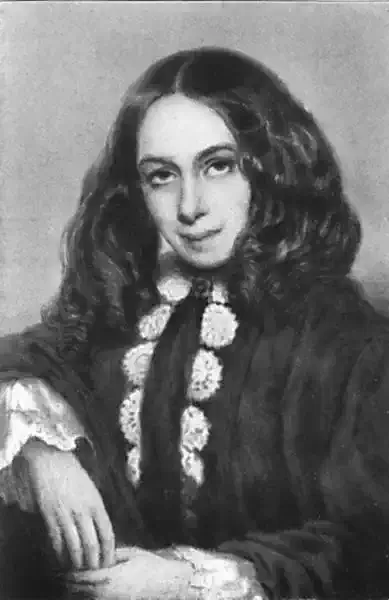
Sonnet XXXIII: Yes, Call Me by My Pet-Name!
Sonnet XXXIII: Yes, Call Me by My Pet-Name!
Yes, call me by my pet-name! let me hear
The name I used to run at, when a child,
From innocent play, and leave the cowslips piled,
To glance up in some face that proved me dear
With the look of its eyes. I miss the clear
Fond voices which, being drawn and reconciled
Into the music of Heaven's undefiled,
Call me no longer. Silence on the bier,
While I call God--call God!--So let thy mouth
Be heir to those who are now exanimate.
Gather the north flowers to complete the south,
And catch the early love up in the late.
Yes, call me by that name,--and I, in truth,
With the same heart, will answer and not wait.
Sonnet XXXII: The First Time
Sonnet XXXII: The First Time
The first time that the sun rose on thine oath
To love me, I looked forward to the moon
To slacken all those bonds which seemed too soon
And quickly tied to make a lasting troth.
Quick-loving hearts, I thought, may quickly loathe;
And, looking on myself, I seemed not one
For such man's love!--more like an out-of-tune
Worn viol, a good singer would be wroth
To spoil his song with, and which, snatched in haste,
Is laid down at the first ill-sounding note.
I did not wrong myself so, but I placed
A wrong on thee. For perfect strains may float
'Neath master-hands, from instruments defaced,--
And great souls, at one stroke, may do and doat.
Sonnet XXXI: Thou Comest!
Sonnet XXXI: Thou Comest!
Thou comest! all is said without a word.
I sit beneath thy looks, as children do
In the noon-sun, with souls that tremble through
Their happy eyelids from an unaverred
Yet prodigal inward joy. Behold, I erred
In that last doubt! and yet I cannot rue
The sin most, but the occasion--that we two
Should for a moment stand unministered
By a mutual presence. Ah, keep near and close,
Thou dovelike help! and, when my fears would rise,
With thy broad heart serenely interpose:
Brood down with thy divine sufficiencies
These thoughts which tremble when bereft of those,
Like callow birds left desert to the skies.
Sonnet XXX: I See Thine Image
Sonnet XXX: I See Thine Image
I see thine image through my tears to-night,
And yet to-day I saw thee smiling. How
Refer the cause?--Beloved, is it thou
Or I, who makes me sad? The acolyte
Amid the chanted joy and thankful rite
May so fall flat, with pale insensate brow,
On the altar-stair. I hear thy voice and vow,
Perplexed, uncertain, since thou art out of sight,
As he, in his swooning ears, the choir's amen.
Beloved, dost thou love? or did I see all
The glory as I dreamed, and fainted when
Too vehement light dilated my ideal,
For my soul's eyes? Will that light come again,
As now these tears come--falling hot and real?
Sonnet XXVIII: My Letters
Sonnet XXVIII: My Letters
My letters-- all dead paper, mute and white!
And yet they seem alive and quivering
Against my tremulous hands which loose the string
And let them drop down on my knee to-night,
This said,--he wished to have me in his sight
Once, as a friend: this fixed a day in spring
To come and touch my hand...a simple thing,
Yet I wept for it!--this...the paper's light...
Said, Dear, I love thee; and I sank and quailed
As if God's future thundered on my past.
This said, I am thine--and so its ink has paled
With lying at my heart that beat too fast.
And this...O Love, thy words have ill availed
If, what this said, I dared repeat at last!
Sonnet XXVII: My Dear Belovèd
Sonnet XXVII: My Dear Belovèd
My dear Belovèd, who hast lifted me
From this drear flat of earth where I was thrown,
And, in betwixt the languid ringlets, blown
A life-breath, till the forehead hopefully
Shines out again, as all the angels see,
Before thy saving kiss! My own, my own,
Who camest to me when the world was gone,
And I who looked for only God, found thee!
I find thee; I am safe, and strong, and glad.
As one who stands in dewless asphodel
Looks backward on the tedious time he had
In the upper life,--so I, with bosom-swell,
Make witness, here, between the good and bad,
That Love, as strong as Death, retrieves as well.
Sonnet XXV: A Heavy Heart, Belovèd
Sonnet XXV: A Heavy Heart, Belovèd
A heavy heart, Belovèd, have I borne
From year to year until I saw thy face,
And sorrow after sorrow took the place
Of all those natural joys as lightly worn
As the stringed pearls, each lifted in its turn
By a beating heart at dance-time. Hopes apace
Were changed to long despairs, till God's own grace
Could scarcely lift above the world forlorn
My heavy heart. Than thou didst bid me bring
And let it drop adown thy calmly great
Deep being! Fast it sinketh, as a thing
Which its own nature doth precipitate,
While thine doth close above it, mediating
Betwixt the stars and the unaccomplished fate.
Sonnet XXVI: I Lived With Visions
Sonnet XXVI: I Lived With Visions
I lived with visions for my company
Instead of men and women, years ago,
And found them gentle mates, nor thought to know
A sweeter music than they played to me.
But soon their trailing purple was not free
Of this world's dust, their lutes did silent grow,
And I myself grew faint and blind below
Their vanishing eyes. Then thou didst come--to be,
Belovèd, what they seemed. Their shining fronts,
Their songs, their splendors (better, yet the same,
As river water hallowed into fonts),
Met in thee, and from out thee overcame
My soul with satisfaction of all wants:
Because God's gifts put man's best dreams to shame.
Sonnet XXIX: I Think of Thee
Sonnet XXIX: I Think of Thee
I think of thee!--my thoughts do twine and bud
About thee,as wild vines, about a tree,
Put out broad leaves, and soon there's nought to see
Except the straggling green which hides the wood.
Yet, O my palm-tree, be it understood
I will not have my thoughts instead of thee
Who art dearer, better! Rather, instantly
Renew thy presence; as a strong tree should,
Rustle thy boughs and set thy trunk all bare,
And let these bands of greenery which insphere thee
Drop heavily down,--burst, shattered, everywhere!
Because, in this deep joy to see and hear thee
And breathe within thy shadow a new air,
I do not think of thee--I am too near thee.
Sonnet XXIV: Let the World's Sharpness
Sonnet XXIV: Let the World's Sharpness
Let the world's sharpness like a clasping knife
Shut in upon itself and do no harm
In this close hand of Love, now soft and warm,
And let us hear no sound of human strife
After the click of the shutting. Life to life -
I lean upon thee, Dear, without alarm,
And feel as safe as guarded by a charm
Against the stab of worldlings, who if rife
Are weak to injure. Very whitely still
The lilies of our lives may reassure
Their blossoms from their roots, accessible
Alone to heavenly dews that drop not fewer;
Growing straight, out of man's reach, on the hill.
God only, who made us rich, can make us poor.