Poems List

The Deserted Garden

The Deserted Garden

I mind me in the days departed,
How often underneath the sun
With childish bounds I used to run

To a garden long deserted.

The beds and walks were vanished quite;
And wheresoe'er had struck the spade,
The greenest grasses Nature laid

To sanctify her right.

I called the place my wilderness,
For no one entered there but I;
The sheep looked in, the grass to espy,


And passed it ne'ertheless.

The trees were interwoven wild,
And spread their boughs enough about
To keep both sheep and shepherd out,


But not a happy child.

Adventurous joy it was for me!
I crept beneath the boughs, and found
A circle smooth of mossy ground

Beneath a poplar tree.

Old garden rose-trees hedged it in,
Bedropt with roses waxen-white
Well satisfied with dew and light

And careless to be seen.

Long years ago it might befall,
When all the garden flowers were trim,
The grave old gardener prided him


On these the most of all.

Some lady, stately overmuch,
Here moving with a silken noise,
Has blushed beside them at the voice


That likened her to such.

And these, to make a diadem,
She often may have plucked and twined,
Half-smiling as it came to mind


That few would look at them.

Oh, little thought that lady proud,
A child would watch her fair white rose,
When buried lay her whiter brows,


And silk was changed for shroud!

Nor thought that gardener, (full of scorns
For men unlearned and simple phrase,)


A child would bring it all its praise
By creeping through the thorns!

To me upon my low moss seat,
Though never a dream the roses sent
Of science or love's compliment,

I ween they smelt as sweet.

It did not move my grief to see
The trace of human step departed:
Because the garden was deserted,

The blither place for me!

Friends, blame me not! a narrow ken
Has childhood 'twixt the sun and sward;
We draw the moral afterward,

We feel the gladness then.

And gladdest hours for me did glide
In silence at the rose-tree wall:
A thrush made gladness musical

Upon the other side.

Nor he nor I did e'er incline
To peck or pluck the blossoms white;
How should I know but roses might

Lead lives as glad as mine?

To make my hermit-home complete,
I brought dear water from the spring
Praised in its own low murmuring,

And cresses glossy wet.

And so, I thought, my likeness grew
(Without the melancholy tale)
To 'Gentle Hermit of the Dale,'


And Angelina too.

For oft I read within my nook
Such minstrel stories; till the breeze
Made sounds poetic in the trees,

And then I shut the book.

If I shut this wherein I write
I hear no more the wind athwart
Those trees, nor feel that childish heart

Delighting in delight.

My childhood from my life is parted,
My footstep from the moss which drew
Its fairy circle round: anew

The garden is deserted.


Another thrush may there rehearse
The madrigals which sweetest are;
No more for me! myself afar

Do sing a sadder verse.

Ah me, ah me! when erst I lay
In that child's-nest so greenly wrought,
I laughed unto myself and thought

'The time will pass away.'

And still I laughed, and did not fear
But that, whene'er was past away
The childish time, some happier play

My womanhood would cheer.

I knew the time would pass away,
And yet, beside the rose-tree wall,
Dear God, how seldom, if at all,

Did I look up to pray!

The time is past; and now that grows
The cypress high among the trees,
And I behold white sepulchres

As well as the white rose, --

When graver, meeker thoughts are given,
And I have learnt to lift my face,
Reminded how earth's greenest place

The color draws from heaven, --

It something saith for earthly pain,
But more for Heavenly promise free,
That I who was, would shrink to be

That happy child again.
419

The Lady's Yes

The Lady's Yes

'Yes,' I answered you last night;
'No,' this morning, Sir, I say.
Colours seen by candlelight,
Will not look the same by day.

When the viols played their best,
Lamps above, and laughs below---
Love me sounded like a jest,
Fit for Yes or fit for No.

Call me false, or call me free--Vow,
whatever light may shine,
No man on your face shall see
Any grief for change on mine.

Yet the sin is on us both--Time
to dance is not to woo---
Wooer light makes fickle troth--Scorn
of me recoils on you.

Learn to win a lady's faith
Nobly, as the thing is high;
Bravely, as for life and death--With
a loyal gravity.

Lead her from the festive boards,
Point her to the starry skies,
Guard her, by your truthful words,
Pure from courtship's flatteries.

By your truth she shall be true--Ever
true, as wives of yore---
And her Yes, once said to you,
SHALL be Yes for evermore.
350

The Best Thing in the World

The Best Thing in the World

What's the best thing in the world?
June-rose, by May-dew impearled;
Sweet south-wind, that means no rain;
Truth, not cruel to a friend;
Pleasure, not in haste to end;
Beauty, not self-decked and curled
Till its pride is over-plain;
Love, when, so, you're loved again.
What's the best thing in the world?
--Something out of it, I think.
425

Tears

Tears


THANK God, bless God, all ye who suffer not
More grief than ye can weep for. That is well--
That is light grieving ! lighter, none befell
Since Adam forfeited the primal lot.
Tears ! what are tears ? The babe weeps in its cot,
The mother singing, at her marriage-bell
The bride weeps, and before the oracle
Of high-faned hills the poet has forgot
Such moisture on his cheeks. Thank God for grace,
Ye who weep only ! If, as some have done,
Ye grope tear-blinded in a desert place

And touch but tombs,--look up I those tears will run
Soon in long rivers down the lifted face,
And leave the vision clear for stars and sun
449

Sonnets from the Portuguese iv

Sonnets from the Portuguese iv

IF thou must love me, let it be for naught
Except for love's sake only. Do not say,
'I love her for her smile--her look--her way

Of speaking gently,--for a trick of thought

That falls in well with mine, and certes brought
A sense of pleasant ease on such a day'-For
these things in themselves, Beloved, may

Be changed, or change for thee--and love, so wrought,
May be unwrought so. Neither love me for
Thine own dear pity's wiping my cheeks dry:
A creature might forget to weep, who bore
Thy comfort long, and lose thy love thereby!
But love me for love's sake, that evermore
Thou mayst love on, through love's eternity.
532

Stanzas on the Death of Lord Byron

Stanzas on the Death of Lord Byron

He was, and is not! Graecia's trembling shore,
Sighing through all her palmy groves, shall tell
That Harold's pilgrimage at last is o'er—
Mute the impassioned tongue, and tuneful shell,
That erst was wont in noblest strains to swell—
Hush'd the proud shouts that rode Aegaea's wave!
For lo! the great Deliv'rer breathes farewell!
Gives to the world his mem'ry and a grave—
Expiring in the land he only lived to save!


Mourn, Hellas, mourn! and o'er thy widow'd brow,
For aye, the cypress wreath of sorrow twine;
And in thy new-form'd beauty, desolate, throw
The fresh-cull'd flowers on his sepulchral shrine.
Yes! let that heart whose fervour was all thine,
In consecrated urn lamented be!
That generous heart where genius thrill'd divine,
Hath spent its last most glorious throb for thee—
Then sank amid the storm that made thy children free!


Britannia's Poet! Graecia's hero, sleeps!
And Freedom, bending o'er the breathless clay,
Lifts up her voice, and in her anguish weeps!
For us, a night hath clouded o'er our day,
And hush'd the lips that breath'd our fairest lay.
Alas! and must the British lyre resound
A requiem, while the spirit wings away
Of him who on its strings such music found,
And taught its startling chords to give so sweet a sound!


The theme grows sadder — but my soul shall find
A language in those tears! No more — no more!
Soon, 'midst the shriekings of the tossing wind,
The 'dark blue depths' he sang of, shall have bore
Our all of Byron to his native shore!
His grave is thick with voices — to the ear
Murm'ring an awful tale of greatness o'er;
But Memory strives with Death, and lingering near,
Shall consecrate the dust of Harold's lonely bier!
532

Sonnet XXXVIII: First Time He Kissed Me

Sonnet XXXVIII: First Time He Kissed Me

First time he kissed me, he but only kissed
The finger of this hand wherewith I write;
And ever since, it grew more clean and white,
Slow to world-greetings, quick with its "Oh, list,"
When the angels speak. A ring of amethyst
I could not wear here, plainer to my sight,
Than that first kiss. The second passed in height
The first, and sought the forehead, and half missed,
Half falling on the hair. O beyond meed!
That was the chrism of love, which love's own crown,
With sanctifying sweetness, did precede.
The third upon my lips was folded down
In perfect, purple state; since when, indeed,
I have been proud and said, "My love, my own."
603

Sonnets from the Portuguese ii

Sonnets from the Portuguese ii

UNLIKE are we, unlike, O princely Heart!
Unlike our uses and our destinies.
Our ministering two angels look surprise

On one another, as they strike athwart

Their wings in passing. Thou, bethink thee, art
A guest for queens to social pageantries,
With gages from a hundred brighter eyes

Than tears even can make mine, to play thy part
Of chief musician. What hast thou to do
With looking from the lattice-lights at me--
A poor, tired, wandering singer, singing through
The dark, and leaning up a cypress tree?
The chrism is on thine head--on mine the dew-And
Death must dig the level where these agree.
452

Sonnet XXXVII: Pardon, Oh, Pardon

Sonnet XXXVII: Pardon, Oh, Pardon

Pardon, oh, pardon, that my soul should make,
Of all that strong divineness which I know
For thine and thee, an image only so
Formed of the sand, and fit to shift and break.
It is that distant years which did not take
Thy sovranty, recoiling with a blow,
Have forced my swimming brain to undergo
Their doubt and dread, and blindly to forsake
Thy purity of likeness and distort
Thy worthiest love to a worthless counterfeit:
As if a shipwrecked Pagan, safe in port,
His guardian sea-god to commemorate,
Should set a sculptured porpoise, gills a-snort
And vibrant tail, within the temple gate.
408

Sonnet XXXVI: When We Met First

Sonnet XXXVI: When We Met First

When we met first and loved, I did not build
Upon the event with marble. Could it mean
To last, a love set pendulous between
Sorrow and sorrow? Nay, I rather thrilled,
Distrusting every light that seemed to gild
The onward path, and feared to overlean
A finger even. And, though I have grown serene
And strong since then, I think that God has willed
A still renewable fear ... O love, O troth ...
Lest these enclasped hands should never hold,
This mutual kiss drop down between us both
As an unowned thing, once the lips being cold.
And Love, be false! if he, to keep one oath,
Must lose one joy, by his life's star foretold.
398

Comments (0)

Log in to post a comment.

NoComments

Identification and basic context

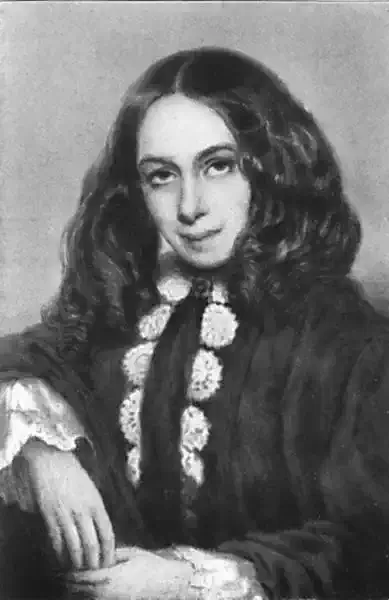
Elizabeth Barrett Browning was an influential English poet of the Victorian era. She is best known for her collection 'Sonnets from the Portuguese' and her long poem 'Aurora Leigh'.

Childhood and education

Born into a wealthy family, Elizabeth received an extensive education, including classical languages, which was unusual for women at the time. She was a precocious reader and writer from a young age, though her health was often delicate.

Literary trajectory

Barrett Browning began publishing poetry in her youth. Her 'Poems' (1844) brought her considerable attention. Her marriage to Robert Browning in 1846 marked a new phase, and they moved to Italy. Her masterpiece, 'Aurora Leigh', a novel in verse, was published in 1857, solidifying her reputation.

Works, style, and literary characteristics

Her major works include 'Sonnets from the Portuguese', 'Aurora Leigh', 'A Drama of Exile', and 'Casa Guidi Windows'. Her poetry often explored themes of love, religion, social justice, and politics. Her style is characterized by intellectual depth, emotional intensity, and a rich, often complex, use of language and imagery. She engaged with contemporary social issues, such as slavery and child labor.

Cultural and historical context

She lived during a period of significant social and political change in Britain, the height of the Victorian era. She was part of a literary circle that included figures like Alfred Tennyson and John Ruskin. Her sympathetic views towards Italian unification (Risorgimento) are evident in some of her works.

Personal life

Her relationship with her father was strained, particularly after he disapproved of her engagement to Robert Browning. Their clandestine marriage and subsequent move to Italy were significant events. Her health issues, including chronic respiratory problems, profoundly impacted her life and possibly her poetry.

Recognition and reception

Barrett Browning was one of the most famous and respected poets of her time, even considered by some as a contender for the Poet Laureateship. Her work was widely read and admired by critics and the public alike.

Influences and legacy

She was influenced by poets like John Milton and William Wordsworth. Her 'Sonnets from the Portuguese' are considered among the greatest love poems in the English language. 'Aurora Leigh' was groundbreaking for its blend of social commentary and poetic narrative, influencing later female writers.

Interpretation and critical analysis

Her work is often studied for its feminist undertones, its engagement with political issues, and its exploration of personal and spiritual themes.

Curiosities and lesser-known aspects

She was addicted to laudanum for much of her adult life, initially prescribed for her health problems.

Death and memory

She died in Florence, Italy, and is buried in the English Cemetery there. Her legacy is cemented as one of the most important poets of the 19th century.