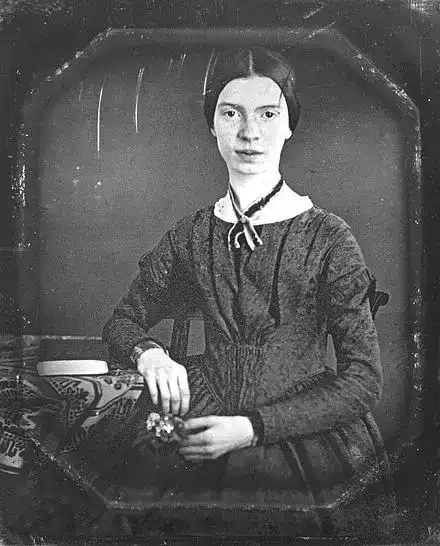
Identification and basic context
Emily Dickinson is one of America's most celebrated poets. She often wrote under her own name. She was born in Amherst, Massachusetts, and died there. Her family was prominent in Amherst society, and she came from a lineage of lawyers and politicians. She was an American national and wrote in English.
Childhood and education
Dickinson grew up in a devoutly religious household, which likely influenced her later theological explorations. She attended Amherst Academy and Mount Holyoke Female Seminary, receiving a rigorous education for the time. Her early readings included the Bible, works by Ralph Waldo Emerson, and classical literature, which undoubtedly shaped her intellectual and poetic development. Significant events in her youth included periods of intense religious engagement and growing introspection.
Literary trajectory
Dickinson began writing poetry at a young age, with her output increasing significantly in the 1860s. Her style evolved, becoming increasingly concise, introspective, and experimental. While she shared her poems with friends and family, she did not actively seek publication. A few poems were published anonymously during her lifetime, often altered by editors. She did not engage with literary magazines or anthologies in a conventional manner.
Works, style, and literary characteristics
Dickinson's major works are her nearly 1,800 poems, most of which were published posthumously. Dominant themes include nature, death, immortality, faith, doubt, love, and the self. Her poems are known for their radical compression, slant rhyme, unconventional capitalization, and use of dashes. Her poetic devices are striking, creating vivid imagery and a unique rhythm. The tone can range from ecstatic to despairing, often employing irony and a deeply personal voice that transcends to the universal. Her language is precise, often using domestic imagery to explore profound philosophical ideas. She is associated with no specific literary movement but is a precursor to modernism.
Cultural and historical context
Dickinson lived during a period of significant social and intellectual change in the United States, including the abolitionist movement and the Civil War, though these are not overt subjects in her poetry. She engaged intellectually with Transcendentalism, particularly through Emerson's writings, and her work reflects a broader cultural questioning of religious and social norms. Her isolation in Amherst created a unique space for her creative development, setting her apart from established literary circles.
Personal life
Dickinson's personal life was largely private and centered in Amherst. Her relationships with family, particularly her brother Austin and his wife Susan Gilbert, were complex and deeply influential. Friendships, such as with Thomas Wentworth Higginson, provided intellectual companionship and some encouragement. Her intense inner life, marked by periods of profound introspection and perhaps illness, is reflected in the depth and originality of her poetry. She did not pursue a parallel profession, dedicating herself to her inner world and writing.
Recognition and reception
During her lifetime, Dickinson received very little recognition, with only a handful of poems published in altered forms. Her major posthumous publication in 1890 by Mabel Loomis Todd and Thomas Wentworth Higginson marked the beginning of her rise to prominence. Over time, her work has achieved immense critical acclaim and immense academic recognition, establishing her as a central figure in American literature.
Influences and legacy
Dickinson was influenced by the Bible, hymnology, and writers like Ralph Waldo Emerson. Her legacy is immense; she profoundly influenced modern poetry with her innovative use of language, form, and thematic exploration. She is a cornerstone of the American literary canon, and her poems are widely translated, studied, and adapted into music and other art forms. Her work continues to inspire poets and readers worldwide.
Interpretation and critical analysis
Dickinson's poetry invites multiple interpretations, often focusing on her exploration of consciousness, spirituality, and the human condition. Critical analysis has delved into her complex relationship with faith and doubt, her unique perspective on death, and the psychological dimensions of her work. Debates often surround the dating and ordering of her poems and the extent of her engagement with social issues.
Curiosities and lesser-known aspects
Dickinson was known for her reclusive habits in her later years, often dressing in white. There is a fascinating tension between her seemingly quiet life and the radical, often explosive, nature of her poetry. Anecdotal evidence suggests her intense observational skills and a profound, sometimes unsettling, wit. She was known to bake and engage in household activities, which stood in contrast to her abstract poetic explorations.
Death and memory
Emily Dickinson died in Amherst, Massachusetts. Her memory is preserved through her extraordinary body of work, the preservation of her home as a museum, and ongoing critical and scholarly engagement with her life and poetry. Numerous posthumous collections and scholarly editions have ensured her enduring presence in literary history.