Emily Dickinson

Emily Dickinson

1830–1886 · lived 55 years US US

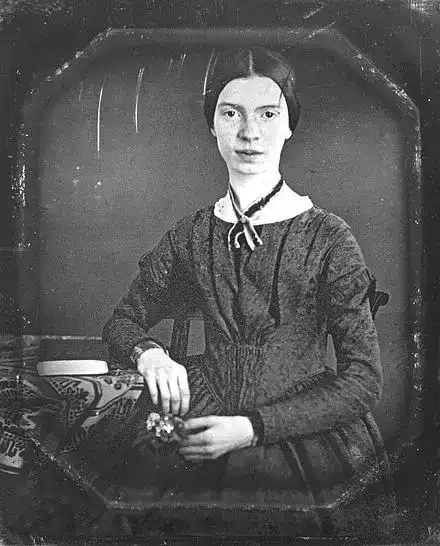
Emily Dickinson was a prolific American poet whose work was largely unknown during her lifetime. Her poems are characterized by their unconventional style, exploring themes of nature, death, immortality, and faith with unique imagery and introspective depth. She is now recognized as one of the most important figures in American poetry, known for her distinct voice and innovative approach to form and language.

n. 1830-12-10, Amherst · m. 1886-05-15, Amherst

150,122 Views

We see-Comparatively

We see-Comparatively

534

We see-Comparatively-
The Thing so towering high
We could not grasp its segment
Unaided-Yesterday-

This Morning's finer Verdict-
Makes scarcely worth the toil-
A furrow-Our Cordillera-
Our Apennine-a Knoll-

Perhaps 'tis kindly-done us-
The Anguish-and the loss-
The wrenching-for His Firmament
The Thing belonged to us-

To spare these Striding Spirits
Some Morning of Chagrin-
The waking in a Gnat's-embrace-
Our Giants-further on-
Read full poem
Bio

Identification and basic context

Emily Dickinson is one of America's most celebrated poets. She often wrote under her own name. She was born in Amherst, Massachusetts, and died there. Her family was prominent in Amherst society, and she came from a lineage of lawyers and politicians. She was an American national and wrote in English.

Childhood and education

Dickinson grew up in a devoutly religious household, which likely influenced her later theological explorations. She attended Amherst Academy and Mount Holyoke Female Seminary, receiving a rigorous education for the time. Her early readings included the Bible, works by Ralph Waldo Emerson, and classical literature, which undoubtedly shaped her intellectual and poetic development. Significant events in her youth included periods of intense religious engagement and growing introspection.

Literary trajectory

Dickinson began writing poetry at a young age, with her output increasing significantly in the 1860s. Her style evolved, becoming increasingly concise, introspective, and experimental. While she shared her poems with friends and family, she did not actively seek publication. A few poems were published anonymously during her lifetime, often altered by editors. She did not engage with literary magazines or anthologies in a conventional manner.

Works, style, and literary characteristics

Dickinson's major works are her nearly 1,800 poems, most of which were published posthumously. Dominant themes include nature, death, immortality, faith, doubt, love, and the self. Her poems are known for their radical compression, slant rhyme, unconventional capitalization, and use of dashes. Her poetic devices are striking, creating vivid imagery and a unique rhythm. The tone can range from ecstatic to despairing, often employing irony and a deeply personal voice that transcends to the universal. Her language is precise, often using domestic imagery to explore profound philosophical ideas. She is associated with no specific literary movement but is a precursor to modernism.

Cultural and historical context

Dickinson lived during a period of significant social and intellectual change in the United States, including the abolitionist movement and the Civil War, though these are not overt subjects in her poetry. She engaged intellectually with Transcendentalism, particularly through Emerson's writings, and her work reflects a broader cultural questioning of religious and social norms. Her isolation in Amherst created a unique space for her creative development, setting her apart from established literary circles.

Personal life

Dickinson's personal life was largely private and centered in Amherst. Her relationships with family, particularly her brother Austin and his wife Susan Gilbert, were complex and deeply influential. Friendships, such as with Thomas Wentworth Higginson, provided intellectual companionship and some encouragement. Her intense inner life, marked by periods of profound introspection and perhaps illness, is reflected in the depth and originality of her poetry. She did not pursue a parallel profession, dedicating herself to her inner world and writing.

Recognition and reception

During her lifetime, Dickinson received very little recognition, with only a handful of poems published in altered forms. Her major posthumous publication in 1890 by Mabel Loomis Todd and Thomas Wentworth Higginson marked the beginning of her rise to prominence. Over time, her work has achieved immense critical acclaim and immense academic recognition, establishing her as a central figure in American literature.

Influences and legacy

Dickinson was influenced by the Bible, hymnology, and writers like Ralph Waldo Emerson. Her legacy is immense; she profoundly influenced modern poetry with her innovative use of language, form, and thematic exploration. She is a cornerstone of the American literary canon, and her poems are widely translated, studied, and adapted into music and other art forms. Her work continues to inspire poets and readers worldwide.

Interpretation and critical analysis

Dickinson's poetry invites multiple interpretations, often focusing on her exploration of consciousness, spirituality, and the human condition. Critical analysis has delved into her complex relationship with faith and doubt, her unique perspective on death, and the psychological dimensions of her work. Debates often surround the dating and ordering of her poems and the extent of her engagement with social issues.

Curiosities and lesser-known aspects

Dickinson was known for her reclusive habits in her later years, often dressing in white. There is a fascinating tension between her seemingly quiet life and the radical, often explosive, nature of her poetry. Anecdotal evidence suggests her intense observational skills and a profound, sometimes unsettling, wit. She was known to bake and engage in household activities, which stood in contrast to her abstract poetic explorations.

Death and memory

Emily Dickinson died in Amherst, Massachusetts. Her memory is preserved through her extraordinary body of work, the preservation of her home as a museum, and ongoing critical and scholarly engagement with her life and poetry. Numerous posthumous collections and scholarly editions have ensured her enduring presence in literary history.

Poems

541

There is a pain—so utter

There is a pain—so utter

599

There is a pain—so utter—
It swallows substance up—
Then covers the Abyss with Trance—
So Memory can step
Around—across—upon it—
As one within a Swoon—
Goes safely—where an open eye—
Would drop Him—Bone by Bone.
227

There came a Wind like a Bugle

There came a Wind like a Bugle

There cam a Wind like a Bugle -
It quivered through the Grass
And a Green Chill upon the Heat
So ominous did pass
We barred the Windows and the Doors
As from an Emerald Ghost -
The Doom's electric Moccasin
The very instant passed -
On a strange Mob of panting Trees
And Fences fled away
And Rivers where the Houses ran
Those looked that lived - that Day -
The Bell within the steeple wild
The flying tidings told -
How much can come
And much can go,
And yet abide the World!
316

There is a flower that Bees prefer

There is a flower that Bees prefer

380

There is a flower that Bees prefer-
And Butterflies-desire-
To gain the Purple Democrat
The Humming Bird-aspire-

And Whatsoever Insect pass-
A Honey bear away
Proportioned to his several dearth
And her-capacity-

Her face be rounder than the Moon
And ruddier than the Gown
Or Orchis in the Pasture-
Or Rhododendron-worn-

She doth not wait for June-
Before the World be Green-
Her sturdy little Countenance
Against the Wind-be seen-

Contending with the Grass-
Near Kinsman to Herself-
For Privilege of Sod and Sun-
Sweet Litigants for Life-

And when the Hills be full-
And newer fashions blow-
Doth not retract a single spice
For pang of jealousy-

Her Public-be the Noon-
Her Providence-the Sun-
Her Progress-by the Bee-proclaimed-
In sovereign-Swerveless Tune-

The Bravest-of the HostSurrendering-
the last-
Nor even of Defeat-aware-
What cancelled by the Frost-
284

The Zeroes—taught us—Phosphorous

The Zeroes—taught us—Phosphorous

689

The Zeroes—taught us—Phosphorous—
We learned to like the Fire
By playing Glaciers—when a Boy—
And Tinder—guessed—by power
Of Opposite—to balance Odd—
If White—a Red—must be!
Paralysis—our Primer—dumb—
Unto Vitality!
241

There are two Ripenings—one—of sight

There are two Ripenings—one—of sight

332

There are two Ripenings—one—of sight—
Whose forces Spheric wind
Until the Velvet product
Drop spicy to the ground—
A homelier maturing—
A process in the Bur—
That teeth of Frosts alone disclose
In far October Air.
260

The Woodpecker

The Woodpecker

His bill an auger is,
His head, a cap and frill.
He laboreth at every tree,--
A worm his utmost goal.
421

The World-stands-solemner-to me

The World-stands-solemner-to me

493

The World-stands-solemner-to me-
Since I was wed-to Him-
A modesty befits the soul
That bears another's-name-
A doubt-if it be fair-indeed-
To wear that perfect-pearl-
The Man-upon the Woman-binds-
To clasp her soul-for all-
A prayer, that it more angel-prove-
A whiter Gift-within-
To that munificence, that chose-
So unadorned-a Queen-
A Gratitude-that such be true-
It had esteemed the Dream-
Too beautiful-for Shape to prove-
Or posture-to redeem!
216

The wind trapped like a tired man,

The wind trapped like a tired man,

The wind tapped like a tired man,
And like a host, 'Come in,'
I boldly answered; entered then
My residence within


A rapid, footless guest,
To offer whom a chair
Were as impossible as hand
A sofa to the air.


No bone had he to bind him,
His speech was like the push
Of numerous humming-birds at once
From a superior bush.


His countenance a billow,
His fingers, if he pass,
Let go a music, as of tunes
Blown tremulous in glass.


He visited, still flitting;
Then, like a timid man,
Again he tapped--'t was flurriedly--
And I became alone.
334

The wind begun to rock the grass

The wind begun to rock the grass

The wind begun to rock the grass
With threatening tunes and low,--
He flung a menace at the earth,
A menace at the sky.


The leaves unhooked themselves from trees
And started all abroad;
The dust did scoop itself like hands
And throw away the road.


The wagons quickened on the streets,
The thunder hurried slow;
The lightning showed a yellow beak,
And then a livid claw.


The birds put up the bars to nests,
The cattle fled to barns;
There came one drop of giant rain,
And then, as if the hands


That held the dams had parted hold,
The waters wrecked the sky
But overlooked my father's house,
lust quartering a tree.
291

The Way I read a Letter's—this

The Way I read a Letter's—this

636

The Way I read a Letter's—this—
'Tis first—I lock the Door—
And push it with my fingers—next—
For transport it be sure—


And then I go the furthest off
To counteract a knock—
Then draw my little Letter forth
And slowly pick the lock—


Then—glancing narrow, at the Wall—
And narrow at the floor
For firm Conviction of a Mouse
Not exorcised before—


Peruse how infinite I am
To no one that You—know—
And sigh for lack of Heaven—but not
The Heaven God bestow—
291

Quotes

40

Videos

50

Comments (0)

Share
Log in to post a comment.

No comments yet. Be the first to comment.