
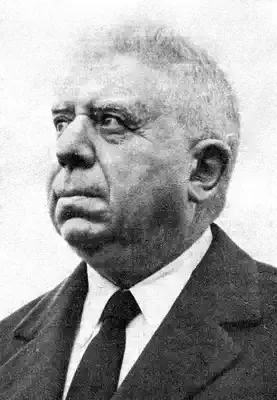
Eugenio Montale
1896–1981
· lived 84 years
 IT
IT
IT
Eugenio Montale was one of the most important Italian poets of the 20th century, winner of the Nobel Prize in Literature. His work is marked by austere lyricism, the exploration of the Ligurian landscape, and reflection on the existential condition of modern man, incommunicability, and the absence of meaning in a world in crisis. His poetry is known for its density, its use of concrete imagery, and its search for a truth that manifests itself fragmentarily.
n. 1896-10-12, Génova · m. 1981-09-12, Milão
2,234
Views
Bio
Identification and basic context
Eugenio Montale was an Italian poet, journalist, translator, and literary critic. He was born in Genoa, Liguria, Italy, and died in Milan. He is widely considered one of the greatest Italian poets of the 20th century and one of the main representatives of European poetry of that period. He was awarded the Nobel Prize in Literature in 1975. He wrote in Italian.Childhood and education
Montale had a childhood marked by fragile health and an education that allowed him to develop an early love for literature and nature. He received a humanistic education, although he abandoned formal studies in philosophy at the age of 14, dedicating himself to self-study, especially in literature and foreign languages. He was strongly influenced by the Ligurian landscape, philosophy, and music.Literary career
His literary career began to take shape in the 1920s, with the publication of his first book of poems, *Ossi di seppia* (Cuttlefish Bones), in 1925. This book marked the beginning of his distinctive poetic voice. Over the decades, he published other important works such as *Le occasioni* (The Occasions) and *La bufera e altro* (The Storm and Other Things), consolidating his style and worldview. In addition to poetry, he was an active journalist, literary critic, and translator, collaborating with various publications.Work, style, and literary characteristics
Montale's main works include *Ossi di seppia*, *Le occasioni*, *La bufera e altro*, and *Satura*. The dominant themes in his poetry are incommunicability, the malaise of living, the passage of time, memory, nature (especially the rugged Ligurian landscape), the absence of meaning, and the search for a "miracle" or an epiphany that can reveal a hidden meaning. His style is characterized by the objectivity of images, the use of "objective correlatives" (concrete things that evoke states of mind), contained musicality, and an often elegiac and anti-rhetorical tone. He uses both free verse and more traditional forms. His language is precise, dense, and ambiguous, requiring careful reading. Montale is often associated with Hermeticism, an Italian literary movement that values dense and evocative poetic language, although his work transcends this classification.Cultural and historical context
Montale lived in a turbulent period of Italian history, including fascism, World War II, and post-war reconstruction. His poetry reflects the existential anguish and disillusionment of a man facing a world in crisis. He was an intellectual critical of the fascist regime, having signed Benedetto Croce's "Manifesto degli intellettuali antifascisti" (Manifesto of the Anti-fascist Intellectuals). He integrated into literary and intellectual circles but always maintained a stance of independence and detachment.Personal life
Montale's life was marked by discretion. His affective relationships, especially his love for Drusilla Tanzi (who would become his wife and whom he called "Mosca"), played an important role in his poetry. His profession as a journalist and critic allowed him to remain financially stable, although poetry was his true vocation. His political stance was always one of discreet but firm anti-fascism.Recognition and reception
Montale's recognition was gradual but consolidated over the decades, culminating in the Nobel Prize in Literature in 1975. During his lifetime, he was widely celebrated as one of the great poets of his generation, with his work being studied and admired for its depth and originality. His popularity was not that of a mass poet, but rather that of a master of words and thought.Influences and legacy
Montale was influenced by poets such as Dante, Leopardi, and French authors such as Baudelaire and Mallarmé. His work, in turn, profoundly influenced subsequent generations of Italian and European poets, who found in his poetry a model of aesthetic rigor and existential depth. He is an unavoidable poet in the Italian and world literary canon. His work has been extensively translated and studied.Interpretation and critical analysis
Montale's work is often analyzed as an exploration of the human condition in modernity, marked by uncertainty, pain, and difficulty of communication. His "objective correlatives" are seen as keys to deciphering his existential anxieties. Critics debate his relationship with Hermeticism and his role as a "civic poet" or "metaphysical poet."Curiosities and lesser-known aspects
Montale was known for his discreet elegance and subtle humor. He had a great appreciation for music, especially for composers like Bach. He was also an attentive observer of the world around him, capturing details of everyday life that became poetic material. His relationship with animals, particularly with his dogs, was also an aspect of his private life.Death and memory
Eugenio Montale died in Milan in 1981. After his death, his work continued to be published, studied, and admired. Montale's memory is that of one of the pillars of modern poetry, a master of words who knew how to express the complexities of the human spirit in one of the most difficult periods in history.Poems
0No poems found
Quotes
2Comments (0)
Log in
to post a comment.
No comments yet. Be the first to comment.