
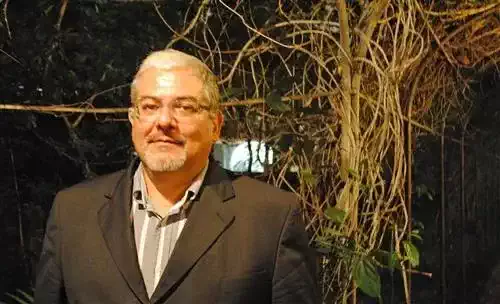
Frederico Barbosa
b. 1961
 BR
BR
BR
Frederico Barbosa is a Brazilian poet whose work is characterized by its lyrical depth, exploration of themes such as love, death, time, and the human condition, and by a rigorous and musical language. Through poetry that dialogues with tradition, but also opens itself to modernity, Barbosa constructs a dense and reflective poetic universe, marked by unique sensitivity and a keen eye for the complexities of existence.
n. 1961-02-20, Recife PE · m. , Zaragoza
62
Views
Bio
Identification and Basic Context
Frederico Barbosa was born in Salvador, Bahia, Brazil, on February 5, 1959. He is a Brazilian poet, essayist, and translator. Son of a middle-class family, he grew up in an environment conducive to cultural and intellectual development. He is one of the relevant names in contemporary Brazilian poetry.Childhood and Education
He spent his childhood and youth in Salvador, where he attended Colégio São Paulo. His intellectual formation was marked by a solid base of reading, from an early age, of classic and contemporary authors. He developed a special taste for literature and philosophy, which would profoundly influence his poetic work.Literary Career
He began his literary activity at a young age, participating in student gatherings and publications. He published his first book of poems, "As Formas da Noite" (The Forms of the Night), in 1982. Since then, he has published regularly, alternating poetry with essays and translations. His work has evolved in the exploration of existential themes and the refinement of poetic form.Work, Style, and Literary Characteristics
Among his most significant poetic works are "As Formas da Noite" (1982), "O Sabor do Silêncio" (The Taste of Silence) (1997), "Paixão e Morte de um Poeta" (Passion and Death of a Poet) (2003), and "O Livro das Sombras" (The Book of Shadows) (2011). The central themes of his poetry are love, death, time, memory, solitude, and the search for the meaning of existence. His style is marked by restrained lyricism, vocabulary precision, verse musicality, and a careful formal structure, often inspired by tradition, but without falling into anachronism. His poetic voice is reflective, sometimes melancholic, and capable of expressing a deep intimacy with the reader. Frederico Barbosa is known for his ability to create powerful images and address philosophical questions in an accessible and moving way.Cultural and Historical Context
Frederico Barbosa is part of the panorama of post-modern Brazilian poetry, dialoguing with authors from different generations and currents. His work subtly reflects the anxieties of contemporary society, especially regarding the human condition in a constantly changing world. He has actively participated in literary and cultural debates, both in Brazil and Portugal.Personal Life
His personal life is marked by remarkable discretion, with a deep dedication to writing and study. His experiences and reflections on love, loss, and the passage of time are elements that are transfigured in his poetry. His profession as an essayist and translator complements his activity as a poet.Recognition and Reception
Frederico Barbosa is widely recognized by critics as one of the most important poets of his generation in Brazil. His work has received praise for its lyrical quality, rigorous poetic technique, and thematic depth. He is a frequent presence in anthologies and literary publications.Influences and Legacy
Influenced by poets such as Carlos Drummond de Andrade, Manuel Bandeira, Fernando Pessoa, and other masters of Portuguese-language poetry, Frederico Barbosa builds his own legacy. His work has contributed to the renewal of contemporary Brazilian poetry, inspiring other poets with his ability to combine tradition with innovation and thematic depth with formal beauty.Interpretation and Critical Analysis
Frederico Barbosa's poetry is often analyzed for its exploration of the great existential questions, its ability to translate the complexities of the human soul into poetic language, and its formal mastery. His lyricism, though sometimes melancholic, also carries a latent hope in beauty and transcendence.Curiosities and Lesser-Known Aspects
Besides being a poet, Frederico Barbosa is a talented translator of authors such as Shakespeare, Milton, and T.S. Eliot. His passion for literature spans various languages and eras. His personal discretion contrasts with the expressive intensity of his poetic work.Death and Memory
(No information available on death and memory for Frederico Barbosa, as he is a living author.)Poems
0No poems found
Videos
50
Comments (0)
Log in
to post a comment.
No comments yet. Be the first to comment.