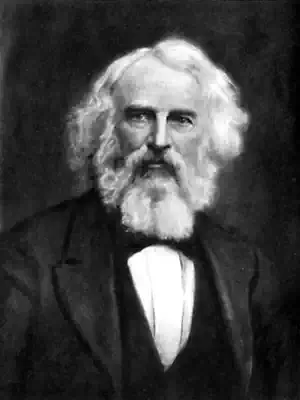
Oliver Basselin. (Birds Of Passage. Flight The First)
Oliver Basselin. (Birds Of Passage. Flight The First)
In the Valley of the Vire
Still is seen an ancient mill,
With its gables quaint and queer,
And beneath the window-sill,
On the stone,
These words alone:
'Oliver Basselin lived here.'
Far above it, on the steep,
Ruined stands the old Chateau;
Nothing but the donjon-keep
Left for shelter or for show.
Its vacant eyes
Stare at the skies,
Stare at the valley green and deep.
Once a convent, old and brown,
Looked, but ah! it looks no more,
From the neighboring hillside down
On the rushing and the roar
Of the stream
Whose sunny gleam
Cheers the little Norman town.
In that darksome mill of stone,
To the water's dash and din,
Careless, humble, and unknown,
Sang the poet Basselin
Songs that fill
That ancient mill
With a splendor of its own.
Never feeling of unrest
Broke the pleasant dream he dreamed;
Only made to be his nest,
All the lovely valley seemed;
No desire
Of soaring higher
Stirred or fluttered in his breast.
True, his songs were not divine;
Were not songs of that high art,
Which, as winds do in the pine,
Find an answer in each heart;
But the mirth
Of this green earth
Laughed and revelled in his line.
From the alehouse and the inn,
Opening on the narrow street,
Came the loud, convivial din,
Singing and applause of feet,
The laughing lays
That in those days
Sang the poet Basselin.
In the castle, cased in steel,
Knights, who fought at Agincourt,
Watched and waited, spur on heel;
But the poet sang for sport
Songs that rang
Another clang,
Songs that lowlier hearts could feel.
In the convent, clad in gray,
Sat the monks in lonely cells,
Paced the cloisters, knelt to pray,
And the poet heard their bells;
But his rhymes
Found other chimes,
Nearer to the earth than they.
Gone are all the barons bold,
Gone are all the knights and squires,
Gone the abbot stern and cold,
And the brotherhood of friars;
Not a name
Remains to fame,
From those mouldering days of old!
But the poet's memory here
Of the landscape makes a part;
Like the river, swift and clear,
Flows his song through many a heart;
Haunting still
That ancient mill,
In the Valley of the Vire.
Old Age. (Sonnet IV.)
Old Age. (Sonnet IV.)
The course of my long life hath reached at last,
In fragile bark o'er a tempestuous sea,
The common harbor, where must rendered be
Account of all the actions of the past.
The impassioned phantasy, that, vague and vast,
Made art an idol and a king to me,
Was an illusion, and but vanity
Were the desires that lured me and harassed.
The dreams of love, that were so sweet of yore,
What are they now, when two deaths may be mine,--
One sure, and one forecasting its alarms?
Painting and sculpture satisfy no more
The soul now turning to the Love Divine,
That oped, to embrace us, on the cross its arms.
O Ship of State
O Ship of State
Thou, too, sail on, O Ship of State!
Sail on, O Union, strong and great!
Humanity with all its fears,
With all the hopes of future years,
Is hanging breathless on thy fate!
We know what Master laid thy keel,
What Workmen wrought thy ribs of steel,
Who made each mast, and sail, and rope,
What anvils rang, what hammers beat,
In what a forge and what a heat
Were shaped the anchors of thy hope!
Fear not each sudden sound and shock,
'Tis of the wave and not the rock;
'Tis but the flapping of the sail,
And not a rent made by the gale!
In spite of rock and tempest's roar,
In spite of false lights on the shore,
Sail on, nor fear to breast the sea!
Our hearts, our hopes, are all with thee.
Our hearts, our hopes, our prayers, our tears,
Our faith triumphant o'er our fears,
Are all with thee, -are all with thee!
My Lost Youth
My Lost Youth
Often I think of the beautiful town
That is seated by the sea;
Often in thought go up and down
The pleasant streets of that dear old town,
And my youth comes back to me.
And a verse of a Lapland song
Is haunting my memory still:
"A boy's will is the wind's will,
And the thoughts of youth are long, long thoughts."
I can see the shadowy lines of its trees,
And catch, in sudden gleams,
The sheen of the far-surrounding seas,
And islands that were the Hesperides
Of all my boyish dreams.
And the burden of that old song,
It murmurs and whispers still:
"A boy's will is the wind's will,
And the thoughts of youth are long, long thoughts."
I remember the black wharves and the ships,
And the sea-tides tossing free;
And Spanish sailors with bearded lips,
And the beauty and mystery of the ships,
And the magic of the sea.
And the voice of that wayward song
Is singing and saying still:
"A boy's will is the wind's will,
And the thoughts of youth are long, long thoughts."
I remember the bulwarks by the shore,
And the fort upon the hill;
The sunrise gun, with its hollow roar,
The drum-beat repeated o'er and o'er,
And the bugle wild and shrill.
And the music of that old song
Throbs in my memory still:
"A boy's will is the wind's will,
And the thoughts of youth are long, long thoughts."
I remember the sea-fight far away,
How it thundered o'er the tide!
And the dead captains, as they lay
In their graves, o'erlooking the tranquil bay
Where they in battle died.
And the sound of that mournful song
Goes through me with a thrill:
"A boy's will is the wind's will,
And the thoughts of youth are long, long thoughts."
I can see the breezy dome of groves,
The shadows of Deering's Woods;
And the friendships old and the early loves
Come back with a Sabbath sound, as of doves
In quiet neighborhoods.
And the verse of that sweet old song,
It flutters and murmurs still:
"A boy's will is the wind's will,
And the thoughts of youth are long, long thoughts."
I remember the gleams and glooms that dart
Across the school-boy's brain;
The song and the silence in the heart,
That in part are prophecies, and in part
Are longings wild and vain.
And the voice of that fitful song
Sings on, and is never still:
"A boy's will is the wind's will,
And the thoughts of youth are long, long thoughts."
There are things of which I may not speak;
There are dreams that cannot die;
There are thoughts that make the strong heart weak,
And bring a pallor into the cheek,
And a mist before the eye.
And the words of that fatal song
Come over me like a chill:
"A boy's will is the wind's will,
And the thoughts of youth are long, long thoughts."
Strange to me now are the forms I meet
When I visit the dear old town;
But the native air is pure and sweet,
And the trees that o'ershadow each well-known street,
As they balance up and down,
Are singing the beautiful song,
Are sighing and whispering still:
"A boy's will is the wind's will,
And the thoughts of youth are long, long thoughts."
And Deering's Woods are fresh and fair,
And with joy that is almost pain
My heart goes back to wander there,
And among the dreams of the days that were,
I find my lost youth again.
And the strange and beautiful song,
The groves are repeating it still:
"A boy's will is the wind's will,
And the thoughts of youth are long, long thoughts."
Nature
Nature
As a fond mother, when the day is o'er,
Leads by the hand her little child to bed,
Half willing, half reluctant to be led,
And leave his broken playthings on the floor,
Still gazing at them through the open door,
Nor wholly reassured and comforted
By promises of others in their stead,
Which though more splendid, may not please him more;
So Nature deals with us, and takes away
Our playthings one by one, and by the hand
Leads us to rest so gently, that we go
Scarce knowing if we wish to go or stay,
Being too full of sleep to understand
How far the unknown transcends the what we know.
Morituri Salutamus: Poem for the Fiftieth Anniversary of th
Morituri Salutamus: Poem for the Fiftieth Anniversary of th
Tempora labuntur, tacitisque senescimus annis,
Et fugiunt freno non remorante dies.
Ovid, Fastorum, Lib. vi.
"O Cæsar, we who are about to die
Salute you!" was the gladiators' cry
In the arena, standing face to face
With death and with the Roman populace.
O ye familiar scenes,--ye groves of pine,
That once were mine and are no longer mine,-Thou
river, widening through the meadows green
To the vast sea, so near and yet unseen,-Ye
halls, in whose seclusion and repose
Phantoms of fame, like exhalations, rose
And vanished,--we who are about to die,
Salute you; earth and air and sea and sky,
And the Imperial Sun that scatters down
His sovereign splendors upon grove and town.
Ye do not answer us! ye do not hear!
We are forgotten; and in your austere
And calm indifference, ye little care
Whether we come or go, or whence or where.
What passing generations fill these halls,
What passing voices echo from these walls,
Ye heed not; we are only as the blast,
A moment heard, and then forever past.
Not so the teachers who in earlier days
Led our bewildered feet through learning's maze;
They answer us--alas! what have I said?
What greetings come there from the voiceless dead?
What salutation, welcome, or reply?
What pressure from the hands that lifeless lie?
They are no longer here; they all are gone
Into the land of shadows,--all save one.
Honor and reverence, and the good repute
That follows faithful service as its fruit,
Be unto him, whom living we salute.
The great Italian poet, when he made
His dreadful journey to the realms of shade,
Met there the old instructor of his youth,
And cried in tones of pity and of ruth:
"Oh, never from the memory of my heart
Your dear, paternal image shall depart,
Who while on earth, ere yet by death surprised,
Taught me how mortals are immortalized;
How grateful am I for that patient care
All my life long my language shall declare."
To-day we make the poet's words our own,
And utter them in plaintive undertone;
Nor to the living only be they said,
But to the other living called the dead,
Whose dear, paternal images appear
Not wrapped in gloom, but robed in sunshine here;
Whose simple lives, complete and without flaw,
Were part and parcel of great Nature's law;
Who said not to their Lord, as if afraid,
"Here is thy talent in a napkin laid,"
But labored in their sphere, as men who live
In the delight that work alone can give.
Peace be to them; eternal peace and rest,
And the fulfilment of the great behest:
"Ye have been faithful over a few things,
Over ten cities shall ye reign as kings."
And ye who fill the places we once filled,
And follow in the furrows that we tilled,
Young men, whose generous hearts are beating high,
We who are old, and are about to die,
Salute you; hail you; take your hands in ours,
And crown you with our welcome as with flowers!
How beautiful is youth! how bright it gleams
With its illusions, aspirations, dreams!
Book of Beginnings, Story without End,
Each maid a heroine, and each man a friend!
Aladdin's Lamp, and Fortunatus' Purse,
That holds the treasures of the universe!
All possibilities are in its hands,
No danger daunts it, and no foe withstands;
In its sublime audacity of faith,
"Be thou removed!" it to the mountain saith,
And with ambitious feet, secure and proud,
Ascends the ladder leaning on the cloud!
As ancient Priam at the Scæan gate
Sat on the walls of Troy in regal state
With the old men, too old and weak to fight,
Chirping like grasshoppers in their delight
To see the embattled hosts, with spear and shield,
Of Trojans and Achaians in the field;
So from the snowy summits of our years
We see you in the plain, as each appears,
And question of you; asking, "Who is he
That towers above the others? Which may be
Atreides, Menelaus, Odysseus,
Ajax the great, or bold Idomeneus?"
Let him not boast who puts his armor on
As he who puts it off, the battle done.
Study yourselves; and most of all note well
Wherein kind Nature meant you to excel.
Not every blossom ripens into fruit;
Minerva, the inventress of the flute,
Flung it aside, when she her face surveyed
Distorted in a fountain as she played;
The unlucky Marsyas found it, and his fate
Was one to make the bravest hesitate.
Write on your doors the saying wise and old,
"Be bold! be bold!" and everywhere, "Be bold;
Be not too bold!" Yet better the excess
Than the defect; better the more than less;
Better like Hector in the field to die,
Than like a perfumed Paris turn and fly.
And now, my classmates; ye remaining few
That number not the half of those we knew,
Ye, against whose familiar names not yet
The fatal asterisk of death is set,
Ye I salute! The horologe of Time
Strikes the half-century with a solemn chime,
And summons us together once again,
The joy of meeting not unmixed with pain.
Where are the others? Voices from the deep
Caverns of darkness answer me: "They sleep!"
I name no names; instinctively I feel
Each at some well-remembered grave will kneel,
And from the inscription wipe the weeds and moss,
For every heart best knoweth its own loss.
I see their scattered gravestones gleaming white
Through the pale dusk of the impending night;
O'er all alike the impartial sunset throws
Its golden lilies mingled with the rose;
We give to each a tender thought, and pass
Out of the graveyards with their tangled grass,
Unto these scenes frequented by our feet
When we were young, and life was fresh and sweet.
What shall I say to you? What can I say
Better than silence is? When I survey
This throng of faces turned to meet my own,
Friendly and fair, and yet to me unknown,
Transformed the very landscape seems to be;
It is the same, yet not the same to me.
So many memories crowd upon my brain,
So many ghosts are in the wooded plain,
I fain would steal away, with noiseless tread,
As from a house where some one lieth dead.
I cannot go;--I pause;--I hesitate;
My feet reluctant linger at the gate;
As one who struggles in a troubled dream
To speak and cannot, to myself I seem.
Vanish the dream! Vanish the idle fears!
Vanish the rolling mists of fifty years!
Whatever time or space may intervene,
I will not be a stranger in this scene.
Here every doubt, all indecision, ends;
Hail, my companions, comrades, classmates, friends!
Ah me! the fifty years since last we met
Seem to me fifty folios bound and set
By Time, the great transcriber, on his shelves,
Wherein are written the histories of ourselves.
What tragedies, what comedies, are there;
What joy and grief, what rapture and despair!
What chronicles of triumph and defeat,
Of struggle, and temptation, and retreat!
What records of regrets, and doubts, and fears!
What pages blotted, blistered by our tears!
What lovely landscapes on the margin shine,
What sweet, angelic faces, what divine
And holy images of love and trust,
Undimmed by age, unsoiled by damp or dust!
Whose hand shall dare to open and explore
These volumes, closed and clasped forevermore?
Not mine. With reverential feet I pass;
I hear a voice that cries, "Alas! alas!
Whatever hath been written shall remain,
Nor be erased nor written o'er again;
The unwritten only still belongs to thee:
Take heed, and ponder well what that shall be."
As children frightened by a thunder-cloud
Are reassured if some one reads aloud
A tale of wonder, with enchantment fraught,
Or wild adventure, that diverts their thought,
Let me endeavor with a tale to chase
The gathering shadows of the time and place,
And banish what we all too deeply feel
Wholly to say, or wholly to conceal.
In mediæval Rome, I know not where,
There stood an image with its arm in air,
And on its lifted finger, shining clear,
A golden ring with the device, "Strike here!"
Greatly the people wondered, though none guessed
The meaning that these words but half expressed,
Until a learned clerk, who at noonday
With downcast eyes was passing on his way,
Paused, and observed the spot, and marked it well,
Whereon the shadow of the finger fell;
And, coming back at midnight, delved, and found
A secret stairway leading underground.
Down this he passed into a spacious hall,
Lit by a flaming jewel on the wall;
And opposite, in threatening attitude,
With bow and shaft a brazen statue stood.
Upon its forehead, like a coronet,
Were these mysterious words of menace set:
"That which I am, I am; my fatal aim
None can escape, not even yon luminous flame!"
Midway the hall was a fair table placed,
With cloth of gold, and golden cups enchased
With rubies, and the plates and knives were gold,
And gold the bread and viands manifold.
Around it, silent, motionless, and sad,
Were seated gallant knights in armor clad,
And ladies beautiful with plume and zone,
But they were stone, their hearts within were stone;
And the vast hall was filled in every part
With silent crowds, stony in face and heart.
Long at the scene, bewildered and amazed
The trembling clerk in speechless wonder gazed;
Then from the table, by his greed made bold,
He seized a goblet and a knife of gold,
And suddenly from their seats the guests upsprang,
The vaulted ceiling with loud clamors rang,
The archer sped his arrow, at their call,
Shattering the lambent jewel on the wall,
And all was dark around and overhead;-Stark
on the floor the luckless clerk lay dead!
The writer of this legend then records
Its ghostly application in these words:
The image is the Adversary old,
Whose beckoning finger points to realms of gold;
Our lusts and passions are the downward stair
That leads the soul from a diviner air;
The archer, Death; the flaming jewel, Life;
Terrestrial goods, the goblet and the knife;
The knights and ladies, all whose flesh and bone
By avarice have been hardened into stone;
The clerk, the scholar whom the love of pelf
Tempts from his books and from his nobler self.
The scholar and the world! The endless strife,
The discord in the harmonies of life!
The love of learning, the sequestered nooks,
And all the sweet serenity of books;
The market-place, the eager love of gain,
Whose aim is vanity, and whose end is pain!
But why, you ask me, should this tale be told
To men grown old, or who are growing old?
It is too late! Ah, nothing is too late
Till the tired heart shall cease to palpitate.
Cato learned Greek at eighty; Sophocles
Wrote his grand Oedipus, and Simonides
Bore off the prize of verse from his compeers,
When each had numbered more than fourscore years,
And Theophrastus, at fourscore and ten,
Had but begun his "Characters of Men."
Chaucer, at Woodstock with the nightingales,
At sixty wrote the Canterbury Tales;
Goethe at Weimar, toiling to the last,
Completed Faust when eighty years were past.
These are indeed exceptions; but they show
How far the gulf-stream of our youth may flow
Into the arctic regions of our lives,
Where little else than life itself survives.
As the barometer foretells the storm
While still the skies are clear, the weather warm
So something in us, as old age draws near,
Betrays the pressure of the atmosphere.
The nimble mercury, ere we are aware,
Descends the elastic ladder of the air;
The telltale blood in artery and vein
Sinks from its higher levels in the brain;
Whatever poet, orator, or sage
May say of it, old age is still old age.
It is the waning, not the crescent moon;
The dusk of evening, not the blaze of noon;
It is not strength, but weakness; not desire,
But its surcease; not the fierce heat of fire,
The burning and consuming element,
But that of ashes and of embers spent,
In which some living sparks we still discern,
Enough to warm, but not enough to burn.
What then? Shall we sit idly down and say
The night hath come; it is no longer day?
The night hath not yet come; we are not quite
Cut off from labor by the failing light;
Something remains for us to do or dare;
Even the oldest tree some fruit may bear;
Not Oedipus Coloneus, or Greek Ode,
Or tales of pilgrims that one morning rode
Out of the gateway of the Tabard Inn,
But other something, would we but begin;
For age is opportunity no less
Than youth itself, though in another dress,
And as the evening twilight fades away
The sky is filled with stars, invisible by day.
Musings
Musings
I sat by my window one night,
And watched how the stars grew high;
And the earth and skies were a splendid sight
To a sober and musing eye.
From heaven the silver moon shone down
With gentle and mellow ray,
And beneath the crowded roofs of the town
In broad light and shadow lay.
A glory was on the silent sea,
And mainland and island too,
Till a haze came over the lowland lea,
And shrouded that beautiful blue.
Bright in the moon the autumn wood
Its crimson scarf unrolled,
And the trees like a splendid army stood
In a panoply of gold!
I saw them waving their banners high,
As their crests to the night wind bowed,
And a distant sound on the air went by,
Like the whispering of a crowd.
Then I watched from my window how fast
The lights all around me fled,
As the wearied man to his slumber passed
And the sick one to his bed.
All faded save one, that burned
With distant and steady light;
But that, too, went out -- and I turned
Where my own lamp within shone bright!
Thus, thought I, our joys must die,
Yes -- the brightest from earth we win:
Till each turns away, with a sign,
To the lamp that burns brightly within.
Milton
Milton
I pace the sounding sea-beach and behold
How the voluminous billows roll and run,
Upheaving and subsiding, while the sun
Shines through their sheeted emerald far unrolled,
And the ninth wave, slow gathering fold by fold
All its loose-flowing garments into one,
Plunges upon the shore, and floods the dun
Pale reach of sands, and changes them to gold.
So in majestic cadence rise and fall
The mighty undulations of thy song,
O sightless bard, England's Mæonides!
And ever and anon, high over all
Uplifted, a ninth wave superb and strong,
Floods all the soul with its melodious seas.
Moods
Moods
Oh that a Song would sing itself to me
Out of the heart of Nature, or the heart
Of man, the child of Nature, not of Art,
Fresh as the morning, salt as the salt sea,
With just enough of bitterness to be
A medicine to this sluggish mood, and start
The life-blood in my veins, and so impart
Healing and help in this dull lethargy!
Alas! not always doth the breath of song
Breathe on us. It is like the wind that bloweth
At its own will, not ours, nor tarrieth long;
We hear the sound thereof, but no man knoweth
From whence it comes, so sudden and swift and strong,
Nor whither in its wayward course it goeth.
Maidenhood
Maidenhood
Maiden! with the meek, brown eyes,
In whose orbs a shadow lies
Like the dusk in evening skies!
Thou whose locks outshine the sun,
Golden tresses, wreathed in one,
As the braided streamlets run!
Standing, with reluctant feet,
Where the brook and river meet,
Womanhood and childhood fleet!
Gazing, with a timid glance,
On the brooklet's swift advance,
On the river's broad expanse!
Deep and still, that gliding stream
Beautiful to thee must seem,
As the river of a dream.
Then why pause with indecision,
When bright angels in thy vision
Beckon thee to fields Elysian?
Seest thou shadows sailing by,
As the dove, with startled eye,
Sees the falcon's shadow fly?
Hearest thou voices on the shore,
That our ears perceive no more,
Deafened by the cataract's roar?
O, thou child of many prayers!
Life hath quickeands,--Life hath snares
Care and age come unawares!
Like the swell of some sweet tune,
Morning rises into noon,
May glides onward into June.
Childhood is the bough, where slumbered
Birds and blossoms many-numbered;--
Age, that bough with snows encumbered.
Gather, then, each flower that grows,
When the young heart overflows,
To embalm that tent of snows.
Bear a lily in thy hand;
Gates of brass cannot withstand
One touch of that magic wand.
Bear through sorrow, wrong, and ruth,
In thy heart the dew of youth,
On thy lips the smile of truth1
O, that dew, like balm, shall steal
Into wounds that cannot heal,
Even as sleep our eyes doth seal;
And that smile, like sunshine, dart
Into many a sunless heart,
For a smile of God thou art.