
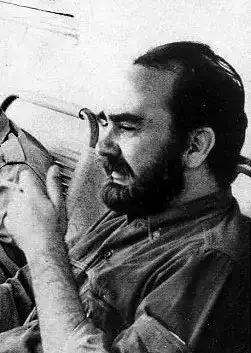
Herberto Helder
 PT
PT
Herberto Helder was a singular and enigmatic Portuguese poet, known for his overwhelming and experimental work that defies easy classification. His poetry is a dense and labyrinthine universe, marked by transgressive language, by the visceral exploration of the body, sexuality, death, and transcendence. Helder is considered one of the most original and influential poets in contemporary Portuguese literature, with a body of work that continues to intrigue and fascinate readers and critics with its radicalism and profound reflection on the human condition and the very nature of language and poetry.
n. 1930-11-23, Funchal · m. 2015-03-23, Cascais
Bio
Identification and basic context
Herberto Helder, whose birth name was Herberto Helder da Silva, was a Portuguese poet, translator, and editor, widely considered one of the most original and enigmatic figures in 20th and 21st-century Portuguese literature. He was born in Funchal, Madeira, and lived much of his life in continental Portugal, in Lisbon and Porto. He wrote in Portuguese, and his work is marked by constant linguistic and thematic experimentation, exploring the limits of language and representation.Childhood and education
Little is known about his childhood and education, as Helder cultivated deep secrecy around his personal life. It is known that he had a formal education, but his true formation seems to have been self-taught and shaped by intense engagement with literature, philosophy, and the arts. His work reveals a vast culture and a unique ability to absorb and reconfigure diverse influences.Literary career
Herberto Helder's literary career is marked by intense, although sometimes sporadic, production, often averse to editorial conventions. He began his literary activity in the 1950s and 1960s, publishing poems in magazines and anthologies. His work evolved in a direction of radicalization and deepening, exploring increasingly complex themes and using increasingly bold and transgressive language. He was also a translator and editor, playing a relevant role in disseminating foreign works in Portugal.Work, style, and literary characteristics
His main works include "A Colher na Boca" (1961), "O Ofício de Ser Saudade" (1975), "Poesia" (1974), and "Payback" (1977). The central themes of his poetry are the body, sexuality, death, the sacred, matter, memory, and language itself. His style is unmistakable, characterized by extraordinary imagistic density, a rich and sometimes obscure vocabulary, and fragmented, elliptical syntax. Helder uses resources such as bold metaphors, accumulation, and repetition to create an effect of vertigo and intensity. His poetic voice is visceral, confessional, and at the same time universal, exploring the fragility and strength of the human being. He introduced radical innovations in the form and content of Portuguese poetry, engaging with tradition but projecting it into an uncertain and experimental future. He is often associated with existentialist poetics and an unparalleled literary avant-garde.Work, style, and literary characteristics
Cultural and historical context Herberto Helder lived through a period of great historical transformations in Portugal, including the end of the dictatorship and the transition to democracy. However, he remained, to a large extent, on the fringes of established literary circles and artistic movements, cultivating a stance of independence and detachment. His work dialogues with modernist tradition but projects beyond it, anticipating many of the concerns of contemporary poetry.Work, style, and literary characteristics
Personal life Helder was a notoriously reclusive figure, averse to public exposure. Little is known about his personal life, affective relationships, or political and religious convictions. His work is, in itself, the main gateway to his inner universe, where human experience is explored in its rawest and most transcendent aspects.Work, style, and literary characteristics
Recognition and reception Although he maintained a discreet stance, Herberto Helder earned a place of deep respect and admiration in Portuguese literature. His work is considered avant-garde, and its influence has grown over time, being recognized by critics, academics, and an increasingly broad audience attracted by its radicalism and originality.Work, style, and literary characteristics
Influences and legacy The influences on Herberto Helder are vast and diverse, encompassing universal literature, philosophy, religion, and the arts. His legacy is that of a poet who pushed poetic language to new limits, who explored the complexity of being, and who offered an uncompromising and visceral vision of existence. He influenced a new generation of poets with his audacity and creative freedom.Work, style, and literary characteristics
Interpretation and critical analysis Helder's work is a constant challenge to criticism, given its complexity, density, and polysemic nature. Interpretations focus on his exploration of alterity, transgression, the body as a site of revelation, and language as primordial matter. Debates about his position in Portuguese poetry and his impact on contemporary literature are recurrent.Work, style, and literary characteristics
Curiosities and lesser-known aspects One of the most curious aspects of Herberto Helder is his mystery. He lived a practically anonymous life, protecting his privacy with almost absolute rigor. His work, however, is overwhelmingly transparent and visceral, contrasting with his external silence.Work, style, and literary characteristics
Death and memory Herberto Helder passed away in Lisbon, leaving behind a body of work that continues to be discovered and studied. His memory is that of an uncompromising poet, a creator of worlds, and a master of words who indelibly marked the Portuguese literary landscape.Poems
0No poems found
Videos
50
Comments (0)
No comments yet. Be the first to comment.