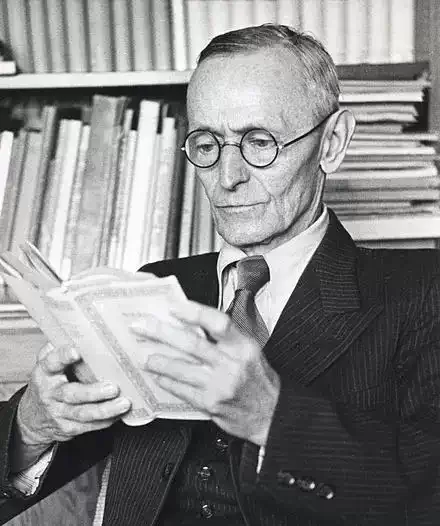
Hermann Hesse

Hermann Hesse

1877–1962 · lived 85 years DE DE

Hermann Hesse was a German-born poet, novelist, and painter who later became a Swiss citizen. Awarded the Nobel Prize in Literature in 1946, his works explore themes of self-discovery, spirituality, and the duality of human nature. Hesse's early life was marked by a search for identity, influenced by his parents' missionary work and his own spiritual leanings. His literary career spanned decades, producing influential novels like 'Siddhartha,' 'Demian,' and 'Steppenwolf,' which resonated with readers seeking meaning in a rapidly changing world.

n. 1877-07-02, Calw · m. 1962-08-09, Montagnola

18,330 Views

Thinking Of A Friend At Night

Thinking Of A Friend At Night

In this evil year, autumn comes early...
I walk by night in the field, alone, the rain clatters,
The wind on my hat...And you? And you, my friend?


You are standing--maybe--and seeing the sickle moon
Move in a small arc over the forests
And bivouac fire, red in the black valley.
You are lying--maybe--in a straw field and sleeping
And dew falls cold on your forehead and battle jacket.


It's possible tonight you're on horseback,
The farthest outpost, peering along, with a gun in your fist,
Smiling, whispering, to your exhausted horse.
Maybe--I keep imagining--you are spending the night
As a guest in a strange castle with a park
And writing a letter by candlelight, and tapping
On the piano keys by the window,
Groping for a sound...


--And maybe
You are already silent, already dead, and the day
Will shine no longer into your beloved
Serious eyes, and your beloved brown hand hangs wilted,
And your white forehead split open--Oh, if only,
If only, just once, that last day, I had shown you, told you
Something of my love, that was too timid to speak!


But you know me, you know...and, smiling, you nod
Tonight in front of your strange castle,
And you nod to your horse in the drenched forest,
And you nod to your sleep to your harsh clutter of straw,
And think about me, and smile.
And maybe,
Maybe some day you will come back from the war,
and take a walk with me some evening,
And somebody will talk about Longwy, Luttich, Dammerkirch,
And smile gravely, and everything will be as before,
And no one will speak a word of his worry,
Of his worry and tenderness by night in the field,
Of his love. And with a single joke
You will frighten away the worry, the war, the uneasy nights,
The summer lightning of shy human friendship,
Into the cool past that will never come back.


Translated by James Wright


Submitted by Holt
Read full poem
Bio

Identification and basic context

Hermann Karl Hesse was a German-born novelist, poet, and painter, who later became a naturalized Swiss citizen. He is widely regarded as one of the most significant literary figures of the 20th century, particularly known for his exploration of spiritual and psychological themes. His work often delves into the individual's search for self-understanding, authenticity, and inner peace amidst the complexities of modern life.

Childhood and education

Hesse's childhood was deeply influenced by his parents, who were Protestant missionaries in India. This background instilled in him an early exposure to Eastern philosophies and religions, which would profoundly shape his later literary work. He attended various schools, including a gymnasium in Göppingen and later a monastery school in Maulbronn, though he struggled with the rigid academic environment. He was a voracious reader and developed a strong interest in philosophy and literature, engaging in significant self-education. Early influences included the writings of German Romantic poets, philosophers like Nietzsche and Schopenhauer, and Eastern spiritual texts.

Literary trajectory

Hesse began his literary career in the late 19th century, initially working as a bookseller and then as an editor. His first novel, *Peter Camenzind*, was published in 1904 and achieved considerable success, establishing him as a promising writer. His early works often reflected a Romantic sensibility and a critique of bourgeois society. However, his trajectory evolved significantly after World War I, marked by a period of intense personal crisis and a turn towards psychoanalysis, particularly the work of Carl Jung. This led to a more introspective and psychologically complex phase in his writing, evident in novels like *Demian* (published under a pseudonym) and *Siddhartha*.

Works, style, and literary characteristics

Hesse's major works include *Peter Camenzind* (1904), *Demian* (1919), *Siddhartha* (1922), *Steppenwolf* (1927), *Narcissus and Goldmund* (1930), and *The Glass Bead Game* (1943), for which he was awarded the Nobel Prize in Literature in 1946. His novels frequently explore themes of duality (spirit versus nature, intellect versus instinct), the quest for self-knowledge, the artist's struggle, spiritual seeking, and the search for meaning in a chaotic world. His style is often characterized by lyrical prose, introspective narration, and a blend of realism and symbolism. He masterfully employed allegorical elements and drew heavily on Eastern and Western philosophical and religious traditions. His poetic voice is deeply personal, often confessional, and reflective. Hesse's innovations lie in his synthesis of Western psychological thought with Eastern mysticism and his profound exploration of the individual's inner journey.

Cultural and historical context

Hesse lived through significant historical upheavals, including two World Wars. He was deeply affected by the rise of Nazism and the ensuing conflict, which led him to renounce his German citizenship and embrace Swiss nationality. His works often served as a counterpoint to the prevailing nationalism and materialism of his time, advocating for inner peace and individual authenticity. He was part of a literary milieu that included contemporaries grappling with similar existential questions, though his spiritual explorations set him apart. His novels gained considerable international traction, especially after World War II, resonating with a global audience seeking solace and meaning.

Personal life

Hesse's personal life was marked by considerable emotional turbulence and a persistent search for inner balance. He experienced difficult relationships, including two divorces and strained family connections. His struggles with mental health and existential crises led him to seek psychoanalytic treatment, which deeply informed his writing. He found solace in art, music, and nature. His friendships with other artists and intellectuals, though sometimes complex, provided intellectual stimulation.

Recognition and reception

Hesse achieved significant recognition during his lifetime, culminating in the Nobel Prize in Literature in 1946. His novels, particularly *Siddhartha* and *Steppenwolf*, gained immense popularity, especially among younger generations in the post-war era and the counter-culture movements of the 1960s and 70s. While initially sometimes viewed as too esoteric by mainstream critics, his work has endured, solidifying his place as a classic author whose explorations of the human condition continue to be highly relevant.

Influences and legacy

Hesse was influenced by a wide range of thinkers and artists, including Johann Wolfgang von Goethe, Friedrich Nietzsche, Arthur Schopenhauer, Carl Jung, and various Eastern spiritual traditions (Buddhism, Hinduism). His legacy is immense; he is credited with popularizing Eastern philosophy and spirituality in the West through his accessible literary narratives. His themes of self-discovery and authenticity continue to inspire readers worldwide, and his works remain a staple in academic studies and popular literature.

Interpretation and critical analysis

Hesse's works are rich ground for critical analysis, often interpreted through the lenses of psychology, philosophy, and comparative religion. Key critical debates revolve around his portrayal of the artist, the nature of spiritual enlightenment, and the tension between the individual and society. His characters often embody archetypal struggles for self-realization.

Curiosities and lesser-known aspects

Beyond his literary achievements, Hesse was a talented painter, producing numerous watercolors and drawings that reflected his inner world and his connection to nature. He was also a passionate gardener. His later years were spent in relative seclusion in Montagnola, Switzerland, where he focused on writing and painting.

Death and memory

Hermann Hesse died in Montagnola, Switzerland, in 1962. His literary estate is carefully managed, and his works continue to be translated and read globally. He is remembered not only as a Nobel laureate but as a profound voice for the introspective journey and the universal human quest for meaning.

Poems

7

Thinking Of A Friend At Night

Thinking Of A Friend At Night

In this evil year, autumn comes early...
I walk by night in the field, alone, the rain clatters,
The wind on my hat...And you? And you, my friend?


You are standing--maybe--and seeing the sickle moon
Move in a small arc over the forests
And bivouac fire, red in the black valley.
You are lying--maybe--in a straw field and sleeping
And dew falls cold on your forehead and battle jacket.


It's possible tonight you're on horseback,
The farthest outpost, peering along, with a gun in your fist,
Smiling, whispering, to your exhausted horse.
Maybe--I keep imagining--you are spending the night
As a guest in a strange castle with a park
And writing a letter by candlelight, and tapping
On the piano keys by the window,
Groping for a sound...


--And maybe
You are already silent, already dead, and the day
Will shine no longer into your beloved
Serious eyes, and your beloved brown hand hangs wilted,
And your white forehead split open--Oh, if only,
If only, just once, that last day, I had shown you, told you
Something of my love, that was too timid to speak!


But you know me, you know...and, smiling, you nod
Tonight in front of your strange castle,
And you nod to your horse in the drenched forest,
And you nod to your sleep to your harsh clutter of straw,
And think about me, and smile.
And maybe,
Maybe some day you will come back from the war,
and take a walk with me some evening,
And somebody will talk about Longwy, Luttich, Dammerkirch,
And smile gravely, and everything will be as before,
And no one will speak a word of his worry,
Of his worry and tenderness by night in the field,
Of his love. And with a single joke
You will frighten away the worry, the war, the uneasy nights,
The summer lightning of shy human friendship,
Into the cool past that will never come back.


Translated by James Wright


Submitted by Holt
593

Stages

Stages


As every flower fades and as all youth
Departs, so life at every stage,
So every virtue, so our grasp of truth,
Blooms in its day and may not last forever.
Since life may summon us at every age
Be ready, heart, for parting, new endeavor,
Be ready bravely and without remorse
To find new light that old ties cannot give.
In all beginnings dwells a magic force
For guarding us and helping us to live.
Serenely let us move to distant places
And let no sentiments of home detain us.


The Cosmic Spirit seeks not to restrain us
But lifts us stage by stage to wider spaces.
If we accept a home of our own making,
Familiar habit makes for indolence.
We must prepare for parting and leave-taking
Or else remain the slave of permanence.
Even the hour of our death may send
Us speeding on to fresh and newer spaces,
And life may summon us to newer races.
So be it, heart: bid farewell without end.
911

Lying In Grass

Lying In Grass

Is this everything now, the quick delusions of flowers,
And the down colors of the bright summer meadow,
The soft blue spread of heaven, the bees' song,
Is this everything only a god's
Groaning dream,
The cry of unconscious powers for deliverance?
The distant line of the mountain,
That beautifully and courageously rests in the blue,
Is this too only a convulsion,
Only the wild strain of fermenting nature,
Only grief, only agony, only meaningless fumbling,
Never resting, never a blessed movement?
No! Leave me alone, you impure dream
Of the world in suffering!
The dance of tiny insects cradles you in an evening radiance,
The bird's cry cradles you,
A breath of wind cools my forehead
With consolation.
Leave me alone, you unendurably old human grief!
Let it all be pain.
Let it all be suffering, let it be wretched-
But not this one sweet hour in the summer,
And not the fragrance of the red clover,
And not the deep tender pleasure
In my soul.


Translated by James Wright


Submitted by Holt
671

In Secret We Thirst

In Secret We Thirst

Graceful, spiritual,
with the gentleness of arabesques
our life is similar
to the existence of fairies
that spin in soft cadence
around nothingness
to which we sacrifice
the here and now

Dreams of beauty, youthful joy
like a breath in pure harmony
with the depth of your young surface
where sparkles the longing for the night
for blood and barbarity

In the emptiness, spinning, without aims or needs
dance free our lives
always ready for the game
yet, secretly, we thirst for reality
for the conceiving, for the birth
we are thirst for sorrows and death
633

Across The Fields

Across The Fields

Across the sky, the clouds move,
Across the fields, the wind,
Across the fields the lost child
Of my mother wanders.


Across the street, leaves blow,
Across the trees, birds cry --
Across the mountains, far away,
My home must be.
681

How Heavy The Days

How Heavy The Days

How heavy the days are.
There's not a fire that can warm me,
Not a sun to laugh with me,
Everything bare,
Everything cold and merciless,
And even the beloved, clear
Stars look desolately down,
Since I learned in my heart that
Love can die.


Translated by James Wright


Submitted by Holt
575

A Swarm Of Gnats

A Swarm Of Gnats

Many thousand glittering motes
Crowd forward greedily together
In trembling circles.
Extravagantly carousing away
For a whole hour rapidly vanishing,
They rave, delirious, a shrill whir,
Shivering with joy against death.
While kingdoms, sunk into ruin,
Whose thrones, heavy with gold, instantly scattered
Into night and legend, without leaving a trace,
Have never known so fierce a dancing.


Translated by James Wright


Submitted by Holt
663

Quotes

28

Videos

50

Comments (0)

Share
Log in to post a comment.

No comments yet. Be the first to comment.