
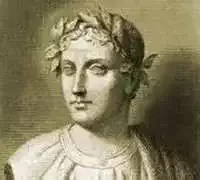
Horácio

Horácio

65–8 · lived 0 years IT IT

Quintus Horatius Flaccus, commonly known as Horace, was a prominent Roman lyric poet during the time of Augustus. He is regarded as one of the greatest Roman lyric poets. His works, including Odes, Epodes, Satires, and Epistles, offer a vivid portrayal of Roman society and human nature. Horace's poetry is characterized by its technical mastery, elegant style, and philosophical depth, often exploring themes of moderation, the passage of time, and the pursuit of a happy life. His influence on Western literature is profound and enduring, shaping poetic traditions for centuries.

n. 0065-12-08, Venosa · m. 0008-11-27, Roma

185 Views

BkIV:XIV Drusus and Tiberius

BkIV:XIV Drusus and Tiberius

What care the Citizens and the Senators
shall take in immortalising your virtues,
granting you full honours, Augustus,
with titles and memorial plaques, O,


greatest of princes, wherever the sun shines
over the countries where people can live, you,
whose power in war the Vindelici
free of our Roman laws, till now, have learnt.


For, with your army, brave Drusus, demolished
the Genauni, that implacable race, in more
direct retaliation, the swift
Breuni, and their defences, established


on the formidable Alpine heights: and soon
Tiberius, the elder Nero, entered
that fierce fight, with his favourable
omens, defeating the wild Rhaetians:


it was wonderful to see with what destruction,
in contesting the war, he exhausted those minds
intent on the deaths of our freemen,
as the south wind, almost, when it troubles


the ungovernable waves, while the Pleiades’
constellation pierces the clouds, he was eager
to attack the hostile ranks, and drive
his neighing horse through the midst of their fire.


As, bull-like, the Aufidus rolls on, flowing
by the domains of Apulian Daunus,
when it rages and threatens fearful
destruction to their cultivated fields,


so Tiberius overwhelmed the armoured
ranks of barbarians, his fierce impetus
covering the earth, mowing down front
and rear, and conquering them without loss,


yours the troops, the strategy and the friendly
gods. For on that date when Alexandria
opened all its harbour, and empty
palaces to you, in supplication,


good Fortune, fifteen years later, delivered
a favourable outcome to the campaign,
and awarded fame, and the glory
hoped-for, to your imperial action.


The Spaniards, never conquered before, the Medes,


the Indians, marvel at you, the roving
Scythians, O eager protector
of Italy and Imperial Rome.


The Nile, that conceals its origin, hears you,
the Danube hears, and the swift-flowing Tigris,
the Ocean, filled with monsters, roaring
around the distant island of Britain,


and the regions of Gaul, unafraid of death,
and the stubborn Iberian land, hear you:
Sygambri, delighting in slaughter,
stand, with grounded weapons, worshipping you.
Read full poem
Bio

Identification and basic context

Horace, whose full name was Quintus Horatius Flaccus, was a celebrated Roman lyric poet. He was born in Venusia (modern Venosa), Italy, and died in Rome. His father, a freedman, ensured Horace received a high-quality education. Horace was a Roman citizen and wrote in Latin.

Childhood and education

Horace's father, despite being a freedman, invested heavily in his son's education, sending him to Rome for schooling and later to Athens to study philosophy. This education provided him with a broad understanding of Greek literature and philosophy, significantly shaping his intellectual and poetic development.

Literary trajectory

Horace's literary career began after his return to Rome. He gained patronage from influential figures like Maecenas, who became a close friend and supporter. This patronage allowed Horace to dedicate himself to poetry. His early works include the Epodes and Satires, followed by the more polished Odes and Epistles. He became a prominent voice in the Augustan literary circle.

Works, style, and literary characteristics

Horace's major works include the Epodes, Satires (Sermones), Odes (Carmina), and Epistles (Epistulae), the latter including the Ars Poetica. His poetry explores themes of love, friendship, patriotism, the fleeting nature of life (carpe diem), moderation (aurea mediocritas), and the wisdom of a simple, virtuous life. He mastered various poetic forms, particularly the lyric ode, adapting Greek meters into Latin with great skill. His style is known for its clarity, precision, elegance, and wit. He often used irony and a conversational tone, especially in his Satires and Epistles. He is associated with the Golden Age of Latin literature.

Cultural and historical context

Horace lived during the tumultuous transition from the Roman Republic to the Roman Empire, under the reign of Augustus. He was part of a vibrant literary scene that included Virgil and Ovid. His poetry often reflects the political and social climate of his time, advocating for peace and stability while subtly commenting on public life. He was a beneficiary of the Augustan cultural revival.

Personal life

Horace's personal life was marked by his close friendship with Gaius Maecenas, a wealthy patron of the arts who provided him with a Sabine farm. This estate became a refuge and a source of inspiration for his poetry. While he served briefly as a military tribune, his primary focus remained on his literary pursuits. His personal beliefs often centered on Stoic and Epicurean philosophies, advocating for a balanced and content existence.

Recognition and reception

Horace was highly acclaimed during his lifetime and is considered one of the greatest Latin poets. His works were widely studied and admired by subsequent generations. He has consistently been recognized for his technical brilliance, wisdom, and enduring relevance.

Influences and legacy

Horace was deeply influenced by Greek poets like Sappho, Alcaeus, and Pindar. His legacy is immense; he profoundly influenced Western poetry, particularly lyric poetry and satire. Poets from the Renaissance to modern times have emulated his style, themes, and philosophical outlook. His Ars Poetica remains a foundational text in literary criticism.

Interpretation and critical analysis

Horace's poetry is often interpreted as a philosophical guide to living a good life, emphasizing moderation, self-sufficiency, and appreciating the present moment. His advice on poetry in the Ars Poetica has been subject to endless analysis and debate.

Curiosities and lesser-known aspects

Despite his fame, Horace often expressed a desire for a quiet, unobtrusive life, valuing his independence and his Sabine farm above public recognition. He was known for his meticulous craftsmanship, revising his poems extensively.

Death and memory

Horace died shortly after his patron Maecenas. He was buried near Maecenas's tomb on the Esquiline Hill in Rome. His memory is preserved through his enduring literary works, which continue to be studied and appreciated worldwide.

Poems

52

BkI:II To Augustus

BkI:II To Augustus

The Father’s sent enough dread hail
and snow to earth already, striking
sacred hills with fiery hand,
to scare the city,


and scare the people, lest again
we know Pyrrha’s age of pain
when Proteus his sea-herds drove
across high mountains,


and fishes lodged in all the elms,
that used to be the haunt of doves,
and the trembling roe-deer swam
the whelming waters.


We saw the yellow Tiber’s waves
hurled backwards from the Tuscan shore,
toppling Numa’s Regia and
the shrine of Vesta,


far too fierce now, the fond river,
in his revenge of wronged Ilia,
drowning the whole left bank, deep,
without permission.


Our children, fewer for their father’s
vices, will hear metal sharpened
that’s better destined for the Persians,
and of battles too.


Which gods shall the people call on
when the Empire falls in ruins?
With what prayer shall the virgins
tire heedless Vesta?


Whom will Jupiter assign to
expiate our sins? We pray you,
come, cloud veiling your bright shoulders,
far-sighted Apollo:


or laughing Venus Erycina,
if you will, whom Cupid circles,
or you, if you see your children
neglected, Leader,


you sated from the long campaign,
who love the war-shouts and the helmets,
and the Moor’s cruel face among his
blood-stained enemies.


Or you, winged son of kindly Maia,


changing shape on earth to human
form, and ready to be named as
Caesar’s avenger:

Don’t rush back to the sky, stay long
among the people of Quirinus,
no swifter breeze take you away,
unhappy with our

sins: here to delight in triumphs,
in being called our prince and father,
making sure the Medes are punished,
lead us, O Caesar.
261

BkI:I The Dedication: To Maecenas

BkI:I The Dedication: To Maecenas

Maecenas, descendant of royal ancestors,
O my protector, and my sweet glory,
some are delighted by showers of dust,
Olympic dust, over their chariots, they
are raised to the gods, as Earth’s masters, by posts
clipping the red-hot wheels, by noble palms:
this man, if the fickle crowd of Citizens
compete to lift him to triple honours:
that one, if he’s stored away in his granary
whatever he gleaned from the Libyan threshing.
The peasant who loves to break clods in his native
fields, won’t be tempted, by living like Attalus,
to sail the seas, in fear, in a Cyprian boat.
The merchant afraid of the African winds as
they fight the Icarian waves, loves the peace
and the soil near his town, but quickly rebuilds
his shattered ships, unsuited to poverty.
There’s one who won’t scorn cups of old Massic,
nor to lose the best part of a whole day lying
under the greenwood tree, or softly
close to the head of sacred waters.
Many love camp, and the sound of trumpets
mixed with the horns, and the warfare hated
by mothers. The hunter, sweet wife forgotten,
stays out under frozen skies, if his faithful
hounds catch sight of a deer, or a Marsian
wild boar rampages, through his close meshes.
But the ivy, the glory of learned brows,
joins me to the gods on high: cool groves,
and the gathering of light nymphs and satyrs,
draw me from the throng, if Euterpe the Muse
won’t deny me her flute, and Polyhymnia
won’t refuse to exert herself on her Lesbian lyre.
And if you enter me among all the lyric poets,
my head too will be raised to touch the stars.
324

Quotes

40

Videos

50

Comments (0)

Share
Log in to post a comment.

No comments yet. Be the first to comment.