
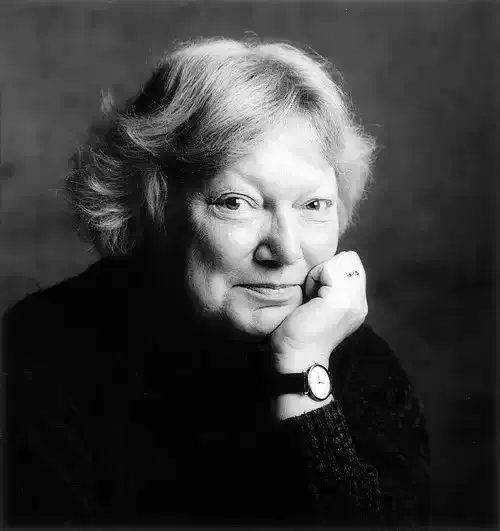
Inger Christensen
1935–2009
· lived 73 years
 DK
DK
DK
Inger Christensen was a Danish poet and essayist, known for her experimental and engaged poetry. Her work explores themes such as language, nature, existence, and the human condition, often using mathematical and scientific structures to organize her verses. She was a prominent figure in Scandinavian literature, with a production that spanned poetry, fiction, and essays, and which continues to be widely studied and admired for its originality and depth.
n. 1935-01-16, Vejle · m. 2009-01-02, Copenhaga
58
Views
Bio
Identification and basic context
Inger Christensen (1935-2009) was a prominent Danish poet, novelist, and essayist, widely recognized for her innovative and intellectually stimulating work. Pseudonyms or heteronyms were not a prominent feature of her career. She was born in Vejle, Denmark, and died in Copenhagen. Her family background placed her in the middle class of a society undergoing modernization, in a vibrant Danish cultural context open to international influences. Her nationality was Danish, and her primary writing language was Danish. The historical context in which she lived was the second half of the 20th century, marked by the Cold War, the emergence of social and environmental movements, and profound technological and cultural transformations.Childhood and education
Her childhood unfolded in a relatively stable family environment, but her youth was marked by events that would influence her worldview. She received a solid formal education, attending high school in Vejle and later studying Danish and English literature at the University of Aarhus, where she graduated in 1958. Her education was also significantly enriched by self-study and avid reading of a wide range of authors and schools of thought. Her early influences included European modernist poetry, existentialist philosophy, scientific studies (particularly biology and physics), and linguistic theories. She absorbed the lessons of poets like Rainer Maria Rilke, T.S. Eliot, and also the ideas of thinkers like Ludwig Wittgenstein. Significant events in her youth, such as World War II, although not directly experienced at a very young age, left a mark on the collective imagination and her sensitivity to the fragilities of human existence and the need for order.Literary career
Inger Christensen began her literary career relatively late, with the publication of her first collection of poems, "Detænkebord" (The Thinking Table), in 1969. Her literary evolution was marked by a continuous search for new forms of expression, exploring the relationship between language, science, and reality. Her work evolved from more restrained and introspective poems to more complex and ambitious structures, which integrated mathematical and natural systems. Her chronological work is punctuated by poetry collections that demonstrate this progression, including "Krydsild" (Crossfire, 1970), "Evighedsblomsten" (The Flower of Eternity, 1972), "Det (Det)" (It, 1979), and the acclaimed "Alfabet" (Alphabet, 1981). Her activity as a literary critic and essayist was also relevant, contributing reflections on poetry, language, and society.Work, style, and literary characteristics
Inger Christensen's major works include "Det" (It, 1979), a novel that explores the nature of existence and language in a fragmented way, and "Alfabet" (Alphabet, 1981), a poetic epic that uses the structure of the alphabet and mathematical sequences to address creation, destruction, and hope in a world threatened by nuclear war. Other important works are "Detær" (It is, 1969), "Krydsild" (Crossfire, 1970), "Evighedsblomsten" (The Flower of Eternity, 1972), and "Sommerfugledalen" (The Butterfly Valley, 1998), a cycle of sonnets. The dominant themes in her work are language as a means and limit of understanding, the relationship between humans and nature, the fragility of existence, memory, the ecological crisis, and the possibility of a new beginning. Her style is characterized by formal experimentation, the integration of scientific systems (such as the Fibonacci sequence in "Alphabet"), lexical precision, imagistic density, and an often reflective and elegiac, yet also hopeful, tone. She used free verse and more structured forms, such as the sonnet in "Sommerfugledalen". Her poetic voice is often personal and confessional, but it rises to a universal dimension by addressing existential and social issues. She introduced formal innovations by integrating mathematical and scientific structures into poetry, creating a bridge between the arts and sciences. Her work dialogues with the modernist tradition but projects it into a contemporary context of environmental and existential crisis. She is often associated with postmodernism and with poetry of an ecological and philosophical nature.Work, style, and literary characteristics
Cultural and historical context Inger Christensen lived in a period of intense social and political change, including the Cold War and the emergence of feminist and environmental movements. Her work, especially "Alphabet," reflects a deep concern with the nuclear threat and the increasingly evident ecological crisis. She engaged with other Scandinavian and European writers, participating in literary circles that debated the issues of the time. She was considered part of a generation of Danish writers seeking new forms of expression to address the complexity of the modern world. Her philosophical stance was marked by a profound awareness of the interconnectedness of all beings and the urgency of a new ecological ethic. The society and culture of the second half of the 20th century, with its technological optimism contrasting with the threat of annihilation, profoundly influenced her work, leading her to question the limits of human knowledge and action.Work, style, and literary characteristics
Personal life Inger Christensen's personal life, although not the primary focus of her work, is inseparable from her intellectual output. Her relationships, though not widely disclosed in detail, informed her sensitivity to human interconnectedness and vulnerability. Her friendships and interactions within the Danish literary scene shaped her professional path. Personal experiences and crises, although not explicitly detailed, may have contributed to the existential depth of her poetry. Christensen worked as a teacher and essayist, not living solely from her literary work. Her philosophical beliefs, deeply connected to ecology and the interconnectedness of life, informed her worldview and her writing. Her civic engagement manifested in her poetry, which often took on a tone of warning and reflection on the future of humanity and the planet.Work, style, and literary characteristics
Recognition and reception Inger Christensen achieved a prominent position in Danish and international literature, being considered one of the most important voices in contemporary poetry. She received several awards and distinctions throughout her career, including the Grand Prize of the Swedish Academy (1978), the Nordic Prize of the Swedish Academy (2004), and the Danish State Literary Prize. Her critical reception was consistently positive, both at the time and over time, recognizing the originality and relevance of her work. Her popularity extended beyond academic circles, reaching readers who identified with her existential and environmental concerns.Work, style, and literary characteristics
Influences and legacy Inger Christensen was influenced by a wide range of authors, including Rainer Maria Rilke, T.S. Eliot, Søren Kierkegaard, as well as by the natural sciences. Her work, in turn, influenced later generations of poets, especially in Scandinavia and Europe, particularly those interested in ecological poetry, formal experimentation, and the intersection between literature and science. Her impact on world literature is significant for her ability to address universal themes with innovative language and a profound awareness of the contemporary context. "Alphabet" is considered a landmark in 20th-century poetry. Her academic studies are numerous, with analyses dedicated to her mathematical structure, her ecological discourse, and her philosophical dimension. Her work has been widely translated into various languages, promoting its international dissemination.Work, style, and literary characteristics
Interpretation and critical analysis Inger Christensen's work offers multiple readings, from analyses focused on her mathematical and linguistic structure to interpretations that highlight her profound humanism and ecological commitment. Philosophically and existentially, her poetry interrogates the human relationship with the cosmos, nature, and language itself, questioning our capacity to understand and coexist harmoniously. "Alphabet," in particular, has been the subject of critical debate regarding its prophetic nature and its relevance as a call to action in a world in crisis.Work, style, and literary characteristics
Curiosities and lesser-known aspects Although known for her intellectual and structured approach, Inger Christensen possessed a deep sensibility and a unique ability to evoke the beauty and fragility of the natural world. Her writing habits involved rigorous discipline and deep immersion in the themes she explored, often resorting to long periods of research and reflection. Her approach to poetry, which integrated logic and mathematics, can be seen as an attempt to find order and meaning in a chaotic and fragmented world. Manuscripts and correspondence reveal her creative process, where experimentation and the search for the exact word were constant.Work, style, and literary characteristics
Death and memory Inger Christensen passed away in 2009, after a battle with cancer. Her death marked the end of an era in Danish and Scandinavian literature. Posthumous publications continued to disseminate her work and keep her memory alive, solidifying her place as one of the most important poetic voices of the 20th century.Poems
0No poems found
Comments (0)
Log in
to post a comment.
No comments yet. Be the first to comment.