Poems List

When The Fox Dies, His Skin Counts

When The Fox Dies, His Skin Counts

WE young people in the shade

Sat one sultry day;
Cupid came, and "Dies the Fox"
With us sought to play.
Each one of my friends then sat
By his mistress dear;


Cupid, blowing out the torch,
Said: "The taper's here!"
Then we quickly sent around
The expiring brand;


Each one put it hastily
ln his neighbour's hand.
Dorilis then gave it me,
With a scoffing jest;


Sudden into flame it broke,
By my fingers press'd.
And it singed my eyes and face,
Set my breast on fire;


Then above my head the blaze
Mounted ever higher.
Vain I sought to put it out;
Ever burned the flame;


Stead of dying, soon the Fox
Livelier still became.
304

Wedding Night

Wedding Night

Far from the feasting, in the bedroom
Sits loyal Amor and quakes with dread:
What if the guests become too zestful,
Break the peace of the bridal bed?
A mystical and holy shimmer
Flows from his pale flames of gold;
For you both a whirl of incense
Readies pleasures manifold.


How throbs your heart as chiming timepiece
Chases noisy guests away;
Any moment, lips you burn for
Nought will utter, nought gainsay.
You hasten with her to the temple,
There to consummate your bliss;
The guardian holds aloft his flambeau,
Still and small as a taper is.


How she trembles with your kisses,
Bosom, lips, and cheeks, and brow:
His severities are shivers,
Your derring-do is duty now.
Quick, Amor helps you undress her,
He has half your enterprise;
Roguish, then, but also modest,
He'll be closing both his eyes.
427

Welcome And Farewell

Welcome And Farewell

QUICK throbb'd my heart: to norse! haste, haste,

And lo! 'twas done with speed of light;
The evening soon the world embraced,
And o'er the mountains hung the night.


Soon stood, in robe of mist, the oak,


A tow'ring giant in his size,
Where darkness through the thicket broke,
And glared with hundred gloomy eyes.
From out a hill of clouds the moon
With mournful gaze began to peer:


The winds their soft wings flutter'd soon,


And murmur'd in mine awe-struck ear;
The night a thousand monsters made,
Yet fresh and joyous was my mind;


What fire within my veins then play'd!
What glow was in my bosom shrin'd!
I saw thee, and with tender pride
Felt thy sweet gaze pour joy on me;


While all my heart was at thy side.


And every breath I breath'd for thee.
The roseate hues that spring supplies
Were playing round thy features fair,


And love for me--ye Deities!
I hoped it, I deserved it ne'er!
But, when the morning sun return'd,
Departure filled with grief my heart:


Within thy kiss, what rapture burn'd!


But in thy look, what bitter smart!
I went--thy gaze to earth first roved
Thou follow'dst me with tearful eye:


And yet, what rapture to be loved!
And, Gods, to love--what ecstasy!
571

Valediction

Valediction


I ONCE was fond of fools,

And bid them come each day;
Then each one brought his tools
The carpenter to play;


The roof to strip first choosing,


Another to supply,
The wood as trestles using,
To move it by-and-by,


While here and there they ran,


And knock'd against each other;
To fret I soon began,
My anger could not smother,


So cried, "Get out, ye fools!"


At this they were offended
Then each one took his tools,
And so our friendship ended.
Since that, I've wiser been,
And sit beside my door;


When one of them is seen,


I cry, "Appear no more!"
"Hence, stupid knave!" I bellow:
At this he's angry too:


"You impudent old fellow!


And pray, sir, who are you?
Along the streets we riot,
And revel at the fair;


But yet we're pretty quiet,
And folks revile us ne'er.

Don't call us names, then, please!"--
At length I meet with ease,
For now they leave my door-


'Tis better than before!
362

Venetian Epigrams I

Venetian Epigrams I

Sarcophagi, urns, were all covered with lifelike scenes,
fauns dancing with girls from a Bacchanalian choir,
paired-off, goat-footed creatures puffing their cheeks,
forcing ear-splitting notes from the blaring horns.
Cymbals and drumbeats, the marble is seen and is heard.
How delightful the fruit in the beaks of fluttering birds!
No startling noise can scare them, or scare away love,
Amor, whose torch waves more gladly in this happy throng.
So fullness overcomes death, and the ashes within
seem still, in their silent house, to feel love’s delight.
So may the Poet’s sarcophagus be adorned,
with this book the writer has filled with the beauty of life.
405

Trilogy Of Passion 03 Atonement

Trilogy Of Passion 03 Atonement

PASSION brings reason--who can pacify

An anguish'd heart whose loss hath been so great?
Where are the hours that fled so swiftly by?
In vain the fairest thou didst gain from fate;


Sad is the soul, confused the enterprise;
The glorious world, how on the sense it dies!
In million tones entwined for evermore,
Music with angel-pinions hovers there,


To pierce man's being to its inmost core,
Eternal beauty has its fruit to bear;


The eye grows moist, in yearnings blest reveres
The godlike worth of music as of tears.
And so the lighten'd heart soon learns to see
That it still lives, and beats, and ought to beat,


Off'ring itself with joy and willingly,
In grateful payment for a gift so sweet.


And then was felt,--oh may it constant prove!--
The twofold bliss of music and of love.
360

Trilogy Of Passion 01 To Werther

Trilogy Of Passion 01 To Werther

ONCE more, then, much-wept shadow, thou dost dare

Boldly to face the day's clear light,
To meet me on fresh blooming meadows fair,


And dost not tremble at my sight.
Those happy times appear return'd once more.


When on one field we quaff'd refreshing dew,
And, when the day's unwelcome toils were o'er,


The farewell sunbeams bless'd our ravish'd view;
Fate bade thee go,--to linger here was mine,--
Going the first, the smaller loss was thine.


The life of man appears a glorious fate:
The day how lovely, and the night how great!
And we 'mid Paradise-like raptures plac'd,
The sun's bright glory scarce have learn'd to taste.


When strange contending feelings dimly cover,
Now us, and now the forms that round us hover;
One's feelings by no other are supplied,
'Tis dark without, if all is bright inside;
An outward brightness veils my sadden'd mood,
When Fortune smiles,--how seldom understood!
Now think we that we know her, and with might
A woman's beauteous form instils delight;
The youth, as glad as in his infancy,
The spring-time treads, as though the spring were he
Ravish'd, amazed, he asks, how this is done?
He looks around, the world appears his own.
With careless speed he wanders on through space,
Nor walls, nor palaces can check his race;
As some gay flight of birds round tree-tops plays,
So 'tis with him who round his mistress strays;
He seeks from AEther, which he'd leave behind him,
The faithful look that fondly serves to bind him.


Yet first too early warn'd, and then too late,
He feels his flight restrain'd, is captur'd straight
To meet again is sweet, to part is sad,
Again to meet again is still more glad,
And years in one short moment are enshrin'd;
But, oh, the harsh farewell is hid behind!


Thou smilest, friend, with fitting thoughts inspired;
By a dread parting was thy fame acquired,
Thy mournful destiny we sorrow'd o'er,
For weal and woe thou left'st us evermore,
And then again the passions' wavering force
Drew us along in labyrinthine course;


And we, consumed by constant misery,
At length must part--and parting is to die!
How moving is it, when the minstrel sings,
To 'scape the death that separation brings!
Oh grant, some god, to one who suffers so,
To tell, half-guilty, his sad tale of woe.
347

To The Moon

To The Moon

BUSH and vale thou fill'st again

With thy misty ray,
And my spirit's heavy chain
Castest far away.
Thou dost o'er my fields extend
Thy sweet soothing eye,


Watching like a gentle friend,
O'er my destiny.
Vanish'd days of bliss and woe
Haunt me with their tone,


Joy and grief in turns I know,
As I stray alone.
Stream beloved, flow on! flow on!
Ne'er can I be gay!


Thus have sport and kisses gone,
Truth thus pass'd away.
Once I seem'd the lord to be
Of that prize so fair!


Now, to our deep sorrow, we
Can forget it ne'er.
Murmur, stream, the vale along,
Never cease thy sighs;


Murmur, whisper to my song
Answering melodies!
When thou in the winter's night
Overflow'st in wrath,


Or in spring-time sparklest bright,
As the buds shoot forth.
He who from the world retires,
Void of hate, is blest;


Who a friend's true love inspires,
Leaning on his breast!
That which heedless man ne'er knew,
Or ne'er thought aright,


Roams the bosom's labyrinth through,
Boldly into night.
443

To The Husbandman

To The Husbandman

SMOOTHLY and lightly the golden seed by the furrow is cover'd;

Yet will a deeper one, friend, cover thy bones at the last.
Joyously plough'd and sow'd! Here food all living is budding,
E'en from the side of the tomb Hope will not vanish away.
368

To The Golden Heart That He Wore Around His Neck

To The Golden Heart That He Wore Around His Neck

OH thou token loved of joys now perish'd

That I still wear from my neck suspended,
Art thou stronger than our spirit-bond so cherish'd?
Or canst thou prolong love's days untimely ended?
Lily, I fly from thee! I still am doom'd to range


Thro' countries strange,


Thro' distant vales and woods, link'd on to thee!
Ah, Lily's heart could surely never fall
So soon away from me!
As when a bird bath broken from his thrall,
And seeks the forest green,


Proof of imprisonment he bears behind him,
A morsel of the thread once used to bind him;
The free-born bird of old no more is seen,
For he another's prey bath been.
243

Comments (0)

Log in to post a comment.

NoComments

Identification and basic context

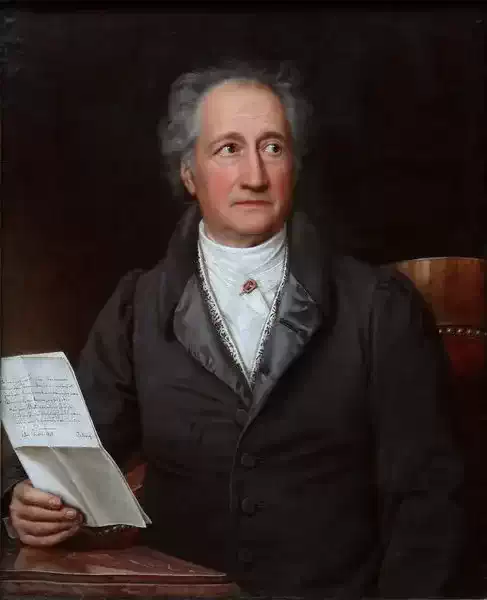
Johann Wolfgang von Goethe was a central figure in German literature and a polymath whose work spanned poetry, drama, novels, scientific inquiry, and political theory. Born into a prominent family in Frankfurt, he was a key figure of the Weimar Classicism movement. Goethe's writings are characterized by their depth, philosophical inquiry, and exploration of human nature, often infused with a blend of Romantic sensibility and Neoclassical form. He was also a minister of state in the Duchy of Weimar, demonstrating a profound engagement with civic and political life. His national and linguistic identity were deeply rooted in Germany, and his work was primarily written in German, though its impact transcended linguistic boundaries.

Childhood and education

Goethe received an excellent education, benefiting from private tutors and the intellectual stimulation of his household, which included his father's library. He was exposed to classical literature, languages, and the arts from an early age. His formal education included studies at the University of Leipzig and the University of Strasbourg, where he studied law but also delved into literature and alchemy. He was influenced by the burgeoning Sturm und Drang movement, which emphasized individual emotion and rebellion against artistic conventions, as well as by Enlightenment ideals and the rediscovery of classical antiquity. His early experiences and readings laid the foundation for his multifaceted literary and intellectual development.

Literary trajectory

Goethe's literary career began in his youth with the Sturm und Drang movement, marked by works like "The Sorrows of Young Werther." This period was characterized by intense emotional expression and a focus on individual experience. His move to Weimar marked a shift towards Weimar Classicism, characterized by a more balanced, harmonious, and ethically focused approach, exemplified by "Iphigenia in Tauris" and "Torquato Tasso." The creation of "Faust," which occupied him for much of his life, represents the apex of his philosophical and dramatic achievement, evolving through different phases and reflecting his mature contemplation of human existence. He was also actively involved in periodicals and collaborated with other writers, contributing significantly to the literary landscape of his time.

Works, style, and literary characteristics

Goethe's major works include the epistolary novel "The Sorrows of Young Werther" (1774), the dramas "Iphigenia in Tauris" (1787) and "Egmont" (1788), the novel "Wilhelm Meister's Apprenticeship" (1795-96), and his monumental dramatic poem "Faust" (Part I, 1808; Part II, 1832). His themes are vast, encompassing love, nature, science, art, religion, the human condition, and the pursuit of knowledge and self-realization. His style evolved from the passionate and individualistic Sturm und Drang to the balanced, formal elegance of Weimar Classicism, and later, a more complex, symbolic, and philosophical mode in "Faust Part II." He masterfully employed various forms, including lyric poetry, dramatic verse, and prose, often experimenting with meter and structure. His poetic voice ranged from intensely personal and lyrical to philosophical and universal. Goethe's language is rich, precise, and evocative, utilizing powerful imagery and rhetorical devices to explore profound ideas. He is credited with significant innovations in German literature, bridging Romanticism and Classicism, and profoundly influencing the development of the European novel and drama.

Cultural and historical context

Goethe lived through a period of immense upheaval in European history, including the French Revolution and the Napoleonic Wars, which profoundly shaped his worldview and writings. He was a central figure of the Weimar Classicism movement, alongside Friedrich Schiller, representing a peak of German cultural achievement during a time when Germany was politically fragmented. His engagement with Enlightenment thought, the rediscovery of Greek and Roman antiquity, and the rise of Romanticism placed him at the intersection of major intellectual currents. His positions in Weimar gave him insight into political affairs, and his work often reflected on societal structures, the role of the individual, and the nature of governance.

Personal life

Goethe's personal life was rich and complex. His relationships, particularly with Charlotte von Stein, had a significant impact on his emotional and creative life. His later relationship with Christiane Vulpius, whom he eventually married, brought him domestic stability. He maintained friendships with many leading intellectuals of his time, including Schiller and Herder, and also experienced literary rivalries. Goethe's scientific pursuits, particularly in botany and optics, were not merely academic but intertwined with his poetic vision, reflecting a holistic view of knowledge. His philosophical and spiritual beliefs evolved throughout his life, moving from a pantheistic view of nature to a more nuanced engagement with Christian themes, particularly in his later works.

Recognition and reception

Goethe achieved immense fame and recognition during his lifetime, both within Germany and internationally. He was revered as a literary genius and a national icon. His works were widely translated and admired, and he received numerous honors and distinctions. The reception of his work has remained consistently high, with "Faust" considered one of the greatest works of world literature. While he enjoyed immense popularity and academic respect during his life, his complex philosophical and literary achievements continue to be subjects of intensive scholarly study and critical analysis.

Influences and legacy

Goethe was influenced by a wide array of sources, including classical Greek and Roman literature, the Bible, Shakespeare, and the emerging Sturm und Drang and Enlightenment philosophies. His legacy is immeasurable; he profoundly influenced German literature and culture, shaping the development of Romanticism, Realism, and subsequent literary movements. His concepts, such as the "eternal feminine" in "Faust," and his exploration of the human drive for self-fulfillment, have resonated across generations. He is a cornerstone of the German literary canon and a globally recognized literary figure. His works have been translated into virtually every major language and have inspired countless adaptations in music, theater, and film.

Interpretation and critical analysis

Goethe's work, particularly "Faust," has been subjected to endless interpretation and critical analysis. Themes of good versus evil, the pursuit of knowledge, the nature of progress, and the relationship between the spiritual and material worlds are central to scholarly debate. His complex philosophical outlook, blending elements of Romanticism, Classicism, and humanism, continues to provoke discussion. The tension between individual freedom and societal responsibility, and the search for meaning in a complex world, remain enduring aspects of his critical legacy.

Curiosities and lesser-known aspects

Goethe's fascination with science extended to empirical studies, including his theory of colors, which, though controversial, demonstrated his rigorous approach to observation. His personal life contained elements of both conventionality and unconventionality; his long-term relationship with Christiane Vulpius, who came from a lower social class, was unusual for a man of his stature. He maintained a disciplined writing routine, often working in the early hours of the morning. Anecdotes abound about his charismatic presence and his ability to engage with people from all walks of life. His extensive correspondence provides invaluable insights into his thoughts and daily life.

Death and memory

Johann Wolfgang von Goethe died in Weimar at the age of 82. His death was a significant national event, marking the end of an era in German culture. His memory is celebrated through numerous institutions, monuments, and cultural events dedicated to his life and work. His literary and scientific contributions continue to be studied and revered, ensuring his enduring place in the annals of world culture. His collected works are vast and continue to be published and re-edited, testifying to his lasting impact.