Poems List

The Wedding Night

The Wedding Night

WITHIN the chamber, far away

From the glad feast, sits Love in dread
Lest guests disturb, in wanton play,
The silence of the bridal bed.


His torch's pale flame serves to gild


The scene with mystic sacred glow;
The room with incense-clouds is fil'd,
That ye may perfect rapture know.
How beats thy heart, when thou dost hear
The chime that warns thy guests to fly!


How glow'st thou for those lips so dear,


That soon are mute, and nought deny!
With her into the holy place
Thou hast'nest then, to perfect all;


The fire the warder's hands embrace,
Grows, like a night-light, dim and small.
How heaves her bosom, and how burns
Her face at every fervent kiss!


Her coldness now to trembling turns,


Thy daring now a duty is.
Love helps thee to undress her fast,
But thou art twice as fast as he;


And then he shuts both eye at last,
With sly and roguish modesty.
398

The Way To Behave

The Way To Behave

THOUGH tempers are bad and peevish folks swear,
Remember to ruffle thy brows, friend, ne'er;
And let not the fancies of women so fair
E'er serve thy pleasure in life to impair.
306

The Wanderer's Storm-Song

The Wanderer's Storm-Song

He whom thou ne'er leavest, Genius,
Feels no dread within his heart
At the tempest or the rain.
He whom thou ne'er leavest, Genius,
Will to the rain-clouds,
Will to the hailstorm,
Sing in reply
As the lark sings,
Oh thou on high!


Him whom thou ne'er leavest, Genius,
Thou wilt raise above the mud-track
With thy fiery pinions.
He will wander,
As, with flowery feet,
Over Deucalion's dark flood,
Python-slaying, light, glorious,
Pythius Apollo.


Him whom thou ne'er leavest, Genius,
Thou wilt place upon thy fleecy pinion
When he sleepeth on the rock,--
Thou wilt shelter with thy guardian wing
In the forest's midnight hour.


Him whom thou ne'er leavest, Genius,
Thou wilt wrap up warmly
In the snow-drift;
Tow'rd the warmth approach the Muses,
Tow'rd the warmth approach the Graces.


Ye Muses, hover round me!
Ye Graces also!
That is water, that is earth,
And the son of water and of earth
Over which I wander,
Like the gods.


Ye are pure, like the heart of the water,
Ye are pure like the marrow of earth,
Hov'ring round me, while I hover
Over water, o'er the earth
Like the gods.


Shall he, then, return,
The small, the dark, the fiery peasant?
Shall he, then, return, waiting
Only thy gifts, oh Father Bromius,
And brightly gleaming, warmth-spreading fire?
Return with joy?
And I, whom ye attended,
Ye Muses and ye Graces,


Whom all awaits that ye,
Ye Muses and ye Graces,
Of circling bliss in life
Have glorified--shall I
Return dejected?


Father Bromius!
Thourt the Genius,
Genius of ages,
Thou'rt what inward glow
To Pindar was,
What to the world
Phoebus Apollo.


Woe! Woe Inward warmth,
Spirit-warmth,
Central-point!
Glow, and vie with
Phoebus Apollo!
Coldly soon
His regal look
Over thee will swiftly glide,-


Envy-struck
Linger o'er the cedar's strength,
Which, to flourish,
Waits him not.


Why doth my lay name thee the last?
Thee, from whom it began,
Thee, in whom it endeth,
Thee, from whom it flows,
Jupiter Pluvius!
Tow'rd thee streams my song.
And a Castalian spring
Runs as a fellow-brook,
Runs to the idle ones,
Mortal, happy ones,
Apart from thee,
Who cov'rest me around,
Jupiter Pluvius!


Not by the elm-tree
Him didst thou visit,
With the pair of doves
Held in his gentle arm,--
With the beauteous garland of roses,--
Caressing him, so blest in his flowers,
Anacreon,
Storm-breathing godhead!
Not in the poplar grove,
Near the Sybaris' strand,


Not on the mountain's
Sun-illumined brow
Didst thou seize him,
The flower-singing,
Honey-breathing,
Sweetly nodding
Theocritus.


When the wheels were rattling,
Wheel on wheel tow'rd the goal,
High arose
The sound of the lash
Of youths with victory glowing,
In the dust rolling,
As from the mountain fall
Showers of stones in the vale--
Then thy soul was brightly glowing, Pindar--
Glowing? Poor heart!


There, on the hill,--
Heavenly might!
But enough glow
Thither to wend,
Where is my cot!
346

The Wanderer

The Wanderer

WANDERER.

YOUNG woman, may God bless thee,
Thee, and the sucking infant
Upon thy breast!
Let me, 'gainst this rocky wall,
Neath the elm-tree's shadow,
Lay aside my burden,
Near thee take my rest.


WOMAN.


What vocation leads thee,
While the day is burning,
Up this dusty path?
Bring'st thou goods from out the town
Round the country?
Smil'st thou, stranger,
At my question?


WANDERER.


From the town no goods I bring.
Cool is now the evening;
Show to me the fountain
'Whence thou drinkest,
Woman young and kind!


WOMAN.


Up the rocky pathway mount;
Go thou first! Across the thicket
Leads the pathway tow'rd the cottage
That I live in,
To the fountain
Whence I drink.


WANDERER.


Signs of man's arranging hand
See I 'mid the trees!
Not by thee these stones were join'd,
Nature, who so freely scatterest!


WOMAN.


Up, still up!


WANDERER.


Lo, a mossy architrave is here!
I discern thee, fashioning spirit!


On the stone thou hast impress'd thy seal.
WOMAN.
Onward, stranger!
WANDERER.
Over an inscription am I treading!


'Tis effaced!
Ye are seen no longer,
Words so deeply graven,
Who your master's true devotion
Should have shown to thousand grandsons!


WOMAN.
At these stones, why
Start'st thou, stranger?


Many stones are lying yonder
Round my cottage.
WANDERER.
Yonder?
WOMAN.
Through the thicket,


Turning to the left,
Here!
WANDERER.
Ye Muses and ye Graces!
WOMAN.
This, then, is my cottage.
WANDERER.
'Tis a ruin'd temple!


WOMAN.
Just below it, see,
Springs the fountain
Whence I drink.


WANDERER.


Thou dost hover
O'er thy grave, all glowing,
Genius! while upon thee
Hath thy master-piece
Fallen crumbling,
Thou Immortal One!


WOMAN.


Stay, a cup I'll fetch thee
Whence to drink.


WANDERER.


Ivy circles thy slender
Form so graceful and godlike.
How ye rise on high
From the ruins,
Column-pair
And thou, their lonely sister yonder,--
How thou,
Dusky moss upon thy sacred head,--
Lookest down in mournful majesty
On thy brethren's figures
Lying scatter'd
At thy feet!
In the shadow of the bramble
Earth and rubbish veil them,
Lofty grass is waving o'er them
Is it thus thou, Nature, prizest
Thy great masterpiece's masterpiece?
Carelessly destroyest thou
Thine own sanctuary,
Sowing thistles there?


WOMAN.


How the infant sleeps!
Wilt thou rest thee in the cottage,
Stranger? Wouldst thou rather
In the open air still linger?
Now 'tis cool! take thou the child
While I go and draw some water.
Sleep on, darling! sleep!


WANDERER.


Sweet is thy repose!
How, with heaven-born health imbued,
Peacefully he slumbers!
Oh thou, born among the ruins
Spread by great antiquity,


On thee rest her spirit!
He whom it encircles
Will, in godlike consciousness,
Ev'ry day enjoy.
Full, of germ, unfold,
As the smiling springtime's
Fairest charm,
Outshining all thy fellows!
And when the blossom's husk is faded,
May the full fruit shoot forth
From out thy breast,
And ripen in the sunshine!


WOMAN.


God bless him!--Is he sleeping still?
To the fresh draught I nought can add,
Saving a crust of bread for thee to eat.


WANDERER.


I thank thee well.
How fair the verdure all around!
How green!


WOMAN.


My husband soon
Will home return
From labour. Tarry, tarry, man,
And with us eat our evening meal.


WANDERER.


Is't here ye dwell?


WOMAN.


Yonder, within those walls we live.
My father 'twas who built the cottage
Of tiles and stones from out the ruins.
'Tis here we dwell.
He gave me to a husbandman,
And in our arms expired.--
Hast thou been sleeping, dearest heart
How lively, and how full of play!
Sweet rogue!


WANDERER.


Nature, thou ever budding one,
Thou formest each for life's enjoyments,


And, like a mother, all thy children dear,
Blessest with that sweet heritage,--a home
The swallow builds the cornice round,
Unconscious of the beauties
She plasters up.
The caterpillar spins around the bough,
To make her brood a winter house;
And thou dost patch, between antiquity's
Most glorious relics,
For thy mean use,
Oh man, a humble cot,--
Enjoyest e'en mid tombs!--
Farewell, thou happy woman!


WOMAN.


Thou wilt not stay, then?


WANDERER.


May God preserve thee,
And bless thy boy!


WOMAN.


A happy journey!


WANDERER.


Whither conducts the path
Across yon hill?


WOMAN.


To Cuma.


WANDERER.


How far from hence?


WOMAN.


'Tis full three miles.


WANDERER.


Farewell!
Oh Nature, guide me on my way!
The wandering stranger guide,
Who o'er the tombs
Of holy bygone times
Is passing,


To a kind sheltering place,
From North winds safe,
And where a poplar grove
Shuts out the noontide ray!
And when I come
Home to my cot
At evening,
Illumined by the setting sun,
Let me embrace a wife like this,
Her infant in her arms!
298

The Visit

The Visit

FAIN had I to-day surprised my mistress,
But soon found I that her door was fasten'd.
Yet I had the key safe in my pocket,
And the darling door I open'd softly!
In the parlour found I not the maiden,
Found the maiden not within her closet,
Then her chamber-door I gently open'd,
When I found her wrapp'd in pleasing slumbers,
Fully dress'd, and lying on the sofa.


While at work had slumber stolen o'er her;
For her knitting and her needle found I
Resting in her folded bands so tender;
And I placed myself beside her softly,
And held counsel, whether I should wake her.


Then I looked upon the beauteous quiet
That on her sweet eyelids was reposing
On her lips was silent truth depicted,
On her cheeks had loveliness its dwelling,
And the pureness of a heart unsullied
In her bosom evermore was heaving.
All her limbs were gracefully reclining,
Set at rest by sweet and godlike balsam.
Gladly sat I, and the contemplation
Held the strong desire I felt to wake her
Firmer and firmer down, with mystic fetters.


"Oh, thou love," methought, "I see that slumber,
Slumber that betrayeth each false feature,
Cannot injure thee, can nought discover
That could serve to harm thy friend's soft feelings.


"Now thy beauteous eyes are firmly closed,
That, when open, form mine only rapture.
And thy sweet lips are devoid of motion,
Motionless for speaking or for kissing;
Loosen'd are the soft and magic fetters
Of thine arms, so wont to twine around me,
And the hand, the ravishing companion
Of thy sweet caresses, lies unmoving.
Were my thoughts of thee but based on error,
Were the love I bear thee self-deception,
I must now have found it out, since Amor
Is, without his bandage, placed beside me."


Long I sat thus, full of heartfelt pleasure
At my love, and at her matchless merit;
She had so delighted me while slumbering,
That I could not venture to awake her.


Then I on the little table near her


Softly placed two oranges, two roses;
Gently, gently stole I from her chamber.
When her eyes the darling one shall open,
She will straightway spy these colourd presents,
And the friendly gift will view with wonder,
For the door will still remain unopen'd.


If perchance I see to-night the angel,
How will she rejoice,--reward me doubly
For this sacrifice of fond affection!
574

The Traveller And The Farm-Maiden

The Traveller And The Farm-Maiden

HE.
CANST thou give, oh fair and matchless maiden,
'Neath the shadow of the lindens yonder,--
Where I'd fain one moment cease to wander,--


Food and drink to one so heavy laden?
SHE.
Wouldst thou find refreshment, traveller weary,
Bread, ripe fruit and cream to meet thy wishes,--
None but Nature's plain and homely dishes,--


Near the spring may soothe thy wanderings dreary.
HE.
Dreams of old acquaintance now pass through me,
Ne'er-forgotten queen of hours of blisses.
Likenesses I've often found, but this is


One that quite a marvel seemeth to me!
SHE.
Travellers often wonder beyond measure,
But their wonder soon see cause to smother;
Fair and dark are often like each other,


Both inspire the mind with equal pleasure.
HE.
Not now for the first time I surrender
To this form, in humble adoration;
It was brightest midst the constellation


In the hail adorn'd with festal splendour.
SHE.
Be thou joyful that 'tis in my power
To complete thy strange and merry story!
Silks behind her, full of purple glory,


Floated, when thou saw'st her in that hour.
HE.
No, in truth, thou hast not sung it rightly!
Spirits may have told thee all about it;
Pearls and gems they spoke of, do not doubt it,--


By her gaze eclipsed,--it gleam'd so brightly!
SHE.
This one thing I certainly collected:
That the fair one--(say nought, I entreat thee!)
Fondly hoping once again to meet thee,


Many a castle in the air erected.
HE.
By each wind I ceaselessly was driven,
Seeking gold and honour, too, to capture!
When my wand'rings end, then oh, what rapture,


If to find that form again 'tis given!
SHE.
'Tis the daughter of the race now banish'd
That thou seest, not her likeness only;
Helen and her brother, glad though lonely,


Till this farm of their estate now vanish'd.
HE.
But the owner surely is not wanting
Of these plains, with ev'ry beauty teeming?
Verdant fields, broad meads, and pastures gleaming,


Gushing springs, all heav'nly and enchanting.
SHE.
Thou must hunt the world through, wouldst thou find him!--
We have wealth enough in our possession,


And intend to purchase the succession,
When the good man leaves the world behind him.
HE.
I have learnt the owner's own condition,


And, fair maiden, thou indeed canst buy it;
But the cost is great, I won't deny it,--
Helen is the price,--with thy permission!


SHE.
Did then fate and rank keep us asunder,
And must Love take this road, and no other?
Yonder comes my dear and trusty brother;


What will he say to it all, I wonder?
342

The Unequal Marriage

The Unequal Marriage

EVEN this heavenly pair were unequally match'd when united:
Psyche grew older and wise, Amor remain'd still a child,
289

The Spring Oracle

The Spring Oracle

OH prophetic bird so bright,
Blossom-songster, cuckoo bight!
In the fairest time of year,
Dearest bird, oh! deign to hear
What a youthful pair would pray,
Do thou call, if hope they may:
Thy cuck-oo, thy cuck-oo.
Ever more cuck-oo, cuck-oo!


Hearest thou? A loving pair
Fain would to the altar fare;
Yes! a pair in happy youth,
Full of virtue, full of truth.
Is the hour not fix'd by fate?
Say, how long must they still wait?
Hark! cuck-oo! hark! cuck-oo!
Silent yet! for shame, cuck-oo!


'Tis not our fault, certainly!
Only two years patient be!
But if we ourselves please here,
Will pa-pa-papas appear?
Know that thou'lt more kindness do us,
More thou'lt prophesy unto us.
One! cuck-oo! Two! cuck-oo!
Ever, ever, cuck-oo, cuck-oo, coo!


If we've calculated clearly,
We have half a dozen nearly.
If good promises we'll give,
Wilt thou say how long we'II live?
Truly, we'll confess to thee,
We'd prolong it willingly.
Coo cuck-oo, coo cuck-oo,
Coo, coo, coo, coo, coo, coo, coo, coo, coo!


Life is one continued feast-(
If we keep no score, at least).
If now we together dwell,
Will true love remain as well?
For if that should e'er decay,
Happiness would pass away.
Coo cuck-oo, coo cuck-oo,
Coo, coo, coo, coo, coo, coo, coo, coo, coo!
398

The Spinner

The Spinner

As I calmly sat and span,

Toiling with all zeal,
Lo! a young and handsome man
Pass'd my spinning-wheel.
And he praised,--what harm was there?--
Sweet the things he said--


Praised my flax-resembling hair,
And the even thread.
He with this was not content,
But must needs do more;


And in twain the thread was rent,
Though 'twas safe before.
And the flax's stonelike weight
Needed to be told;


But no longer was its state
Valued as of old.
When I took it to the weaver,
Something felt I start,


And more quickly, as with fever,
Throbb'd my trembling heart.
Then I bear the thread at length
Through the heat, to bleach;


But, alas, I scarce have strength
To the pool to reach.
What I in my little room
Span so fine and slight,--


As was likely. I presume--
Came at last to light.
400

The Same

The Same

HUSH'D on the hill
Is the breeze;
Scarce by the zephyr
The trees
Softly are press'd;

The woodbird's asleep on the bough.
Wait, then, and thou
Soon wilt find rest.
366

Comments (0)

Log in to post a comment.

NoComments

Identification and basic context

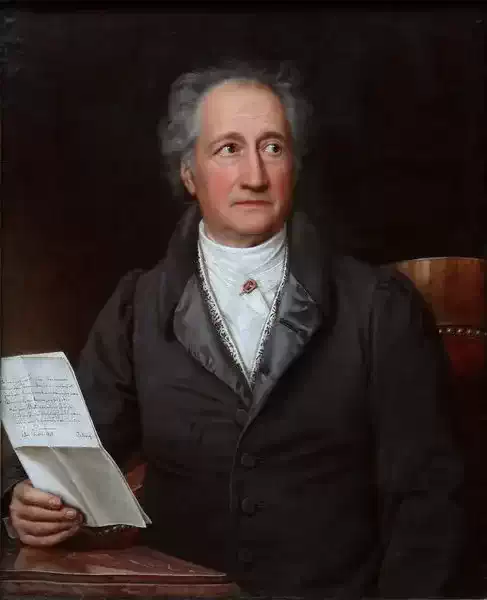
Johann Wolfgang von Goethe was a central figure in German literature and a polymath whose work spanned poetry, drama, novels, scientific inquiry, and political theory. Born into a prominent family in Frankfurt, he was a key figure of the Weimar Classicism movement. Goethe's writings are characterized by their depth, philosophical inquiry, and exploration of human nature, often infused with a blend of Romantic sensibility and Neoclassical form. He was also a minister of state in the Duchy of Weimar, demonstrating a profound engagement with civic and political life. His national and linguistic identity were deeply rooted in Germany, and his work was primarily written in German, though its impact transcended linguistic boundaries.

Childhood and education

Goethe received an excellent education, benefiting from private tutors and the intellectual stimulation of his household, which included his father's library. He was exposed to classical literature, languages, and the arts from an early age. His formal education included studies at the University of Leipzig and the University of Strasbourg, where he studied law but also delved into literature and alchemy. He was influenced by the burgeoning Sturm und Drang movement, which emphasized individual emotion and rebellion against artistic conventions, as well as by Enlightenment ideals and the rediscovery of classical antiquity. His early experiences and readings laid the foundation for his multifaceted literary and intellectual development.

Literary trajectory

Goethe's literary career began in his youth with the Sturm und Drang movement, marked by works like "The Sorrows of Young Werther." This period was characterized by intense emotional expression and a focus on individual experience. His move to Weimar marked a shift towards Weimar Classicism, characterized by a more balanced, harmonious, and ethically focused approach, exemplified by "Iphigenia in Tauris" and "Torquato Tasso." The creation of "Faust," which occupied him for much of his life, represents the apex of his philosophical and dramatic achievement, evolving through different phases and reflecting his mature contemplation of human existence. He was also actively involved in periodicals and collaborated with other writers, contributing significantly to the literary landscape of his time.

Works, style, and literary characteristics

Goethe's major works include the epistolary novel "The Sorrows of Young Werther" (1774), the dramas "Iphigenia in Tauris" (1787) and "Egmont" (1788), the novel "Wilhelm Meister's Apprenticeship" (1795-96), and his monumental dramatic poem "Faust" (Part I, 1808; Part II, 1832). His themes are vast, encompassing love, nature, science, art, religion, the human condition, and the pursuit of knowledge and self-realization. His style evolved from the passionate and individualistic Sturm und Drang to the balanced, formal elegance of Weimar Classicism, and later, a more complex, symbolic, and philosophical mode in "Faust Part II." He masterfully employed various forms, including lyric poetry, dramatic verse, and prose, often experimenting with meter and structure. His poetic voice ranged from intensely personal and lyrical to philosophical and universal. Goethe's language is rich, precise, and evocative, utilizing powerful imagery and rhetorical devices to explore profound ideas. He is credited with significant innovations in German literature, bridging Romanticism and Classicism, and profoundly influencing the development of the European novel and drama.

Cultural and historical context

Goethe lived through a period of immense upheaval in European history, including the French Revolution and the Napoleonic Wars, which profoundly shaped his worldview and writings. He was a central figure of the Weimar Classicism movement, alongside Friedrich Schiller, representing a peak of German cultural achievement during a time when Germany was politically fragmented. His engagement with Enlightenment thought, the rediscovery of Greek and Roman antiquity, and the rise of Romanticism placed him at the intersection of major intellectual currents. His positions in Weimar gave him insight into political affairs, and his work often reflected on societal structures, the role of the individual, and the nature of governance.

Personal life

Goethe's personal life was rich and complex. His relationships, particularly with Charlotte von Stein, had a significant impact on his emotional and creative life. His later relationship with Christiane Vulpius, whom he eventually married, brought him domestic stability. He maintained friendships with many leading intellectuals of his time, including Schiller and Herder, and also experienced literary rivalries. Goethe's scientific pursuits, particularly in botany and optics, were not merely academic but intertwined with his poetic vision, reflecting a holistic view of knowledge. His philosophical and spiritual beliefs evolved throughout his life, moving from a pantheistic view of nature to a more nuanced engagement with Christian themes, particularly in his later works.

Recognition and reception

Goethe achieved immense fame and recognition during his lifetime, both within Germany and internationally. He was revered as a literary genius and a national icon. His works were widely translated and admired, and he received numerous honors and distinctions. The reception of his work has remained consistently high, with "Faust" considered one of the greatest works of world literature. While he enjoyed immense popularity and academic respect during his life, his complex philosophical and literary achievements continue to be subjects of intensive scholarly study and critical analysis.

Influences and legacy

Goethe was influenced by a wide array of sources, including classical Greek and Roman literature, the Bible, Shakespeare, and the emerging Sturm und Drang and Enlightenment philosophies. His legacy is immeasurable; he profoundly influenced German literature and culture, shaping the development of Romanticism, Realism, and subsequent literary movements. His concepts, such as the "eternal feminine" in "Faust," and his exploration of the human drive for self-fulfillment, have resonated across generations. He is a cornerstone of the German literary canon and a globally recognized literary figure. His works have been translated into virtually every major language and have inspired countless adaptations in music, theater, and film.

Interpretation and critical analysis

Goethe's work, particularly "Faust," has been subjected to endless interpretation and critical analysis. Themes of good versus evil, the pursuit of knowledge, the nature of progress, and the relationship between the spiritual and material worlds are central to scholarly debate. His complex philosophical outlook, blending elements of Romanticism, Classicism, and humanism, continues to provoke discussion. The tension between individual freedom and societal responsibility, and the search for meaning in a complex world, remain enduring aspects of his critical legacy.

Curiosities and lesser-known aspects

Goethe's fascination with science extended to empirical studies, including his theory of colors, which, though controversial, demonstrated his rigorous approach to observation. His personal life contained elements of both conventionality and unconventionality; his long-term relationship with Christiane Vulpius, who came from a lower social class, was unusual for a man of his stature. He maintained a disciplined writing routine, often working in the early hours of the morning. Anecdotes abound about his charismatic presence and his ability to engage with people from all walks of life. His extensive correspondence provides invaluable insights into his thoughts and daily life.

Death and memory

Johann Wolfgang von Goethe died in Weimar at the age of 82. His death was a significant national event, marking the end of an era in German culture. His memory is celebrated through numerous institutions, monuments, and cultural events dedicated to his life and work. His literary and scientific contributions continue to be studied and revered, ensuring his enduring place in the annals of world culture. His collected works are vast and continue to be published and re-edited, testifying to his lasting impact.