Poems List

To The Chosen One

To The Chosen One

HAND in hand! and lip to lip!

Oh, be faithful, maiden dear!
Fare thee well! thy lover's ship
Past full many a rock must steers


But should he the haven see,


When the storm has ceased to break,
And be happy, reft of thee,--
May the Gods fierce vengeance take!
Boldly dared is well nigh won!
Half my task is solved aright;


Ev'ry star's to me a sun,


Only cowards deem it night.
Stood I idly by thy side,
Sorrow still would sadden me;


But when seas our paths divide,
Gladly toil I,--toil for thee!
Now the valley I perceive,
Where together we will go,


And the streamlet watch each eve,


Gliding peacefully below
Oh, the poplars on yon spot!
Oh, the beech trees in yon grove!


And behind we'll build a cot,
Where to taste the joys of love!
326

To My Friend - Ode II

To My Friend - Ode II

THOU go'st! I murmur--
Go! let me murmur.
Oh, worthy man,
Fly from this land!


Deadly marshes,
Steaming mists of October
Here interweave their currents,
Blending for ever.


Noisome insects
Here are engender'd;
Fatal darkness
Veils their malice.


The fiery-tongued serpent,
Hard by the sedgy bank,
Stretches his pamper'd body,
Caress'd by the sun's bright beams.


Tempt no gentle night-rambles
Under the moon's cold twilight!
Loathsome toads hold their meetings
Yonder at every crossway.


Injuring not,
Fear will they cause thee.
Oh, worthy man,
Fly from this land!
364

To Mignon

To Mignon

OVER vale and torrent far
Rolls along the sun's bright car.
Ah! he wakens in his course

Mine, as thy deep-seated smart

In the heart.
Ev'ry morning with new force.
Scarce avails night aught to me;


E'en the visions that I see
Come but in a mournful guise;

And I feel this silent smart
In my heart
With creative pow'r arise.

During many a beauteous year
I have seen ships 'neath me steer,
As they seek the shelt'ring bay;


But, alas, each lasting smart


In my heart
Floats not with the stream away.
I must wear a gala dress,


Long stored up within my press,
For to-day to feasts is given;

None know with what bitter smart
Is my heart
Fearfully and madly riven.

Secretly I weep each tear,
Yet can cheerful e'en appear,
With a face of healthy red;

For if deadly were this silent smart

In my heart,
Ah, I then had long been dead!
THE MOUNTAIN CASTLE.
THERE stands on yonder high mountain
A castle built of yore,


Where once lurked horse and horseman


In rear of gate and of door.
Now door and gate are in ashes,
And all around is so still;


And over the fallen ruins
I clamber just as I will.
Below once lay a cellar,
With costly wines well stor'd;


No more the glad maid with her pitcher
Descends there to draw from the hoard.
No longer the goblet she places
Before the guests at the feast;


The flask at the meal so hallow'd
No longer she fills for the priest.
No more for the eager squire
The draught in the passage is pour'd;


No more for the flying present
Receives she the flying reward.
For all the roof and the rafters,
They all long since have been burn'd,


And stairs and passage and chapel
To rubbish and ruins are turn'd.
Yet when with lute and with flagon,
When day was smiling and bright,


I've watch'd my mistress climbing
To gain this perilous height,
Then rapture joyous and radiant
The silence so desolate brake,


And all, as in days long vanish'd,
Once more to enjoyment awoke;
As if for guests of high station


The largest rooms were prepared;
As if from those times so precious
A couple thither had fared;


As if there stood in his chapel
The priest in his sacred dress,
And ask'd: "Would ye twain be united?"


And we, with a smile, answer'd, "Yes!"
And songs that breath'd a deep feeling,
That touched the heart's innermost chord,


The music-fraught mouth of sweet echo,
Instead of the many, outpour'd.
And when at eve all was hidden
In silence unbroken and deep,


The glowing sun then look'd upwards,
And gazed on the summit so steep.
And squire and maiden then glitter'd
As bright and gay as a lord,


She seized the time for her present,
And he to give her reward.
498

To Lina

To Lina

SHOULD these songs, love, as they fleet,

Chance again to reach thy hand,
At the piano take thy seat,
Where thy friend was wont to stand!
Sweep with finger bold the string,
Then the book one moment see:


But read not! do nought but sing!
And each page thine own will be!
Ah, what grief the song imparts
With its letters, black on white,


That, when breath'd by thee, our hearts
Now can break and now delight!
282

To His Coy One

To His Coy One

SEEST thou yon smiling Orange?
Upon the tree still hangs it;
Already March bath vanish'd,
And new-born flow'rs are shooting.
I draw nigh to the tree then,
And there I say: Oh Orange,
Thou ripe and juicy Orange,
Thou sweet and luscious Orange,
I shake the tree, I shake it,
Oh fall into my lap!
349

Three Palinodias - 03 Rain And Rainbow

Three Palinodias - 03 Rain And Rainbow

DURING a heavy storm it chanced
That from his room a cockney glanced
At the fierce tempest as it broke,
While to his neighbour thus he spoke:
"The thunder has our awe inspired,
Our barns by lightning have been fired,--
Our sins to punish, I suppose;
But in return, to soothe our woes,
See how the rain in torrents fell,
Making the harvest promise well!
But it's a rainbow that I spy
Extending o'er the dark-grey sky?
With it I'm sure we may dispense,
The colour'd cheat! The vain pretence!"
Dame Iris straightway thus replied:
"Dost dare my beauty to deride?
In realms of space God station'd me
A type of better worlds to be
To eyes that from life's sorrows rove
In cheerful hope to Heav'n above,
And, through the mists that hover here
God and his precepts blest revere.
Do thou, then, grovel like the swine,
And to the ground thy snout confine,
But suffer the enlighten'd eye
To feast upon my majesty."
403

To Charlotte

To Charlotte

'MIDST the noise of merriment and glee,

'Midst full many a sorrow, many a care,
Charlotte, I remember, we remember thee,
How, at evening's hour so fair,

Thou a kindly hand didst reach us,
When thou, in some happy place
Where more fair is Nature s face,
Many a lightly-hidden trace


Of a spirit loved didst teach us.
Well 'tis that thy worth I rightly knew,--
That I, in the hour when first we met,
While the first impression fill'd me yet,


Call'd thee then a girl both good and true.
Rear'd in silence, calmly, knowing nought,
On the world we suddenly are thrown;


Hundred thousand billows round us sport;


All things charm us--many please alone,
Many grieve us, and as hour on hour is stealing,
To and fro our restless natures sway;


First we feel, and then we find each feeling
By the changeful world-stream borne away.
Well I know, we oft within us find
Many a hope and many a smart.


Charlotte, who can know our mind?


Charlotte, who can know our heart?
Ah! 'twould fain be understood, 'twould fain o'erflow
In some creature's fellow-feelings blest,


And, with trust, in twofold measure know
All the grief and joy in Nature's breast.
Then thine eye is oft around thee cast,
But in vain, for all seems closed for ever.

Thus the fairest part of life is madly pass'd


Free from storm, but resting never:

To thy sorrow thou'rt to-day repell'd
By what yesterday obey'd thee.
Can that world by thee be worthy held

Which so oft betray'd thee?
Which, 'mid all thy pleasures and thy pains,
Lived in selfish, unconcern'd repose?


See, the soul its secret cells regains,


And the heart--makes haste to close.
Thus found I thee, and gladly went to meet thee;
"She's worthy of all love!" I cried,


And pray'd that Heaven with purest bliss might greet thee,
Which in thy friend it richly hath supplied.
397

Three Palinodias - 01

Three Palinodias - 01

"Incense is hut a tribute for the gods,--
To mortals 'tis but poison."

THE smoke that from thine altar blows,
Can it the gods offend?
For I observe thou hold'st thy nose--


Pray what does this portend?


Mankind deem incense to excel
Each other earthly thing,
So he that cannot bear its smell,


No incense e'er should bring.
With unmoved face by thee at least
To dolls is homage given;


If not obstructed by the priest,
The scent mounts up to heaven.
354

Thoughts On Jesus Christ's Decent Into Hell

Thoughts On Jesus Christ's Decent Into Hell

WHAT wondrous noise is heard around!
Through heaven exulting voices sound,


A mighty army marches on
By thousand millions follow'd, lo,
To yon dark place makes haste to go


God's Son, descending from His throne!
He goes--the tempests round Him break,


As Judge and Hero cometh He;
He goes--the constellations quake,
The sun, the world quake fearfully.


I see Him in His victor-car,
On fiery axles borne afar,


Who on the cross for us expired.
The triumph to yon realms He shows,--
Remote from earth, where star ne'er glows,


The triumph He for us acquired.
He cometh, Hell to extirpate,


Whom He, by dying, wellnigh kill'd;
He shall pronounce her fearful fate
Hark! now the curse is straight fulfill'd.


Hell sees the victor come at last,
She feels that now her reign is past,


She quakes and fears to meet His sight;
She knows His thunders' terrors dread,
In vain she seeks to hide her head,


Attempts to fly, but vain is flight;
Vainly she hastes to 'scape pursuit


And to avoid her Judge's eye;
The Lord's fierce wrath restrains her foot
Like brazen chains,--she cannot fly.


Here lies the Dragon, trampled down,
He lies, and feels God's angry frown,


He feels, and grinneth hideously;
He feels Hell's speechless agonies,
A thousand times he howls and sighs:


"Oh, burning flames! quick, swallow me!"
There lies he in the fiery waves,


By torments rack'd and pangs infernal,
Instant annihilation craves,
And hears, those pangs will be eternal.


Those mighty squadrons, too, are here,
The partners of his cursed career,


Yet far less bad than he were they.
Here lies the countless throng combined,
In black and fearful crowds entwined,


While round him fiery tempests play;
He sees how they the Judge avoid,


He sees the storm upon them feed,
Yet is not at the sight o'erjoy'd,
Because his pangs e'en theirs exceed.


The Son of Man in triumph passes
Down to Hell's wild and black morasses,


And there unfolds His majesty.
Hell cannot bear the bright array,
For, since her first created day.


Darkness alone e'er govern'd she.
She lay remote from ev'ry light


With torments fill'd in Chaos here;
God turn'd for ever from her sight
His radiant features' glory clear.


Within the realms she calls her own,
She sees the splendour of the Son,


His dreaded glories shining forth;
She sees Him clad in rolling thunder,
She sees the rocks all quake with wonder,


When God before her stands in wrath.
She sees He comes her Judge to be,


She feels the awful pangs inside her,
Herself to slay endeavours she,
But e'en this comfort is denied her.


Now looks she back, with pains untold,
Upon those happy times of old,


When those glories gave her joy;
When yet her heart revered the truth,
When her glad soul, in endless youth


And rapture dwelt, without alloy.
She calls to mind with madden'd thought


How over man her wiles prevail'd;
To take revenge on God she sought,
And feels the vengeance it entail'd.


God was made man, and came to earth.
Then Satan cried with fearful mirth:


"E'en He my victim now shall be!"
He sought to slay the Lord Most High,
The world's Creator now must die;


But, Satan, endless woe to thee!
Thou thought'st to overcome Him then,


Rejoicing in His suffering;
But he in triumph comes again
To bind thee: Death! where is thy sting?


Speak, Hell! where is thy victory?
Thy power destroy'd and scatter'd see!


Know'st thou not now the Highest's might?
See, Satan, see thy rule o'erthrown!


By thousand-varying pangs weigh'd down,
Thou dwell'st in dark and endless night.


As though by lightning struck thou liest,
No gleam of rapture far or wide;


In vain! no hope thou there decriest,--
For me alone Messiah died!


A howling rises through the air,
A trembling fills each dark vault there,


When Christ to Hell is seen to come.
She snarls with rage, but needs must cower
Before our mighty hero's power;


He signs--and Hell is straightway dumb.
Before his voice the thunders break,


On high His victor-banner blows;
E'en angels at His fury quake,
When Christ to the dread judgment goes.


Now speaks He, and His voice is thunder,


He speaks, the rocks are rent in sunder,


His breath is like devouring flames.
Thus speaks He: "Tremble, ye accurs'd!
He who from Eden hurl'd you erst,


Your kingdom's overthrow proclaims.
Look up! My children once were ye,


Your arms against Me then ye turn'd,
Ye fell, that ye might sinners be,
Ye've now the wages that ye earn'd.


"My greatest foeman from that day,
Ye led my dearest friends astray,--


As ye had fallen, man must fall.
To kill him evermore ye sought,
'They all shall die the death,' ye thought;


But howl! for Me I won them all.
For them alone did I descend,


For them pray'd, suffer'd, perish'd I.
Ye ne'er shall gain your wicked end;
Who trusts in Me shall never die.


"In endless chains here lie ye now,
Nothing can save you from the slough.


Not boldness, not regret for crime.
Lie, then, and writhe in brimstone fire!
'Twas ye yourselves drew down Mine ire,


Lie and lament throughout all time!
And also ye, whom I selected,


E'en ye forever I disown,
For ye My saving grace rejected
Ye murmur? blame yourselves alone!


"Ye might have lived with Me in bliss,
For I of yore had promis'd this;


Ye sinn'd, and all My precepts slighted
Wrapp'd in the sleep of sin ye dwelt,
Now is My fearful judgment felt,


By a just doom your guilt requited."--
Thus spake He, and a fearful storm


From Him proceeds, the lightnings glow,


The thunders seize each wicked form,
And hurl them in the gulf below.


The God-man closeth Hell's sad doors,
In all His majesty He soars


From those dark regions back to light.
He sitteth at the Father's side;
Oh, friends, what joy doth this betide!


For us, for us He still will fight!
The angels sacred quire around


Rejoice before the mighty Lord,
So that all creatures hear the sound:
"Zebaoth's God be aye ador'd!"
291

The Yelpers

The Yelpers

OUR rides in all directions bend,

For business or for pleasure,
Yet yelpings on our steps attend,
And barkings without measure.


The dog that in our stable dwells,


After our heels is striding,
And all the while his noisy yells
But show that we are riding.
328

Comments (0)

Log in to post a comment.

NoComments

Identification and basic context

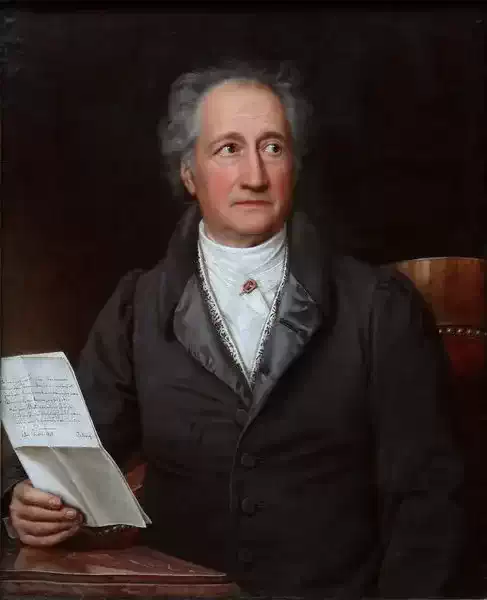
Johann Wolfgang von Goethe was a central figure in German literature and a polymath whose work spanned poetry, drama, novels, scientific inquiry, and political theory. Born into a prominent family in Frankfurt, he was a key figure of the Weimar Classicism movement. Goethe's writings are characterized by their depth, philosophical inquiry, and exploration of human nature, often infused with a blend of Romantic sensibility and Neoclassical form. He was also a minister of state in the Duchy of Weimar, demonstrating a profound engagement with civic and political life. His national and linguistic identity were deeply rooted in Germany, and his work was primarily written in German, though its impact transcended linguistic boundaries.

Childhood and education

Goethe received an excellent education, benefiting from private tutors and the intellectual stimulation of his household, which included his father's library. He was exposed to classical literature, languages, and the arts from an early age. His formal education included studies at the University of Leipzig and the University of Strasbourg, where he studied law but also delved into literature and alchemy. He was influenced by the burgeoning Sturm und Drang movement, which emphasized individual emotion and rebellion against artistic conventions, as well as by Enlightenment ideals and the rediscovery of classical antiquity. His early experiences and readings laid the foundation for his multifaceted literary and intellectual development.

Literary trajectory

Goethe's literary career began in his youth with the Sturm und Drang movement, marked by works like "The Sorrows of Young Werther." This period was characterized by intense emotional expression and a focus on individual experience. His move to Weimar marked a shift towards Weimar Classicism, characterized by a more balanced, harmonious, and ethically focused approach, exemplified by "Iphigenia in Tauris" and "Torquato Tasso." The creation of "Faust," which occupied him for much of his life, represents the apex of his philosophical and dramatic achievement, evolving through different phases and reflecting his mature contemplation of human existence. He was also actively involved in periodicals and collaborated with other writers, contributing significantly to the literary landscape of his time.

Works, style, and literary characteristics

Goethe's major works include the epistolary novel "The Sorrows of Young Werther" (1774), the dramas "Iphigenia in Tauris" (1787) and "Egmont" (1788), the novel "Wilhelm Meister's Apprenticeship" (1795-96), and his monumental dramatic poem "Faust" (Part I, 1808; Part II, 1832). His themes are vast, encompassing love, nature, science, art, religion, the human condition, and the pursuit of knowledge and self-realization. His style evolved from the passionate and individualistic Sturm und Drang to the balanced, formal elegance of Weimar Classicism, and later, a more complex, symbolic, and philosophical mode in "Faust Part II." He masterfully employed various forms, including lyric poetry, dramatic verse, and prose, often experimenting with meter and structure. His poetic voice ranged from intensely personal and lyrical to philosophical and universal. Goethe's language is rich, precise, and evocative, utilizing powerful imagery and rhetorical devices to explore profound ideas. He is credited with significant innovations in German literature, bridging Romanticism and Classicism, and profoundly influencing the development of the European novel and drama.

Cultural and historical context

Goethe lived through a period of immense upheaval in European history, including the French Revolution and the Napoleonic Wars, which profoundly shaped his worldview and writings. He was a central figure of the Weimar Classicism movement, alongside Friedrich Schiller, representing a peak of German cultural achievement during a time when Germany was politically fragmented. His engagement with Enlightenment thought, the rediscovery of Greek and Roman antiquity, and the rise of Romanticism placed him at the intersection of major intellectual currents. His positions in Weimar gave him insight into political affairs, and his work often reflected on societal structures, the role of the individual, and the nature of governance.

Personal life

Goethe's personal life was rich and complex. His relationships, particularly with Charlotte von Stein, had a significant impact on his emotional and creative life. His later relationship with Christiane Vulpius, whom he eventually married, brought him domestic stability. He maintained friendships with many leading intellectuals of his time, including Schiller and Herder, and also experienced literary rivalries. Goethe's scientific pursuits, particularly in botany and optics, were not merely academic but intertwined with his poetic vision, reflecting a holistic view of knowledge. His philosophical and spiritual beliefs evolved throughout his life, moving from a pantheistic view of nature to a more nuanced engagement with Christian themes, particularly in his later works.

Recognition and reception

Goethe achieved immense fame and recognition during his lifetime, both within Germany and internationally. He was revered as a literary genius and a national icon. His works were widely translated and admired, and he received numerous honors and distinctions. The reception of his work has remained consistently high, with "Faust" considered one of the greatest works of world literature. While he enjoyed immense popularity and academic respect during his life, his complex philosophical and literary achievements continue to be subjects of intensive scholarly study and critical analysis.

Influences and legacy

Goethe was influenced by a wide array of sources, including classical Greek and Roman literature, the Bible, Shakespeare, and the emerging Sturm und Drang and Enlightenment philosophies. His legacy is immeasurable; he profoundly influenced German literature and culture, shaping the development of Romanticism, Realism, and subsequent literary movements. His concepts, such as the "eternal feminine" in "Faust," and his exploration of the human drive for self-fulfillment, have resonated across generations. He is a cornerstone of the German literary canon and a globally recognized literary figure. His works have been translated into virtually every major language and have inspired countless adaptations in music, theater, and film.

Interpretation and critical analysis

Goethe's work, particularly "Faust," has been subjected to endless interpretation and critical analysis. Themes of good versus evil, the pursuit of knowledge, the nature of progress, and the relationship between the spiritual and material worlds are central to scholarly debate. His complex philosophical outlook, blending elements of Romanticism, Classicism, and humanism, continues to provoke discussion. The tension between individual freedom and societal responsibility, and the search for meaning in a complex world, remain enduring aspects of his critical legacy.

Curiosities and lesser-known aspects

Goethe's fascination with science extended to empirical studies, including his theory of colors, which, though controversial, demonstrated his rigorous approach to observation. His personal life contained elements of both conventionality and unconventionality; his long-term relationship with Christiane Vulpius, who came from a lower social class, was unusual for a man of his stature. He maintained a disciplined writing routine, often working in the early hours of the morning. Anecdotes abound about his charismatic presence and his ability to engage with people from all walks of life. His extensive correspondence provides invaluable insights into his thoughts and daily life.

Death and memory

Johann Wolfgang von Goethe died in Weimar at the age of 82. His death was a significant national event, marking the end of an era in German culture. His memory is celebrated through numerous institutions, monuments, and cultural events dedicated to his life and work. His literary and scientific contributions continue to be studied and revered, ensuring his enduring place in the annals of world culture. His collected works are vast and continue to be published and re-edited, testifying to his lasting impact.