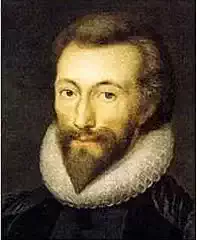
John Donne

John Donne

1572–1631 · lived 59 years GB GB

John Donne was a leading figure of the metaphysical poets, renowned for his intellectual and passionate verse that explored complex themes of love, death, religion, and the human condition. His poetry is characterized by its ingenious conceits, sharp wit, and a profound exploration of spiritual and physical experiences. Donne's career spanned roles as a poet, lawyer, and Anglican priest, culminating in his appointment as Dean of St. Paul's Cathedral. His works, including "Songs and Sonnets" and "Holy Sonnets," continue to be celebrated for their originality, emotional depth, and theological insight.

n. 1572-01-22, Londres · m. 1631-03-31, Londres

32,696 Views

Ascension

Ascension


Salute the last and everlasting day,
Joy at th' uprising of this Sun, and Son,
Ye whose true tears, or tribulation
Have purely wash'd, or burnt your drossy clay.
Behold, the Highest, parting hence away,
Lightens the dark clouds, which He treads upon ;
Nor doth He by ascending show alone,
But first He, and He first enters the way.
O strong Ram, which hast batter'd heaven for me !
Mild Lamb, which with Thy Blood hast mark'd the path !
Bright Torch, which shinest, that I the way may see !
O, with Thy own Blood quench Thy own just wrath ;
And if Thy Holy Spirit my Muse did raise,
Deign at my hands this crown of prayer and praise.
Read full poem
Bio

Identification and basic context

Full name: John Donne. Pseudonyms or heteronyms: Not known to have used significant pseudonyms or heteronyms for his published works. Date and place of birth: Baptized January 30, 1572, London, England. Date and place of death: March 31, 1631, London, England. Family background, social class, and cultural context of origin: Born into a prominent Roman Catholic family during a time of religious persecution of Catholics in Protestant England. His mother was descended from Sir Thomas More. His father was a prosperous ironmonger. This background instilled in him a complex relationship with religious and political authority. Nationality and language(s) of writing: English. Historical context in which they lived: Lived during the Elizabethan and Jacobean eras in England, a period of significant religious tension, exploration, and political intrigue.

Childhood and education

Family background and social environment: Raised in a devout Catholic household, he received a rigorous early education. His family experienced hardship due to their faith. Formal education and self-education: Studied at Hart Hall, Oxford, and Lincoln's Inn for law. He did not take degrees from Oxford, likely due to his Catholic faith. He was highly self-educated, mastering languages and theology. Early influences (readings, culture, religion, politics): Influenced by Catholic theology, Stoic philosophy, classical literature (Latin and Greek poets), and the intellectual climate of Renaissance England. His family's religious affiliations and the prevailing political climate shaped his worldview. Literary, philosophical, or artistic movements absorbed: While not strictly adhering to a single movement, his work reflects Renaissance humanism and later absorbs elements that would define metaphysical poetry. Significant events in youth: His early education, his studies at law, and the early conflicts arising from his Catholic faith.

Literary trajectory

Beginning of writing (when and how it started): Began writing poetry early in his life, initially secular and often satirical, exploring themes of love and human desire. His "Songs and Sonnets" are believed to have been composed during his twenties. Development over time (phases, changes in style): His work evolved from secular love poetry to deeply spiritual and religious verse. This shift occurred significantly after his controversial marriage and subsequent loss of favor, leading him to focus on theology and a career in the Church. Chronological evolution of the work: Early works are characterized by wit, paradox, and often scandalous themes. Later works, particularly the "Holy Sonnets" and his sermons, are marked by profound spiritual struggle, theological depth, and a direct engagement with faith and salvation. Contributions to magazines, newspapers, and anthologies: Not applicable in the modern sense; his works circulated in manuscript form among his friends and admirers. Activity as a critic, translator, or editor: He was not primarily a critic or editor of others' works, though he produced scholarly theological writings.

Works, style, and literary characteristics

Major works with dates and context of production: "Songs and Sonnets" (composed c. 1590s-1610s, published posthumously in 1633), "Holy Sonnets" (composed c. 1609-1610, published posthumously), "Devotions upon Emergent Occasions" (1624). His most famous poems, like "The Flea," "A Valediction: Forbidding Mourning," and "Death, Be Not Proud," are representative of his diverse output. Dominant themes — love, death, time, nature, identity, homeland, spirituality, etc.: Love (both erotic and divine), death (its nature, power, and conquest through faith), time (its passage and the urgency of salvation), spirituality (doubt, faith, sin, redemption), and the complexities of human experience. Form and structure — use of the sonnet, free verse, fixed forms, metrical experimentation: Masterful use of the sonnet form, often with complex rhyme schemes and syllabic variations. Also wrote in other stanzaic forms. His metrical experimentation contributes to the intellectual and dramatic quality of his verse. Poetic devices (metaphor, rhythm, musicality): Famous for his "conceits" – extended, often surprising and elaborate metaphors that connect disparate ideas (e.g., lovers to a compass in "A Valediction: Forbidding Mourning"). His rhythm is often conversational yet highly structured, creating a powerful, logical flow. Tone and poetic voice — lyrical, satirical, elegiac, epic, ironic, confessional: Highly varied: witty and satirical in early love poems, passionate and confessional in spiritual sonnets, didactic and moving in his sermons. His voice is often intellectual, argumentative, and intensely personal. Poetic voice (personal, universal, fragmented, etc.): Often personal and confessional, grappling with individual sin and salvation, yet his meditations on universal themes like love and death resonate broadly. Language and style — vocabulary, imagery density, preferred rhetorical devices: Rich, often Latinate vocabulary, intellectualized language, and extremely dense imagery. He employed paradox, irony, hyperbole, and the metaphysical conceit with great skill. Formal or thematic innovations introduced into literature: Popularized and elevated the "metaphysical conceit," a hallmark of metaphysical poetry. He brought a new intellectual rigor, emotional intensity, and dramatic realism to English poetry. Relationship with tradition and modernity: He engaged deeply with classical and Renaissance traditions but injected them with a new, modern sensibility characterized by intellectual dynamism and psychological exploration. Associated literary movements (e.g., symbolism, modernism): Primarily associated with Metaphysical poetry, which predates modernism but shares a spirit of intellectual experimentation and formal innovation. Lesser-known or unpublished works: His "Paradoxes and Problems" and extensive sermons.

Cultural and historical context

Relationship with historical events (wars, revolutions, regimes): Lived through religious conflicts and political shifts in England. His conversion to Anglicanism and subsequent clerical career were influenced by the religious climate. Relationship with other writers or literary circles: Part of a circle of intellectuals and courtiers. Contemporaries included Ben Jonson, George Herbert, and William Shakespeare. Generation or movement to which they belong (e.g., Romanticism, Modernism, Surrealism): Metaphysical poets. Political or philosophical stance: Initially secular and perhaps anti-clerical, he later became a devout Anglican, a staunch defender of the Church of England, and a trusted preacher for King James I. Influence of society and culture on the work: The intellectual ferment of the Renaissance, the religious divisions of the era, and the courtly culture all influenced his writing. Dialogues and tensions with contemporaries: Engaged in literary and intellectual debates, notably with Ben Jonson, who initially criticized Donne's "verse in droves." Critical reception during life vs. posthumous recognition: His poetry circulated widely in manuscript and was admired by contemporaries, but it was only after his death that his poems were collected and published, leading to a broader appreciation and influence.

Personal life

Significant emotional and family relationships and how they shaped the work: His marriage to Ann More was passionate but led to disgrace and financial hardship, profoundly influencing his early love poetry and later his theological writings. His wife's death was a deeply felt loss. Friendships and literary rivalries: Maintained friendships with prominent figures, including Sir Robert Drury and Sir Henry Wotton. His relationship with Ben Jonson was complex, marked by both respect and criticism. Personal experiences and crises, illnesses, or conflicts: Faced imprisonment for his secret marriage, financial struggles, and ill health, most notably his near-fatal illness which inspired "Devotions upon Emergent Occasions." Parallel professions (if they did not live solely from poetry): Lawyer, politician (Member of Parliament), and later a clergyman and preacher. Religious, spiritual, or philosophical beliefs: Began as a Catholic, converted to Anglicanism, and became a prominent preacher. His spiritual journey was central to his later life and work. Political positions and civic engagement: Served as a Member of Parliament and later as Dean of St. Paul's, engaging in public life and royal service.

Recognition and reception

Place in national and international literature: Considered one of the most important English poets of the 17th century and a foundational figure of English literature. Awards, distinctions, and institutional recognition: Became Dean of St. Paul's Cathedral, a highly prestigious position. Critical reception at the time and over time: Admired by contemporaries in manuscript circulation, but his works were not widely published until after his death. His reputation grew significantly in the 20th century, particularly through the work of T.S. Eliot, who championed the Metaphysical poets. Popularity vs. academic recognition: Highly regarded in academic circles for his intellectual depth and influence, while his more accessible poems like "Go, Lovely Rose" and "Death, Be Not Proud" have achieved broader recognition.

Influences and legacy

Authors who influenced them: Classical poets (Virgil, Horace, Ovid), medieval theologians, St. Augustine, Thomas Aquinas, Montaigne, Petrarch, and contemporaries like Shakespeare. Poets and movements they influenced: Hugely influential on subsequent poets of the Metaphysical school (e.g., George Herbert, Henry Vaughan, Richard Crashaw) and later poets who appreciated intellectual rigor and emotional intensity, including the "New Verse" poets of the 20th century. Impact on national and world literature and on later generations of poets: His innovative use of language, complex thought, and intense emotion profoundly shaped English poetry. His legacy lies in his intellectual daring and his ability to bridge the sacred and the secular. Inclusion in the literary canon: Essential figure in the English literary canon. Translations and international dissemination: His works are widely translated and studied internationally. Adaptations (music, theater, film): His poems have been set to music by numerous composers. Academic studies dedicated to the work: An immense body of scholarly work exists on his poetry, prose, and theological writings.

Interpretation and critical analysis

Possible readings of the work: His love poems are analyzed for their complex psychological portrayals of desire and emotional states. His religious poetry is seen as a testament to faith, doubt, and the struggle for salvation. Philosophical and existential themes: Explores the paradoxes of human existence, the nature of reality, the tension between the material and spiritual worlds, and the ultimate triumph of faith over death. Controversies or critical debates: Debates have centered on his conversion from Catholicism to Anglicanism, the authenticity of his spiritual expressions, and the interpretation of his often paradoxical and provocative conceits.

Curiosities and lesser-known aspects

Lesser-known aspects of personality: Despite his public roles, he maintained a private and often tormented inner life. Contradictions between life and work: The contrast between his youthful, often scandalous secular poetry and his later role as a sober, respected Dean of St. Paul's. Significant or anecdotal episodes that illuminate the author’s profile: His clandestine marriage to Ann More, his subsequent imprisonment, and his famous deathbed sermon, "Death's Duell." Objects, places, or rituals associated with poetic creation: His sermons were delivered with immense passion and theatricality, often improvising from notes. Writing habits: He was known for his prolific output and for refining his poems over long periods. Curious episodes: The legend that he had himself painted as a corpse for a portrait while still alive, to contemplate death.

Death and memory

Circumstances of death: Died of stomach cancer. Posthumous publications: His sermons were published posthumously, and his poetry collections "Songs and Sonnets" and "Holy Sonnets" became foundational texts. His "Devotions" also gained significant recognition.

Poems

96

A Litany

A Litany

I.
THE FATHER.

FATHER of Heaven, and Him, by whom
It, and us for it, and all else for us,
Thou madest, and govern'st ever, come
And re-create me, now grown ruinous:
My heart is by dejection, clay,
And by self-murder, red.
From this red earth, O Father, purge away
All vicious tinctures, that new-fashioned
I may rise up from death, before I'm dead.


II.
THE SON.
O Son of God, who, seeing two things,
Sin and Death, crept in, which were never made,
By bearing one, tried'st with what stings
The other could Thine heritage invade ;
O be Thou nail'd unto my heart,
And crucified again ;
Part not from it, though it from Thee would part,
But let it be by applying so Thy pain,
Drown'd in Thy blood, and in Thy passion slain.


III.
THE HOLY GHOST.


O Holy Ghost, whose temple I
Am, but of mud walls , and condensèd dust,
And being sacrilegiously
Half wasted with youth's fires of pride and lust,
Must with new storms be weather-beat,
Double in my heart Thy flame,
Which let devout sad tears intend, and let—
Though this glass lanthorn, flesh, do suffer maim—
Fire, sacrifice, priest, altar be the same.


IV.
THE TRINITY.


O blessed glorious Trinity,
Bones to philosophy, but milk to faith,
Which, as wise serpents, diversely
Most slipperiness, yet most entanglings hath,


As you distinguish'd, undistinct,
By power, love, knowledge be,
Give me a such self different instinct,
Of these let all me elemented be,
Of power, to love, to know you unnumbered three.


V.
THE VIRGIN MARY.


For that fair blessed mother-maid,
Whose flesh redeem'd us, that she-cherubin,
Which unlock'd paradise, and made
One claim for innocence, and disseizèd sin,
Whose womb was a strange heaven, for there
God clothed Himself, and grew,
Our zealous thanks we pour. As her deeds were
Our helps, so are her prayers ; nor can she sue
In vain, who hath such titles unto you.


VI.
THE ANGELS.


And since this life our nonage is,
And we in wardship to Thine angels be,
Native in heaven's fair palaces
Where we shall be but denizen'd by Thee ;
As th' earth conceiving by the sun,
Yields fair diversity,
Yet never knows what course that light doth run ;
So let me study that mine actions be
Worthy their sight, though blind in how they see.


VII.
THE PATRIARCHS.


And let Thy patriarchs' desire,
—Those great grandfathers of Thy Church, which saw
More in the cloud than we in fire,
Whom nature clear'd more, than us grace and law,
And now in heaven still pray, that we
May use our new helps right—
Be satisfied, and fructify in me ;
Let not my mind be blinder by more light,
Nor faith by reason added lose her sight.


VIII.
THE PROPHETS.

Thy eagle-sighted prophets too,
—Which were Thy Church's organs, and did sound
That harmony which made of two
One law, and did unite, but not confound ;
Those heavenly poets which did see
Thy will, and it express
In rhythmic feet—in common pray for me,
That I by them excuse not my excess
In seeking secrets, or poeticness.

IX.
THE APOSTLES.

And thy illustrious zodiac
Of twelve apostles, which engirt this All,
—From whom whosoever do not take
Their light, to dark deep pits throw down and fall ;—
As through their prayers Thou'st let me know
That their books are divine,
May they pray still, and be heard, that I go
Th' old broad way in applying ; O decline
Me, when my comment would make Thy word mine.

X.
THE MARTYRS.

And since Thou so desirously
Didst long to die, that long before Thou couldst,
And long since Thou no more couldst die,
Thou in thy scatter'd mystic body wouldst
In Abel die, and ever since
In Thine ; let their blood come
To beg for us a discreet patience
Of death, or of worse life ; for O, to some
Not to be martyrs, is a martyrdom.

XI.
THE CONFESSORS.


Therefore with Thee triumpheth there
A virgin squadron of white confessors,
Whose bloods betroth'd not married were,


Tender'd, not taken by those ravishers.
They know, and pray that we may know,
In every Christian
Hourly tempestuous persecutions grow ;
Temptations martyr us alive ; a man
Is to himself a Diocletian.


XII.
THE VIRGINS.


The cold white snowy nunnery,
Which, as Thy Mother, their high abbess, sent
Their bodies back again to Thee,
As Thou hadst lent them, clean and innocent ;
Though they have not obtain'd of Thee,
That or Thy Church or I
Should keep, as they, our first integrity,
Divorce Thou sin in us, or bid it die,
And call chaste widowhead virginity.


XIII.
THE DOCTORS.

The sacred academy above
Of Doctors, whose pains have unclasp'd, and taught
Both books of life to us—for love
To know Thy scriptures tells us, we are wrote
In Thy other book—pray for us there,
That what they have misdone
Or missaid, we to that may not adhere.
Their zeal may be our sin. Lord, let us run
Mean ways, and call them stars, but not the sun.

XIV.
And whilst this universal quire,
That Church in triumph, this in warfare here,
Warm'd with one all-partaking fire
Of love, that none be lost, which cost Thee dear,
Prays ceaselessly, and Thou hearken too
—Since to be gracious
Our task is treble, to pray, bear, and do—
Hear this prayer, Lord ; O Lord, deliver us
From trusting in those prayers, though pour'd out
thus.


XV.
From being anxious, or secure,
Dead clods of sadness, or light squibs of mirth,
From thinking that great courts immure
All, or no happiness, or that this earth
Is only for our prison framed,
Or that Thou'rt covetous
To them whom Thou lovest, or that they are maim'd
From reaching this world's sweet who seek Thee
thus,
With all their might, good Lord, deliver us.


XVI.
From needing danger, to be good,
From owing Thee yesterday's tears to-day,
From trusting so much to Thy blood
That in that hope we wound our soul away,
From bribing Thee with alms, to excuse
Some sin more burdenous,
From light affecting, in religion, news,
From thinking us all soul, neglecting thus
Our mutual duties, Lord, deliver us.


XVII.
From tempting Satan to tempt us,
By our connivance, or slack company,
From measuring ill by vicious
Neglecting to choke sin's spawn, vanity,
From indiscreet humility,
Which might be scandalous
And cast reproach on Christianity,
From being spies, or to spies pervious,
From thirst or scorn of fame, deliver us.


XVIII.
Deliver us through Thy descent
Into the Virgin, whose womb was a place
Of middle kind ; and Thou being sent
To ungracious us, stay'dst at her full of grace ;
And through Thy poor birth, where first Thou
Glorified'st poverty ;
And yet soon after riches didst allow,
By accepting kings' gifts in th' Epiphany ;
Deliver us, and make us to both ways free.


XIX.
And through that bitter agony,
Which is still th' agony of pious wits,
Disputing what distorted Thee,
And interrupted evenness with fits ;
And through Thy free confession,
Though thereby they were then
Made blind, so that Thou mightst from them have gone ;
Good Lord, deliver us, and teach us when
We may not, and we may, blind unjust men.


XX.
Through Thy submitting all, to blows
Thy face, Thy robes to spoil, Thy fame to scorn,
All ways, which rage, or justice knows,
And by which Thou couldst show that Thou wast born ;
And through Thy gallant humbleness
Which Thou in death didst show,
Dying before Thy soul they could express ;
Deliver us from death, by dying so
To this world, ere this world do bid us go.


XXI.
When senses, which Thy soldiers are,
We arm against Thee, and they fight for sin ;
When want, sent but to tame, doth war,
And work despair a breach to enter in ;
When plenty, God's image, and seal,
Makes us idolatrous,
And love it, not him, whom it should reveal ;
When we are moved to seem religious
Only to vent wit ; Lord, deliver us.


XXII.
In churches, when th' infirmity
Of him which speaks, diminishes the word ;
When magistrates do misapply
To us, as we judge, lay or ghostly sword ;
When plague, which is Thine angel, reigns,
Or wars, Thy champions, sway ;
When heresy, Thy second deluge, gains ;
In th' hour of death, th' eve of last Judgment day ;
Deliver us from the sinister way.


XXIII.
Hear us, O hear us, Lord; to Thee
A sinner is more music, when he prays,
Than spheres' or angels' praises be,
In panegyric alleluias ;
Hear us, for till Thou hear us, Lord,
We know not what to say ;
Thine ear to our sighs, tears, thoughts, gives voice and word ;
O Thou, who Satan heard'st in Job's sick day,
Hear Thyself now, for Thou in us dost pray.


XXIV.
That we may change to evenness
This intermitting aguish piety ;
That snatching cramps of wickedness
And apoplexies of fast sin may die ;
That music of Thy promises,
Not threats in thunder may
Awaken us to our just offices ;
What in Thy book Thou dost, or creatures say,
That we may hear, Lord, hear us when we pray.


XXV.
That our ears' sickness we may cure,
And rectify those labyrinths aright,
That we by heark'ning not procure
Our praise, nor others' dispraise so invite ;
That we get not a slipp'riness
And senselessly decline,
From hearing bold wits jest at kings' excess,
To admit the like of majesty divine ;
That we may lock our ears, Lord, open Thine.


XXVI.
That living law, the magistrate,
Which to give us, and make us physic, doth
Our vices often aggravate ;
That preachers taxing sin, before her growth ;
That Satan, and envenom'd men—
Which will, if we starve, dine—
When they do most accuse us, may see then
Us to amendment hear them, Thee decline ;
That we may open our ears, Lord, lock Thine.


XXVII.
That learning, Thine ambassador,
From Thine allegiance we never tempt ;
That beauty, paradise's flower
For physic made, from poison be exempt ;
That wit—born apt high good to do—
By dwelling lazily
On nature's nothing be not nothing too ;
That our affections kill us not, nor die ;
Hear us, weak echoes, O, Thou Ear and Eye.


XXVIII.
Son of God, hear us, and since Thou
By taking our blood, owest it us again,
Gain to Thyself, or us allow ;
And let not both us and Thyself be slain ;
O Lamb of God, which took'st our sin,
Which could not stick to Thee,
O let it not return to us again ;
But patient and physician being free,
As sin is nothing, let it nowhere be.

420

A Lecture Upon The Shadow

A Lecture Upon The Shadow

Stand still, and I will read to thee

A lecture, love, in love's philosophy.
These three hours that we have spent,
Walking here, two shadows went

Along with us, which we ourselves produc'd.

But, now the sun is just above our head,
We do those shadows tread,
And to brave clearness all things are reduc'd.

So whilst our infant loves did grow,
Disguises did, and shadows, flow
From us, and our cares; but now 'tis not so.
That love has not attain'd the high'st degree,
Which is still diligent lest others see.


Except our loves at this noon stay,


We shall new shadows make the other way.
As the first were made to blind
Others, these which come behind

Will work upon ourselves, and blind our eyes.

If our loves faint, and westwardly decline,
To me thou, falsely, thine,
And I to thee mine actions shall disguise.

The morning shadows wear away,
But these grow longer all the day;
But oh, love's day is short, if love decay.
Love is a growing, or full constant light,
And his first minute, after noon, is night.
357

A Jet Ring Sent

A Jet Ring Sent

Thou art not so black as my heart,
Nor half so brittle as her heart, thou art ;
What would'st thou say ? shall both our properties by thee be spoke,
—Nothing more endless, nothing sooner broke?


Marriage rings are not of this stuff ;
Oh, why should ought less precious, or less tough
Figure our loves ? except in thy name thou have bid it say,
'—I'm cheap, and nought but fashion ; fling me away.'


Yet stay with me since thou art come,
Circle this finger's top, which didst her thumb ;
Be justly proud, and gladly safe, that thou dost dwell with me ;
She that, O ! broke her faith, would soon break thee.
336

A Hymn To Christ At The Author's Last Going Into Germany

A Hymn To Christ At The Author's Last Going Into Germany

In what torn ship soever I embark,
That ship shall be my emblem of thy Ark;
What sea soever swallow me, that flood
Shall be to me an emblem of thy blood;
Though thou with clouds of anger do disguise
Thy face, yet through that mask I know those eyes,
Which, though they turn away sometimes,
They never will despise.


I sacrifice this Island unto thee,
And all whom I loved there, and who loved me;
When I have put our seas 'twixt them and me,
Put thou thy sea betwixt my sins and thee.
As the tree's sap doth seek the root below
In winter, in my winter now I go,
Where none but thee, th' Eternal root
Of true Love, I may know.


Nor thou nor thy religion dost control
The amorousness of an harmonious Soul,
But thou wouldst have that love thyself: as thou
Art jealous, Lord, so I am jealous now,
Thou lov'st not, till from loving more, Thou free
My soul: who ever gives, takes liberty:
O, if thou car'st not whom I love
Alas, thou lov'st not me.


Seal then this bill of my Divorce to All,
On whom those fainter beams of love did fall;
Marry those loves, which in youth scattered be
On Fame, Wit, Hopes (false mistresses) to thee.
Churches are best for Prayer, that have least light:
To see God only, I go out of sight:
And to 'scape stormy days, I choose
An Everlasting night.
309

A dialogue between Sir Henry Wootton and Mr. Donne

A dialogue between Sir Henry Wootton and Mr. Donne

[W.]

IF her disdain least change in you can move,
You do not love,
For when that hope gives fuel to the fire,
You sell desire.
Love is not love, but given free ;
And so is mine ; so should yours be.


[D.]


Her heart, that weeps to hear of others' moan,
To mine is stone.
Her eyes, that weep a stranger's eyes to see,
Joy to wound me.
Yet I so well affect each part,
As—caused by them—I love my smart.


[W.]


Say her disdainings justly must be graced
With name of chaste ;
And that she frowns lest longing should exceed,
And raging breed ;
So her disdains can ne'er offend,
Unless self-love take private end.


[D.]


'Tis love breeds love in me, and cold disdain
Kills that again,
As water causeth fire to fret and fume,
Till all consume.
Who can of love more rich gift make,
That to Love's self for love's own sake?


I'll never dig in quarry of an heart
To have no part,
Nor roast in fiery eyes, which always are
Canicular.
Who this way would a lover prove,
May show his patience, not his love.


A frown may be sometimes for physic good,
But not for food ;
And for that raging humour there is sure
A gentler cure.
Why bar you love of private end,
Which never should to public tend?
278

A Burnt Ship

A Burnt Ship

Out of a fired ship, which by no way
But drowning could be rescued from the flame,
Some men leap'd forth, and ever as they came
Near the foes' ships, did by their shot decay;
So all were lost, which in the ship were found,

They in the sea being burnt, they in the burnt ship drown'd.
350

Quotes

40

Videos

50

Comments (0)

Share
Log in to post a comment.

No comments yet. Be the first to comment.