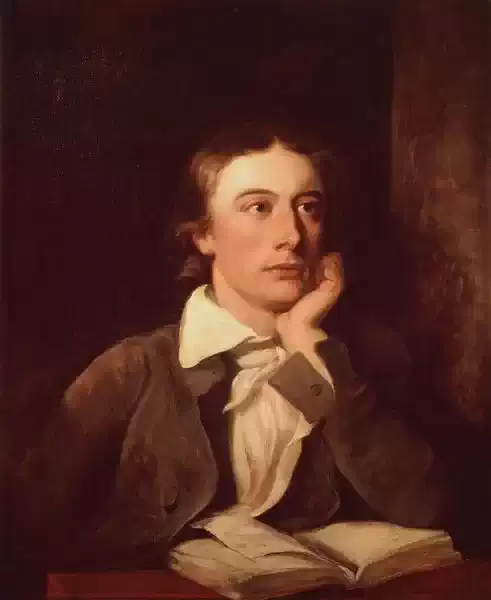
Dedication To Leigh Hunt, Esq.
Dedication To Leigh Hunt, Esq.
Glory and loveliness have pass'd away;
For if we wander out in early morn,
No wreathed incense do we see upborne
Into the east, to meet the smiling day:
No crowd of nymphs soft voic'd and young, and gay,
In woven baskets bringing ears of corn,
Roses, and pinks, and violets, to adorn
The shrine of Flora in her early May.
But there are left delights as high as these,
And I shall ever bless my destiny,
That in a time, when under pleasant trees
Pan is no longer sought, I feel a free,
A leafy luxury, seeing I could please
With these poor offerings, a man like thee.
Bright Star
Bright Star
Bright star, would I were stedfast as thou art-Not
in lone splendour hung aloft the night
And watching, with eternal lids apart,
Like nature's patient, sleepless Eremite,
The moving waters at their priestlike task
Of pure ablution round earth's human shores,
Or gazing on the new soft-fallen mask
Of snow upon the mountains and the moors-No--
yet still stedfast, still unchangeable,
Pillow'd upon my fair love's ripening breast,
To feel for ever its soft fall and swell,
Awake for ever in a sweet unrest,
Still, still to hear her tender-taken breath,
And so live ever--or else swoon to death.
Character Of Charles Brown
Character Of Charles Brown
I.
He is to weet a melancholy carle:
Thin in the waist, with bushy head of hair
As hath the seeded thistle when in parle
It holds the Zephyr, ere it sendeth fair
Its light balloons into the summer air;
Therto his beard had not begun to bloom,
No brush had touch'd his chin or razor sheer;
No care had touch'd his cheek with mortal doom,
But new he was and bright as scarf from Persian loom.
II.
Ne cared he for wine, or half-and-half;
Ne cared he for fish or flesh or fowl,
And sauces held he worthless as the chaff,
He 'sdeigned the swine-head at the wassail-bowl;
Ne with lewd ribbalds sat he cheek by jowl,
Ne with sly Lemans in the scorner's chair;
But after water-brooks this Pilgrim's soul
Panted, and all his food was woodland air
Though he would oft-times feast on gilliflowers rare.
III.
The slang of cities in no wise he knew,
Tipping the wink to him was heathen Greek;
He sipp'd no olden Tom or ruin blue,
Or nantz or cherry-brandy drank full meek
By many a damsel hoarse and rouge of cheek;
Nor did he know each aged watchman's beat,
Nor in obscured purlieus would he seek
For curled Jewesses with ankles neat,
Who as they walk abroad make tinkling with their feet.
Apollo And The Graces
Apollo And The Graces
APOLLO
WHICH of the fairest three
To-day will ride with me?
My steeds are all pawing at the threshold of the morn:
Which of the fairest three
To-day will ride with me
Across the gold Autumn's whole Kingdom of corn?
THE GRACES all answer
I will, I - I - I
young Apollo let me fly
Along with thee,
I will- I, I, I,
The many wonders see
I - I - I - I
And thy lyre shall never have a slackened string:
I, I, I, I,
Thro' the golden day will sing.
Bards of Passion and of Mirth, written on the Blank Page before Beaumont and
Bards of Passion and of Mirth, written on the Blank Page before Beaumont and
Fletcher's Tragi-Comedy 'The Fair Maid of the Inn'
BARDS of Passion and of Mirth,
Ye have left your souls on earth!
Have ye souls in heaven too,
Doubled-lived in regions new?
Yes, and those of heaven commune
With the spheres of sun and moon;
With the noise of fountains wondrous,
And the parle of voices thund'rous;
With the whisper of heaven's trees
And one another, in soft ease
Seated on Elysian lawns
Browsed by none but Dian's fawns;
Underneath large blue-bells tented,
Where the daisies are rose-scented,
And the rose herself has got
Perfume which on earth is not;
Where the nightingale doth sing
Not a senseless, tranced thing,
But divine melodious truth;
Philosophic numbers smooth;
Tales and golden histories
Of heaven and its mysteries.
Thus ye live on high, and then
On the earth ye live again;
And the souls ye left behind you
Teach us, here, the way to find you,
Where your other souls are joying,
Never slumber'd, never cloying.
Here, your earth-born souls still speak
To mortals, of their little week;
Of their sorrows and delights;
Of their passions and their spites;
Of their glory and their shame;
What doth strengthen and what maim.
Thus ye teach us, every day,
Wisdom, though fled far away.
Bards of Passion and of Mirth,
Ye have left your souls on earth!
Ye have souls in heaven too,
Double-lived in regions new!
An Extempore
An Extempore
When they were come into Faery's Court
They rang -- no one at home -- all gone to sport
And dance and kiss and love as faerys do
For Faries be as human lovers true --
Amid the woods they were so lone and wild
Where even the Robin feels himself exil'd
And where the very books as if affraid
Hurry along to some less magic shade.
'No one at home'! the fretful princess cry'd
'And all for nothing such a dre[a]ry ride
And all for nothing my new diamond cross
No one to see my persian feathers toss
No one to see my Ape, my Dwarf, my Fool
Or how I pace my Otaheitan mule.
Ape, Dwarf and Fool why stand you gaping there
Burst the door open, quick -- or I declare
I'll switch you soundly and in pieces tear.'
The Dwarf began to tremble and the Ape
Star'd at the Fool, the Fool was all agape
The Princess grasp'd her switch but just in time
The Dwarf with piteous face began to rhyme.
'O mighty Princess did you ne'er hear tell
What your poor servants know but too too well
Know you the three great crimes in faery land
The first alas! poor Dwarf I understand
I made a whipstock of a faery's wand
The next is snoring in their company
The next the last the direst of the three
Is making free when they are not at home.
I was a Prince -- a baby prince -- my doom
You see, I made a whipstock of a wand
My top has henceforth slept in faery land.
He was a Prince the Fool, a grown up Prince
But he has never been a King's son since
He fell a snoring at a faery Ball
Your poor Ape was a Prince and he poor thing
But ape -- so pray your highness stay awhile
'Tis sooth indeed we know it to our sorrow --
Persist and you may be an ape tomorrow --
While the Dwarf spake the Princess all for spite
Peal'd the brown hazel twig to lilly white
Clench'd her small teeth, and held her lips apart
Try'd to look unconcerned with beating heart.
They saw her highness had made up her mind
And quaver'd like the reeds before the wind
And they had had it, but O happy chance
The Ape for very fear began to dance
And grin'd as all his uglyness did ache--
She staid her vixen fingers for his sake
He was so very ugly: then she took
Her pocket mirror and began to look
First at herself and [then] at him and then
She smil'd at her own beauteous face again.
Yet for all this -- for all her pretty face
She took it in her head to see the place.
Women gain little from experience
Either in Lovers, husbands or expense.
The more their beauty the more fortune too
Beauty before the wide world never knew.
So each fair reasons -- tho' it oft miscarries.
She thought her pretty face would please the fa[e]ries.
'My darling Ape I wont whip you today
Give me the Picklock sirrah and go play.'
They all three wept but counsel was as vain
As crying cup biddy to drops of rain.
Yet lingeringly did the sad Ape forth draw
The Picklock from the Pocket in his Jaw.
The Princess took it and dismounting straight
Trip'd in blue silver'd slippers to the gate
And touch'd the wards, the Door full courteously
Opened -- she enter'd with her servants three.
Again it clos'd and there was nothing seen
But the Mule grasing on the herbage green.
End of Canto xii.
Canto the xiii.
The Mule no sooner saw himself alone
Than he prick'd up his Ears -- and said 'well done!
At least unhappy Prince I may be free --
No more a Princess shall side saddle me
O King of Othaiete -- tho' a Mule
'Aye every inch a King' -- tho' 'Fortune's fool.'
Well done -- for by what Mr. Dwarfy said
I would not give a sixpence for her head.'
Even as he spake he trotted in high glee
To the knotty side of an old Pollard tree
And rub'd his sides against the mossed bark
Till his Girths burst and left him naked stark
Except his Bridle -- how get rid of that
Buckled and tied with many a twist and plait.
At last it struck him to pretend to sleep
And then the thievish Monkies down would creep
And filch the unpleasant trammels quite away.
No sooner thought of than adown he lay
Sham'd a good snore -- the Monkey-men descended
And whom they thought to injure they befriended.
They hung his Bridle on a topmost bough
And of[f] he went run, trot, or anyhow--
Acrostic : Georgiana Augusta Keats
Acrostic : Georgiana Augusta Keats
Give me your patience, sister, while I frame
Exact in capitals your golden name;
Or sue the fair Apollo and he will
Rouse from his heavy slumber and instill
Great love in me for thee and Poesy.
Imagine not that greatest mastery
And kingdom over all the Realms of verse,
Nears more to heaven in aught, than when we nurse
And surety give to love and Brotherhood.
Anthropophagi in Othello's mood;
Ulysses storm'd and his enchanted belt
Glow with the Muse, but they are never felt
Unbosom'd so and so eternal made,
Such tender incense in their laurel shade
To all the regent sisters of the Nine
As this poor offering to you, sister mine.
Kind sister! aye, this third name says you are;
Enchanted has it been the Lord knows where;
And may it taste to you like good old wine,
Take you to real happiness and give
Sons, daughters and a home like honied hive.
A Song About Myself
A Song About Myself
I.
There was a naughty boy,
A naughty boy was he,
He would not stop at home,
He could not quiet be-
He took
In his knapsack
A book
Full of vowels
And a shirt
With some towels,
A slight cap
For night cap,
A hair brush,
Comb ditto,
New stockings
For old ones
Would split O!
This knapsack
Tight at's back
He rivetted close
And followed his nose
To the north,
To the north,
And follow'd his nose
To the north.
II.
There was a naughty boy
And a naughty boy was he,
For nothing would he do
But scribble poetry-
He took
An ink stand
In his hand
And a pen
Big as ten
In the other,
And away
In a pother
He ran
To the mountains
And fountains
And ghostes
And postes
And witches
And ditches
And wrote
In his coat
When the weather
Was cool,
Fear of gout,
And without
When the weather
Was warm-
Och the charm
When we choose
To follow one's nose
To the north,
To the north,
To follow one's nose
To the north!
III.
There was a naughty boy
And a naughty boy was he,
He kept little fishes
In washing tubs three
In spite
Of the might
Of the maid
Nor afraid
Of his Granny-good-
He often would
Hurly burly
Get up early
And go
By hook or crook
To the brook
And bring home
Miller's thumb,
Tittlebat
Not over fat,
Minnows small
As the stall
Of a glove,
Not above
The size
Of a nice
Little baby's
Little fingers-
O he made
'Twas his trade
Of fish a pretty kettle
A kettle-
A kettle
Of fish a pretty kettle
A kettle!
IV.
There was a naughty boy,
And a naughty boy was he,
He ran away to Scotland
The people for to seewww.
PoemHunter.com - The World's Poetry Archive
�
There he found
That the ground
Was as hard,
That a yard
Was as long,
That a song
Was as merry,
That a cherry
Was as red,
That lead
Was as weighty,
That fourscore
Was as eighty,
That a door
Was as wooden
As in England-
So he stood in his shoes
And he wonder'd,
He wonder'd,
He stood in his
Shoes and he wonder'd.
A Party Of Lovers
A Party Of Lovers
Pensive they sit, and roll their languid eyes,
Nibble their toast, and cool their tea with sighs,
Or else forget the purpose of the night,
Forget their tea -- forget their appetite.
See with cross'd arms they sit -- ah! happy crew,
The fire is going out and no one rings
For coals, and therefore no coals Betty brings.
A fly is in the milk-pot -- must he die
By a humane society?
No, no; there Mr. Werter takes his spoon,
Inserts it, dips the handle, and lo! soon
The little straggler, sav'd from perils dark,
Across the teaboard draws a long wet mark.
Arise! take snuffers by the handle,
There's a large cauliflower in each candle.
A winding-sheet, ah me! I must away
To No. 7, just beyond the circus gay.
'Alas, my friend! your coat sits very well;
Where may your tailor live?' 'I may not tell.
O pardon me -- I'm absent now and then.
Where might my tailor live? I say again
I cannot tell, let me no more be teaz'd --
He lives in Wapping, might live where he pleas'd.'
A Dream, After Reading Dante's Episode Of Paolo And Francesca
A Dream, After Reading Dante's Episode Of Paolo And Francesca
As Hermes once took to his feathers light,
When lulled Argus, baffled, swooned and slept,
So on a Delphic reed, my idle spright
So played, so charmed, so conquered, so bereft
The dragon-world of all its hundred eyes;
And seeing it asleep, so fled away,
Not to pure Ida with its snow-cold skies,
Nor unto Tempe, where Jove grieved a day;
But to that second circle of sad Hell,
Where in the gust, the whirlwind, and the flaw
Of rain and hail-stones, lovers need not tell
Their sorrows. Pale were the sweet lips I saw,
Pale were the lips I kissed, and fair the form
I floated with, about that melancholy storm.