
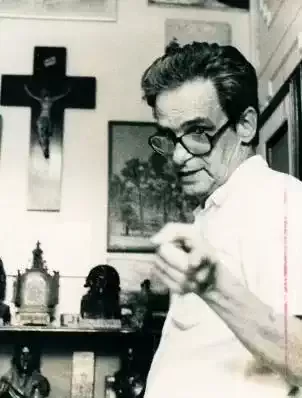
José Paulo Moreira da Fonseca
 BR
BR
José Paulo Moreira da Fonseca was a multifaceted Portuguese artist, recognized as a poet, painter, and sculptor. His poetic work is distinguished by its lyrical depth and exploration of universal themes, reflecting a keen sensitivity to the complexities of human existence. As a painter and sculptor, he demonstrated equally remarkable talent, exploring different artistic languages to express his worldview. His artistic production, although not always widely publicized during his lifetime, left an indelible mark on the Portuguese cultural landscape. His poetic work, in particular, continues to be valued for its originality and its ability to touch the reader with its honesty and beauty.
n. 1922-06-13, Rio de Janeiro · m. 2004-12-04, Rio de Janeiro
Bio
Identification and basic context
Full name: José Paulo Moreira da Fonseca. Pseudonyms or heteronyms are not widely documented. Date and place of birth (and death, if applicable): Born in Lisbon, Portugal, on November 10, 1931. Died in the same city on November 17, 2006. Family background, social class, and cultural context of origin: Specific details about his family background and social class are not widely known, but his intellectual and artistic journey suggests an environment with access to culture. Nationality and writing language(s): Portuguese. He wrote in Portuguese. Historical context in which he lived: He lived most of his life during the Estado Novo and the transition to democracy in Portugal, a period of profound social, political, and cultural changes.Childhood and education
Detailed information about his childhood and academic education is scarce in the publicly available documentation. However, the development of his multiple artistic facets as a poet, painter, and sculptor suggests an education that valued the arts and humanities, or a strong self-taught drive.Literary career
José Paulo Moreira da Fonseca began his literary activity as a poet, but his work also extends to the visual arts. His foray into poetry revealed a unique voice, marked by lyrical depth and reflection on existential themes. His literary career was not limited to writing, integrating into a broader artistic practice.Work, style, and literary characteristics
Work, style, and literary characteristics Main works with dates and production context: * "O Poema Pós-Moderno" (1961) * "O Outro Lado" (1964) * "Cântico das Marés" (1967) * "Livro de Horas" (1975) * "A Luz do Poema" (1986) Dominant themes: Love, death, time, nature, the human condition, the search for meaning, the relationship between art and life. Form and structure: He used various poetic forms, including free verse, with a structure that often favors fluidity and the exploration of rhythm. Poetic resources: Rich use of metaphors, sensory images, and a musical rhythm that lends musicality to his verses. Tone and poetic voice: Predominantly lyrical, contemplative, and sometimes elegiac, with a personal and introspective poetic voice. Language and style: Careful but accessible language, with an imagistic density that invites reflection. His style is marked by clarity and the ability to evoke deep emotions. Formal or thematic innovations introduced in literature: His work is part of the continuity of Portuguese modern poetry, exploring universal themes with originality. Literary movements associated: Although not strictly bound to a movement, his work dialogues with the currents of modernism and postmodernism through its exploration of language and existential themes. Lesser-known or unpublished works: His artistic production, including painting and sculpture, is less publicized than his poetic work.Work, style, and literary characteristics
Cultural and historical context He lived in a period of transition in Portugal, with the end of the dictatorship and the beginning of democracy. This context of change may have influenced his reflection on identity and the human condition. He was a contemporary of a generation of poets who marked Portuguese literature, with whom he shared an interest in renewing poetic language.Work, style, and literary characteristics
Personal life José Paulo Moreira da Fonseca was a versatile artist. His forays into the visual arts (painting and sculpture) reveal a multifaceted creative personality. Details about his personal life, family, and romantic relationships are not widely publicized.Work, style, and literary characteristics
Recognition and reception The recognition of his poetic work grew over time, with particular emphasis after the publication of "O Poema Pós-Moderno." His place in the canon of Portuguese poetry is notable, although perhaps not with the same media projection as other contemporaries.Work, style, and literary characteristics
Influences and legacy His poetry shows influences from the Portuguese lyrical tradition but with a modern approach. His legacy lies in the originality of his poetic voice and his ability to reconcile different forms of artistic expression. He influenced later generations of poets through his exploration of language and existential themes.Work, style, and literary characteristics
Interpretation and critical analysis The work of José Paulo Moreira da Fonseca has been analyzed from the perspective of his reflection on the human condition, the ephemerality of time, and the search for ultimate meaning. His poetry offers a space for contemplation and introspection.Work, style, and literary characteristics
Curiosities and lesser-known aspects Besides poetry, he stood out as a painter and sculptor, demonstrating remarkable artistic versatility. His multifaceted approach to art is a distinctive aspect of his career.Work, style, and literary characteristics
Death and memory He died in Lisbon in 2006. His memory endures through his poetic and artistic work, which continues to be revisited and studied.Poems
0No poems found
Videos
50
Comments (0)
No comments yet. Be the first to comment.