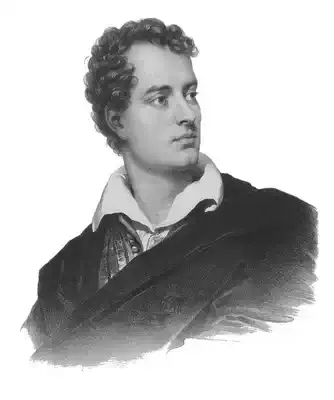
Lord Byron

Lord Byron

1788–1824 · lived 36 years GB GB

George Gordon Byron, famously known as Lord Byron, was a leading figure of the Romantic movement in English literature. His life and works were marked by passionate idealism, flamboyant rebellion against social conventions, and intense personal experiences. Byron's poetry often explored themes of love, freedom, and the sublime, characterized by its lyrical power, dramatic intensity, and engagement with classical and contemporary concerns. His adventurous life, including his involvement in the Greek War of Independence, contributed significantly to his enduring image as a heroic and Byronic figure.

n. 1788-01-22, Cidade de Westminster · m. 1824-04-19, Missolonghi

4,713 Views

On Jordan's Banks

On Jordan's Banks

On Jordan's banks the Arab's camels stray,
On Sion's hill the False One's votaries pray,
The Baaladorer
bows on Sinai's steep Yet
there even
there Oh
God! thy thunders sleep:


There where
thy finger scorch'd the tablet stone!
There where
thy shadow to thy people shone!
Thy glory shrouded in its garb of fire:
Thyself none
living see and not expire!


Oh! in the lightning let thy glance appear;
Sweep from his shiver'd hand the oppressor's spear!
How long by tyrants shall thy land be trod?
How long thy temple worshipless, Oh God?
Read full poem
Bio

Identification and basic context

Lord Byron, whose full name was George Gordon Byron, later Noel Byron, 6th Baron Byron, is widely recognized as one of the most prominent figures of the Romantic era in English literature. He was born into the British aristocracy, inheriting the title of Baron Byron. His nationality was British, and he wrote exclusively in English. The historical context in which he lived was one of significant social, political, and literary upheaval, including the aftermath of the French Revolution and the Napoleonic Wars, and the flourishing of Romanticism.

Childhood and education

Byron's childhood was marked by hardship. His mother, Catherine Gordon, was left with little money and raised him in Aberdeen, Scotland. His father, Captain John Byron, a notorious womanizer, abandoned them when George was three years old. This early separation and his mother's often harsh treatment left a profound impact on him. He was educated at Aberdeen Grammar School and then attended Trinity College, Cambridge. Despite his aristocratic background, his family's financial struggles meant he often felt like an outsider. His early readings included classical literature, the Bible, and the works of contemporary poets, which, along with his volatile home life, shaped his early sensibilities.

Literary trajectory

Byron's literary career began in earnest during his Cambridge years. His first collection of poems, 'Hours of Idleness', published in 1807, was met with harsh criticism, notably from 'The Edinburgh Review', which spurred him to respond with his satire 'English Bards and Scotch Reviewers' (1809). His first major success came with the publication of the opening cantos of 'Childe Harold's Pilgrimage' in 1812, which propelled him to instant fame. This was followed by a series of highly successful narrative poems, often drawing on historical or exotic settings, such as 'The Giaour' (1813), 'The Bride of Abydos' (1813), 'The Corsair' (1814), and 'Lara' (1814). His dramatic works, including 'Manfred' (1817) and 'Cain' (1821), explored profound philosophical and theological questions. His epic poem 'Don Juan' (begun in 1819), a satirical masterpiece, showcased his wit, irony, and expansive vision. Byron also contributed to various literary periodicals and anthologies, and his letters and journals provide significant insights into his life and thought.

Works, style, and literary characteristics

Byron's major works include 'Childe Harold's Pilgrimage', 'Don Juan', 'Manfred', 'Cain', and numerous shorter lyric poems and narrative tales. His dominant themes encompass love (often passionate and unrequited), freedom (personal and political), the struggle against fate, the sublime beauty of nature, heroism, the disillusionment of experience, and critiques of social and religious hypocrisy. Stylistically, Byron was known for his vivid imagery, powerful rhythm, and dramatic intensity. He employed a wide range of forms, from the Spenserian stanza in 'Childe Harold' to ottava rima in 'Don Juan', and experimented with blank verse and other metrical structures. His poetic voice is often marked by a compelling blend of romantic idealism, passionate emotion, sharp wit, and profound irony. His language is rich and evocative, employing striking metaphors and a commanding rhetorical power. Byron's work is often associated with Romanticism, but his cynicism and satirical edge also prefigure later literary developments.

Cultural and historical context

Byron lived through a period of immense change, influenced by the ideals of the French Revolution and the ensuing Napoleonic Wars. He was a prominent figure in the second generation of British Romantics, alongside poets like Shelley and Keats. His radical political views and bohemian lifestyle often placed him at odds with the conservative establishment of his time. His travels and experiences, particularly his involvement in the Greek War of Independence, where he became a national hero, deeply intertwined his life with the political currents of Europe. He was part of a vibrant literary circle, though his relationships with contemporaries like Wordsworth and Coleridge were complex, often marked by admiration and critical distance.

Personal life

Byron's personal life was as dramatic and turbulent as his poetry. His relationships were often intense and tumultuous, including a scandalous marriage to Annabella Milbanke, which ended in separation and fuelled much public speculation. He also had rumored relationships with both men and women. His close friendships with figures like Thomas Moore, his biographer, and Percy Bysshe Shelley were significant. Byron suffered from a club foot, a physical disability that he felt deeply and which may have contributed to his rebellious spirit and his fascination with heroic figures. His later years were defined by his expatriation from England and his commitment to the cause of Greek independence.

Recognition and reception

Byron achieved immense fame during his lifetime, becoming a European celebrity. His works were widely read and admired, and his persona captivated the public imagination. He was hailed as a literary genius and a romantic hero. However, his radicalism and personal scandals also led to significant criticism and public condemnation, particularly after his separation from his wife. Posthumously, his reputation has endured, solidified by his literary achievements and his heroic death. While his works have been subject to critical re-evaluation, his place in the canon of English literature is secure.

Influences and legacy

Byron was influenced by classical poets, Shakespeare, and contemporary Romantic writers. His own influence has been vast, extending across Europe and beyond. The concept of the "Byronic hero" – a brooding, passionate, and rebellious individual – became a significant archetype in literature and culture. He inspired countless writers, artists, and musicians, and his work has been translated into numerous languages. His engagement with themes of liberty and his personal sacrifice for the Greek cause left a lasting legacy.

Interpretation and critical analysis

Byron's work has been interpreted in various ways, often seen as a complex interplay between romantic idealism and cynical realism. Critics have explored the autobiographical elements in his poetry, the philosophical depth of his critiques of religion and society, and his mastery of satire. Debates have often centered on the sincerity of his emotions, the extent of his political engagement, and the relationship between his life and his art. His exploration of themes like freedom, fate, and the human condition continues to resonate.

Curiosities and lesser-known aspects

Byron was known for his eccentricities, including keeping a bear as a pet at Cambridge. He was also an accomplished swimmer and once swam the Hellespont. His diaries and letters reveal a man of great intellect, wit, and also considerable vanity and self-pity. He had a deep affection for his half-sister, Augusta Leigh, which fueled scandalous rumors. His habits included writing late into the night, often fueled by wine and opium.

Death and memory

Byron died in 1824 at the age of 36 from a fever in Missolonghi, Greece, while actively engaged in the Greek War of Independence. His death was mourned throughout Greece and widely in Europe, solidifying his heroic status. His body was returned to England, and he is buried in the parish church of Hucknall. His memory is preserved through his enduring literary works, his status as a national hero in Greece, and the ongoing fascination with his life and legend.

Poems

149

Jeptha's Daughter

Jeptha's Daughter

Since our Country, our God Oh,
my Sire!
Demand that thy Daughter expire;
Since thy triumph was brought by thy vowStrike
the bosom that's bared for thee now!


And the voice of my mourning is o'er,
And the mountains behold me no more:
If the hand that I love lay me low,
There cannot be pain in the blow!


And of this, oh, my Father! be sureThat
the blood of thy child is as pure
As the blessing I beg ere it flow,
And the last thought that soothes me below.


Though the virgins of Salem lament,
Be the judge and the hero unbent!
I have won the great battle for thee,
And my Father and Country are free!


When this blood of thy giving hath gush'd,
When the voice that thou lovest is hush'd,
Let my memory still be thy pride,
And forget not I smiled as I died!
529

Impromptu, In Reply To A Friend

Impromptu, In Reply To A Friend

When, from the heart where Sorrow sits,
Her dusky shadow mounts too high,
And o'er the changing aspect flits,
And clouds the brow, or fills the eye;
Heed not that gloom, which soon shall sink:
My thoughts their dungeon know too well;
Back to my breast the wanderers shrink,
And droop within their silent cell.
426

In The Valley Of The Waters

In The Valley Of The Waters

In the valley of the waters we wept o'er the day
When the host of the stranger made Salem his prey,
And our heads on our bosoms all droopingly lay,
And our hearts were so full of the land far away.


The song they demanded in vainit
lay still
In our souls as the wind that died on the hill;
They called for the harpbut
our blood they shall spill
Ere our right hand shall teach them one tone of our skill.


All stringlessly hung on the willow's sad tree,
As dead as her dead leaf those mute harps must be;
Our hands may be fetter'dour
tears still are free,
For our God and our gloryand,
Sion!Oh,
thee.
572

If That High World

If That High World

If that high world, which lies beyond
Our own, surviving Love endears;
If there the cherish'd heart be fond,
The eye the same, except in tears How
welcome those untrodden spheres!
How sweet this very your to die!
To soar from earth and find all fears
Lost in thy light Eternity!


It must be so: 'tis not for self
That we so tremble on the brink;
And striving to o'erleap the gulf,
Yet cling to Being's severing link.
Oh! in that future let us think
To hold each heart the heart that shares;
With them the immortal waters drink,
And soul in soul grow deathless theirs
532

Imitation Of Tibullus

Imitation Of Tibullus

'Sulpicia ad Cerinthum.'Lib.
iv.

Cruel Cerinthus! does the fell disease
Which racks my breast your fickle bosom please?
Alas! I wish'd but to o'ercome the pain,
That I might live for love and you again;
But now I scarcely shall bewail my fate:
By death alone I can avoid your hate
443

I Speak Not, I Trace Not, I Breathe Not Thy Name

I Speak Not, I Trace Not, I Breathe Not Thy Name

I speak not, I trace not, I breathe not thy name;
There is grief in the sound, there is guilt in the fame;
But the tear that now burns on my cheek may impart
The deep thoughts that dwell in that silence of heart.
Too brief for our passion, too long for our peace,
Were those hours can
their joy or their bitterness cease?
We repent, we abjure, we will break from our chain, We
will part, we will fly to unite
it again!
Oh! thine be the gladness, and mine be the guilt!
Forgive me, adored one! forsake
if thou wilt;
But the heart which is thine shall expire undebased,
And man shall not break it whatever
thou may'st.
And stern to the haughty, but humble to thee,
This soul in its bitterest blackness shall be;
And our days seem as swift, and our moments more sweet,
With thee at my side, than with worlds at our feet.
One sigh of thy sorrow, one look of thy love,
Shall turn me or fix, shall reward or reprove.
And the heartless may wonder at all I resign Thy
lips shall reply, not to them, but to mine.


May, 1814.
667

I would to heaven that I were so much clay

I would to heaven that I were so much clay

I would to heaven that I were so much clay,
As I am blood, bone, marrow, passion, feeling Because
at least the past were passed away And
for the future (
but I write this reeling,
Having got drunk exceedingly today,
So that I seem to stand upon the ceiling)
I say the
future is a serious matter And
so for
God's sake hock
and soda water!
452

Herod's Lament For Mariamne

Herod's Lament For Mariamne

Oh, Mariamne! now for thee
The heart of which thou bled'st is bleeding;
Revenge is lost in agony,
And wild remorse to rage succeeding.
Oh, Mariamne! where art thou?
Thou canst not hear my bitter pleading:
Ah! could'st thouthou
would'st pardon now,
Though Heaven were to my prayer unheeding.


And is she dead?and
did they dare
Obey my frenzy's jealous raving?
My wrath but doom'd my own despair:
The sword that smote her's o'er me waving.But
thou art cold, my murder'd love!
And this dark heart is vainly craving
For her who soars alone above,
And leaves my soul unworthy saving.


She's gone, who shared my diadem;
She sunk, with her my joys entombing;
I swept that flower from Judah's stem,
Whose leaves for me alone were blooming;
And mine's the guilt, and mine the hell,
This bosom's desolation dooming;
And I have earn'd those tortures well,
Which unconsumed are still consuming!
701

From The Prometheus Vinctus Of Aeschylus

From The Prometheus Vinctus Of Aeschylus

Great Jove, to whose almighty throne
Both gods and mortals homage pay,
Ne'er may my soul thy power disown,
Thy dread behests ne'er disobey.
Oft shall the sacred victim fall
In seagirt
Ocean's mossy hall;
My voice shall raise no impious strain
'Gainst him who rules the sky and azure main.


How different now thy joyless fate,
Since first Hesione thy bride,
When placed aloft in godlike state,
The blushing beauty by the side,
Thou sat'st, while reverend Ocean smiled,
And mirthful strains the hours beguiled;
The Nymphs and Tritons dances around,
Nor yet thy doom was fix'd, nor Jove relentless frown'd.
551

From The Last Hill That Looks On Thy Once Holy Dome

From The Last Hill That Looks On Thy Once Holy Dome

I.
From the last hill that looks on thy once holy dome,
I beheld thee, Oh Sion! when rendered to Rome:
'Twas thy last sun went down, and the flames of thy fall
Flash'd back on the last glance I gave to thy wall.
II.
I look'd for thy temple, I look'd for my home,
And forgot for a moment my bondage to come;
I beheld but the deathfire
that fed on thy fane,
And the fastfetter'd
hands that made vengeance in vain.
III.
Oh many an eve, the high spot whence I gazed
Had reflected the last beam of day as it blazed;
While I stood on the height, and beheld the decline
Of the rays from the mountain that shone on thy shrine.
IV.
And now on that mountain I stood on that day,
But I marked not the twilight beam melting away;
Oh! would that the lightning had glared in its stead,
And the thunderbolt burst on the conqueror's head!
V.
But the Gods of the Pagan shall never profane
The shrine where Jehovah disdain'd not to reign;
And scattered and scorn'd as thy people may be,
Our worship, oh Father! is only for thee.
483

Quotes

40

Videos

50

Comments (0)

Share
Log in to post a comment.

No comments yet. Be the first to comment.