
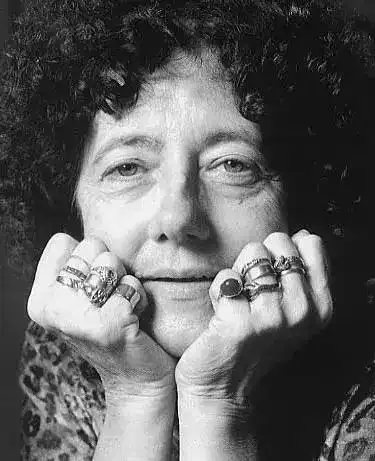
Maria Teresa Horta
 PT
PT
Maria Teresa Horta is a Portuguese writer, poet, and journalist, a prominent figure in contemporary literature. Her work, marked by the exploration of the female condition, sexuality, freedom, and identity, is distinguished by its boldness, transgressive language, and profound reflection on the body and desire. Recognized for her interventionist and feminist writing, Maria Teresa Horta has consistently challenged social and literary conventions, promoting a discourse of emancipation and affirmation of the female voice in society and art. She is one of the most unique and influential voices in Portuguese literature of recent decades.
n. 1937-05-20, Lisboa · m. 2025-02-04, Lisboa
Bio
Identification and basic context
Maria Teresa da Piedade Homem de Carvalho Horta was born in Lisbon, Portugal, on March 22, 1937. She is a writer, poet, and journalist. She writes in Portuguese.Childhood and education
Born into an upper-middle-class family. She attended secondary school in Lisbon and graduated in Germanic Philology from the Faculty of Arts of the University of Lisbon in 1963. Her academic background and contact with foreign literature, particularly English and German, were crucial for the development of her thought and work.Literary career
Her literary activity began in the 1960s, with the publication of poetry and contributions to cultural newspapers and magazines. Her career is marked by stylistic and thematic evolution, with an increasing focus on exploring the female condition and individual freedom. She was one of the founders of the Democratic Women's Movement in 1969. Her work encompasses poetry, prose, and essays, establishing her as a critical and interventionist voice.Work, style, and literary characteristics
Her most emblematic works include "A Menina Duquesa" (1966), "Amor" (1971), "Minha Senhora de Quê" (1977), and "O Terceiro Império" (1978). The dominant themes are the body, sexuality, love, freedom, female identity, social criticism, and patriarchal oppression. She explores poetic form with great freedom, using free verse and direct, sometimes transgressive language. Poetic devices are employed to deconstruct taboos and explore the inner universe. The tone of her poetry is often confessional, ironic, and combative, with a poetic voice that emerges from individual experience to become universally relevant. Her language is dense, imagistic, and challenging, marked by a strong charge of sensuality and criticism. She introduced innovations by addressing female sexuality explicitly and without fear, challenging the norms of the time. She is associated with literary renewal movements and feminism.Work, style, and literary characteristics
Cultural and historical context Maria Teresa Horta lived and wrote during the Estado Novo regime and after the Revolution of April 25, 1974. Her work reflects the need for social change and the struggle for freedom of expression and women's rights. She was an active figure in intellectual and feminist circles, engaging with other writers and activists.Work, style, and literary characteristics
Personal life Maria Teresa Horta is known for her uncompromising defense of individual freedom and female autonomy. Her personal life and her work are intrinsically linked, reflecting her convictions about the body, desire, and emancipation.Work, style, and literary characteristics
Recognition and reception Maria Teresa Horta is a highly prestigious figure in contemporary Portuguese literature. Her work has been the subject of critical and academic analysis, recognizing her importance in the renewal of Portuguese poetry and in the affirmation of literature written by women.Work, style, and literary characteristics
Influences and legacy Influenced by writers such as Gertrude Stein and by literary movements that explore subjectivity and formal freedom. Her legacy lies in her courage to address taboo subjects and her contribution to the deconstruction of patriarchal views in literature and society.Work, style, and literary characteristics
Interpretation and critical analysis Maria Teresa Horta's work is often interpreted as a feminist manifesto and a celebration of the body and desire. Critical analyses highlight her ability to subvert linguistic and social norms, paving the way for new forms of expressing the female experience.Work, style, and literary characteristics
Curiosities and lesser-known aspects She is known for her firm stance and sharp intellect. Her work is often seen as a reflection of her personal convictions, challenging the reader to confront their own perceptions of gender and sexuality.Work, style, and literary characteristics
Death and memory Still active, her work continues to be published, and her memory will undoubtedly be consolidated as one of the most important voices in contemporary Portuguese literature.Poems
0No poems found
Videos
50
Comments (0)
No comments yet. Be the first to comment.