
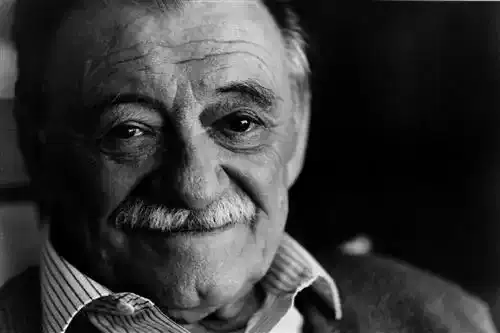
Mario Benedetti
1920–2009
· lived 88 years
 UY
UY
UY
Mario Benedetti was a renowned Uruguayan writer, poet, playwright, and journalist, considered one of the most important names in Latin American literature. His work is characterized by accessible language, a colloquial tone, and deep social sensitivity. Benedetti addressed universal themes such as love, loneliness, politics, and daily life, connecting with a vast readership through poetry and prose that reflect the anxieties and hopes of the common person.
n. 1920-09-14, Paso de los Toros · m. 2009-05-17, Montevidéu
125
Views
Bio
Identification and Basic Context
Mario Orlando Hardy Hamlet Brenno Benedetti Farrugia, known as Mario Benedetti, was a Uruguayan writer, poet, playwright, journalist, and literary critic. He was born in Paso de los Toros, Tacuarembó, Uruguay, and passed away in Montevideo. He is one of the most prominent figures in 20th-century Latin American literature.Childhood and Education
Benedetti had a childhood marked by economic difficulties. At the age of four, he moved with his family to Montevideo. He was educated in boarding schools and, although he did not complete university, his education was extensive and self-taught, with a great interest in literature, history, and politics.Literary Career
He began publishing poems in newspapers and magazines in the 1940s. His first book of poems, "La vispera indeleble," was published in 1945. He achieved international recognition with the novel "La tregua" (The Truce) in 1960. Throughout his career, he produced a vast body of work that includes poetry, novels, short stories, chronicles, and plays, with an evolution marked by thematic depth and stylistic constancy.Work, Style, and Literary Characteristics
Work, Style, and Literary Characteristics His work addresses themes such as everyday love, loneliness, old age, politics, social injustice, and urban life. "La tregua" is an epistolary novel that portrays mature love and the frustrations of office life. His poetry is known for its musicality, confessional tone, and ability to express universal feelings directly and movingly. He used clear, colloquial, and accessible language, close to everyday speech, but rich in metaphors and reflections. Free verse is predominant in his poetry, and the tone can vary between lyrical, melancholic, ironic, and engaged.Work, Style, and Literary Characteristics
Cultural and Historical Context Benedetti lived through a period of intense political and social activity in Latin America, including military dictatorships. His exile in Argentina and Cuba, due to his political stance, profoundly marked his work and life. He belonged to the generation of Latin American writers who sought to give voice to the oppressed and denounce social injustices. He maintained relationships with other important writers of his time.Work, Style, and Literary Characteristics
Personal Life He married Luz López Alegre, his companion for over 60 years, whose presence was fundamental in his life and work. His political commitment led him into exile for several years, an experience that shaped his worldview and literary production. He was an intellectual committed to social causes and a defender of democracy.Work, Style, and Literary Characteristics
Recognition and Reception Benedetti enjoyed immense popularity during his lifetime, being one of the most widely read authors in the Spanish language. He received numerous awards and distinctions worldwide. His work is widely studied in universities and translated into several languages.Work, Style, and Literary Characteristics
Influences and Legacy His work was influenced by poets like Pablo Neruda and Walt Whitman, but he developed a unique voice. Benedetti influenced generations of writers in Latin America and elsewhere with his humanistic approach and social commitment. His legacy is that of a writer who knew how to translate the complexity of modern life and human feelings into accessible and poetic language.Work, Style, and Literary Characteristics
Interpretation and Critical Analysis Benedetti's work is often analyzed as a mirror of the human condition, focusing on the fragility of relationships, the search for meaning in everyday life, and the critique of power structures. His poetry is seen as a balm for the soul and a call to reflection.Work, Style, and Literary Characteristics
Curiosities and Lesser-Known Aspects Benedetti was known for his generosity and humility, despite his immense success. He always maintained a strong connection with the Uruguayan and Latin American people.Work, Style, and Literary Characteristics
Death and Memory Mario Benedetti passed away in Montevideo in 2009, at the age of 88. His death caused great commotion in Uruguay and throughout Latin America. His memory is preserved through his vast body of work, which continues to be read and admired by millions.Poems
0No poems found
Comments (0)
Log in
to post a comment.
No comments yet. Be the first to comment.