
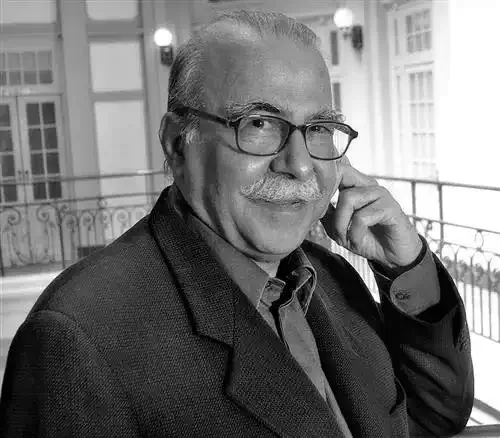
Mário Chamie
1933–2011
· lived 78 years
 BR
BR
BR
Mário Chamie was a Brazilian poet and translator, recognized for his work that moves between tradition and experimentation, exploring themes such as identity, religiosity, love, and the human condition. His poetry is marked by formal rigor, dense language, and innovative imagery, reflecting a deep interest in philosophy and various cultural manifestations. He was also an important promoter of foreign literature in Brazil through his translations.
n. 1933-04-01, Cajobi · m. 2011-07-03, São Paulo
47
Views
Bio
Identification and basic context
Mário Chamie, born in São Paulo in 1933, was a Brazilian poet, translator, and professor. His poetic work is recognized for its philosophical depth and formal experimentation, dialoguing with literary traditions and the avant-gardes of the 20th century. He wrote in Portuguese and also dedicated himself to translating important literary works.Childhood and education
Born into a family of Lebanese origin, Chamie had a childhood marked by immigration and the cultural richness of his heritage. He graduated in Law from the University of São Paulo (USP), but his passion for literature led him to pursue an academic and professional path focused on letters. His intellectual formation was broad, encompassing philosophy, linguistics, and literary studies.Literary career
Mário Chamie's literary career began in the 1950s and 1960s, a period of cultural effervescence in Brazil. He published his first poetry book, "A idade do serrote" (The Age of the Saw), in 1963. Throughout his career, he published several poetry books, exploring different phases of his writing, which varied between introspective lyricism and more radical experimentation. Besides being a poet, Chamie was a prolific translator, responsible for rendering works by authors such as T.S. Eliot, Fernando Pessoa, and William Shakespeare into Portuguese.Work, style, and literary characteristics
Chamie's poetic works include "A idade do serrote" (1963), "O corpo e o sangue" (The Body and the Blood, 1977), "Os olhos do abismo" (The Eyes of the Abyss, 1997), and "O amor é um fogo que arde" (Love is a Fire That Burns, 2002). His central themes address the human condition, the search for meaning, religiosity, love, the ephemeral nature of time, and the relationship between being and the universe. Formally, his poetry demonstrates remarkable rigor, with expressive use of language, which can range from free verse to more elaborate meter. His work is marked by semantic density, powerful imagery, and intrinsic musicality. He is associated with poetry that seeks transcendence and existential deepening, often with a philosophical and metaphysical tone.Cultural and historical context
Mário Chamie lived and produced his work during a period of great transformations in Brazil and the world, including the military dictatorship in the country. His poetry, although often introspective, reflects concerns with the human condition and the existential issues that permeate society. He maintained contact with other writers and intellectuals of his generation, actively participating in the Brazilian cultural scene.Personal life
Mário Chamie's personal life, although less publicly documented, seems to have been dedicated to reflection and artistic and intellectual pursuit. His Lebanese origin and his law degree may have influenced his worldview and his approach to language and culture. His dedication to translation reveals a deep love for literature and a desire to connect different cultural universes.Recognition and reception
The recognition of Mário Chamie's work grew over time, both from critics and the reading public interested in more elaborate and reflective poetry. His translations were also widely praised for their fidelity and literary quality. He is considered one of the important poets of contemporary Brazilian literature.Influences and legacy
Chamie was influenced by poets such as Fernando Pessoa, T.S. Eliot, and Carlos Drummond de Andrade, and by philosophical currents that explore the human condition. His legacy lies in his ability to combine formal rigor with a profound existential and spiritual exploration, as well as his significant work as a translator, which broadened access to fundamental works of universal literature.Interpretation and critical analysis
Mário Chamie's poetry is often analyzed from the perspective of its philosophical density and his search for a transcendent meaning. Critics highlight his ability to create images that connect the particular to the universal, the corporeal to the spiritual. His work has been the subject of academic studies exploring its complex layers of meaning and its contribution to Brazilian poetry.Curiosities and lesser-known aspects
An interesting aspect of his career is the duality between his legal background and his deep dedication to poetry and literary translation. His approach to translation demonstrated meticulous care with words and the aesthetic recreation of the original text.Death and memory
Mário Chamie passed away in 2010, leaving a significant poetic and translational legacy. His work continues to be revisited and celebrated, consolidating his place in the history of Brazilian literature.Poems
0No poems found
Videos
50
Comments (0)
Log in
to post a comment.
No comments yet. Be the first to comment.