
Destiny and Overcoming

Walt Whitman
I Saw Old General At Bay
I SAW old General at bay;
(Old as he was, his grey eyes yet shone out in battle like stars;)
His small force was now completely hemm'd in, in his works;
He call'd for volunteers to run the enemy's lines--a desperate
emergency;
I saw a hundred and more step forth from the ranks--but two or three
were selected;
I saw them receive their orders aside--they listen'd with care--the
adjutant was very grave;
I saw them depart with cheerfulness, freely risking their lives.
414

Johann Wolfgang von Goethe
Winter Journey Over The Hartz Mountain
LIKE the vulture
Who on heavy morning clouds
With gentle wing reposing
Looks for his prey,--
Hover, my song!
For a God hath
Unto each prescribed
His destined path,
Which the happy one
Runs o'er swiftly
To his glad goal:
He whose heart cruel
Fate hath contracted,
Struggles but vainly
Against all the barriers
The brazen thread raises,
But which the harsh shears
Must one day sever.
Through gloomy thickets
Presseth the wild deer on,
And with the sparrows
Long have the wealthy
Settled themselves in the marsh.
Easy 'tis following the chariot
That by Fortune is driven,
Like the baggage that moves
Over well-mended highways
After the train of a prince.
But who stands there apart?
In the thicket, lost is his path;
Behind him the bushes
Are closing together,
The grass springs up again,
The desert engulphs him.
Ah, who'll heal his afflictions,
To whom balsam was poison,
Who, from love's fullness,
Drank in misanthropy only?
First despised, and now a despiser,
He, in secret, wasteth
All that he is worth,
In a selfishness vain.
If there be, on thy psaltery,
Father of Love, but one tone
That to his ear may be pleasing,
Oh, then, quicken his heart!
Clear his cloud-enveloped eyes
Over the thousand fountains
Close by the thirsty one
In the desert.
Thou who createst much joy,
For each a measure o'erflowing,
Bless the sons of the chase
When on the track of the prey,
With a wild thirsting for blood,
Youthful and joyous
Avenging late the injustice
Which the peasant resisted
Vainly for years with his staff.
But the lonely one veil
Within thy gold clouds!
Surround with winter-green,
Until the roses bloom again,
The humid locks,
Oh Love, of thy minstrel!
With thy glimmering torch
Lightest thou him
Through the fords when 'tis night,
Over bottomless places
On desert-like plains;
With the thousand colours of morning
Gladd'nest his bosom;
With the fierce-biting storm
Bearest him proudly on high;
Winter torrents rush from the cliffs,--
Blend with his psalms;
An altar of grateful delight
He finds in the much-dreaded mountain's
Snow-begirded summit,
Which foreboding nations
Crown'd with spirit-dances.
Thou stand'st with breast inscrutable,
Mysteriously disclosed,
High o'er the wondering world,
And look'st from clouds
Upon its realms and its majesty,
Which thou from the veins of thy brethren
Near thee dost water.
406
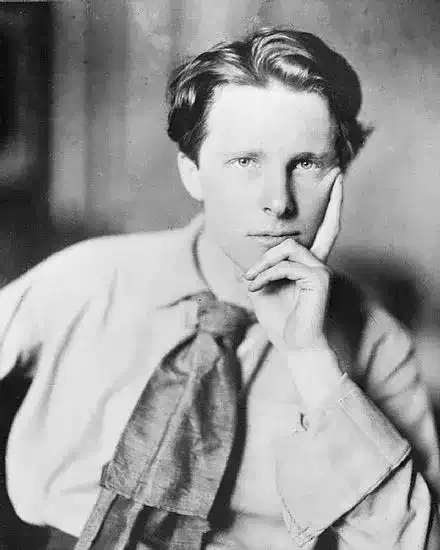
Rupert Brooke
The Night Journey
Hands and lit faces eddy to a line;
The dazed last minutes click; the clamour dies.
Beyond the great-swung arc o’ the roof, divine,
Night, smoky-scarv’d, with thousand coloured eyes
Glares the imperious mystery of the way.
Thirsty for dark, you feel the long-limbed train
Throb, stretch, thrill motion, slide, pull out and sway,
Strain for the far, pause, draw to strength again.…
As a man, caught by some great hour, will rise,
Slow-limbed, to meet the light or find his love;
And, breathing long, with staring sightless eyes,
Hands out, head back, agape and silent, move
Sure as a flood, smooth as a vast wind blowing;
And, gathering power and purpose as he goes,
Unstumbling, unreluctant, strong, unknowing,
Borne by a will not his, that lifts, that grows,
Sweep out to darkness, triumphing in his goal,
Out of the fire, out of the little room.…
—There is an end appointed, O my soul!
Crimson and green the signals burn; the gloom
Is hung with steam’s far-blowing livid streamers.
Lost into God, as lights in light, we fly,
Grown one with will, end-drunken huddled dreamers.
The white lights roar. The sounds of the world die.
And lips and laughter are forgotten things.
Speed sharpens; grows. Into the night, and on,
The strength and splendour of our purpose swings.
The lamps fade; and the stars. We are alone.
408

Ella Wheeler Wilcox
Attainment
Use all your hidden forces.
Do not miss the purpose of this life,
and do not wait for circumstance
to mold or change your fate.
In your own self lies destiny.
Let this vast truth cast out all fear,
all prejudice, all hesitation.
Know that you are great -great
with divinity.
Do dominate environment, and enter into bliss.
Live largely, and hate nothing.
Hold no aim that does not chord
with universal good.
Hear what the voices of the silence say.
All joys are yours if you put forth your claim.
Once you let the spiritual laws be understood,
material things must answer and obey.
405
Johann Wolfgang von Goethe
Another
Go! obedient to my call,
Turn to profit thy young days,
Wiser make betimes thy breast
In Fate's balance as it sways,
Seldom is the cock at rest;
Thou must either mount, or fall,
Thou must either rule and win,
Or submissively give in,
Triumph, or else yield to clamour:
Be the anvil or the hammer.
Turn to profit thy young days,
Wiser make betimes thy breast
In Fate's balance as it sways,
Seldom is the cock at rest;
Thou must either mount, or fall,
Thou must either rule and win,
Or submissively give in,
Triumph, or else yield to clamour:
Be the anvil or the hammer.
399

William Butler Yeats
Solomon And The Witch
AND thus declared that Arab lady:
'Last night, where under the wild moon
On grassy mattress I had laid me,
Within my arms great Solomon,
I suddenly cried out in a strange tongue
Not his, not mine.'
Who understood
Whatever has been said, sighed, sung,
Howled, miau-d, barked, brayed, belled, yelled, cried, crowed,
Thereon replied: 'A cockerel
Crew from a blossoming apple bough
Three hundred years before the Fall,
And never crew again till now,
And would not now but that he thought,
Chance being at one with Choice at last,
All that the brigand apple brought
And this foul world were dead at last.
He that crowed out eternity
Thought to have crowed it in again.
For though love has a spider's eye
To find out some appropriate pain --
Aye, though all passion's in the glance --
For every nerve, and tests a lover
With cruelties of Choice and Chance;
And when at last that murder's over
Maybe the bride-bed brings despair,
For each an imagined image brings
And finds a real image there;
Yet the world ends when these two things,
Though several, are a single light,
When oil and wick are burned in one;
Therefore a blessed moon last night
Gave Sheba to her Solomon.'
'Yet the world stays.'
'If that be so,
Your cockerel found us in the wrong
Although he thought it. worth a crow.
Maybe an image is too strong
Or maybe is not strong enough.'
'The night has fallen; not a sound
In the forbidden sacred grove
Unless a petal hit the ground,
Nor any human sight within it
But the crushed grass where we have lain!
And the moon is wilder every minute.
O! Solomon! let us try again.'
401
Johann Wolfgang von Goethe
As Broad As It's Long
MODEST men must needs endure,
And the bold must humbly bow;
Thus thy fate's the same, be sure,
Whether bold or modest thou.
And the bold must humbly bow;
Thus thy fate's the same, be sure,
Whether bold or modest thou.
402

Rudyard Kipling
A Lover's Journey
When a lover hies abroad
Looking for his love,
Azrael smiling sheathes his sword,
Heaven smiles above.
Earth and sea
His servants be,
And to lesser compass round,
That his love be sooner found!
Looking for his love,
Azrael smiling sheathes his sword,
Heaven smiles above.
Earth and sea
His servants be,
And to lesser compass round,
That his love be sooner found!
398
Johann Wolfgang von Goethe
Neither This Nor That
IF thou to be a slave shouldst will,
Thou'lt get no pity, but fare ill;
And if a master thou wouldst be,
The world will view it angrily;
And if in status quo thou stay,
That thou art but a fool, they'll say.
Thou'lt get no pity, but fare ill;
And if a master thou wouldst be,
The world will view it angrily;
And if in status quo thou stay,
That thou art but a fool, they'll say.
396

Henry Wadsworth Longfellow
The Song Of Hiawatha V: Hiawatha's Fasting
You shall hear how Hiawatha
Prayed and fasted in the forest,
Not for greater skill in hunting,
Not for greater craft in fishing,
Not for triumphs in the battle,
And renown among the warriors,
But for profit of the people,
For advantage of the nations.
First he built a lodge for fasting,
Built a wigwam in the forest,
By the shining Big-Sea-Water,
In the blithe and pleasant Spring-time,
In the Moon of Leaves he built it,
And, with dreams and visions many,
Seven whole days and nights he fasted.
On the first day of his fasting
Through the leafy woods he wandered;
Saw the deer start from the thicket,
Saw the rabbit in his burrow,
Heard the pheasant, Bena, drumming,
Heard the squirrel, Adjidaumo,
Rattling in his hoard of acorns,
Saw the pigeon, the Omeme,
Building nests among the pinetrees,
And in flocks the wild-goose, Wawa,
Flying to the fen-lands northward,
Whirring, wailing far above him.
'Master of Life!' he cried, desponding,
'Must our lives depend on these things?'
On the next day of his fasting
By the river's brink he wandered,
Through the Muskoday, the meadow,
Saw the wild rice, Mahnomonee,
Saw the blueberry, Meenahga,
And the strawberry, Odahmin,
And the gooseberry, Shahbomin,
And the grape.vine, the Bemahgut,
Trailing o'er the alder-branches,
Filling all the air with fragrance!
'Master of Life!' he cried, desponding,
'Must our lives depend on these things?'
On the third day of his fasting
By the lake he sat and pondered,
By the still, transparent water;
Saw the sturgeon, Nahma, leaping,
Scattering drops like beads of wampum,
Saw the yellow perch, the Sahwa,
Like a sunbeam in the water,
Saw the pike, the Maskenozha,
And the herring, Okahahwis,
And the Shawgashee, the crawfish!
'Master of Life!' he cried, desponding,
'Must our lives depend on these things?'
On the fourth day of his fasting
In his lodge he lay exhausted;
From his couch of leaves and branches
Gazing with half-open eyelids,
Full of shadowy dreams and visions,
On the dizzy, swimming landscape,
On the gleaming of the water,
On the splendor of the sunset.
And he saw a youth approaching,
Dressed in garments green and yellow,
Coming through the purple twilight,
Through the splendor of the sunset;
Plumes of green bent o'er his forehead,
And his hair was soft and golden.
Standing at the open doorway,
Long he looked at Hiawatha,
Looked with pity and compassion
On his wasted form and features,
And, in accents like the sighing
Of the South-Wind in the tree-tops,
Said he, 'O my Hiawatha!
All your prayers are heard in heaven,
For you pray not like the others;
Not for greater skill in hunting,
Not for greater craft in fishing,
Not for triumph in the battle,
Nor renown among the warriors,
But for profit of the people,
For advantage of the nations.
'From the Master of Life descending,
I, the friend of man, Mondamin,
Come to warn you and instruct you,
How by struggle and by labor
You shall gain what you have prayed for.
Rise up from your bed of branches,
Rise, O youth, and wrestle with me!'
Faint with famine, Hiawatha
Started from his bed of branches,
From the twilight of his wigwam
Forth into the flush of sunset
Came, and wrestled with Mondamin;
At his touch he felt new courage
Throbbing in his brain and bosom,
Felt new life and hope and vigor
Run through every nerve and fibre.
So they wrestled there together
In the glory of the sunset,
And the more they strove and struggled,
Stronger still grew Hiawatha;
Till the darkness fell around them,
And the heron, the Shuh-shuh-gah,
From her nest among the pine-trees,
Gave a cry of lamentation,
Gave a scream of pain and famine.
''T Is enough!' then said Mondamin,
Smiling upon Hiawatha,
'But tomorrow, when the sun sets,
I will come again to try you.'
And he vanished, and was seen not;
Whether sinking as the rain sinks,
Whether rising as the mists rise,
Hiawatha saw not, knew not,
Only saw that he had vanished,
Leaving him alone and fainting,
With the misty lake below him,
And the reeling stars above him.
On the morrow and the next day,
When the sun through heaven descending,
Like a red and burning cinder
From the hearth of the Great Spirit,
Fell into the western waters,
Came Mondamin for the trial,
For the strife with Hiawatha;
Came as silent as the dew comes,
From the empty air appearing,
Into empty air returning,
Taking shape when earth it touches,
But invisible to all men
In its coming and its going.
Thrice they wrestled there together
In the glory of the sunset,
Till the darkness fell around them,
Till the heron, the Shuh-shuh-gah,
From her nest among the pine-trees,
Uttered her loud cry of famine,
And Mondamin paused to listen.
Tall and beautiful he stood there,
In his garments green and yellow;
To and fro his plumes above him,
Waved and nodded with his breathing,
And the sweat of the encounter
Stood like drops of dew upon him.
And he cried, 'O Hiawatha!
Bravely have you wrestled with me,
Thrice have wrestled stoutly with me,
And the Master of Life, who sees us,
He will give to you the triumph!'
Then he smiled, and said: 'To-morrow
Is the last day of your conflict,
Is the last day of your fasting.
You will conquer and o'ercome me;
Make a bed for me to lie in,
Where the rain may fall upon me,
Where the sun may come and warm me;
Strip these garments, green and yellow,
Strip this nodding plumage from me,
Lay me in the earth, and make it
Soft and loose and light above me.
'Let no hand disturb my slumber,
Let no weed nor worm molest me,
Let not Kahgahgee, the raven,
Come to haunt me and molest me,
Only come yourself to watch me,
Till I wake, and start, and quicken,
Till I leap into the sunshine'
And thus saying, he departed;
Peacefully slept Hiawatha,
But he heard the Wawonaissa,
Heard the whippoorwill complaining,
Perched upon his lonely wigwam;
Heard the rushing Sebowisha,
Heard the rivulet rippling near him,
Talking to the darksome forest;
Heard the sighing of the branches,
As they lifted and subsided
At the passing of the night-wind,
Heard them, as one hears in slumber
Far-off murmurs, dreamy whispers:
Peacefully slept Hiawatha.
On the morrow came Nokomis,
On the seventh day of his fasting,
Came with food for Hiawatha,
Came imploring and bewailing,
Lest his hunger should o'ercome him,
Lest his fasting should be fatal.
But he tasted not, and touched not,
Only said to her, 'Nokomis,
Wait until the sun is setting,
Till the darkness falls around us,
Till the heron, the Shuh-shuh-gah,
Crying from the desolate marshes,
Tells us that the day is ended.'
Homeward weeping went Nokomis,
Sorrowing for her Hiawatha,
Fearing lest his strength should fail him,
Lest his fasting should be fatal.
He meanwhile sat weary waiting
For the coming of Mondamin,
Till the shadows, pointing eastward,
Lengthened over field and forest,
Till the sun dropped from the heaven,
Floating on the waters westward,
As a red leaf in the Autumn
Falls and floats upon the water,
Falls and sinks into its bosom.
And behold! the young Mondamin,
With his soft and shining tresses,
With his garments green and yellow,
With his long and glossy plumage,
Stood and beckoned at the doorway.
And as one in slumber walking,
Pale and haggard, but undaunted,
From the wigwam Hiawatha
Came and wrestled with Mondamin.
Round about him spun the landscape,
Sky and forest reeled together,
And his strong heart leaped within him,
As the sturgeon leaps and struggles
In a net to break its meshes.
Like a ring of fire around him
Blazed and flared the red horizon,
And a hundred suns seemed looking
At the combat of the wrestlers.
Suddenly upon the greensward
All alone stood Hiawatha,
Panting with his wild exertion,
Palpitating with the struggle;
And before him breathless, lifeless,
Lay the youth, with hair dishevelled,
Plumage torn, and garments tattered,
Dead he lay there in the sunset.
And victorious Hiawatha
Made the grave as he commanded,
Stripped the garments from Mondamin,
Stripped his tattered plumage from him,
Laid him in the earth, and made it
Soft and loose and light above him;
And the heron, the Shuh-shuh-gah,
From the melancholy moorlands,
Gave a cry of lamentation,
Gave a cry of pain and anguish!
Homeward then went Hiawatha
To the lodge of old Nokomis,
And the seven days of his fasting
Were accomplished and completed.
But the place was not forgotten
Where he wrestled with Mondamin;
Nor forgotten nor neglected
Was the grave where lay Mondamin,
Sleeping in the rain and sunshine,
Where his scattered plumes and garments
Faded in the rain and sunshine.
Day by day did Hiawatha
Go to wait and watch beside it;
Kept the dark mould soft above it,
Kept it clean from weeds and insects,
Drove away, with scoffs and shoutings,
Kahgahgee, the king of ravens.
Till at length a small green feather
From the earth shot slowly upward,
Then another and another,
And before the Summer ended
Stood the maize in all its beauty,
With its shining robes about it,
And its long, soft, yellow tresses;
And in rapture Hiawatha
Cried aloud, 'It is Mondamin!
Yes, the friend of man, Mondamin!'
Then he called to old Nokomis
And Iagoo, the great boaster,
Showed them where the maize was growing,
Told them of his wondrous vision,
Of his wrestling and his triumph,
Of this new gift to the nations,
Which should be their food forever.
And still later, when the Autumn
Changed the long, green leaves to yellow,
And the soft and juicy kernels
Grew like wampum hard and yellow,
Then the ripened ears he gathered,
Stripped the withered husks from off them,
As he once had stripped the wrestler,
Gave the first Feast of Mondamin,
And made known unto the people
This new gift of the Great Spirit.
395
Ella Wheeler Wilcox
To An Astrologer
Nay, seer, I do not doubt thy mystic lore,
Nor question that the tenor of my life,
Past, present and the future, is revealed
There in my horoscope. I do believe
That yon dead moon compels the haughty seas
To ebb and flow, and that my natal star
Stands like a stern-browed sentinel in space
And challenges events; nor lets one grief,
Or joy, or failure, or success, pass on
To mar or bless my earthly lot, until
It proves its Karmic right to come to me.
All this I grant, but more than this I know!
Before the solar systems were conceived,
When nothing was but the unnamable,
My spirit lived, an atom of the Cause.
Through countless ages and in many forms
It has existed, ere it entered in
This human frame to serve its little day
Upon the earth. The deathless Me of me,
The spark from that great all-creative fire
Is part of that eternal source called God,
And mightier than the universe.
Why, he
Who knows, and knowing, never once forgets
The pedigree divine of his own soul,
Can conquer, shape and govern destiny
And use vast space as ‘twere a board for chess
With stars for pawns; can change his horoscope
To suit his will; turn failure to success,
And from preordained sorrows, harvest joy.
There is no puny planet, sun or moon,
Or zodiacal sign which can control
The God in us! If we bring that to bear
Upon events, we mold them to our wish,
Tis when the infinite ‘neath the finite gropes
That men are governed by their horoscopes.
391
Rudyard Kipling
Kim
Unto whose use the pregnant suns are poised,
With idiot moons and stars retracting stars?
Creep thou between -- thy coming's all unnoised.
Heaven hath her high, as Earth her baser, wars.
Heir to these tumults, this affright, that fray
(By Adam's, fathers', own, sin bound alway);
Peer up, draw out thy horoscope and say
Which planet mends thy threadbare fate, or mars.
385

Robert Louis Stevenson
Sonnet I
NOR judge me light, tho' light at times I seem,
And lightly in the stress of fortune bear
The innumerable flaws of changeful care -
Nor judge me light for this, nor rashly deem
(Office forbid to mortals, kept supreme
And separate the prerogative of God!)
That seaman idle who is borne abroad
To the far haven by the favouring stream.
Not he alone that to contrarious seas
Opposes, all night long, the unwearied oar,
Not he alone, by high success endeared,
Shall reach the Port; but, winged, with some light breeze
Shall they, with upright keels, pass in before
Whom easy Taste, the golden pilot, steered.
384
Rudyard Kipling
The Conversion of Aurelian McGoggin
Ride with an idle whip, ride with an unused heel,
But, once in a way, there will come a day
When the colt must be taught to feel
The lash that falls, and the curb that galls, and the sting
of the rowelled steel.
But, once in a way, there will come a day
When the colt must be taught to feel
The lash that falls, and the curb that galls, and the sting
of the rowelled steel.
382
Henry Wadsworth Longfellow
The Luck of Edenhall. From The German Of Uhland
Of Edenhall, the youthful Lord
Bids sound the festal trumpet's call.
He rises at the banquet board,
And cries, 'mid the drunken revellers all,
'Now bring me the Luck of Edenhall!'
The butler hears the words with pain,
The house's oldest seneschal,
Takes slow from its silken cloth again
The drinking glass of crystal tall;
They call it The Luck of Edenhall.
Then said the Lord, 'This glass to praise,
Fill with red wine from Portugal!'
The graybeard with trembling hand obeys;
A purple light shines over all,
It beams from the Luck of Edenhall.
Then speaks the Lord, and waves it light:
'This glass of flashing crystal tall
Gave to my sires the Fountain-Sprite;
She wrote in it,
If this glass doth fall,
Farewell then, O Luck of Edenhall!
''Twas right a goblet the Fate should be
Of the joyous race of Edenhall!
Deep draughts drink we right willingly:
And willingly ring, with merry call,
Kling! klang! to the Luck of Edenhall!'
First rings it deep, and full, and mild,
Like to the song of a nightingale
Then like the roar of a torrent wild;
Then mutters at last like the thunder's fall,
The glorious Luck of Edenhall.
'For its keeper takes a race of might,
The fragile goblet of crystal tall;
It has lasted longer than is right;
King! klang!--with a harder blow than all
Will I try the Luck of Edenhall!'
As the goblet ringing flies apart,
Suddenly cracks the vaulted hall;
And through the rift, the wild flames start;
The guests in dust are scattered all,
With the breaking Luck of Edenhall!
In storms the foe, with fire and sword;
He in the night had scaled the wall,
Slain by the sword lies the youthful Lord,
But holds in his hand the crystal tall,
The shattered Luck of Edenhall.
On the morrow the butler gropes alone,
The graybeard in the desert hall,
He seeks his Lord's burnt skeleton,
He seeks in the dismal ruin's fall
The shards of the Luck of Edenhall.
'The stone wall,' saith he, 'doth fall aside,
Down must the stately columns fall;
Glass is this earth's Luck and Pride;
In atoms shall fall this earthly ball
One day like the Luck of Edenhall!'
380
Ella Wheeler Wilcox
In the Long Run
In the long run fame finds the deserving man.
The lucky wight may prosper for a day,
But in good time true merit leads the van,
And vain pretense, unnoticed, goes its way.
There is no Chance, no Destiny, no Fate,
But Fortune smiles on those who work and wait,
In the long run.
In the long run all goodly sorrow pays,
There is no better thing than righteous pain,
The sleepless nights, the awful thorn-crowned days,
Bring sure reward to tortured soul and brain.
Unmeaning joys enervate in the end,
But sorrow yields a glorious dividend
In the long run.
In the long run all hidden things are known,
The eye of truth will penetrate the night,
And good or ill, thy secret shall be known,
However well 't is guarded from the light.
All the unspoken motives of the breast
Are fathomed by the years and stand confest
In the long run.
In the long run all love is paid by love,
Though undervalued by the hosts of earth;
The great eternal Governemnt above
Keeps strict account and will redeem its worth.
Give thy love freely; do not count the cost;
So beautiful a thing was never lost
In the long run.
380
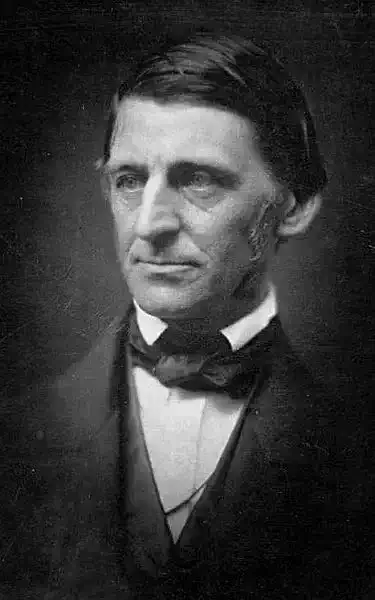
Ralph Waldo Emerson
The Park
The prosperous and beautiful
To me seem not to wear
The yoke of conscience masterful,
Which galls me everywhere.
I cannot shake off the god;
On my neck he makes his seat;
I look at my face in the glass,
My eyes his eye-balls meet.
Enchanters! enchantresses!
Your gold makes you seem wise:
The morning mist within your grounds
More proudly rolls, more softly lies.
Yet spake yon purple mountain,
Yet said yon ancient wood,
That night or day, that love or crime
Lead all souls to the Good.
377
William Butler Yeats
The Indian To His Love
THE island dreams under the dawn
And great boughs drop tranquillity;
The peahens dance on a smooth lawn,
A parrot sways upon a tree,
Raging at his own image in the enamelled sea.
Here we will moor our lonely ship
And wander ever with woven hands,
Murmuring softly lip to lip,
Along the grass, along the sands,
Murmuring how far away are the unquiet lands:
How we alone of mortals are
Hid under quiet boughs apart,
While our love grows an Indian star,
A meteor of the burning heart,
One with the tide that gleams, the wings that gleam
and dart,
The heavy boughs, the burnished dove
That moans and sighs a hundred days:
How when we die our shades will rove,
When eve has hushed the feathered ways,
With vapoury footsole by the water's drowsy blaze.
375
Alexander Pope
From an Essay on Man
Heav'n from all creatures hides the book of fate,
All but the page prescrib'd, their present state:
From brutes what men, from men what spirits know:
Or who could suffer being here below?
The lamb thy riot dooms to bleed today,
Had he thy reason, would he skip and play?
Pleas'd to the last, he crops the flow'ry food,
And licks the hand just rais'd to shed his blood.
Oh blindness to the future! kindly giv'n,
That each may fill the circle mark'd by Heav'n:
Who sees with equal eye, as God of all,
A hero perish, or a sparrow fall,
Atoms or systems into ruin hurl'd,
And now a bubble burst, and now a world.
Hope humbly then; with trembling pinions soar;
Wait the great teacher Death; and God adore.
What future bliss, he gives not thee to know,
But gives that hope to be thy blessing now.
Hope springs eternal in the human breast:
Man never is, but always to be blest:
The soul, uneasy and confin'd from home,
Rests and expatiates in a life to come.
Lo! the poor Indian, whose untutor'd mind
Sees God in clouds, or hears him in the wind;
His soul, proud science never taught to stray
Far as the solar walk, or milky way;
Yet simple nature to his hope has giv'n,
Behind the cloud topp'd hill, an humbler heav'n;
Some safer world in depth of woods embrac'd,
Some happier island in the wat'ry waste,
Where slaves once more their native land behold,
No fiends torment, no Christians thirst for gold.
To be, contents his natural desire,
He asks no angel's wing, no seraph's fire;
But thinks, admitted to that equal sky.
376

Walter de la Mare
Alexander
It was the Great Alexander,
Capped with a golden helm,
Sate in the ages, in his floating ship,
In a dead calm.
Voices of sea-maids singing
Wandered across the deep:
The sailors labouring on their oars
Rowed as in sleep.
All the high pomp of Asia,
Charmed by that siren lay,
Out of their weary and dreaming minds
Faded away.
Like a bold boy sate their Captain,
His glamour withered and gone,
In the souls of his brooding mariners,
While the song pined on.
Time like a falling dew,
Life like the scene of a dream
Laid between slumber and slumber
Only did seem. . . .
O Alexander, then,
In all us mortals too,
Wax not so overbold
On the wave dark-blue!
Come the calm starry night,
Who then will hear
Aught save the singing
Of the sea-maids clear?
376

Emily Dickinson
It's easy to invent a Life
It's easy to invent a Life-
God does it-every DayCreation-
but the Gambol
Of His Authority
It's easy to efface it-
The thrifty Deity
Could scarce afford Eternity
To Spontaneity-
The Perished Patterns murmur-
But His Perturbless Plan
Proceed-inserting Here-a SunThere-
leaving out a Man-
God does it-every DayCreation-
but the Gambol
Of His Authority
It's easy to efface it-
The thrifty Deity
Could scarce afford Eternity
To Spontaneity-
The Perished Patterns murmur-
But His Perturbless Plan
Proceed-inserting Here-a SunThere-
leaving out a Man-
367

Carl Sandburg
Population Drifts
New-mown hay smell and wind of the plain made her
a woman whose ribs had the power of the hills in
them and her hands were tough for work and there
was passion for life in her womb.
She and her man crossed the ocean and the years that
marked their faces saw them haggling with landlords
and grocers while six children played on the stones
and prowled in the garbage cans.
One child coughed its lungs away, two more have adenoids
and can neither talk nor run like their mother,
one is in jail, two have jobs in a box factory
And as they fold the pasteboard, they wonder what the
wishing is and the wistful glory in them that flutters
faintly when the glimmer of spring comes on
the air or the green of summer turns brown:
They do not know it is the new-mown hay smell calling
and the wind of the plain praying for them to come
back and take hold of life again with tough hands
and with passion.
366
Henry Wadsworth Longfellow
King Trisanku
Viswamitra the Magician,
By his spells and incantations,
Up to Indra's realms elysian
Raised Trisanku, king of nations.
Indra and the gods offended
Hurled him downward, and descending
In the air he hung suspended,
With these equal powers contending.
Thus by aspirations lifted,
By misgivings downward driven,
Human hearts are tossed and drifted
Midway between earth and heaven.
362
Henry Wadsworth Longfellow
The Saga of King Olaf: XVIII. King Olaf And Earl Sigvald
On the gray sea-sands
King Olaf stands,
Northward and seaward
He points with his hands.
With eddy and whirl
The sea-tides curl,
Washing the sandals
Of Sigvald the Earl.
The mariners shout,
The ships swing about,
The yards are all hoisted,
The sails flutter out.
The war-horns are played,
The anchors are weighed,
Like moths in the distance
The sails flit and fade.
The sea is like lead
The harbor lies dead,
As a corse on the sea-shore,
Whose spirit has fled!
On that fatal day,
The histories say,
Seventy vessels
Sailed out of the bay.
But soon scattered wide
O'er the billows they ride,
While Sigvald and Olaf
Sail side by side.
Cried the Earl: 'Follow me!
I your pilot will be,
For I know all the channels
Where flows the deep sea!'
So into the strait
Where his foes lie in wait,
Gallant King Olaf
Sails to his fate!
Then the sea-fog veils
The ships and their sails;
Queen Sigrid the Haughty,
Thy vengeance prevails!
363