
Happiness and Joy
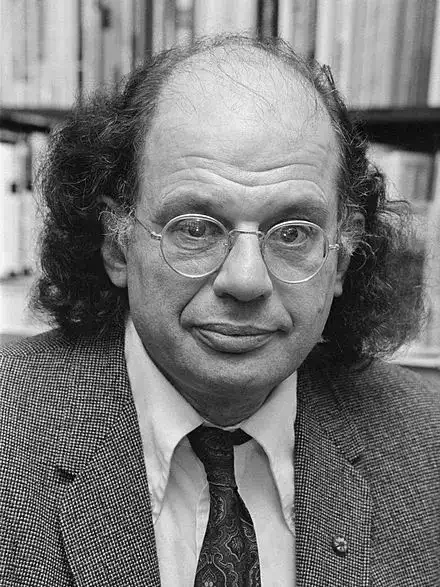
Allen Ginsberg
Syllables at Rocky Mountain Dharma Center
Tail turned to red sunset on a juniper crown a lone magpie cawks.
Mad at Oryoki in the shrine-room -- Thistles blossomed late afternoon.
Put on my shirt and took it off in the sun walking the path to lunch.
A dandelion seed floats above the marsh grass with the mosquitos.
At 4 A.M. the two middleaged men sleeping together holding hands.
In the half-light of dawn a few birds warble under the Pleiades.
Sky reddens behind fir trees, larks twitter, sparrows cheep cheep cheep
cheep cheep.
646

Paul Laurence Dunbar
Summer in the South
The Oriole sings in the greening grove
As if he were half-way waiting,
The rosebuds peep from their hoods of green,
Timid, and hesitating.
The rain comes down in a torrent sweep
And the nights smell warm and pinety,
The garden thrives, but the tender shoots
Are yellow-green and tiny.
Then a flash of sun on a waiting hill,
Streams laugh that erst were quiet,
The sky smiles down with a dazzling blue
And the woods run mad with riot.
638
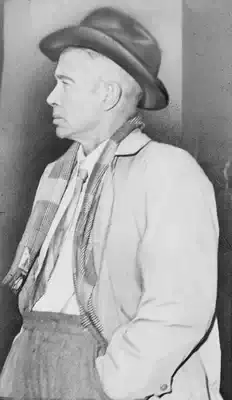
E. E. Cummings
in just
in Justspring
when the world is mudluscious
the little
lame balloonman
whistles far and wee
and eddieandbill come
running from marbles and
piracies and it's spring
when the world is puddle-wonderful
the queer
old balloonman whistles
far and wee
and bettyandisbel come dancing
from hop-scotch and jump-rope and
it's spring
and the goat-footed
balloonMan whistles
far
and
wee
633

Walt Whitman
Poems Of Joys
O TO make the most jubilant poem!
Even to set off these, and merge with these, the carols of Death.
O full of music! full of manhood, womanhood, infancy!
Full of common employments! full of grain and trees.
O for the voices of animals! O for the swiftness and balance of
fishes!
O for the dropping of rain-drops in a poem!
O for the sunshine, and motion of waves in a poem.
O the joy of my spirit! it is uncaged! it darts like lightning!
It is not enough to have this globe, or a certain time--I will have
thousands of globes, and all time.
O the engineer's joys!
To go with a locomotive!
To hear the hiss of steam--the merry shriek--the steam-whistle--the
laughing locomotive!
To push with resistless way, and speed off in the distance.
O the gleesome saunter over fields and hill-sides!
The leaves and flowers of the commonest weeds--the moist fresh
stillness of the woods,
The exquisite smell of the earth at day-break, and all through the
forenoon.
O the horseman's and horsewoman's joys!
The saddle--the gallop--the pressure upon the seat--the cool gurgling
by the ears and hair.
O the fireman's joys!
I hear the alarm at dead of night,
I hear bells--shouts!--I pass the crowd--I run!
The sight of the flames maddens me with pleasure.
O the joy of the strong-brawn'd fighter, towering in the arena, in
perfect condition, conscious of power, thirsting to meet his
opponent.
O the joy of that vast elemental sympathy which only the human Soul
is capable of generating and emitting in steady and limitless
floods.
O the mother's joys!
The watching--the endurance--the precious love--the anguish--the
patiently yielded life.
O the joy of increase, growth, recuperation;
The joy of soothing and pacifying--the joy of concord and harmony.
O to go back to the place where I was born!
To hear the birds sing once more!
To ramble about the house and barn, and over the fields, once more,
And through the orchard and along the old lanes once more.
O male and female!
O the presence of women! (I swear there is nothing more exquisite to
me than the mere presence of women;)
O for the girl, my mate! O for the happiness with my mate!
O the young man as I pass! O I am sick after the friendship of him
who, I fear, is indifferent to me.
O the streets of cities!
The flitting faces--the expressions, eyes, feet, costumes! O I cannot
tell how welcome they are to me.
O to have been brought up on bays, lagoons, creeks, or along the
coast!
O to continue and be employ'd there all my life!
O the briny and damp smell--the shore--the salt weeds exposed at low
water,
The work of fishermen--the work of the eel-fisher and clam-fisher.
O it is I!
I come with my clam-rake and spade! I come with my eel-spear;
Is the tide out? I join the group of clam-diggers on the flats,
I laugh and work with them--I joke at my work, like a mettlesome
young man.
In winter I take my eel-basket and eel-spear and travel out on foot
on the ice--I have a small axe to cut holes in the ice;
Behold me, well-clothed, going gaily, or returning in the afternoon-my
brood of tough boys accompaning me,
My brood of grown and part-grown boys, who love to be with no one
else so well as they love to be with me,
By day to work with me, and by night to sleep with me.
Or, another time, in warm weather, out in a boat, to lift the
lobster-pots, where they are sunk with heavy stones, (I know
the buoys;)
O the sweetness of the Fifth-month morning upon the water, as I row,
just before sunrise, toward the buoys;
I pull the wicker pots up slantingly--the dark-green lobsters are
desperate with their claws, as I take them out--I insert wooden
pegs in the joints of their pincers,
I go to all the places, one after another, and then row back to the
shore,
There, in a huge kettle of boiling water, the lobsters shall be
boil'd till their color becomes scarlet.
Or, another time, mackerel-taking,
Voracious, mad for the hook, near the surface, they seem to fill the
water for miles:
Or, another time, fishing for rock-fish, in Chesapeake Bay--I one of
the brown-faced crew:
Or, another time, trailing for blue-fish off Paumanok, I stand with
braced body,
My left foot is on the gunwale--my right arm throws the coils of
slender rope,
In sight around me the quick veering and darting of fifty skiffs, my
companions.
O boating on the rivers!
The voyage down the Niagara, (the St. Lawrence,)--the superb
scenery--the steamers,
The ships sailing--the Thousand Islands--the occasional timber-raft,
and the raftsmen with long-reaching sweep-oars,
The little huts on the rafts, and the stream of smoke when they cook
their supper at evening.
O something pernicious and dread!
Something far away from a puny and pious life!
Something unproved! Something in a trance!
Something escaped from the anchorage, and driving free.
O to work in mines, or forging iron!
Foundry casting--the foundry itself--the rude high roof--the ample
and shadow'd space,
The furnace--the hot liquid pour'd out and running.
O to resume the joys of the soldier:
To feel the presence of a brave general! to feel his sympathy!
To behold his calmness! to be warm'd in the rays of his smile!
To go to battle! to hear the bugles play, and the drums beat!
To hear the crash of artillery! to see the glittering of the bayonets
and musket-barrels in the sun!
To see men fall and die, and not complain!
To taste the savage taste of blood! to be so devilish!
To gloat so over the wounds and deaths of the enemy.
O the whaleman's joys! O I cruise my old cruise again!
I feel the ship's motion under me--I feel the Atlantic breezes
fanning me,
I hear the cry again sent down from the mast-head--There--she blows!
--Again I spring up the rigging, to look with the rest--We see--we
descend, wild with excitement,
I leap in the lower'd boat--We row toward our prey, where he lies,
We approach, stealthy and silent--I see the mountainous mass,
lethargic, basking,
I see the harpooneer standing up--I see the weapon dart from his
vigorous arm:
O swift, again, now, far out in the ocean, the wounded whale,
settling, running to windward, tows me;
--Again I see him rise to breathe--We row close again,
I see a lance driven through his side, press'd deep, turn'd in the
wound,
Again we back off--I see him settle again--the life is leaving him
fast,
As he rises, he spouts blood--I see him swim in circles narrower and
narrower, swiftly cutting the water--I see him die;
He gives one convulsive leap in the centre of the circle, and then
falls flat and still in the bloody foam.
O the old manhood of me, my joy!
My children and grand-children--my white hair and beard,
My largeness, calmness, majesty, out of the long stretch of my life.
O the ripen'd joy of womanhood!
O perfect happiness at last!
I am more than eighty years of age--my hair, too, is pure white--I am
the most venerable mother;
How clear is my mind! how all people draw nigh to me!
What attractions are these, beyond any before? what bloom, more than
the bloom of youth?
What beauty is this that descends upon me, and rises out of me?
O the orator's joys!
To inflate the chest--to roll the thunder of the voice out from the
ribs and throat,
To make the people rage, weep, hate, desire, with yourself,
To lead America--to quell America with a great tongue.
O the joy of my soul leaning pois'd on itself--receiving identity
through materials, and loving them--observing characters, and
absorbing them;
O my soul, vibrated back to me, from them--from facts, sight,
hearing, touch, my phrenology, reason, articulation,
comparison, memory, and the like;
The real life of my senses and flesh, transcending my senses and
flesh;
My body, done with materials--my sight, done with my material
eyes;
Proved to me this day, beyond cavil, that it is not my material
eyes which finally see,
Nor my material body which finally loves, walks, laughs, shouts,
embraces, procreates.
O the farmer's joys!
Ohioan's, Illinoisian's, Wisconsinese', Kanadian's, Iowan's,
Kansian's, Missourian's, Oregonese' joys;
To rise at peep of day, and pass forth nimbly to work,
To plow land in the fall for winter-sown crops,
To plough land in the spring for maize,
To train orchards--to graft the trees--to gather apples in the fall.
O the pleasure with trees!
The orchard--the forest--the oak, cedar, pine, pekan-tree,
The honey-locust, black-walnut, cottonwood, and magnolia.
O Death! the voyage of Death!
The beautiful touch of Death, soothing and benumbing a few moments,
for reasons;
Myself, discharging my excrementitious body, to be burn'd, or
render'd to powder, or buried,
My real body doubtless left to me for other spheres,
My voided body, nothing more to me, returning to the purifications,
further offices, eternal uses of the earth.
O to bathe in the swimming-bath, or in a good place along shore!
To splash the water! to walk ankle-deep--to race naked along the
shore.
O to realize space!
The plenteousness of all--that there are no bounds;
To emerge, and be of the sky--of the sun and moon, and the flying
clouds, as one with them.
O the joy of a manly self-hood!
Personality--to be servile to none--to defer to none--not to any
tyrant, known or unknown,
To walk with erect carriage, a step springy and elastic,
To look with calm gaze, or with a flashing eye,
To speak with a full and sonorous voice, out of a broad chest,
To confront with your personality all the other personalities of the
earth.
Know'st thou the excellent joys of youth?
Joys of the dear companions, and of the merry word, and laughing
face?
Joys of the glad, light-beaming day--joy of the wide-breath'd
games?
Joy of sweet music--joy of the lighted ball-room, and the dancers?
Joy of the friendly, plenteous dinner--the strong carouse, and
drinking?
Yet, O my soul supreme!
Know'st thou the joys of pensive thought?
Joys of the free and lonesome heart--the tender, gloomy heart?
Joy of the solitary walk--the spirit bowed yet proud--the suffering
and the struggle?
The agonistic throes, the extasies--joys of the solemn musings, day
or night?
Joys of the thought of Death--the great spheres Time and Space?
Prophetic joys of better, loftier love's ideals--the Divine Wife--the
sweet, eternal, perfect Comrade?
Joys all thine own, undying one--joys worthy thee, O Soul.
O, while I live, to be the ruler of life--not a slave,
To meet life as a powerful conqueror,
No fumes--no ennui--no more complaints, or scornful criticisms.
O me repellent and ugly!
To these proud laws of the air, the water, and the ground, proving my
interior Soul impregnable,
And nothing exterior shall ever take command of me.
O to attract by more than attraction!
How it is I know not--yet behold! the something which obeys none of
the rest,
It is offensive, never defensive--yet how magnetic it draws.
O joy of suffering!
To struggle against great odds! to meet enemies undaunted!
To be entirely alone with them! to find how much one can stand!
To look strife, torture, prison, popular odium, death, face to face!
To mount the scaffold! to advance to the muzzles of guns with perfect
nonchalance!
To be indeed a God!
O, to sail to sea in a ship!
To leave this steady, unendurable land!
To leave the tiresome sameness of the streets, the sidewalks and the
houses;
To leave you, O you solid motionless land, and entering a ship,
To sail, and sail, and sail!
O to have my life henceforth a poem of new joys!
To dance, clap hands, exult, shout, skip, leap, roll on, float on,
To be a sailor of the world, bound for all ports,
A ship itself, (see indeed these sails I spread to the sun and air,)
A swift and swelling ship, full of rich words--full of joys.
617
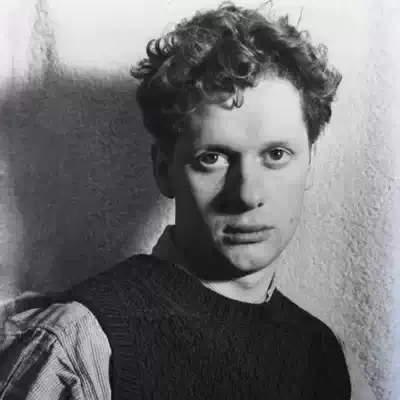
Dylan Thomas
Being But Men
Being but men, we walked into the trees
Afraid, letting our syllables be soft
For fear of waking the rooks,
For fear of coming
Noiselessly into a world of wings and cries.
If we were children we might climb,
Catch the rooks sleeping, and break no twig,
And, after the soft ascent,
Thrust out our heads above the branches
To wonder at the unfailing stars.
Out of confusion, as the way is,
And the wonder, that man knows,
Out of the chaos would come bliss.
That, then, is loveliness, we said,
Children in wonder watching the stars,
Is the aim and the end.
Being but men, we walked into the trees.
617

Rabindranath Tagore
Light
Light, my light, the world-filling light,
the eye-kissing light,
heart-sweetening light!
Ah, the light dances, my darling, at the center of my life;
the light strikes, my darling, the chords of my love;
the sky opens, the wind runs wild, laughter passes over the earth.
The butterflies spread their sails on the sea of light.
Lilies and jasmines surge up on the crest of the waves of light.
The light is shattered into gold on every cloud, my darling,
and it scatters gems in profusion.
Mirth spreads from leaf to leaf, my darling,
and gladness without measure.
The heaven's river has drowned its banks
and the flood of joy is abroad.
619

William Wordsworth
Lines Written In Early Spring
I HEARD a thousand blended notes,
While in a grove I sate reclined,
In that sweet mood when pleasant thoughts
Bring sad thoughts to the mind.
To her fair works did Nature link
The human soul that through me ran;
And much it grieved my heart to think
What man has made of man.
Through primrose tufts, in that green bower,
The periwinkle trailed its wreaths;
And 'tis my faith that every flower
Enjoys the air it breathes.
The birds around me hopped and played,
Their thoughts I cannot measure:---
But the least motion which they made,
It seemed a thrill of pleasure.
The budding twigs spread out their fan,
To catch the breezy air;
And I must think, do all I can,
That there was pleasure there.
If this belief from heaven be sent,
If such be Nature's holy plan,
Have I not reason to lament
What man has made of man?
609
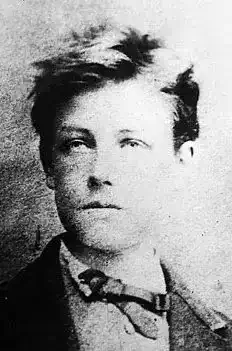
Arthur Rimbaud
Young Greedyguts
Cap of silk moiré, little wand of ivory,
Clothes very dark.
Paul watches the cupboard,
sticks out little tongue at pear,
Prepares, gives a poke, and squitters.
Original French
Jeune goinfre
Casquette
De moire,
Quéquette
D'ivoire,
Toilette
Très noire,
Paul guette
L'armoire,
Projette
Languette
Sur poire,
S'apprête
Baguette,
Et foire.
Clothes very dark.
Paul watches the cupboard,
sticks out little tongue at pear,
Prepares, gives a poke, and squitters.
Original French
Jeune goinfre
Casquette
De moire,
Quéquette
D'ivoire,
Toilette
Très noire,
Paul guette
L'armoire,
Projette
Languette
Sur poire,
S'apprête
Baguette,
Et foire.
591

Henry Wadsworth Longfellow
In The Harbour: Sundown
The summer sun is sinking low;
Only the tree-tops redden and glow:
Only the weathercock on the spire
Of the neighboring church is a flame of fire;
All is in shadow below.
O beautiful, awful summer day,
What hast thou given, what taken away?
Life and death, and love and hate,
Homes made happy or desolate,
Hearts made sad or gay!
On the road of life one mile-stone more!
In the book of life one leaf turned o'er!
Like a red seal is the setting sun
On the good and the evil men have done,--
Naught can to-day restore!
597
Arthur Rimbaud
O Seasons, O Chateaux
1. (From: Fetes de la Patience)
O seasons, O chateaux,
Where is the flawless soul?
O seasons, O chateaux,
The magic study I pursued,
Of happiness, none can elude.
O may it live, each time
The Gallic cock makes rhyme.
Nothing else I desire,
It’s possessed my life entire.
That charm! It’s taken heart and soul
Scattered all my effort so.
Where’s the sense in what I say?
It makes the whole thing fly away!
O seasons, O chateaux!
O Seasons, O Chateaux
2. (From: Une Saison en Enfer)
O seasons, O chateaux!
Where is the flawless soul?
The magic study I pursued,
Of happiness, none can elude.
A health to it, each time
The Gallic cock makes rhyme.
Ah! There’s nothing I desire,
It’s possessed my life entire.
That charm has taken heart and soul
Scattered all my efforts so.
O seasons, O chateaux!
The hour of its flight, alas!
Will be the hour I pass.
O seasons, O chateaux!
O seasons, O chateaux,
Where is the flawless soul?
O seasons, O chateaux,
The magic study I pursued,
Of happiness, none can elude.
O may it live, each time
The Gallic cock makes rhyme.
Nothing else I desire,
It’s possessed my life entire.
That charm! It’s taken heart and soul
Scattered all my effort so.
Where’s the sense in what I say?
It makes the whole thing fly away!
O seasons, O chateaux!
O Seasons, O Chateaux
2. (From: Une Saison en Enfer)
O seasons, O chateaux!
Where is the flawless soul?
The magic study I pursued,
Of happiness, none can elude.
A health to it, each time
The Gallic cock makes rhyme.
Ah! There’s nothing I desire,
It’s possessed my life entire.
That charm has taken heart and soul
Scattered all my efforts so.
O seasons, O chateaux!
The hour of its flight, alas!
Will be the hour I pass.
O seasons, O chateaux!
585
Rabindranath Tagore
Superior
Mother, your baby is silly! She is so absurdly childish!
She does not know the difference between the lights in the
streets and the stars.
When we play at eating with pebbles, she thinks they are real
food, and tries to put them into her mouth.
When I open a book before her and ask her to learn her a, b,
c, she tears the leaves with her hands and roars for joy at
nothing; this is your baby's way of doing her lesson.
When I shake my head at her in anger and scold her and call
her naughty, she laughs and thinks it great fun.
Everybody knows that father is away, but if in play I call
aloud "Father," she looks about her in excitement and thinks that
father is near.
When I hold my class with the donkeys that our washer man
brings to carry away the clothes and I warn her that I am the
schoolmaster, she will scream for no reason and call me dada.
Your baby wants to catch the moon. She is so funny; she calls
Ganesh Ganush.
Mother, your baby is silly! She is so absurdly childish!
568

William Blake
Blind Man's Buff
When silver snow decks Susan's clothes,
And jewel hangs at th' shepherd's nose,
The blushing bank is all my care,
With hearth so red, and walls so fair;
`Heap the sea-coal, come, heap it higher,
The oaken log lay on the fire.'
The well-wash'd stools, a circling row,
With lad and lass, how fair the show!
The merry can of nut-brown ale,
The laughing jest, the love-sick tale,
Till, tir'd of chat, the game begins.
The lasses prick the lads with pins;
Roger from Dolly twitch'd the stool,
She, falling, kiss'd the ground, poor fool!
She blush'd so red, with sidelong glance
At hob-nail Dick, who griev'd the chance.
But now for Blind man's Buff they call;
Of each encumbrance clear the hall--
Jenny her silken 'kerchief folds,
And blear-eyed Will the black lot holds.
Now laughing stops, with `Silence! hush!'
And Peggy Pout gives Sam a push.
The Blind man's arms, extended wide,
Sam slips between:--`O woe betide
Thee, clumsy Will!'--but titt'ring Kate
Is penn'd up in the corner straight!
And now Will's eyes beheld the play;
He thought his face was t'other way.
`Now, Kitty, now! what chance hast thou,
Roger so near thee!--Trips, I vow!'
She catches him--then Roger ties
His own head up--but not his eyes;
For thro' the slender cloth he sees,
And runs at Sam, who slips with ease
His clumsy hold; and, dodging round,
Sukey is tumbled on the ground!--
`See what it is to play unfair!
Where cheating is, there's mischief there.'
But Roger still pursues the chase,--
`He sees! he sees!' cries, softly, Grace;
`O Roger, thou, unskill'd in art,
Must, surer bound, go thro' thy part!'
Now Kitty, pert, repeats the rimes,
And Roger turns him round three times,
Then pauses ere he starts--but Dick
Was mischief bent upon a trick;
Down on his hands and knees he lay
Directly in the Blind man's way,
Then cries out `Hem!' Hodge heard, and ran
With hood-wink'd chance--sure of his man;
But down he came. -- Alas, how frail
Our best of hopes, how soon they fail!
With crimson drops he stains the ground;
Confusion startles all around.
Poor piteous Dick supports his head,
And fain would cure the hurt he made.
But Kitty hasted with a key,
And down his back they straight convey
The cold relief; the blood is stay'd,
And Hodge again holds up his head.
Such are the fortunes of the game,
And those who play should stop the same
By wholesome laws; such as all those
Who on the blinded man impose
Stand in his stead; as, long a-gone,
When men were first a nation grown,
Lawless they liv'd, till wantonness
A nd liberty began t' increase,
And one man lay in another's way;
Then laws were made to keep fair play.
554
William Blake
A Cradle Song
Sweet dreams form a shade,
O'er my lovely infants head.
Sweet dreams of pleasant streams,
By happy silent moony beams
Sweet sleep with soft down.
Weave thy brows an infant crown.
Sweet sleep Angel mild,
Hover o'er my happy child.
Sweet smiles in the night,
Hover over my delight.
Sweet smiles Mothers smiles,
All the livelong night beguiles.
Sweet moans, dovelike sighs,
Chase not slumber from thy eyes,
Sweet moans, sweeter smiles,
All the dovelike moans beguiles.
Sleep sleep happy child,
All creation slept and smil'd.
Sleep sleep, happy sleep.
While o'er thee thy mother weep
Sweet babe in thy face,
Holy image I can trace.
Sweet babe once like thee.
Thy maker lay and wept for me
Wept for me for thee for all,
When he was an infant small.
Thou his image ever see.
Heavenly face that smiles on thee,
Smiles on thee on me on all,
Who became an infant small,
Infant smiles are His own smiles,
Heaven & earth to peace beguiles.
549
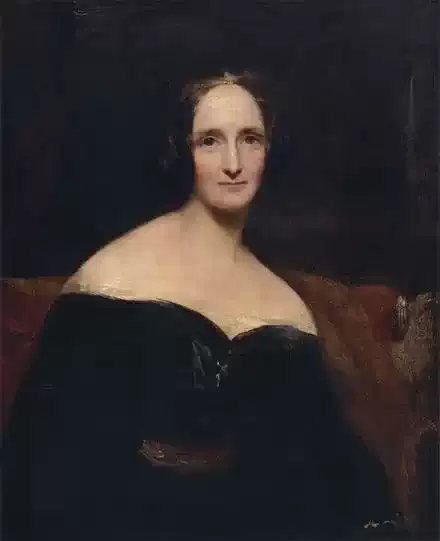
Percy Bysshe Shelley
Invocation
Rarely, rarely, comest thou,
Spirit of Delight!
Wherefore hast thou left me now
Many a day and night?
Many a weary night and day
'Tis since thou art fled away.
How shall ever one like me
Win thee back again?
With the joyous and the free
Thou wilt scoff at pain.
Spirit false! thou hast forgot
All but those who need thee not.
As a lizard with the shade
Of a trembling leaf,
Thou with sorrow art dismayed;
Even the sighs of grief
Reproach thee, that thou art not near,
And reproach thou wilt not hear.
Let me set my mournful ditty
To a merry measure;
Thou wilt never come for pity,
Thou wilt come for pleasure; -
Pity then will cut away
Those cruel wings, and thou wilt stay.
I love all that thou lovest,
Spirit of Delight!
The fresh Earth in new leaves dressed,
And the starry night;
Autumn evening, and the morn
When the golden mists are born.
I love snow and all the forms
Of the radiant frost;
I love waves, and winds, and storms,
Everything almost
Which is Nature's, and may be
Untainted by man's misery.
I love tranquil solitude,
And such society
As is quiet, wise, and good: -
Between thee and me
What diff'rence? but thou dost possess
The things I seek, not love them less.
I love Love -though he has wings,
And like light can flee,
But above all other things,
Spirit, I love thee -
Thou art love and life! O come!
Make once more my heart thy home!
Spirit of Delight!
Wherefore hast thou left me now
Many a day and night?
Many a weary night and day
'Tis since thou art fled away.
How shall ever one like me
Win thee back again?
With the joyous and the free
Thou wilt scoff at pain.
Spirit false! thou hast forgot
All but those who need thee not.
As a lizard with the shade
Of a trembling leaf,
Thou with sorrow art dismayed;
Even the sighs of grief
Reproach thee, that thou art not near,
And reproach thou wilt not hear.
Let me set my mournful ditty
To a merry measure;
Thou wilt never come for pity,
Thou wilt come for pleasure; -
Pity then will cut away
Those cruel wings, and thou wilt stay.
I love all that thou lovest,
Spirit of Delight!
The fresh Earth in new leaves dressed,
And the starry night;
Autumn evening, and the morn
When the golden mists are born.
I love snow and all the forms
Of the radiant frost;
I love waves, and winds, and storms,
Everything almost
Which is Nature's, and may be
Untainted by man's misery.
I love tranquil solitude,
And such society
As is quiet, wise, and good: -
Between thee and me
What diff'rence? but thou dost possess
The things I seek, not love them less.
I love Love -though he has wings,
And like light can flee,
But above all other things,
Spirit, I love thee -
Thou art love and life! O come!
Make once more my heart thy home!
534
William Blake
The Birds
He. Where thou dwellest, in what grove,
Tell me Fair One, tell me Love;
Where thou thy charming nest dost build,
O thou pride of every field!
She. Yonder stands a lonely tree,
There I live and mourn for thee;
Morning drinks my silent tear,
And evening winds my sorrow bear.
He. O thou summer's harmony,
I have liv'd and mourn'd for thee;
Each day I mourn along the wood,
And night hath heard my sorrows loud.
She. Dost thou truly long for me?
And am I thus sweet to thee?
Sorrow now is at an end,
O my Lover and my Friend!
He. Come, on wings of joy we'll fly
To where my bower hangs on high;
Come, and make thy calm retreat
Among green leaves and blossoms sweet.
539

Robert Louis Stevenson
A Good Boy
I woke before the morning, I was happy all the day,
I never said an ugly word, but smiled and stuck to play.
And now at last the sun is going down behind the wood,
And I am very happy, for I know that I've been good.
My bed is waiting cool and fresh, with linen smooth and fair,
And I must be off to sleepsin-by, and not forget my prayer.
I know that, till to-morrow I shall see the sun arise,
No ugly dream shall fright my mind, no ugly sight my eyes.
But slumber hold me tightly till I waken in the dawn,
And hear the thrushes singing in the lilacs round the lawn.
537
Paul Laurence Dunbar
Little Brown Baby
Little brown baby wif spa'klin' eyes,
Come to yo' pappy an' set on his knee.
What you been doin', suh -- makin' san' pies?
Look at dat bib -- you's es du'ty ez me.
Look at dat mouf -- dat's merlasses, I bet;
Come hyeah, Maria, an' wipe off his han's.
Bees gwine to ketch you an' eat you up yit,
Bein' so sticky an sweet -- goodness lan's!
Little brown baby wif spa'klin' eyes,
Who's pappy's darlin' an' who's pappy's chile?
Who is it all de day nevah once tries
Fu' to be cross, er once loses dat smile?
Whah did you git dem teef? My, you's a scamp!
Whah did dat dimple come f'om in yo' chin?
Pappy do' know you -- I b'lieves you's a tramp;
Mammy, dis hyeah's some ol' straggler got in!
Let's th'ow him outen de do' in de san',
We do' want stragglers a-layin' 'roun' hyeah;
Let's gin him 'way to de big buggah-man;
I know he's hidin' erroun' hyeah right neah.
Buggah-man, buggah-man, come in de do',
Hyeah's a bad boy you kin have fu' to eat.
Mammy an' pappy do' want him no mo',
Swaller him down f'om his haid to his feet!
Dah, now, I t'ought dat you'd hug me up close.
Go back, ol' buggah, you sha'n't have dis boy.
He ain't no tramp, ner no straggler, of co'se;
He's pappy's pa'dner an' play-mate an' joy.
Come to you' pallet now -- go to yo' res';
Wisht you could allus know ease an' cleah skies;
Wisht you could stay jes' a chile on my breas'--
Little brown baby wif spa'klin' eyes!
531
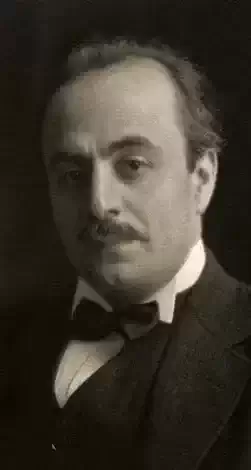
Khalil Gibran
Joy and Sorrow chapter VIII
Then a woman said, "Speak to us of Joy and Sorrow."
And he answered:
Your joy is your sorrow unmasked.
And the selfsame well from which your laughter rises was oftentimes filled with your
tears.
And how else can it be?
The deeper that sorrow carves into your being, the more joy you can contain.
Is not the cup that hold your wine the very cup that was burned in the potter's oven?
And is not the lute that soothes your spirit, the very wood that was hollowed with
knives?
When you are joyous, look deep into your heart and you shall find it is only that which
has given you sorrow that is giving you joy.
When you are sorrowful look again in your heart, and you shall see that in truth you
are weeping for that which has been your delight.
Some of you say, "Joy is greater than sorrow," and others say, "Nay, sorrow is the
greater."
But I say unto you, they are inseparable.
Together they come, and when one sits alone with you at your board, remember that
the other is asleep upon your bed.
Verily you are suspended like scales between your sorrow and your joy.
Only when you are empty are you at standstill and balanced.
When the treasure-keeper lifts you to weigh his gold and his silver, needs must your
joy or your sorrow rise or fall.
530
William Blake
Sleep! Sleep! Beauty Bright
Sleep! sleep! beauty bright,
Dreaming o'er the joys of night;
Sleep! sleep! in thy sleep
Little sorrows sit and weep.
Sweet Babe, in thy face
Soft desires I can trace,
Secret joys and secret smiles,
Little pretty infant wiles.
As thy softest limbs I feel,
Smiles as of the morning steal
O'er thy cheek, and o'er thy breast
Where thy little heart does rest.
O! the cunning wiles that creep
In thy little heart asleep.
When thy little heart does wake
Then the dreadful lightnings break,
From thy cheek and from thy eye,
O'er the youthful harvests nigh.
Infant wiles and infant smiles
Heaven and Earth of peace beguiles.
529
Walt Whitman
We Two-How Long We Were Fool'd
WE two--how long we were fool'd!
Now transmuted, we swiftly escape, as Nature escapes;
We are Nature--long have we been absent, but now we return;
We become plants, leaves, foliage, roots, bark;
We are bedded in the ground--we are rocks;
We are oaks--we grow in the openings side by side;
We browse--we are two among the wild herds, spontaneous as any;
We are two fishes swimming in the sea together;
We are what the locust blossoms are--we drop scent around the lanes,
mornings and evenings;
We are also the coarse smut of beasts, vegetables, minerals;
We are two predatory hawks--we soar above, and look down;
We are two resplendent suns--we it is who balance ourselves, orbic
and stellar--we are as two comets;
We prowl fang'd and four-footed in the woods--we spring on prey;
We are two clouds, forenoons and afternoons, driving overhead;
We are seas mingling--we are two of those cheerful waves, rolling
over each other, and interwetting each other;
We are what the atmosphere is, transparent, receptive, pervious,
impervious:
We are snow, rain, cold, darkness--we are each product and influence
of the globe;
We have circled and circled till we have arrived home again--we two
have;
We have voided all but freedom, and all but our own joy.
529
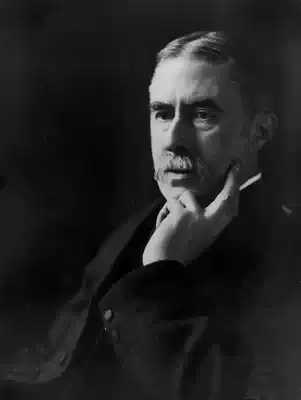
Alfred Edward Housman
The Merry Guide
Once in the wind of morning
I ranged the thymy wold;
The world-wide air was azure
And all the brooks ran gold.
There through the dews beside me
Behold a youth that trod,
With feathered cap on forehead,
And poised a golden rod.
With mien to match the morning
And gay delightful guise
And friendly brows and laughter
He looked me in the eyes.
Oh whence, I asked, and whither?
He smiled and would not say.
And looked at me and beckoned,
And laughed and led the way.
And with kind looks and laughter
And nought to say beside,
We two went on together,
I and my happy guide.
Across the glittering pastures
And empty upland still
And solitude of shepherds
High in the folded hill,
By hanging woods and hamlets
That gaze through orchards down
On many a windmill turning
And far-discovered town,
With gay regards of promise
And sure unslackened stride
And smiles and nothing spoken
Led on my merry guide.
By blowing realms of woodland
With sunstruck vanes afield
And cloud-led shadows sailing
About the windy weald,
By valley-guarded granges
And silver waters wide,
Content at heart I followed
With my delightful guide.
And like the cloudy shadows
Across the country blown
We two fare on for ever,
But not we two alone.
With the great gale we journey
That breathes from gardens thinned,
Borne in the drift of blossoms
Whose petals throng the wind;
Buoyed on the heaven-ward whisper
Of dancing leaflets whirled
From all the woods that autumn
Bereaves in all the world.
And midst the fluttering legion
Of all that ever died
I follow, and before us
Goes the delightful guide,
With lips that brim with laughter
But never once respond,
And feet that fly on feathers,
And serpent-circled wand.
526
Paul Laurence Dunbar
A Golden Day
I Found you and I lost you,
All on a gleaming day.
The day was filled with sunshine,
And the land was full of May.
A golden bird was singing
Its melody divine,
I found you and I loved you,
And all the world was mine.
I found you and I lost you,
All on a golden day,
But when I dream of you, dear,
It is always brimming May.
All on a gleaming day.
The day was filled with sunshine,
And the land was full of May.
A golden bird was singing
Its melody divine,
I found you and I loved you,
And all the world was mine.
I found you and I lost you,
All on a golden day,
But when I dream of you, dear,
It is always brimming May.
521
Rabindranath Tagore
The Gardener LXXVI: The Fair Was On
The fair was on before the temple.
It had rained from the early morning
and the day came to its end.
Brighter than all the gladness of
the crowd was the bright smile of
a girl who bought for a farthing a
whistle of palm leaf.
The shrill joy of that whistle floated
above all laughter and noise.
An endless throng of people came
and jostled together. The road was
muddy, the river in flood, the field
under water in ceaseless rain.
Greater than all the troubles of
the crowd was a little boy's trouble-he
had not a farthing to buy a painted
stick.
His wistful eyes gazing at the shop
made this whole meeting of men so
pitiful.
507

Rudyard Kipling
How the Camel Got His Hump
The Camel's hump is an ugly lump
Which well you may see at the Zoo;
But uglier yet is the hump we get
From having too little to do.
Kiddies and grown-ups too-oo-oo,
If we haven't enough to do-oo-oo,
We get the hump--
Cameelious hump--
The hump that is black and blue!
We climb out of bed with a frouzly head,
And a snarly-yarly voice.
We shiver and scowl and we grunt and we growl
At our bath and our boots and our toys;
And there ought to be a corner for me
(And I know' there is one for you)
When we get the hump--
Cameelious hump--
The hump that is black and blue!
The cure for this ill is not to sit still,
Or frowst with a book by the fire;
But to take a large hoe and a shovel also,
And dig till you gently perspire;
And then you will find that the sun and the wind,
And the Djinn of the Garden too,
Have lifted the hump--
The horrible hump--
The hump that is black and blue!
I get it as well as you-oo-oo--
If I haven't enough to do-oo-oo!
We all get hump--
Cameelious hump--
Kiddies and grown-ups too!
503