
War and Peace

Henry Wadsworth Longfellow
Tales Of A Wayside Inn : Part 1. The Musician's Tale; The Saga of King Olaf XI.
-- Bishop Sigurd At Salten Fiord
Loud the anngy wind was wailing
As King Olaf's ships came sailing
Northward out of Drontheim haven
To the mouth of Salten Fiord.
Though the flying sea-spray drenches
Fore and aft the rowers' benches,
Not a single heart is craven
Of the champions there on board.
All without the Fiord was quiet
But within it storm and riot,
Such as on his Viking cruises
Raud the Strong was wont to ride.
And the sea through all its tide-ways
Swept the reeling vessels sideways,
As the leaves are swept through sluices,
When the flood-gates open wide.
''T is the warlock! 't is the demon
Raud!' cried Sigurd to the seamen;
'But the Lord is not affrighted
By the witchcraft of his foes.'
To the ship's bow he ascended,
By his choristers attended,
Round him were the tapers lighted,
And the sacred incense rose.
On the bow stood Bishop Sigurd,
In his robes, as one transfigured,
And the Crucifix he planted
High amid the rain and mist.
Then with holy water sprinkled
All the ship; the mass-bells tinkled.
Loud the monks around him chanted,
Loud he read the Evangelist.
As into the Fiord they darted,
On each side the water parted;
Down a path like silver molten
Steadily rowed King Olaf's ships;
Steadily burned all night the tapers,
And the White Christ through the vapors
Gleamed across the Fiord of Salten,
As through John's Apocalypse,--
Till at last they reached Raud's dwelling
On the little isle of Gelling;
Not a guard was at the doorway,
Not a glimmer of light was seen.
But at anchor, carved and gilded,
Lay the dragon-ship he builded;
'T was the grandest ship in Norway,
With its crest and scales of green.
Up the stairway, softly creeping,
To the loft where Raud was sleeping,
With their fists they burst asunder
Bolt and bar that held the door.
Drunken with sleep and ale they found him,
Dragged him from his bed and bound him,
While he stared with stupid wonder,
At the look and garb they wore.
Then King Olaf said: 'O Sea-King!
Little time have we for speaking,
Choose between the good and evil;
Be baptized, or thou shalt die!?
But in scorn the heathen scoffer
Answered: 'I disdain thine offer;
Neither fear I God nor Devil;
Thee and thy Gospel I defy!'
Then between his jaws distended,
When his frantic struggles ended,
Through King Olaf's horn an adder,
Touched by fire, they forced to glide.
Sharp his tooth was as an arrow,
As he gnawed through bone and marrow;
But without a groan or shudder,
Raud the Strong blaspheming died.
Then baptized they all that region,
Swarthy Lap and fair Norwegian,
Far as swims the salmon, leaping,
Up the streams of Salten Fiord.
In their temples Thor and Odin
Lay in dust and ashes trodden,
As King Olaf, onward sweeping,
Preached the Gospel with his sword.
Then he took the carved and gilded
Dragon-ship that Raud had builded,
And the tiller single-handed,
Grasping, steered into the main.
Southward sailed the sea-gulls o'er him,
Southward sailed the ship that bore him,
Till at Drontheim haven landed
Olaf and his crew again.
272

Henry Lawson
Fighting Hard
Rolling out to fight for England, singing songs across the sea;
Rolling North to fight for England, and to fight for you and me.
Fighting hard for France and England, where the storms of Death are hurled;
Fighting hard for Australasia and the honour of the World!
Fighting hard.
Fighting hard for Sunny Queensland—fighting for Bananaland,
Fighting hard for West Australia, and the mulga and the sand;
Fighting hard for Plain and Wool-Track, and the haze of western heat—
Fighting hard for South Australia and the bronze of Farrar’s Wheat!
Fighting hard.
Fighting hard for fair Victoria, and the mountain and the glen;
(And the Memory of Eureka—there were other tyrants then),
For the glorious Gippsland forests and the World’s great Singing Star—
For the irrigation channels where the cabbage gardens are—
Fighting hard.
Fighting hard for gale and earthquake, and the wind-swept ports between;
For the wild flax and manuka and the terraced hills of green.
Fighting hard for wooden homesteads, where the mighty kauris stand—
Fighting hard for fern and tussock!—Fighting hard for Maoriland!
Fighting hard.
Fighting hard for little Tassy, where the apple orchards grow;
(And the Northern Territory just to give the place a show),
Fighting hard for Home and Empire, while the Commonwealth prevails—
And, in spite of all her blunders, dying hard for New South Wales.
Dying hard.
Fighting for the Pride of Old Folk, and the people that you know;
And the girl you left behind you—(ah! the time is passing slow).
For the proud tears of a sister! come you back, or never come!
And the weary Elder Brother, looking after things at home—
Fighting Hard!
You Lucky Devils
!
Fighting hard.
270
Henry Lawson
The Drums of Ages
Drums of all that’s right and wrong—of love and hate and scorn,
And the new-born baby hears them and it wails when it is born.
Drums of all that is to be, and all that has gone by,
And we hear them when we’re dreaming, and we hear them while we die.
Drums of martyred innocence and drums of driven guilt
Beating backward from the future when the first rude town was built;
Beating louder through the slave days and the dark and hungry nights,
While the hovels filled the valleys and the castles crowned the heights;
Beating louder while the mansions shifted east from miles of slums—
Don’t you hear them? Don’t you hear them? Don’t you hear the alley drums?
Drums of human sacrifice and drums of war at home—
While the Romans conquered nations they were beating loud in Rome.
Children heard them through the ages, mothers paused and glanced behind,
Madmen saw and heard the drummers, but the rest were deaf and blind.
Peasants starved on fields of plenty, workmen rotted in the slums—
Till the drummers came to Paris and the nations heard the drums.
Drums of hope and bursting hearts—the drums of Westward Ho!—
From the homes of generations and their native land they go.
’Groom and bride and grey-haired mother, bent old men who go alone—
Fleeing bitter persecution for the terrible unknown:
Seeking freedom, rest, or justice—and the peace that never comes—
And the wilderness was conquered when the pilgrims beat their drums.
Drums of Greed that followed fast where men had made the way,
Waking drums of stern rebellion when the exiles turned at bay,
Spreading death and desolation, breeding old-world hells anew,
Until England lost a nation for the blindness of a few.
Still the dirty Jewish talon reached from palaces and slums
Till a hundred thousand English died to stop the farmers’ drums.
Drums of tortured hearts o’ men—the drums that never ceased—
Throbbing through the British Empire from the heart of London East;
Growling louder still wherever, in the wake of those who lead,
Comes the murmur of the board-room and the stealthy steps of greed;
Growling through the Southern cities, murmuring in the Western gums,
Till the Empire falls to pieces at the beating of the drums!
Drums of all that’s right and wrong—of love and hate and scorn;
And the new-born baby hears them, and he wails when he is born.
Drums of all that is to be, and all that has gone by—
And we hear there when we’re dreaming, and we hear then while we die.
270

Emily Dickinson
When I was small, a Woman died
When I was small, a Woman died
Today-
her Only Boy
Went up from the Potomac-
His face all Victory
To look at her-How slowly
The Seasons must have turned
Till Bullets clipt an Angle
And He passed quickly round-
If pride shall be in Paradise-
Ourself cannot decide-
Of their imperial Conduct-
No person testified-
But, proud in Apparition-
That Woman and her Boy
Pass back and forth, before my Brain
As even in the sky
I'm confident that Bravoes-
Perpetual break abroad
For Braveries, remote as this
In Scarlet Maryland-
270
Henry Lawson
To Be Amused
You ask me to be gay and glad
While lurid clouds of danger loom,
And vain and bad and gambling mad,
Australia races to her doom.
You bid me sing the light and fair,
The dance, the glance on pleasure's wings –
While you have wives who will not bear,
And beer to drown the fear of things.
A war with reason you would wage
To be amused for your short span,
Until your children's heritage
Is claimed for China by Japan.
The football match, the cricket score,
The "scraps", the tote, the mad'ning Cup –
You drunken fools that evermore
"To-morrow morning" sober up!
I see again with haggard eyes,
The thirsty land, the wasted flood;
Unpeopled plains beyond the skies,
And precious streams that run to mud;
The ruined health, the wasted wealth,
In our mad cities by the seas,
The black race suicide by stealth,
The starved and murdered industries!
You bid me make a farce of day,
And make a mockery of death;
While not five thousand miles away
The yellow millions pant for breath!
But heed me now, nor ask me this –
Lest you too late should wake to find
That hopeless patriotism is
The strongest passion in mankind!
You'd think the seer sees, perhaps,
While staring on from days like these,
Politeness in the conquering Japs,
Or mercy in the banned Chinese!
I mind the days when parents stood,
And spake no word, while children ran
From Christian lanes and deemed it good
To stone a helpless Chinaman.
I see the stricken city fall,
The fathers murdered at their doors,
The sack, the massacre of all
Save healthy slaves and paramours –
The wounded hero at the stake,
The pure girl to the leper's kiss –
God, give us faith, for Christ's own sake
To kill our womankind ere this.
I see the Bushman from Out Back,
From mountain range and rolling downs,
And carts race on each rough bush track
With food and rifles from the towns;
I see my Bushmen fight and die
Amongst the torn blood-spattered trees,
And hear all night the wounded cry
For men! More men and batteries!
I see the brown and yellow rule
The southern lands and southern waves,
White children in the heathen school,
And black and white together slaves;
I see the colour-line so drawn
(I see it plain and speak I must),
That our brown masters of the dawn
Might, aye, have fair girls for their lusts!
With land and life and race at stake –
No matter which race wronged, or how –
Let all and one Australia make
A superhuman effort now.
Clear out the blasting parasites,
The paid-for-one-thing manifold,
And curb the goggled "social-lights"
That "scorch" to nowhere with our gold.
Store guns and ammunition first,
Build forts and warlike factories,
Sink bores and tanks where drought is worst,
Give over time to industries.
The outpost of the white man's race,
Where next his flag shall be unfurled,
Make clean the place! Make strong the place!
Call white men in from all the world!
269

Robert W. Service
Hot Digitty Dog
Hot digitty dog! Now, ain't it queer,
I've been abroad for over a year;
Seen a helluva lot since then,
Killed, I reckon, a dozen men;
Six was doubtful, but six was sure,
Three in Normandy, three in the Ruhr.
Four I got with a hand grenade,
Two I shot in a midnight raid:
Oh, I ain't sorry, except perhaps
To think that my jerries wasn't japs.
Hot digitty dog! Now ain't it tough;
I oughta be handed hero stuff -
Bands and banquets, and flags and flowers,
Speeches, peaches, confetti showers;
"Welcome back to the old home town,
Colour Sargent Josephus Brown.
Fought like a tiger, one of our best,
Medals and ribands on his chest.
cheers for a warrior, fresh from the fight . . ."
Sure I'd 'a got 'em - - had I been white.
Hot digitty dog! It's jist too bad,
Gittin' home an' nobody gald;
Sneakin' into the Owl Drug Store
Nobody knowin' me any more;
Admirin' my uniform fine and fit -
Say, I've certainly changed a bit
From the lanky lad who used to croon
To a battered banjo in Shay's Saloon;
From the no-good nigger who runned away
After stickin' his knife into ol' man Shay.
They's a lynched me, for he was white,
But he raped my sister one Sunday night;
So I did what a proper man should do,
And I sunk his body deep in the slough.
Oh, he taunted me to my dark disgrace,
Called me a nigger, spat in my face;
So I buried my jack-knife in his heart,
Laughin' to see the hot blood start;
Laughin' still, though it's long ago,
And nobody's ever a-gonna know.
Nobody's ever a-gonna tell
How Ol' Man Shay went straight to hell;
nobody's gonna make me confess -
And what is a killin' more or less.
My skin may be black, but by Christ! I fight;
I've slain a dozen, and each was white,
And none of 'em ever did me no harm,
And my conscience is clear - I've no alarm;
So I'll go where I sank Ol' Man Shay in the bog,
And spit in the water . . . Hot digitty dog!
268
Henry Lawson
On the Summit of Mt. Clarence
On the summit of Mount Clarence rotting slowly in the air
Stands a tall and naked flagstaff, relic of the Russian scare—
Russian scare that scares no longer, for the cry is “All is well”—
Yet the flagstaff still is standing like a lonely sentinel.
And it watches through the seasons—winter’s cold and summer’s heat,
Watches seaward, watches ever for the phantom Russian fleet.
In a cave among the ridges, where the scrub is tall and thick
With no human being near him dwells a wretched lunatic:
On Mount Clarence in the morning he will fix his burning eyes,
And he scans the sea and watches for the signal flag to rise;
In his ears the roar of cannon and the sound of battle drums
While he cleans his gun and watches for the foe that never comes.
And they say, at dreary nightfall, when the storms are howling round
Comes a phantom ship to anchor in the waters of the “Sound”,
And the lunatic who sees it wakes the landscape with his whoops,
Loads his gun and marches seaward at the head of airy troops—
To the summit of Mount Clarence leads them on with martial tread,
Fires his gun and sends the Russians to the mustering of the dead.
267
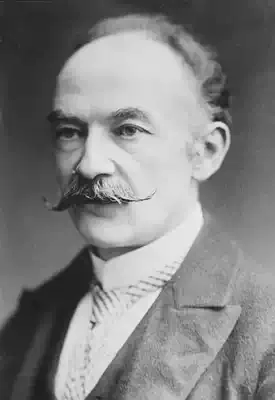
Thomas Hardy
The Souls of the Slain
I
The thick lids of Night closed upon me
Alone at the Bill
Of the Isle by the Race {} -
Many-caverned, bald, wrinkled of face -
And with darkness and silence the spirit was on me
To brood and be still.
II
No wind fanned the flats of the ocean,
Or promontory sides,
Or the ooze by the strand,
Or the bent-bearded slope of the land,
Whose base took its rest amid everlong motion
Of criss-crossing tides.
III
Soon from out of the Southward seemed nearing
A whirr, as of wings
Waved by mighty-vanned flies,
Or by night-moths of measureless size,
And in softness and smoothness well-nigh beyond hearing
Of corporal things.
IV
And they bore to the bluff, and alighted -
A dim-discerned train
Of sprites without mould,
Frameless souls none might touch or might hold -
On the ledge by the turreted lantern, farsighted
By men of the main.
V
And I heard them say "Home!" and I knew them
For souls of the felled
On the earth's nether bord
Under Capricorn, whither they'd warred,
And I neared in my awe, and gave heedfulness to them
With breathings inheld.
VI
Then, it seemed, there approached from the northward
A senior soul-flame
Of the like filmy hue:
And he met them and spake: "Is it you,
O my men?" Said they, "Aye! We bear homeward and hearthward
To list to our fame!"
VII
"I've flown there before you," he said then:
"Your households are well;
But--your kin linger less
On your glory arid war-mightiness
Than on dearer things."--"Dearer?" cried these from the dead then,
"Of what do they tell?"
VIII
"Some mothers muse sadly, and murmur
Your doings as boys -
Recall the quaint ways
Of your babyhood's innocent days.
Some pray that, ere dying, your faith had grown firmer,
And higher your joys.
IX
"A father broods: 'Would I had set him
To some humble trade,
And so slacked his high fire,
And his passionate martial desire;
Had told him no stories to woo him and whet him
To this due crusade!"
X
"And, General, how hold out our sweethearts,
Sworn loyal as doves?"
--"Many mourn; many think
It is not unattractive to prink
Them in sables for heroes. Some fickle and fleet hearts
Have found them new loves."
XI
"And our wives?" quoth another resignedly,
"Dwell they on our deeds?"
--"Deeds of home; that live yet
Fresh as new--deeds of fondness or fret;
Ancient words that were kindly expressed or unkindly,
These, these have their heeds."
XII
--"Alas! then it seems that our glory
Weighs less in their thought
Than our old homely acts,
And the long-ago commonplace facts
Of our lives--held by us as scarce part of our story,
And rated as nought!"
XIII
Then bitterly some: "Was it wise now
To raise the tomb-door
For such knowledge? Away!"
But the rest: "Fame we prized till to-day;
Yet that hearts keep us green for old kindness we prize now
A thousand times more!"
XIV
Thus speaking, the trooped apparitions
Began to disband
And resolve them in two:
Those whose record was lovely and true
Bore to northward for home: those of bitter traditions
Again left the land,
XV
And, towering to seaward in legions,
They paused at a spot
Overbending the Race -
That engulphing, ghast, sinister place -
Whither headlong they plunged, to the fathomless regions
Of myriads forgot.
XVI
And the spirits of those who were homing
Passed on, rushingly,
Like the Pentecost Wind;
And the whirr of their wayfaring thinned
And surceased on the sky, and but left in the gloaming
Sea-mutterings and me.
267

Jonathan Swift
Jack Frenchman’s Lamentation
Ye Commons and Peers,
Pray lend me your ears,
I'll sing you a song, (if I can,)
How Lewis le Grand
Was put to a stand,
By the arms of our gracious Queen Anne.
How his army so great,
Had a total defeat,
And close by the river Dender:
Where his grandchildren twain,
For fear of being slain,
Gallop'd off with the Popish Pretender.
To a steeple on high,
The battle to spy,
Up mounted these clever young men;
But when from the spire,
They saw so much fire,
Most cleverly came down again.
Then on horseback they got
All on the same spot,
By advice of their cousin Vendosme,
O Lord! cried out he,
Unto young Burgundy,
Would your brother and you were at home!
While this he did say,
Without more delay,
Away the young gentry fled;
Whose heels for that work,
Were much lighter than cork,
Though their hearts were as heavy as lead.
Not so did behave
Young Hanover brave,
In this bloody field I assure ye:
When his war-horse was shot
He valued it not,
But fought it on foot like a fury.
Full firmly he stood,
As became his high blood,
Which runs in his veins so blue:
For this gallant young man,
Being a-kin to QUEEN ANNE,
Did as (were she a man) she would do.
What a racket was here,
(I think 'twas last year,)
For a little misfortune in Spain!
For by letting 'em win,
We have drawn the puts in,
To lose all they're worth this campaign.
Though Bruges and Ghent
To Monsieur we lent,
With interest they shall repay 'em;
While Paris may sing,
With her sorrowful king,
Nunc dimittis instead of Te Deum.
From this dream of success,
They'll awaken, we guess,
At the sound of great Marlborough's drums,
They may think, if they will,
Of Ahnanza still,
But 'tis Blenheim wherever he comes.
O Lewis perplex'd,
What general next!
Thou hast hitherto changed in vain;
He has beat 'em all round,
If no new one's found,
He shall beat 'em over again.
We'll let Tallard out,
If he'll take t'other bout;
And much he's improved, let me tell ye,
With Nottingham ale
At every meal,
And good beef and pudding in belly.
But as losers at play,
Their dice throw away,
While the winners do still win on;
Let who will command,
Thou hadst better disband,
For, old Bully, thy doctors are gone.
267
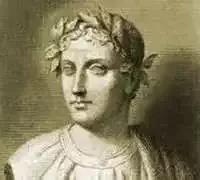
Horácio
BkIII:XIV Augustus Returns
O citizens, conquering Caesar is home
from the Spanish shores, who, like Hercules, now
was said to be seeking that laurel, that’s bought
at the price of death.
May his wife rejoice in a matchless husband,
having sacrificed to true gods, appear now
with our famous leader’s sister, and, all dressed
in holy ribbons,
the mothers of virgins and youths, now safe and
sound. And you, O you boys and you young girls who
are still without husbands, spare us any of
your ill-omened words
This day will be a true holiday for me,
and banish dark care: I’ll not fear civil war,
nor sudden death by violence, while Caesar has
command of the earth.
Go, now, you boys, seek out perfumes and garlands
and a jar that’s old as the Marsian War,
if any of them have managed to escape
Spartacus’s eyes.
And tell that graceful Neaera to hurry
and fasten all her perfumed hair in a knot:
if her hateful doorkeeper causes
delay, come away.
My greying hair softens a spirit eager
for arguments and passionate fights:
I’d not have endured it in my hot youth, while
Plancus was Consul.
266

Wilfred Owen
The Letter
With B.E.F. Jun . Dear Wife,
(Oh blast this pencil. 'Ere, Bill, lend's a knife.)
I'm in the pink at present, dear.
I think the war will end this year.
We don't see much of them square-'eaded 'Uns.
We're out of harm's way, not bad fed.
I'm longing for a taste of your old buns.
(Say, Jimmie, spare's a bite of bread.)
There don't seem much to say just now.
(Yer what? Then don't, yer ruddy cow!
And give us back me cigarette!)
I'll soon be 'ome. You mustn't fret.
My feet's improvin', as I told you of.
We're out in the rest now. Never fear.
(VRACH! By crumbs, but that was near.)
Mother might spare you half a sov.
Kiss Nell and Bert. When me and you-
(Eh? What the 'ell! Stand to? Stand to!
Jim, give's a hand with pack on, lad.
Guh! Christ! I'm hit. Take 'old. Aye, bad.
No, damn your iodine. Jim? 'Ere!
Write my old girl, Jim, there's a dear.)
266
Robert W. Service
The Fool
"But it isn't playing the game," he said,
And he slammed his books away;
"The Latin and Greek I've got in my head
Will do for a duller day."
"Rubbish!" I cried; "The bugle's call
Isn't for lads from school."
D'ye think he'd listen? Oh, not at all:
So I called him a fool, a fool.
Now there's his dog by his empty bed,
And the flute he used to play,
And his favourite bat . . . but Dick he's dead,
Somewhere in France, they say:
Dick with his rapture of song and sun,
Dick of the yellow hair,
Dicky whose life had but begun,
Carrion-cold out there.
Look at his prizes all in a row:
Surely a hint of fame.
Now he's finished with, -- nothing to show:
Doesn't it seem a shame?
Look from the window! All you see
Was to be his one day:
Forest and furrow, lawn and lea,
And he goes and chucks it away.
Chucks it away to die in the dark:
Somebody saw him fall,
Part of him mud, part of him blood,
The rest of him -- not at all.
And yet I'll bet he was never afraid,
And he went as the best of 'em go,
For his hand was clenched on his broken blade,
And his face was turned to the foe.
And I called him a fool . . . oh how blind was I!
And the cup of my grief's abrim.
Will Glory o' England ever die
So long as we've lads like him?
So long as we've fond and fearless fools,
Who, spurning fortune and fame,
Turn out with the rallying cry of their schools,
Just bent on playing the game.
A fool! Ah no! He was more than wise.
His was the proudest part.
He died with the glory of faith in his eyes,
And the glory of love in his heart.
And though there's never a grave to tell,
Nor a cross to mark his fall,
Thank God! we know that he "batted well"
In the last great Game of all.
263
Henry Lawson
The Old Stockman's Lament
Wrap me up in me stockwhip and blanket,
And bury me deep down below,
Where this piffle and sham won’t disgust me,
In the land where the coolibahs grow;
For I’ve stayed with some well-to-do people,
And I’ve dined with some middle-class folk;
And I’ve sorrowed by clock-tower and steeple
Till my heart for the Commonwealth’s broke.
They have flown in another direction,
Who used to clack-clack by the hour
Of “this awful Freetrade and Protection,”
Of our dear darling member “in power,”
And the Higher Religion for Dossers,
And the Need of an Object for Drunks—
Now they’re all of them Red or Blue Crossers,
With their tails sticking out of their trunks.
There are citified Martins in dozens—
The Darling Point Martins the pick—
Who used to be horrified cousins
Of a Martin we knew as “Mad Mick.”
He is hanging out somewhere where French is;
But they heard he’d enlisted—somehow,
And ’twould paralyse Mick in the trenches
To know how he’s glorified now.
You remember the George Henry Crosses?
They’ve packed up twelve trunks in despair.
He’s the boss of the back-station bosses,
And Ernie’s the son and the heir.
He has never put hands on a wether,
Nor heard a pithed store-bullock grunt;
So they’re taking the mailboat to England
To see Ernie safe to the Front.
And each of the war-going parsons
Costs many a heart-breaking tear—
Like that caddish young cub of old Carson’s,
All found and four hundred a year.
He feels not a word that he preaches,
But he will not be criticised there,
Where, out where the flying shell screeches,
Poor Tommy must fight, sweat and swear.
“Our relatives, too” (hang the Censor!)
Each girl has a tear on her cheek.
Cousin Roger has gone as dispenser
(Expenses and three pounds a week.
More risky than list’ning to sermons,
As some of our fellows will find,
Is a fierce fortnight’s fight with the Germans
In front—and with Roger behind.)
And the Girls, they are writing like blazes,
And Auntie is moaning like hell;
And I wish I was under the daisies—
Or the bluegum would do just as well.
So I want to be wropped in me blanket,
And buried down—deep down—below;
Where this cant and this cackle won’t reach me—
In the land where the coolibahs grow.
264
Emily Dickinson
Bless God, he went as soldiers
Bless God, he went as soldiers,
His musket on his breast-
Grant God, he charge the bravest
Of all the martial blest!
Please God, might I behold him
In epauletted white-
I should not fear the foe then-
I should not fear the fight!
His musket on his breast-
Grant God, he charge the bravest
Of all the martial blest!
Please God, might I behold him
In epauletted white-
I should not fear the foe then-
I should not fear the fight!
263
Horácio
BkI:II To Augustus
The Father’s sent enough dread hail
and snow to earth already, striking
sacred hills with fiery hand,
to scare the city,
and scare the people, lest again
we know Pyrrha’s age of pain
when Proteus his sea-herds drove
across high mountains,
and fishes lodged in all the elms,
that used to be the haunt of doves,
and the trembling roe-deer swam
the whelming waters.
We saw the yellow Tiber’s waves
hurled backwards from the Tuscan shore,
toppling Numa’s Regia and
the shrine of Vesta,
far too fierce now, the fond river,
in his revenge of wronged Ilia,
drowning the whole left bank, deep,
without permission.
Our children, fewer for their father’s
vices, will hear metal sharpened
that’s better destined for the Persians,
and of battles too.
Which gods shall the people call on
when the Empire falls in ruins?
With what prayer shall the virgins
tire heedless Vesta?
Whom will Jupiter assign to
expiate our sins? We pray you,
come, cloud veiling your bright shoulders,
far-sighted Apollo:
or laughing Venus Erycina,
if you will, whom Cupid circles,
or you, if you see your children
neglected, Leader,
you sated from the long campaign,
who love the war-shouts and the helmets,
and the Moor’s cruel face among his
blood-stained enemies.
Or you, winged son of kindly Maia,
changing shape on earth to human
form, and ready to be named as
Caesar’s avenger:
Don’t rush back to the sky, stay long
among the people of Quirinus,
no swifter breeze take you away,
unhappy with our
sins: here to delight in triumphs,
in being called our prince and father,
making sure the Medes are punished,
lead us, O Caesar.
263

Anonymous
I Don't Want to Die
I WANT to go home,
I want to go home,
I don't want to go in the trenches no more,
Where whizz-bangs and shrapnel they whistle and roar.
Take me over the sea
Where the Alleyman can't get at me.
Oh my,
I don't want to die,
I want to go home.
I want to go home,
I don't want to go in the trenches no more,
Where whizz-bangs and shrapnel they whistle and roar.
Take me over the sea
Where the Alleyman can't get at me.
Oh my,
I don't want to die,
I want to go home.
264
Thomas Hardy
The Bridge of Lodi (Spring, )
I
When of tender mind and body
I was moved by minstrelsy,
And that strain "The Bridge of Lodi"
Brought a strange delight to me.
II
In the battle-breathing jingle
Of its forward-footing tune
I could see the armies mingle,
And the columns cleft and hewn
III
On that far-famed spot by Lodi
Where Napoleon clove his way
To his fame, when like a god he
Bent the nations to his sway.
IV
Hence the tune came capering to me
While I traced the Rhone and Po;
Nor could Milan's Marvel woo me
From the spot englamoured so.
V
And to-day, sunlit and smiling,
Here I stand upon the scene,
With its saffron walls, dun tiling,
And its meads of maiden green,
VI
Even as when the trackway thundered
With the charge of grenadiers,
And the blood of forty hundred
Splashed its parapets and piers . . .
VII
Any ancient crone I'd toady
Like a lass in young-eyed prime,
Could she tell some tale of Lodi
At that moving mighty time.
VIII
So, I ask the wives of Lodi
For traditions of that day;
But alas! not anybody
Seems to know of such a fray.
IX
And they heed but transitory
Marketings in cheese and meat,
Till I judge that Lodi's story
Is extinct in Lodi's street.
X
Yet while here and there they thrid them
In their zest to sell and buy,
Let me sit me down amid them
And behold those thousands die . . .
XI
- Not a creature cares in Lodi
How Napoleon swept each arch,
Or where up and downward trod he,
Or for his memorial March!
XII
So that wherefore should I be here,
Watching Adda lip the lea,
When the whole romance to see here
Is the dream I bring with me?
XIII
And why sing "The Bridge of Lodi"
As I sit thereon and swing,
When none shows by smile or nod he
Guesses why or what I sing? . . .
XIV
Since all Lodi, low and head ones,
Seem to pass that story by,
It may be the Lodi-bred ones
Rate it truly, and not I.
XV
Once engrossing Bridge of Lodi,
Is thy claim to glory gone?
Must I pipe a palinody,
Or be silent thereupon?
XVI
And if here, from strand to steeple,
Be no stone to fame the fight,
Must I say the Lodi people
Are but viewing crime aright?
Nay; I'll sing "The Bridge of Lodi" -
That long-loved, romantic thing,
Though none show by smile or nod he
Guesses why and what I sing!
261

John Greenleaf Whittier
Italy
ACROSS the sea I heard the groans
Of nations in the intervals
Of wind and wave. Their blood and bones
Cried out in torture, crushed by thrones,
And sucked by priestly cannibals.
I dreamed of Freedom slowly gained
By martyr meekness, patience, faith,
And lo! an athlete grimly stained,
With corded muscles battle-strained,
Shouting it from the fields of death!
I turn me, awe-struck, from the sight,
Among the clamoring thousands mute,
I only know that God is right,
And that the children of the light
Shall tread the darkness under foot.
I know the pent fire heaves its crust,
That sultry skies the bolt will form
To smite them clear; that Nature must
The balance of her powers adjust,
Though with the earthquake and the storm.
God reigns, and let the earth rejoice!
I bow before His sterner plan.
Dumb are the organs of my choice;
He speaks in battle's stormy voice,
His praise is in the wrath of man!
Yet, surely as He lives, the day
Of peace He promised shall be ours,
To fold the flags of war, and lay
Its sword and spear to rust away,
And sow its ghastly fields with flowers!
262
Henry Lawson
Queen Hilda of Virland
PART I
Queen Hilda rode along the lines,
And she was young and fair;
And forward on her shoulders fell
The heavy braids of hair:
No gold was ever dug from earth
Like that burnished there –
No sky so blue as were her eyes
Had man seen anywhere.
'Twas so her gay court poets sang,
And we believed it true.
But men must fight for golden hair
And die for eyes of blue!
Cheer after cheer, the long half mile
(It has been ever thus),
And evermore her winsome smile
She turned and turned on us.
The Spring-burst over wood and sea,
The day was warm and bright –
Young Clarence stood on my left hand,
Old Withen on the right.
With fifteen thousand men, or more,
With plumes and banners gay,
To sail that day to foreign war,
And our ships swarmed on the bay.
Old Withen muttered in his beard I listened with a sigh –
"Good Faith! for such a chit as that
Strong men must kill and die.
She'll back to her embroideree,
And fools that bow and smirk,
And we must sail across the sea
And go to other work.
"And wherefore? Wherefore," Withen said,
"Is this red quarrel sought?
Because of clacking painted hags
And foreign fops at Court!
Because 'tis said a drunken king,
In lands we've never seen,
Said something foolish in his cups
Of our young silly queen!
"Good faith! in her old great-aunt's time
'Twere different, I vow:
If old Dame Ruth were here, she'd get
Some sharp advising now!"
(At this a grim smile went about
For men could say in sooth
That none who'd seen her face could doubt
The fair fame of Dame Ruth.)
If Clarence heard, he said no word;
His soul was fresh and clean;
The glory in his boyish eyes
Was shining for his Queen!
And as she passed, he gazed as one
An angel might regard.
(Old Withen looked as if he'd like
To take and smack her hard.)
We only smiled at anything
That good old Withen said,
For he, half blind, through smoke and flame
Had borne her grandsire dead;
And he, in Virland's danger time,
Where both her brothers died,
Had ridden to red victory
By her brave father's side.
Queen Hilda rode along the lines
'Mid thundering cheers the while,
And each man sought – and seemed to get –
Her proud and happy smile.
Queen Hilda little dreamed – Ah, me! –
On what dark miry plain,
And what blood-blinded eyes would see
Her girlish smile again!
Queen Hilda rode on through the crowd,
We heard the distant roar;
We heard the clack of gear and plank,
The sailors on the shore.
Queen Hilda sought her "bower" to rest,
(For her day's work was done),
We kissed our wives – or others' wives –
And sailed ere set of sun.
(Some sail because they're married men,
And some because they're free –
To come or not come back agen,
And such of old were we.
Some sail for fame and some for loot
And some for love – or lust –
And some to fish and some to shoot
And some because they must.
(Some sail who know not why they roam
When they are come aboard,
And some for wives and loves at home,
And some for those abroad.
Some sail because the path is plain,
And some because they choose,
And some with nothing left to gain
And nothing left to lose.
(And we have sailed from Virland, we,
For a woman's right or wrong,
And we are One, and One, and Three,
And Fifteen Thousand strong.
For Right or Wrong and Virland's fame –
You dared us and we come
To write in blood a woman's name
And take a letter home.)
PART II
King Death came riding down the lines
And broken lines were they,
With scarce a soldier who could tell
Where friend or foeman lay:
The storm cloud looming over all,
Save where the west was red,
And on the field, of friend and foe,
Ten thousand men lay dead.
Boy Clarence lay in slush and blood
With his face deathly white;
Old Withen lay by his left side
And I knelt at his right.
And Clarence ever whispered,
Though with dying eyes serene:
"I loved her for her girlhood,.
Will someone tell the Queen?"
And this old Withen's message,
When his time shortly came:
"I loved her for her father's sake
But I fought for Virland's fame:
Go, take you this, a message
From me," Old Withen said,
"Who knelt beside her father,
And his when they were dead:
"I who in sport or council,
I who as boy and man,
Would aye speak plainly to them
Were it Court, or battle's van –
(Nay! fear not, she will listen
And my words be understood,
And she will heed my message,
For I know her father's blood.)
"If shame there was – (I judge not
As I'd not be judged above:
The Royal blood of Virland
Was ever hot to love,
Or fight.) – the slander's wiped out,
As witness here the slain:
But, if shame there was, then tell her
Let it not be again."
At home once more in Virland
The glorious Spring-burst shines:
Queen Hilda rides right proudly
Down our victorious lines.
The gaps were filled with striplings,
And Hilda wears a rose:
And what the wrong or right of it
Queen Hilda only knows.
But, be it state or nation
Or castle, town, or shed,
Or be she wife or monarch
Or widowed or unwed –
Now this is for your comfort,
And it has ever been:
That, wrong or right, a man must fight
For his country and his queen.
259
Henry Lawson
Every Man Should have a Rifle
So I sit and write and ponder, while the house is deaf and dumb,
Seeing visions "over yonder" of the war I know must come.
In the corner - not a vision - but a sign for coming days
Stand a box of ammunition and a rifle in green baize.
And in this, the living present, let the word go through the land,
Every tradesman, clerk and peasant should have these two things at hand.
No - no ranting song is needed, and no meeting, flag or fuss -
In the future, still unheeded, shall the spirit come to us!
Without feathers, drum or riot on the day that is to be,
We shall march down, very quiet, to our stations by the sea.
While the bitter parties stifle every voice that warns of war,
Every man should own a rifle and have cartridges in store!
260
Anonymous
Episode
"THE bloody swath of Swedes and Geats
and the storm of their strife, were seen afar,
how folk against folk the fight had wakened.
The ancient king with his atheling band
sought his citadel, sorrowing much:
Ongentheow earl went up to his burg.
He had tested Hygelac's hardihood,
the proud one's prowess, would prove it no longer,
defied no more those fighting-wanderers
nor hoped from the seamen to save his hoard,
his bairn and his bride: so he bent him again,
old, to his earth-walls. Yet after him came
with slaughter for Swedes the standards of Hygelac
o'er peaceful plains in pride advancing,
till Hrethelings fought in the fenced town.
Then Ongentheow with edge of sword,
the hoary-bearded, was held at bay,
and the folk-king there was forced to suffer
Eofor's anger. In ire, at the king
Wulf Wonreding with weapon struck;
and the chieftain's blood, for that blow, in streams
flowed 'neath his hair. No fear felt he,
stout old Scylfing, but straightway repaid
in better bargain that bitter stroke
and faced his foe with fell intent.
Nor swift enough was the son of Wonred
answer to render the aged chief;
too soon on his head the helm was cloven;
blood-bedecked he bowed to earth,
and fell adown; not doomed was he yet,
and well he waxed, though the wound was sore.
Then the hardy Hygelac-thane,
when his brother fell, with broad brand smote,
giants' sword crashing through giants'-helm
across the shield-wall: sank the king,
his folk's old herdsman, fatally hurt.
There were many to bind the brother's wounds
and lift him, fast as fate allowed
his people to wield the place-of-war.
But Eofor took from Ongentheow,
earl from other, the iron-breastplate,
hard sword hilted, and helmet too,
and the hoar-chief's harness to Hygelac carried,
who took the trappings, and truly promised
rich fee 'mid folk, -- and fulfilled it so.
For that grim strife gave the Geatish lord,
Hrethel's offspring, when home he came,
to Eofor and Wulf a wealth of treasure,
Each of them had a hundred thousand
in land and linked rings; nor at less price reckoned
mid-earth men such mighty deeds!
And to Eofor he gave his only daughter
in pledge of grace, the pride of his home.
"Such is the feud, the foeman's rage,
death-hate of men: so I deem it sure
that the Swedish folk will seek us home
for this fall of their friends, the fighting-Scylfings,
when once they learn that our warrior leader
lifeless lies, who land and hoard
ever defended from all his foes,
furthered his folk's weal, finished his course
a hardy hero. -- Now haste is best,
that we go to gaze on our Geatish lord,
and bear the bountiful breaker-of-rings
to the funeral pyre. No fragments merely
shall burn with the warrior. Wealth of jewels,
gold untold and gained in terror,
treasure at last with his life obtained,
all of that booty the brands shall take,
fire shall eat it. No earl must carry
memorial jewel. No maiden fair
shall wreathe her neck with noble ring:
nay, sad in spirit and shorn of her gold,
oft shall she pass o'er paths of exile
now our lord all laughter has laid aside,
all mirth and revel. Many a spear
morning-cold shall be clasped amain,
lifted aloft; nor shall lilt of harp
those warriors wake; but the wan-hued raven,
fain o'er the fallen, his feast shall praise
and boast to the eagle how bravely he ate
when he and the wolf were wasting the slain."
So he told his sorrowful tidings,
and little he lied, the loyal man
of word or of work. The warriors rose;
sad, they climbed to the Cliff-of-Eagles,
went, welling with tears, the wonder to view.
Found on the sand there, stretched at rest,
their lifeless lord, who had lavished rings
of old upon them. Ending-day
had dawned on the doughty-one; death had seized
in woful slaughter the Weders' king.
There saw they, besides, the strangest being,
loathsome, lying their leader near,
prone on the field. The fiery dragon,
fearful fiend, with flame was scorched.
Reckoned by feet, it was fifty measures
in length as it lay. Aloft erewhile
it had revelled by night, and anon come back,
seeking its den; now in death's sure clutch
it had come to the end of its earth-hall joys.
By it there stood the stoups and jars;
dishes lay there, and dear-decked swords
eaten with rust, as, on earth's lap resting,
a thousand winters they waited there.
For all that heritage huge, that gold
of bygone men, was bound by a spell,
so the treasure-hall could be touched by none
of human kind, -- save that Heaven's King,
God himself, might give whom he would,
Helper of Heroes, the hoard to open, --
even such a man as seemed to him meet.
259
Henry Lawson
Years After the War In Australia
The Big rough boys from the runs out back were first where the balls flew free,
And yelled in the slang of the Outside Track: ‘By God, it’s a Christmas spree!’
‘It’s not too rusty’—and ‘Wool away!’—‘stand clear of the blazing shoots!’—
‘Sheep O! Sheep O!’—‘We’ll cut out to-day’—‘Look out for the boss’s boots!’
‘What price the tally in camp to-night!’—‘What price the boys Out Back!’
‘Go it, you tigers, for Right or Might and the pride of the Outside Track!’
‘Needle and thread!’—‘I have broke my comb!’—‘Now ride, you flour-bags, ride!’
‘Fight for your mates and the folk at home!’—‘Here’s for the Lachlan side!’
Those men of the West would sneer and scoff at the gates of hell ajar,
And oft the sight of a head cut off was hailed by a yell for ‘Tar!’
I heard the push in the Red Redoubt, irate at a luckless shot:
‘Look out for the blooming shell, look out!’—‘Gor’ bli’me, but that’s red-hot!’
‘It’s Bill the Slogger—poor bloke—he’s done. A chunk of the shell was his;
‘I wish the beggar that fired that gun could get within reach of Liz.’
‘Those foreign gunners will give us rats, but I wish it was Bill they missed.’
‘I’d like to get at their bleeding hats with a rock in my (something) fist.’
‘Hold up, Billy; I’ll stick to you; they’ve hit you under the belt;
‘If we get the waddle I’ll swag you through, if the blazing mountains melt;
‘You remember the night when the traps got me for stoushing a bleeding Chow,
‘And you went for ’em proper and laid out three, and I won’t forget it now.’
And, groaning and swearing, the pug replied: ‘I’m done . . . they’ve knocked me out!
‘I’d fight them all for a pound a-side, from the boss to the rouseabout.
‘My nut is cracked and my legs is broke, and it gives me worse than hell;
‘I trained for a scrap with a twelve-stone bloke, and not with a bursting shell.
‘You needn’t mag, for I knowed, old chum, I knowed, old pal, you’d stick;
‘But you can’t hold out till the reg’lars come, and you’d best be nowhere quick.
‘They’ve got a force and a gun ashore, both of our wings is broke;
‘They’ll storm the ridge in a minute more, and the best you can do is smoke.’
And Jim exclaimed: ‘You can smoke, you chaps, but me—Gor’ bli’me, no!
‘The push that ran from the George-street traps won’t run from a foreign foe.
‘I’ll stick to the gun while she makes them sick, and I’ll stick to what’s left of Bill.’
And they hiss through their blackened teeth: ‘We’ll stick! by the blazing flame, we will!’
And long years after the war was past, they told in the town and bush
How the ridge of death to the bloody last was held by a Sydney push;
How they fought to the end in a sheet of flame, how they fought with their rifle-stocks,
And earned, in a nobler sense, the name of their ancient weapons—‘rocks.’
In the western camps it was ever our boast, when ’twas bad for the kangaroo:
If the enemy’s forces take the coast, they must take the mountains, too;
‘They may force their way by the western line or round by a northern track,
But they won’t run short of a decent spree with the men who are left out back!’
When we burst the enemy’s ironclads and won by a run of luck,
We whooped as loudly as Nelson’s lads when a French three-decker struck—
And when the enemy’s troops prevailed the truth was never heard—
We lied like heroes who never failed explaining how that occurred.
You bushmen sneer in the old bush way at the new-chum jackeroo,
But ‘cuffs-’n’-collers’ were out that day, and they stuck to their posts like glue;
I never believed that a dude could fight till a Johnny led us then;
We buried his bits in the rear that night for the honour of George-street men.
And Jim the Ringer—he fought, he did. The regiment nicknamed Jim,
‘Old Heads a Caser’ and ‘Heads a Quid,’ but it never was ‘tails’ with him.
The way that he rode was a racing rhyme, and the way that he finished grand;
He backed the enemy every time, and died in a hand-to-hand!
I’ll never forget when the ringer and I were first in the Bush Brigade,
With Warrego Bill, from the Live-till-you-Die, in the last grand charge we made.
And Billy died—he was full of sand—he said, as I raised his head:
‘I’m full of love for my native land, but a lot too full of lead.
‘Tell ’em,’ said Billy, ‘and tell old dad, to look after the cattle pup;’
But his eyes grew bright, though his voice was sad, and he said, as I held him up:
‘I have been happy on western farms. And once, when I first went wrong,
‘Around my neck were the trembling arms of the girl I’d loved so long.
‘Far out on the southern seas I’ve sailed, and ridden where brumbies roam,
‘And oft, when all on the station failed, I’ve driven the outlaw home.
‘I’ve spent a cheque in a day and night, and I’ve made a cheque as quick;
‘I struck a nugget when times were tight, and the stores had stopped our tick.
‘I’ve led the field on the old bay mare, and I hear the cheering still,
‘When mother and sister and she were there, and the old man yelled for Bill;
‘But, save for her, could I live my while again in the old bush way,
‘I’d give it all for the last half-mile in the race we rode to-day!’
And he passed away as the stars came out—he died as old heroes die—
I heard the sound of the distant rout, and the Southern Cross was high.
260
Henry Lawson
Fall In, My Men, Fall In
The short hour's halt is ended,
The red gone from the west,
The broken wheel is mended,
And the dead men laid to rest.
Three days have we retreated
The brave old Curse-and-Grin –
Outnumbered and defeated –
Fall in, my men, fall in.
Poor weary, hungry sinners,
Past caring and past fear,
The camp-fires of the winners
Are gleaming in the rear.
Each day their front advances,
Each day the same old din,
But freedom holds the chances –
Fall in, my men, fall in.
Despair's cold fingers searches
The sky is black ahead,
We leave in barns and churches
Our wounded and our dead.
Through cold and rain and darkness
And mire that clogs like sin,
In failure in its starkness –
Fall in, my men, fall in.
We go and know not whither,
Nor see the tracks we go –
A horseman gaunt shall tell us,
A rain-veiled light shall show.
By wood and swamp and mountain,
The long dark hours begin –
Before our fresh wounds stiffen –
Fall in, my men, fall in.
With old wounds dully aching –
Fall in, my men, fall in –
See yonder starlight breaking
Through rifts where storm clouds thin!
See yonder clear sky arching
The distant range upon?
I'll plan while we are marching –
Move on, my men - march on!
259
Thomas Hardy
The Going of the Battery Wives. (Lament)
I
O it was sad enough, weak enough, mad enough -
Light in their loving as soldiers can be -
First to risk choosing them, leave alone losing them
Now, in far battle, beyond the South Sea! . . .
II
- Rain came down drenchingly; but we unblenchingly
Trudged on beside them through mirk and through mire,
They stepping steadily--only too readily! -
Scarce as if stepping brought parting-time nigher.
III
Great guns were gleaming there, living things seeming there,
Cloaked in their tar-cloths, upmouthed to the night;
Wheels wet and yellow from axle to felloe,
Throats blank of sound, but prophetic to sight.
IV
Gas-glimmers drearily, blearily, eerily
Lit our pale faces outstretched for one kiss,
While we stood prest to them, with a last quest to them
Not to court perils that honour could miss.
V
Sharp were those sighs of ours, blinded these eyes of ours,
When at last moved away under the arch
All we loved. Aid for them each woman prayed for them,
Treading back slowly the track of their march.
VI
Someone said: "Nevermore will they come: evermore
Are they now lost to us." O it was wrong!
Though may be hard their ways, some Hand will guard their ways,
Bear them through safely, in brief time or long.
VII
- Yet, voices haunting us, daunting us, taunting us,
Hint in the night-time when life beats are low
Other and graver things . . . Hold we to braver things,
Wait we, in trust, what Time's fulness shall show.
258