
Childhood

Robert Louis Stevenson
Sonnet III
I have a hoard of treasure in my breast;
The grange of memory steams against the door,
Full of my bygone lifetime's garnered store -
Old pleasures crowned with sorrow for a zest,
Old sorrow grown a joy, old penance blest,
Chastened remembrance of the sins of yore
That, like a new evangel, more and more
Supports our halting will toward the best.
Ah! what to us the barren after years
May bring of joy or sorrow, who can tell?
O, knowing not, who cares? It may be well
That we shall find old pleasures and old fears,
And our remembered childhood seen thro' tears,
The best of Heaven and the worst of Hell.
389
Robert Louis Stevenson
Farewell to the Farm
The coach is at the door at last;
The eager children, mounting fast
And kissing hands, in chorus sing:
Good-bye, good-bye, to everything!
To house and garden, field and lawn,
The meadow-gates we swang upon,
To pump and stable, tree and swing,
Good-bye, good-bye, to everything!
And fare you well for evermore,
O ladder at the hayloft door,
O hayloft where the cobwebs cling,
Good-bye, good-bye, to everything!
Crack goes the whip, and off we go;
The trees and houses smaller grow;
Last, round the woody turn we sing:
Good-bye, good-bye, to everything!
384

Ella Wheeler Wilcox
Peek-A-Boo
The cunningest thing that a baby can do
Is the very first time it plays peek-a-boo;
When it hides its pink little face in its hands,
And crows, and shows that it understands
What nurse, and mamma and papa, too,
Mean when they hide and cry, 'Peek-a-boo, peek-a-boo.'
Oh, what a wonderful thing it is,
When they find that baby can play like this;
And everyone listens, and thinks it true
That baby's gurgle means 'Peek-a-boo, peek-a-boo';
And over and over the changes are rung
On the marvelous infant who talks so young.
I wonder if any one ever knew
A baby that never played peek-a-boo, peek-a-boo.
'Tis old as the hills are. I believe
Cain was taught it by Mother Eve;
For Cain was an innocent baby, too,
And I am sure he played peek-a-boo, peek-a-boo.
And the whole world full of the children of men,
Have all of them played that game since then.
Kings and princes and beggars, too,
Everyone has played peek-a-boo, peek-a-boo.
Thief and robber and ruffian bold,
The crazy tramp and the drunkard old,
All have been babies who laughed and knew
How to hide, and play peek-a-boo, peek-a-boo.
381
Robert Louis Stevenson
To Any Reader
As from the house your mother sees
You playing round the garden trees,
So you may see, if you will look
Through the windows of this book,
Another child, far, far away,
And in another garden, play.
But do not think you can at all,
By knocking on the window, call
That child to hear you. He intent
Is all on his play-business bent.
He does not hear; he will not look,
Nor yet be lured out of this book.
For, long ago, the truth to say,
He has grown up and gone away,
And it is but a child of air
That lingers in the garden there.
380

Henry Van Dyke
Music
I
PRELUDE
Daughter of Psyche, pledge of that last night
When, pierced with pain and bitter-sweet delight,
She knew her Love and saw her Lord depart,
Then breathed her wonder and her woe forlorn
Into a single cry, and thou wast born?
Thou flower of rapture and thou fruit of grief;
Invisible enchantress of the heart;
Mistress of charms that bring relief
To sorrow, and to joy impart
A heavenly tone that keeps it undefiled,--
Thou art the child
Of Amor, and by right divine
A throne of love is thine,
Thou flower-folded, golden-girdled, star-crowned Queen,
Whose bridal beauty mortal eyes have never seen!
II
Thou art the Angel of the pool that sleeps,
While peace and joy lie hidden in its deeps,
Waiting thy touch to make the waters roll
In healing murmurs round the weary soul.
Ah, when wilt thou draw near,
Thou messenger of mercy robed in song?
My lonely heart has listened for thee long;
And now I seem to hear
Across the crowded market-place of life,
Thy measured foot-fall, ringing light and clear
Above the unmeaning noises and the unruly strife;
In quiet cadence, sweet and slow,
Serenely pacing to and fro,
Thy far-off steps are magical and dear.
Ah, turn this way, come close and speak to me!
>From this dull bed of languor set my spirit free,
And bid me rise, and let me walk awhile with thee
III
Where wilt thou lead me first?
In what still region
Of thy domain,
Whose provinces are legion,
Wilt thou restore me to myself again,
And quench my heart's long thirst?
I pray thee lay thy golden girdle down,
And put away thy starry crown:
For one dear restful hour
Assume a state more mild.
Clad only in thy blossom-broidered gown
That breathes familiar scent of many a flower,
Take the low path that leads thro' pastures green;
And though thou art a Queen,
Be Rosamund awhile, and in thy bower,
By tranquil love and simple joy beguiled,
Sing to my soul, as mother to her child.
IV
O lead me by the hand,
And let my heart have rest,
And bring me back to childhood land,
To find again the long-lost band
Of playmates blithe and blest.
Some quaint, old-fashioned air,
That all the children knew,
Shall run before us everywhere,
Like a little maid with flying hair,
To guide the merry crew.
Along the garden ways
We chase the light-foot tune,
And in and out the flowery maze,
With eager haste and fond delays,
In pleasant paths of June.
For us the fields are new,
For us the woods are rife
With fairy secrets, deep and true,
And heaven is but a tent of blue
Above the game of life.
The world is far away:
The fever and the fret,
And all that makes the heart grow gray,
Is out of sight and far away,
Dear Music, while I hear thee play
That olden, golden roundelay,
"Remember and forget!"
V
SLEEP SONG
Forget, forget!
The tide of life is turning;
The waves of light ebb slowly down the west:
Along the edge of dark some stars are burning
To guide thy spirit safely to an isle of rest.
A little rocking on the tranquil deep
Of song, to soothe thy yearning,
A little slumber and a little sleep,
And so, forget, forget!
Forget, forget,--
The day was long in pleasure;
Its echoes die away across the hill;
Now let thy heart beat time to their slow measure
That swells, and sinks, and faints, and falls, till all is still.
Then, like a weary child that loves to keep
Locked in its arms some treasure,
Thy soul in calm content shall fall asleep,
And so forget, forget.
Forget, forget,--
And if thou hast been weeping,
Let go the thoughts that bind thee to thy grief:
Lie still, and watch the singing angels, reaping
The golden harvest of thy sorrow, sheaf by sheaf;
Or count thy joys like flocks of snow-white sheep
That one by one come creeping
Into the quiet fold, until thou sleep,
And so forget, forget!
Forget, forget,--
Thou art a child and knowest
So little of thy life! But music tells
One secret of the world thro' which thou goest
To work with morning song, to rest with evening bells:
Life is in tune with harmony so deep
That when the notes are lowest
Thou still canst lay thee down in peace and sleep,
For God will not forget.
VI
HUNTING SONG
Out of the garden of playtime, out of the bower of rest,
Fain would I follow at daytime, music that calls to a quest.
Hark, how the galloping measure
Quickens the pulses of pleasure;
Gaily saluting the morn
With the long clear note of the hunting-horn
Echoing up from the valley,
Over the mountain side,--
Rally, you hunters, rally,
Rally, and ride!
Drink of the magical potion music has mixed with her wine,
Full of the madness of motion, joyful, exultant, divine!
Leave all your troubles behind you,
Ride where they never can find you,
Into the gladness of morn,
With the long, clear note of the hunting-horn,
Swiftly o'er hillock and hollow,
Sweeping along with the wind,--
Follow, you hunters, follow,
Follow and find!
What will you reach with your riding? What is the charm of the chase?
Just the delight and the striding swing of the jubilant pace.
Danger is sweet when you front her,--
In at the death, every hunter!
Now on the breeze the mort is borne
In the long, clear note of the hunting-horn,
Winding merrily, over and over,--
Come, come, come!
Home again, Ranger! home again, Rover!
Turn again, home!
VII
DANCE-MUSIC
Now let the sleep-tune blend with the play-tune,
Weaving the mystical spell of the dance;
Lighten the deep tune, soften the gay tune,
Mingle a tempo that turns in a trance.
Half of it sighing, half of it smiling,
Smoothly it swings, with a triplicate beat;
Calling, replying, yearning, beguiling,
Wooing the heart and bewitching the feet.
Every drop of blood
Rises with the flood,
Rocking on the waves of the strain;
Youth and beauty glide
Turning with the tide--
Music making one out of twain,
Bearing them away, and away, and away,
Like a tone and its terce--
Till the chord dissolves, and the dancers stay,
And reverse.
Violins leading, take up the measure,
Turn with the tune again,--clarinets clear
Answer their pleading,--harps full of pleasure
Sprinkle their silver like light on the mere.
Semiquaver notes,
Merry little motes,
Tangled in the haze
Of the lamp's golden rays,
Quiver everywhere
In the air,
Like a spray,--
Till the fuller stream of the might of the tune,
Gliding like a dream in the light of the moon,
Bears them all away, and away, and away,
Floating in the trance of the dance.
Then begins a measure stately,
Languid, slow, serene;
All the dancers move sedately,
Stepping leisurely and straitly,
With a courtly mien;
Crossing hands and changing places,
Bowing low between,
While the minuet inlaces
Waving arms and woven paces,--
Glittering damaskeen.
Where is she whose form is folden
In its royal sheen?
>From our longing eyes withholden
By her mystic girdle golden,
Beauty sought but never seen,
Music walks the maze, a queen.
VIII
THE SYMPHONY
Music, they do thee wrong who say thine art
Is only to enchant the sense.
For every timid motion of the heart,
And every passion too intense
To bear the chain of the imperfect word,
And every tremulous longing, stirred
By spirit winds that come we know not whence
And go we know not where,
And every inarticulate prayer
Beating about the depths of pain or bliss,
Like some bewildered bird
That seeks its nest but knows not where it is,
And every dream that haunts, with dim delight,
The drowsy hour between the day and night,
The wakeful hour between the night and day,--
Imprisoned, waits for thee,
Impatient, yearns for thee,
The queen who comes to set the captive free
Thou lendest wings to grief to fly away,
And wings to joy to reach a heavenly height;
And every dumb desire that Storms within the breast
Thou leadest forth to sob or sing itself to rest.
All these are thine, and therefore love is thine.
For love is joy and grief,
And trembling doubt, and certain-sure belief,
And fear, and hope, and longing unexpressed,
In pain most human, and in rapture brief
Almost divine.
Love would possess, yet deepens when denied;
And love would give, yet hungers to receive;
Love like a prince his triumph would achieve;
And like a miser in the dark his joys would hide.
Love is most bold:
He leads his dreams like armed men in line;
Yet when the siege is set, and he must speak,
Calling the fortress to resign
Its treasure, valiant love grows weak,
And hardly dares his purpose to unfold.
Less with his faltering lips than with his eyes
He claims the longed-for prize:
Love fain would tell it all, yet leaves the best untold.
But thou shalt speak for love. Yea, thou shalt teach
The mystery of measured tone,
The Pentecostal speech
That every listener heareth as his own.
For on thy head the cloven tongues of fire,--
Diminished chords that quiver with desire,
And major chords that glow with perfect peace,--
Have fallen from above;
And thou canst give release
In music to the burdened heart of love.
Sound with the 'cellos' pleading, passionate strain
The yearning theme, and let the flute reply
In placid melody, while violins complain,
And sob, and sigh,
With muted string;
Then let the oboe half-reluctant sing
Of bliss that trembles on the verge of pain,
While 'cellos plead and plead again,
With throbbing notes delayed, that would impart
To every urgent tone the beating of the heart.
So runs the andante, making plain
The hopes and fears of love without a word.
Then comes the adagio, with a yielding theme
Through which the violas flow soft as in a dream,
While horns and mild bassoons are heard
In tender tune, that seems to float
Like an enchanted boat
Upon the downward-gliding stream,
Toward the allegro's wide, bright sea
Of dancing, glittering, blending tone,
Where every instrument is sounding free,
And harps like wedding-chimes are rung, and trumpets blown
Around the barque of love
That sweeps, with smiling skies above,
A royal galley, many-oared,
Into the happy harbour of the perfect chord.
IX
IRIS
Light to the eye and Music to the ear,--
These are the builders of the bridge that springs
>From earths's dim shore of half-remembered things
To reach the spirit's home, the heavenly sphere
Where nothing silent is and nothing dark.
So when I see the rainbow's arc
Spanning the showery sky, far-off I hear
Music, and every colour sings:
And while the symphony builds up its round
Full sweep of architectural harmony
Above the tide of Time, far, far away I see
A bow of colour in the bow of sound.
Red as the dawn the trumpet rings,
Imperial purple from the trombone flows,
The mellow horn melts into evening rose.
Blue as the sky, the choir of strings
Darkens in double-bass to ocean's hue,
Rises in violins to noon-tide's blue,
With threads of quivering light shot through and through.
Green as the mantle that the summer flings
Around the world, the pastoral reeds in time
Embroider melodies of May and June.
Yellow as gold,
Yea, thrice-refined gold,
And purer than the treasures of the mine,
Floods of the human voice divine
Along the arch in choral song are rolled.
So bends the bow complete:
And radiant rapture flows
Across the bridge, so full, so strong, so sweet,
That the uplifted spirit hardly knows
Whether the Music-Light that glows
Within the arch of tones and colours seven
Is sunset-peace of earth, or sunrise-joy of Heaven.
X
SEA AND SHORE
Music, I yield to thee;
As swimmer to the sea
I give my Spirit to the flood of song:
Bear me upon thy breast
In rapture and at rest,
Bathe me in pure delight and make me strong;
From strife and struggle bring release,
And draw the waves of passion into tides of peace.
Remember'd songs, most dear,
In living songs I hear,
While blending voices gently swing and sway
In melodies of love,
Whose mighty currents move,
With singing near and singing far away;
Sweet in the glow of morning light,
And sweeter still across the starlit gulf of night.
Music, in thee we float,
And lose the lonely note
Of self in thy celestial-ordered strain,
Until at last we find
The life to love resigned
In harmony of joy restored again;
And songs that cheered our mortal days
Break on the coast of light in endless hymns of praise.
378
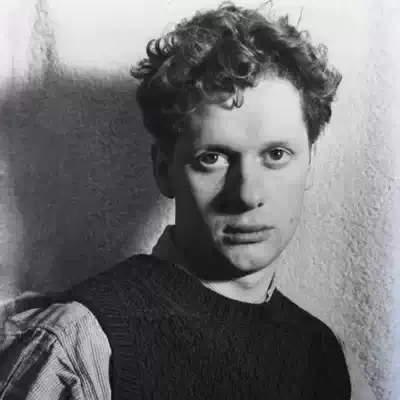
Dylan Thomas
Poem In October
It was my thirtieth year to heaven
Woke to my hearing from harbour and neighbour wood
And the mussel pooled and the heron
Priested shore
The morning beckon
With water praying and call of seagull and rook
And the knock of sailing boats on the net webbed wall
Myself to set foot
That second
In the still sleeping town and set forth.
My birthday began with the water-
Birds and the birds of the winged trees flying my name
Above the farms and the white horses
And I rose
In rainy autumn
And walked abroad in a shower of all my days.
High tide and the heron dived when I took the road
Over the border
And the gates
Of the town closed as the town awoke.
A springful of larks in a rolling
Cloud and the roadside bushes brimming with whistling
Blackbirds and the sun of October
Summery
On the hill's shoulder,
Here were fond climates and sweet singers suddenly
Come in the morning where I wandered and listened
To the rain wringing
Wind blow cold
In the wood faraway under me.
Pale rain over the dwindling harbour
And over the sea wet church the size of a snail
With its horns through mist and the castle
Brown as owls
But all the gardens
Of spring and summer were blooming in the tall tales
Beyond the border and under the lark full cloud.
There could I marvel
My birthday
Away but the weather turned around.
It turned away from the blithe country
And down the other air and the blue altered sky
Streamed again a wonder of summer
With apples
Pears and red currants
And I saw in the turning so clearly a child's
Forgotten mornings when he walked with his mother
Through the parables
Of sun light
And the legends of the green chapels
And the twice told fields of infancy
That his tears burned my cheeks and his heart moved in mine.
These were the woods the river and sea
Where a boy
In the listening
Summertime of the dead whispered the truth of his joy
To the trees and the stones and the fish in the tide.
And the mystery
Sang alive
Still in the water and singingbirds.
And there could I marvel my birthday
Away but the weather turned around. And the true
Joy of the long dead child sang burning
In the sun.
It was my thirtieth
Year to heaven stood there then in the summer noon
Though the town below lay leaved with October blood.
O may my heart's truth
Still be sung
On this high hill in a year's turning.
372
Robert Louis Stevenson
Envoy For A Child's Garden Of Verses
WHETHER upon the garden seat
You lounge with your uplifted feet
Under the May's whole Heaven of blue;
Or whether on the sofa you,
No grown up person being by,
Do some soft corner occupy;
Take you this volume in your hands
And enter into other lands,
For lo! (as children feign) suppose
You, hunting in the garden rows,
Or in the lumbered attic, or
The cellar - a nail-studded door
And dark, descending stairway found
That led to kingdoms underground:
There standing, you should hear with ease
Strange birds a-singing, or the trees
Swing in big robber woods, or bells
On many fairy citadels:
There passing through (a step or so -
Neither mamma nor nurse need know!)
From your nice nurseries you would pass,
Like Alice through the Looking-Glass
Or Gerda following Little Ray,
To wondrous countries far away.
Well, and just so this volume can
Transport each little maid or man
Presto from where they live away
Where other children used to play.
As from the house your mother sees
You playing round the garden trees,
So you may see if you but look
Through the windows of this book
Another child far, far away
And in another garden play.
But do not think you can at all,
By knocking on the window, call
That child to hear you. He intent
Is still on his play-business bent.
He does not hear, he will not look,
Nor yet be lured out of this book.
For long ago, the truth to say,
He has grown up and gone away;
And it is but a child of air
That lingers in the garden there.
374

Walt Whitman
What Am I, After All?
WHAT am I, after all, but a child, pleas'd with the sound of my own
name? repeating it over and over;
I stand apart to hear--it never tires me.
To you, your name also;
Did you think there was nothing but two or three pronunciations in
the sound of your name?
name? repeating it over and over;
I stand apart to hear--it never tires me.
To you, your name also;
Did you think there was nothing but two or three pronunciations in
the sound of your name?
372

James Whitcomb Riley
Uncle Mart's Poem
THE OLD SNOW-MAN
Ho! the old Snow-Man
That Noey Bixler made!
He looked as fierce and sassy
As a soldier on parade!-'
Cause Noey, when he made him,
While we all wuz gone, you see,
He made him, jist a-purpose,
Jist as fierce as he could be!--
But when we all got _ust_ to him,
Nobody wuz afraid
Of the old Snow-Man
That Noey Bixler made!
'Cause Noey told us 'bout him
And what he made him fer:-He'd
come to feed, that morning
He found we wuzn't here;
And so the notion struck him,
When we all come taggin' home
'Tud _s'prise_ us ef a' old Snow-Man
'Ud meet us when we come!
So, when he'd fed the stock, and milked,
And ben back home, and chopped
His wood, and et his breakfast, he
Jist grabbed his mitts and hopped
Right in on that-air old Snow-Man
That he laid out he'd make
Er bust a trace _a-tryin_'--jist
Fer old-acquaintance sake!--
But work like that wuz lots more fun.
He said, than when he played!
Ho! the old Snow-Man
That Noey Bixler made!
He started with a big snow-ball,
And rolled it all around;
And as he rolled, more snow 'ud stick
And pull up off the ground.--
He rolled and rolled all round the yard-'
Cause we could see the _track_,
All wher' the snow come off, you know,
And left it wet and black.
He got the Snow-Man's _legs-part_ rolled--
In front the kitchen-door,--
And then he hat to turn in then
And roll and roll some more!--
He rolled the yard all round agin,
And round the house, at that--
Clean round the house and back to wher'
The blame legs-half wuz at!
He said he missed his dinner, too--
Jist clean fergot and stayed
There workin'. Ho! the old Snow-Man
That Noey Bixler made!
And Noey said he hat to _hump_
To git the _top-half_ on
The _legs-half!_--When he _did_, he said,
His wind wuz purt'-nigh gone.--
He said, I jucks! he jist drapped down
There on the old porch-floor
And panted like a dog!--And then
He up! and rolled some more!--
The _last_ batch--that wuz fer his head,-And--
time he'd got it right
And clumb and fixed it on, he said--
He hat to quit fer night!--
And _then_, he said, he'd kep' right on
Ef they'd ben any _moon_
To work by! So he crawled in bed--
And _could_ a-slep' tel _noon_,
He wuz so plum wore out! he said,--
But it wuz washin'-day,
And hat to cut a cord o' wood
'Fore he could git away!
But, last, he got to work agin,--
With spade, and gouge, and hoe,
And trowel, too--(All tools 'ud do
What _Noey_ said, you know!)
He cut his eyebrows out like cliffs--
And his cheekbones and chin
Stuck _furder_ out--and his old _nose_
Stuck out as fur-agin!
He made his eyes o' walnuts,
And his whiskers out o' this
Here buggy-cushion stuffin'--_moss_,
The teacher says it is.
And then he made a' old wood'-gun,
Set keerless-like, you know,
Acrost one shoulder--kindo' like
Big Foot, er Adam Poe--
Er, mayby, Simon Girty,
The dinged old Renegade!
_Wooh!_ the old Snow-Man
That Noey Bixler made!
And there he stood, all fierce and grim,
A stern, heroic form:
What was the winter blast to him,
And what the driving storm?--
What wonder that the children pressed
Their faces at the pane
And scratched away the frost, in pride
To look on him again?--
What wonder that, with yearning bold,
Their all of love and care
Went warmest through the keenest cold
To that Snow-Man out there!
But the old Snow-Man--
What a dubious delight
He grew at last when Spring came on
And days waxed warm and bright.--
Alone he stood--all kith and kin
Of snow and ice were gone;--
Alone, with constant teardrops in
His eyes and glittering on
His thin, pathetic beard of black--
Grief in a hopeless cause!-Hope--
hope is for the man that _dies_--
What for the man that _thaws!_
O Hero of a hero's make!--
Let _marble_ melt and fade,
But never _you_--you old Snow-Man
That Noey Bixler made!
Ho! the old Snow-Man
That Noey Bixler made!
He looked as fierce and sassy
As a soldier on parade!-'
Cause Noey, when he made him,
While we all wuz gone, you see,
He made him, jist a-purpose,
Jist as fierce as he could be!--
But when we all got _ust_ to him,
Nobody wuz afraid
Of the old Snow-Man
That Noey Bixler made!
'Cause Noey told us 'bout him
And what he made him fer:-He'd
come to feed, that morning
He found we wuzn't here;
And so the notion struck him,
When we all come taggin' home
'Tud _s'prise_ us ef a' old Snow-Man
'Ud meet us when we come!
So, when he'd fed the stock, and milked,
And ben back home, and chopped
His wood, and et his breakfast, he
Jist grabbed his mitts and hopped
Right in on that-air old Snow-Man
That he laid out he'd make
Er bust a trace _a-tryin_'--jist
Fer old-acquaintance sake!--
But work like that wuz lots more fun.
He said, than when he played!
Ho! the old Snow-Man
That Noey Bixler made!
He started with a big snow-ball,
And rolled it all around;
And as he rolled, more snow 'ud stick
And pull up off the ground.--
He rolled and rolled all round the yard-'
Cause we could see the _track_,
All wher' the snow come off, you know,
And left it wet and black.
He got the Snow-Man's _legs-part_ rolled--
In front the kitchen-door,--
And then he hat to turn in then
And roll and roll some more!--
He rolled the yard all round agin,
And round the house, at that--
Clean round the house and back to wher'
The blame legs-half wuz at!
He said he missed his dinner, too--
Jist clean fergot and stayed
There workin'. Ho! the old Snow-Man
That Noey Bixler made!
And Noey said he hat to _hump_
To git the _top-half_ on
The _legs-half!_--When he _did_, he said,
His wind wuz purt'-nigh gone.--
He said, I jucks! he jist drapped down
There on the old porch-floor
And panted like a dog!--And then
He up! and rolled some more!--
The _last_ batch--that wuz fer his head,-And--
time he'd got it right
And clumb and fixed it on, he said--
He hat to quit fer night!--
And _then_, he said, he'd kep' right on
Ef they'd ben any _moon_
To work by! So he crawled in bed--
And _could_ a-slep' tel _noon_,
He wuz so plum wore out! he said,--
But it wuz washin'-day,
And hat to cut a cord o' wood
'Fore he could git away!
But, last, he got to work agin,--
With spade, and gouge, and hoe,
And trowel, too--(All tools 'ud do
What _Noey_ said, you know!)
He cut his eyebrows out like cliffs--
And his cheekbones and chin
Stuck _furder_ out--and his old _nose_
Stuck out as fur-agin!
He made his eyes o' walnuts,
And his whiskers out o' this
Here buggy-cushion stuffin'--_moss_,
The teacher says it is.
And then he made a' old wood'-gun,
Set keerless-like, you know,
Acrost one shoulder--kindo' like
Big Foot, er Adam Poe--
Er, mayby, Simon Girty,
The dinged old Renegade!
_Wooh!_ the old Snow-Man
That Noey Bixler made!
And there he stood, all fierce and grim,
A stern, heroic form:
What was the winter blast to him,
And what the driving storm?--
What wonder that the children pressed
Their faces at the pane
And scratched away the frost, in pride
To look on him again?--
What wonder that, with yearning bold,
Their all of love and care
Went warmest through the keenest cold
To that Snow-Man out there!
But the old Snow-Man--
What a dubious delight
He grew at last when Spring came on
And days waxed warm and bright.--
Alone he stood--all kith and kin
Of snow and ice were gone;--
Alone, with constant teardrops in
His eyes and glittering on
His thin, pathetic beard of black--
Grief in a hopeless cause!-Hope--
hope is for the man that _dies_--
What for the man that _thaws!_
O Hero of a hero's make!--
Let _marble_ melt and fade,
But never _you_--you old Snow-Man
That Noey Bixler made!
368
Henry Van Dyke
Dulcis Memoria
Long, long ago I heard a little song,
(Ah, was it long ago, or yesterday?)
So lowly, slowly wound the tune along,
That far into my heart it found the way:
A melody consoling and endearing;
And still, in silent hours, I'm often hearing
The small, sweet song that does not die away.
Long, long ago I saw a little flower,-(
Ah, was it long ago, or yesterday?)
So fair of face and fragrant for an hour,
That something dear to me it seemed to say:
A thought of joy that blossomed into being
Without a word; and now I'm often seeing
The friendly flower that does not fade away.
Long, long ago we had a little child,-(
Ah, was it long ago, or yesterday?)
Into his mother's eyes and mine he smiled
Unconscious love; warm in our arms he lay.
An angel called! Dear heart, we could not hold him;
Yet secretly your arms and mine infold him--
Our little child who does not go away.
Long, long ago? Ah, memory, make it clear-(
It was not long ago, but yesterday,)
So little and so helpless and so dear
Let not the song be lost, the flower decay!
His voice, his waking eyes, his gentle sleeping:
The smallest things are safest in thy keeping.
Sweet memory, keep our child with us always.
365
James Whitcomb Riley
Friday Afternoon
To William Morris Pierson
[1868-1870]
Of the wealth of facts and fancies
That our memories may recall,
The old school-day romances
Are the dearest, after all!--.
When some sweet thought revises
The half-forgotten tune
That opened 'Exercises'
On 'Friday Afternoon.'
We seem to hear the clicking
Of the pencil and the pen,
And the solemn, ceaseless ticking
Of the timepiece ticking then;
And we note the watchful master,
As he waves the warning rod,
With our own heart beating faster
Than the boy's who threw the wad.
Some little hand uplifted,
And the creaking of a shoe:--
A problem left unsifted
For the teacher's hand to do:
The murmured hum of learning--
And the flutter of a book;
The smell of something burning,
And the school's inquiring look.
The bashful boy in blushes;
And the girl, with glancing eyes,
Who hides her smiles, and hushes
The laugh about to rise,--
Then, with a quick invention,
Assumes a serious face,
To meet the words, 'Attention!
Every scholar in his place!'
The opening song, page 20.--
Ah! dear old 'Golden Wreath,'
You willed your sweets in plenty;
And some who look beneath
The leaves of Time will linger,
And loving tears will start,
As Fancy trails her finger
O'er the index of the heart.
'Good News from Home'--We hear it
Welling tremulous, yet clear
And holy as the spirit
Of the song we used to hear-
'Good news for me' (A throbbing
And an aching melody)-'
Has come across the'--(sobbing,
Yea, and salty) 'dark blue sea!'
Or the paean 'Scotland's burning!'
With its mighty surge and swell
Of chorus, still returning
To its universal yell--
Till we're almost glad to drop to
Something sad and full of pain--
And 'Skip verse three,' and stop, too,
Ere our hearts are broke again.
Then 'the big girls'' compositions,
With their doubt, and hope, and glow
Of heart and face,--conditions
Of 'the big boys'--even so,--
When themes of 'Spring,' and 'Summer'
And of 'Fall,' and 'Winter-time'
Droop our heads and hold us dumber
Than the sleigh-bell's fancied chime.
Elocutionary science-(
Still in changeless infancy!)--
With its 'Cataline's Defiance,'
And 'The Banner of the Free':
Or, lured from Grandma's attic,
A ramshackle 'rocker' there,
Adds a skreek of the dramatic
To the poet's 'Old Arm-Chair.'
Or the 'Speech of Logan' shifts us
From the pathos, to the fire;
And Tell (with Gessler) lifts us
Many noble notches higher.--
Till a youngster, far from sunny,
With sad eyes of watery blue,
Winds up with something 'funny,'
Like 'Cock-a-doodle-do!'
Then a dialogue--selected
For its realistic worth:--
The Cruel Boy detected
With a turtle turned to earth
Back downward; and, in pleading,
The Good Boy--strangely gay
At such a sad proceeding--
Says, 'Turn him over, pray!'
So the exercises taper
Through gradations of delight
To the reading of 'The Paper,'
Which is entertaining--quite!
For it goes ahead and mentions
'If a certain Mr. O.
Has serious intentions
That he ought to tell her so.'
It also 'Asks permission
To intimate to 'John'
The dubious condition
Of the ground he's standing on';
And, dropping the suggestion
To 'mind what he's about,'
It stuns him with the question:
'Does his mother know he's out?'
And among the contributions
To this 'Academic Press'
Are 'Versified Effusions'
By--'Our lady editress'--
Which fact is proudly stated
By the CHIEF of the concern,-'
Though the verse communicated
Bears the pen-name 'Fanny Fern.' '
. . . . . .
When all has been recited,
And the teacher's bell is heard,
And visitors, invited,
Have dropped a kindly word,
A hush of holy feeling
Falls down upon us there,
As though the day were kneeling,
With the twilight for the prayer.
. . . . . .
Midst the wealth of facts and fancies
That our memories may recall,
Thus the old school-day romances
Are the dearest, after all!--
When some sweet thought revises
The half-forgotten tune
That opened 'Exercises,'
On 'Friday Afternoon.'
365
Dylan Thomas
Ghosts whooed like owls in the long nights when I dared not look over my shoulder
Ghosts whooed like owls in the long nights when I dared not look over my shoulder;
animals lurked in the cubbyhole under the stairs and the gas meter ticked. And I
remember that we went singing carols once, when there wasn't the shaving of a moon
to light the flying streets. At the end of a long road was a drive that led to a large
house, and we stumbled up the darkness of the drive that night, each one of us afraid,
each one holding a stone in his hand in case, and all of us too brave to say a word. The
wind through the trees made noises as of old and unpleasant and maybe webfooted
men wheezing in caves. We reached the black bulk of the house. "What shall we give
them? Hark the Herald?"
"No," Jack said, "Good King Wencelas. I'll count three." One, two three, and we began
to sing, our voices high and seemingly distant in the snow-felted darkness round the
house that was occupied by nobody we knew. We stood close together, near the dark
door. Good King Wencelas looked out On the Feast of Stephen ... And then a small, dry
voice, like the voice of someone who has not spoken for a long time, joined our
singing: a small, dry, eggshell voice from the other side of the door: a small dry voice
through the keyhole. And when we stopped running we were outside our house; the
front room was lovely; balloons floated under the hot-water-bottle-gulping gas;
everything was good again and shone over the town.
"Perhaps it was a ghost," Jim said.
"Perhaps it was trolls," Dan said, who was always reading.
"Let's go in and see if there's any jelly left," Jack said. And we did that.
Always on Christmas night there was music. An uncle played the fiddle, a cousin sang
"Cherry Ripe," and another uncle sang "Drake's Drum." It was very warm in the little
house. Auntie Hannah, who had got on to the parsnip wine, sang a song about
Bleeding Hearts and Death, and then another in which she said her heart was like a
Bird's Nest; and then everybody laughed again; and then I went to bed. Looking
through my bedroom window, out into the moonlight and the unending smoke-colored
snow, I could see the lights in the windows of all the other houses on our hill and hear
the music rising from them up the long, steady falling night. I turned the gas down, I
got into bed. I said some words to the close and holy darkness, and then I slept.
362
James Whitcomb Riley
How John Quit The Farm
Nobody on the old farm here but Mother, me and John,
Except, of course, the extry he'p when harvest-time come on--
And then, I want to say to you, we _needed_ he'p about,
As you'd admit, ef you'd a-seen the way the crops turned out!
A better quarter-section, ner a richer soil warn't found
Than this-here old-home place o' ourn fer fifty miles around!--
The house was small--but plenty-big we found it from the day
That John--our only livin' son--packed up and went way.
You see, we tuck sich pride in John--his mother more 'n me-That's
natchurul; but _both_ of us was proud as proud could be;
Fer the boy, from a little chap, was most oncommon bright,
And seemed in work as well as play to take the same delight.
He allus went a-whistlin' round the place, as glad at heart
As robins up at five o'clock to git an airly start;
And many a time 'fore daylight Mother's waked me up to say-'
Jest listen, David!--listen!--Johnny's beat the birds to-day!'
High-sperited from boyhood, with a most inquirin' turn,--
He wanted to learn ever'thing on earth they was to learn:
He'd ast more plaguey questions in a mortal-minute here
Than his grandpap in Paradise could answer in a year!
And read! w'y, his own mother learnt him how to read and spell;
And 'The Childern of the Abbey'--w'y, he knowed that book as well
At fifteen as his parents!--and 'The Pilgrim's Progress,' too--
Jest knuckled down, the shaver did, and read 'em through and through!
At eighteen, Mother 'lowed the boy must have a better chance--
That we ort to educate him, under any circumstance;
And John he j'ined his mother, and they ding-donged and kep' on,
Tel I sent him off to school in town, half glad that he was gone.
But--I missed him--w'y of course I did!--The Fall and Winter through
I never built the kitchen-fire, er split a stick in two,
Er fed the stock, er butchered, er swung up a gambrel-pin,
But what I thought o' John, and wished that he was home agin.
He'd come, sometimes--on Sund'ys most--and stay the Sund'y out;
And on Thanksgivin'-Day he 'peared to like to be about:
But a change was workin' on him--he was stiller than before,
And did n't joke, ner laugh, ner sing and whistle any more.
And his talk was all so proper; and I noticed, with a sigh,
He was tryin' to raise side-whiskers, and had on a striped tie,
And a standin'-collar, ironed up as stiff and slick as bone;
And a breast-pin, and a watch and chain and plug-hat of his own.
But when Spring-weather opened out, and John was to come home
And he'p me through the season, I was glad to see him come;
But my happiness, that evening, with the settin' sun went down,
When he bragged of 'a position' that was offered him in town.
'But,' says I, 'you'll not accept it?' 'W'y, of course
I will,' says he.-'
This drudgin' on a farm,' he says, 'is not the life fer me;
I've set my stakes up higher,' he continued, light and gay,
'And town's the place fer me, and I'm a-goin' right away!'
And go he did!--his mother clingin' to him at the gate,
A-pleadin' and a-cryin'; but it hadn't any weight.
I was tranquiller, and told her 'twarn't no use to worry so,
And onclasped her arms from round his neck round mine--and let him go!
I felt a little bitter feelin' foolin' round about
The aidges of my conscience; but I didn't let it out;--
I simply retch out, trimbly-like, and tuck the boy's hand,
And though I did n't say a word, I knowed he'd understand.
And--well!--sence then the old home here was mighty lonesome, shore!
With me a-workin' in the field, and Mother at the door,
Her face ferever to'rds the town, and fadin' more and more---
Her only son nine miles away, a-clerkin' in a store!
The weeks and months dragged by us; and sometimes the boy would write
A letter to his mother, savin' that his work was light,
And not to feel oneasy about his health a bit--
Though his business was confinin', he was gittin' used to it.
And sometimes he would write and ast how _I_ was gittin' on,
And ef I had to pay out much fer he'p sence he was gone;
And how the hogs was doin', and the balance of the stock,
And talk on fer a page er two jest like he used to talk.
And he wrote, along 'fore harvest, that he guessed he would git home,
Fer business would, of course be dull in town.--But _didn't_ come:--
We got a postal later, sayin' when they had no trade
They filled the time 'invoicin' goods,' and that was why he staid.
And then he quit a-writin' altogether: Not a word--
Exceptin' what the neighbors brung who'd been to town and heard
What store John was clerkin' in, and went round to inquire
If they could buy their goods there less and sell their produce higher.
And so the Summer faded out, and Autumn wore away,
And a keener Winter never fetched around Thanksgivin'-Day!
The night before that day of thanks I'll never quite fergit,
The wind a-howlin' round the house--it makes me creepy yit!
And there set me and Mother--me a-twistin' at the prongs
Of a green scrub-ellum forestick with a vicious pair of tongs,
And Mother sayin', '_David! David!_' in a' undertone,
As though she thought that I was thinkin' bad-words unbeknown.
'I've dressed the turkey, David, fer to-morrow,' Mother said,
A-tryin' to wedge some pleasant subject in my stubborn head,-'
And the mince-meat I'm a-mixin' is perfection mighty nigh;
And the pound-cake is delicious-rich--' 'Who'll eat 'em?' I-says-I.
'The cramberries is drippin-sweet,' says Mother, runnin' on,
P'tendin' not to hear me;--'and somehow I thought of John
All the time they was a-jellin'--fer you know they allus was
His favour--he likes 'em so!' Says I, 'Well, s'pose he does?'
'Oh, nothin' much!' says Mother, with a quiet sort o' smile-'
This gentleman behind my cheer may tell you after while!'
And as I turned and looked around, some one riz up and leant
And put his arms round Mother's neck, and laughed in low content.
'It's _me_,' he says--'your fool-boy John, come back to shake your hand;
Set down with you, and talk with you, and make you understand
How dearer yit than all the world is this old home that we
Will spend Thanksgivin' in fer life--jest Mother, you and me!'
* * * * * *
Nobody on the old farm here but Mother, me and John,
Except of course the extry he'p, when harvest-time comes on;
And then, I want to say to you, we _need_ sich he'p about,
As you'd admit, ef you could see the way the crops turns out!
362
James Whitcomb Riley
A Home-Made Fairy Tale
Bud, come here to your uncle a spell,
And I'll tell you something you mustn't tell--
For it's a secret and shore-'nuf true,
And maybe I oughtn't to tell it to you--!
But out in the garden, under the shade
Of the apple-trees, where we romped and played
Till the moon was up, and you thought I'd gone
Fast asleep--, That was all put on!
For I was a-watchin' something queer
Goin' on there in the grass, my dear--!
'Way down deep in it, there I see
A little dude-Fairy who winked at me,
And snapped his fingers, and laughed as low
And fine as the whine of a mus-kee-to!
I kept still-- watchin' him closer-- and
I noticed a little guitar in his hand,
Which he leant 'ginst a little dead bee-- and laid
His cigarette down on a clean grass-blade,
And then climbed up on the shell of a snail--
Carefully dusting his swallowtail--
And pulling up, by a waxed web-thread,
This little guitar, you remember. I said!
And there he trinkled and trilled a tune--,
'My Love, so Fair, Tans in the Moon!'
Till presently, out of the clover-top
He seemed to be singing to, came k'pop!
The purtiest, daintiest Fairy face
In all this world, or any place!
Then the little ser'nader waved his hand,
As much as to say, 'We'll excuse you!' and
I heard, as I squinted my eyelids to,
A kiss like the drip of a drop of dew!
359
Robert Louis Stevenson
The Land of Counterpane
When I was sick and lay a-bed,
I had two pillows at my head,
And all my toys beside me lay,
To keep me happy all the day.
And sometimes for an hour or so
I watched my leaden soldiers go,
With different uniforms and drills,
Among the bed-clothes, through the hills;
And sometimes sent my ships in fleets
All up and down among the sheets;
Or brought my trees and houses out,
And planted cities all about.
I was the giant great and still
That sits upon the pillow-hill,
And sees before him, dale and plain,
The pleasant land of counterpane.
354
Robert Louis Stevenson
The Swing
How do you like to go up in a swing,
Up in the air so blue?
Oh, I do think it the pleasantest thing
Ever a child can do!
Up in the air and over the wall,
Till I can see so wide,
River and trees and cattle and all
Over the countryside--
Till I look down on the garden green,
Down on the roof so brown--
Up in the air I go flying again,
Up in the air and down!
348

Henry Wadsworth Longfellow
Voices Of The Night : Prelude
Pleasant it was, when woods were green,
And winds were soft and low,
To lie amid some sylvan scene,
Where, the long drooping boughs between
Shadows dark and sunlight sheen
Alternate come and go;
Or where the denser grove receives
No sunlight from above
But the dark foliage interweaves
In one unbroken roof of leaves,
Underneath whose sloping eaves
The shadows hardly move.
Beneath some patriarchal tree
I lay upon the ground;
His hoary arms uplifted he,
And all the broad leaves over me
Clapped their little hands in glee,
With one continuous sound;--
A slumberous sound,--a sound that brings
The feelings of a dream,--
As of innumerable wings,
As, when a bell no longer swings,
Faint the hollow murmur rings
O'er meadow, lake, and stream.
And dreams of that which cannot die,
Bright visins, came to me,
As lapped in thought I used to lie,
And gaze into the summer sky,
Where the sailing clouds went by,
Like ships upon the sea;
Dreams that the soul of youth engage
Ere Fancy has been quelled;
Old legends of the monkish page.
Traditions of the saint and sage,
Tales that have the rime of age,
And chronicles of Eld.
And, loving still these quaint old themes,
Even in the city's throng
I feel the freshness of the streams,
That, crossed by shades and sunny gleams,
Water the green land of dreams,
The holy land of song.
Therefore, at Pentecost, which brings
The Spring, clothed like a bride,
When nestling buds unfold their wings,
And bishop's-caps have golden rings,
Musing upon many things,
I sought the woodlands wide.
The green trees whispered low and mild,
It was a sound of joy!
They were my playmates when a child
And rocked me in their arms so wild!
Still they looked at me and smiled
As if I were a boy;
And ever whispered, mild and low,
'Come, be a child once more!'
And waved their long arms to and fro,
And beckoned solemnly and slow;
O, I could not choose but go
Into the woodlands hoar;
Into the blithe and breathing air,
Into the solemn wood.
Solemn and silent everywhere!
Nature with folded hands seemed there,
Kneeling at her evening prayer!
Like one in prayer I stood.
Before me rose an avenue
Of tall and sombrous pines;
Abroad their fan-like branches grew,
And, where the sunshine darted throught
Spread a vapor soft and blue,
In long and sloping lines.
And, falling on my weary brain,
Like a fast-falling shower,
The dreams of youth came back again,
Low lispings of the summer rain,
Dropping on the ripened grain,
As once upon the flower.
Visions of childhood! Stay, O stay!
Ye were so sweet and wild!
And distant voices seemed to say,
'It cannot be! They pass away!
Other themes demand thy lay;
Thou art no more a child!
'The land of Song within thee lies,
Watered by living springs;
The lids of Fancy's sleepless eyes
Are gates unto that Paradise;
Holy thoughts, like stars, arise,
Its clouds are angels' wings.
'Learn, that henceforth thy song shall be
Not mountains capped with snow,
Nor forests sounding like the sea,
Nor rivers flowing ceaselessly,
Where the woodlands bend to see
The bending heavens below.
'There is a forest where the din
Of iron branches sounds!
A mighty river roara between,
And whosoever looks therein,
Sees the heavens all black with sin,--
Sees not ita depths, nor bounds.
'Athwart the swinging branches cast,
Soft rays of sunshine pour;
Then comes the fearful wintry blast;
Our hopes, like withered leaves, fall fast;
Pallid lips say, 'It is past!
We can return no more!'
'Look, then, into thine heart, and write!
Yes, into Life's deep stream!
All forms of sorrow and delight,
All solemn Voices of the Night,
That can soothe thee, or affright,--
Be these henceforth thy theme.'
338

Carl Sandburg
Upstairs
I too have a garret of old playthings.
I have tin soldiers with broken arms upstairs.
I have a wagon and the wheels gone upstairs.
I have guns and a drum, a jumping-jack and a magic lantern.
And dust is on them and I never look at them upstairs.
I too have a garret of old playthings.
I have tin soldiers with broken arms upstairs.
I have a wagon and the wheels gone upstairs.
I have guns and a drum, a jumping-jack and a magic lantern.
And dust is on them and I never look at them upstairs.
I too have a garret of old playthings.
338
James Whitcomb Riley
Old Man's Nursery Rhyme
I.
In the jolly winters
Of the long-ago,
It was not so cold as now--
O! No! No!
Then, as I remember,
Snowballs, to eat,
Were as good as apples now,
And every bit as sweet!
II.
In the jolly winters
Of the dead-and-gone,
Bub was warm as summer,
With his red mitts on,--
Just in his little waist
And-
pants all together,
Who ever heard him growl
About cold weather?
III.
In the jolly winters of the long-ago--
Was it _half_ so cold as now?
O! No! No!
Who caught his death o' cold,
Making prints of men
Flat-backed in snow that now's
Twice as cold again?
IV.
In the jolly winters
Of the dead-and-gone,
Startin' out rabbit-hunting
Early as the dawn,--
Who ever froze his fingers,
Ears, heels, or toes,-Or'd
a cared if he had?
Nobody knows!
V.
Nights by the kitchen-stove,
Shelling white and red
Corn in the skillet, and
Sleepin' four abed!
Ah! the jolly winters
Of the long-ago!
We were not so old as now-
O! No! No!
In the jolly winters
Of the long-ago,
It was not so cold as now--
O! No! No!
Then, as I remember,
Snowballs, to eat,
Were as good as apples now,
And every bit as sweet!
II.
In the jolly winters
Of the dead-and-gone,
Bub was warm as summer,
With his red mitts on,--
Just in his little waist
And-
pants all together,
Who ever heard him growl
About cold weather?
III.
In the jolly winters of the long-ago--
Was it _half_ so cold as now?
O! No! No!
Who caught his death o' cold,
Making prints of men
Flat-backed in snow that now's
Twice as cold again?
IV.
In the jolly winters
Of the dead-and-gone,
Startin' out rabbit-hunting
Early as the dawn,--
Who ever froze his fingers,
Ears, heels, or toes,-Or'd
a cared if he had?
Nobody knows!
V.
Nights by the kitchen-stove,
Shelling white and red
Corn in the skillet, and
Sleepin' four abed!
Ah! the jolly winters
Of the long-ago!
We were not so old as now-
O! No! No!
339
James Whitcomb Riley
The Boys
Where are they?--the friends of my childhood enchanted--
The clear, laughing eyes looking back in my own,
And the warm, chubby fingers my palms have so wanted,
As when we raced over
Pink pastures of clover,
And mocked the quail's whir and the bumblebee's drone?
Have the breezes of time blown their blossomy faces
Forever adrift down the years that are flown?
Am I never to see them romp back to their places,
Where over the meadow,
In sunshine and shadow,
The meadow-larks trill, and the bumblebees drone?
Where are they? Ah! dim in the dust lies the clover;
The whippoorwill's call has a sorrowful tone,
And the dove's--I have wept at it over and over;--
I want the glad luster
Of youth, and the cluster
Of faces asleep where the bumblebees drone!
338
Robert Louis Stevenson
The Dumb Soldier
When the grass was closely mown,
Walking on the lawn alone,
In the turf a hole I found
And hid a soldier underground.
Spring and daisies came apace;
Grasses hid my hiding-place;
Grasses run like a green sea
O'er the lawn up to my knee.
Under grass alone he lies,
Looking up with leaden eyes,
Scarlet coat and pointed gun,
To the stars and to the sun.
When the grass is ripe like grain,
When the scythe is stoned again,
When the lawn is shaven clear,
Then my hole shall reappear.
I shall find him, never fear,
I shall find my grenadier;
But, for all that's gone and come,
I shall find my soldier dumb.
He has lived, a little thing,
In the grassy woods of spring;
Done, if he could tell me true,
Just as I should like to do.
He has seen the starry hours
And the springing of the flowers;
And the fairy things that pass
In the forests of the grass.
In the silence he has heard
Talking bee and ladybird,
And the butterfly has flown
O'er him as he lay alone.
Not a word will he disclose,
Not a word of all he knows.
I must lay him on the shelf,
And make up the tale myself.
336
Henry Van Dyke
A Child in the Garden
When to the garden of untroubled thought
I came of late, and saw the open door,
And wished again to enter, and explore
The sweet, wild ways with stainless bloom inwrought,
And bowers of innocence with beauty fraught,
It seemed some purer voice must speak before
I dared to tread that garden loved of yore,
That Eden lost unknown and found unsought.
Then just within the gate I saw a child, --
A stranger-child, yet to my heart most dear;
He held his hands to me, and softly smiled
With eyes that knew no shade of sin or fear:
"Come in," he said, "and play awhile with me;"
"I am the little child you used to be."
334
James Whitcomb Riley
Fool-Youngens
Me an' Bert an' Minnie-Belle
Knows a joke, an' we won't tell!
No, we don't--'cause we don't know
_Why_ we got to laughin' so;
But we got to laughin' so,
'We ist kep' a-laughin'.
Wind wuz blowin' in the tree--
An' wuz only ist us three
Playin' there; an' ever' one
Ketched each other, like we done,
Squintin' up there at the sun
Like we wuz a-laughin'.
Nothin' funny anyway;
But I laughed, an' so did they--
An' we all three laughed, an' nen
Squint' our eyes an' laugh' again:
Ner we didn't ist _p'ten'_--
We wuz _shore-'nough_ laughin'.
'We ist laugh' an' laugh', tel Bert
Say he _can't_ quit an' it hurt.
Nen I _howl_, an' Minnie-Belle
She tear up the grass a spell
An' ist stop her yeers an' _yell_
Like she'd _die_ a-laughin'.
Never sich fool-youngens yit!
Nothin' funny,--not a bit!--
But we laugh' so; tel we whoop'
Purt'-nigh like we have the croup--
All so hoarse we'd wheeze an' whoop
An' ist _choke_ a-laughin'.
330

John Greenleaf Whittier
The Barefoot Boy
Blessings on thee, little man,
Barefoot boy, with cheek of tan!
With thy turned-up pantaloons,
And thy merry whistled tunes;
With thy red lip, redder still
Kissed by strawberries on the hill;
With the sunshine on thy face,
Through thy torn brim's jaunty grace;
From my heart I give thee joy, I
was once a barefoot boy!
Prince thou art, - the grown-up man
Only is republican.
Let the million-dollared ride!
Barefoot, trudging at his side,
Thou hast more than he can buy
In the reach of ear and eye, Outward
sunshine, inward joy:
Blessings on thee, barefoot boy!
Oh for boyhood's painless play,
Sleep that wakes in laughing day,
Health that mocks the doctor's rules,
Knowledge never learned of schools,
Of the wild bee's morning chase,
Of the wild-flower's time and place,
Flight of fowl and habitude
Of the tenants of the wood;
How the tortoise bears his shell,
How the woodchuck digs his cell,
And the ground-mole sinks his well;
How the robin feeds her young,
How the oriole's nest is hung;
Where the whitest lilies blow,
Where the freshest berries grow,
Where the ground-nut trails its vine,
Where the wood-grape's clusters shine;
Of the black wasp's cunning way,
Mason of his walls of clay,
And the architectural plans
Of gray hornet artisans!
For, eschewing books and tasks,
Nature answers all he asks;
Hand in hand with her he walks,
Face to face with her he talks,
Part and parcel of her joy, Blessings
on the barefoot boy!
Oh for boyhood's time of June,
Crowding years in one brief moon,
When all things I heard or saw,
Me, their master, waited for.
I was rich in flowers and trees,
Humming-birds and honey-bees;
For my sport the squirrel played,
Plied the snouted mole his spade;
For my taste the blackberry cone
Purpled over hedge and stone;
Laughed the brook for my delight
Through the day and through the night,
Whispering at the garden wall,
Talked with me from fall to fall;
Mine the sand-rimmed pickerel pond,
Mine the walnut slopes beyond,
Mine, on bending orchard trees,
Apples of Hesperides!
Still as my horizon grew,
Larger grew my riches too;
All the world I saw or knew
Seemed a complex Chinese toy,
Fashioned for a barefoot boy!
Oh for festal dainties spread,
Like my bowl of milk and bread;
Pewter spoon and bowl of wood,
On the door-stone, gray and rude!
O'er me, like a regal tent,
Cloudy-ribbed, the sunset bent,
Purple-curtained, fringed with gold,
Looped in many a wind-swung fold;
While for music came the play
Of the pied frogs' orchestra;
And, to light the noisy choir,
Lit the fly his lamp of fire.
I was monarch: pomp and joy
Waited on the barefoot boy!
Cheerily, then, my little man,
Live and laugh, as boyhood can!
Though the flinty slopes be hard,
Stubble-speared the new-mown sward,
Every morn shall lead thee through
Fresh baptisms of the dew;
Every evening from thy feet
Shall the cool wind kiss the heat:
All too soon these feet must hide
In the prison cells of pride,
Lose the freedom of the sod,
Like a colt's for work be shod,
Made to tread the mills of toil,
Up and down in ceaseless moil:
Happy if their track be found
Never on forbidden ground;
Happy if they sink not in
Quick and treacherous sands of sin.
Ah! that thou couldst know thy joy,
Ere it passes, barefoot boy!
332