
Platonic Love

Ella Wheeler Wilcox
Two Roses
A humble wild-rose, pink and slender,
Was plucked and placed in a bright bouquet,
Beside a Jacqueminot’s royal splendour,
And both in my lady’s boudoir lay.
Said the haughty bud, in a tone of scorning,
‘I wonder why you are called a rose?
Your leaves will fade in a single morning;
No blood of mine in your pale cheek glows.
‘Your course green stalk shows dust of the highway,
You have no depths of fragrant bloom;
And what could you learn in a rustic byway
To fit you to lie in my lady’s room?
‘If called to adorn her warm, white bosom,
What have you to offer for such a place,
Beside my fragrant and splendid blossom,
Ripe with colour and rich with grace?
Said the sweet wild-rose, ‘Despite your dower
Of finer breeding and deeper hue,
Despite your beauty, fair, high-bred flower,
It is I who should lie on her breast, not you.
‘For small account is your hot-house glory
Beside the knowledge that came to me
When I heard by the wayside love’s old story
And felt the kiss of the amorous bee.’
367

John Keats
Sonnet VI. To G. A. W.
Nymph of the downward smile and sidelong glance!
In what diviner moments of the day
Art thou most lovely? -- when gone far astray
Into the labyrinths of sweet utterance,
Or when serenely wandering in a trance
Of sober thought? -- Or when starting away,
With careless robe to meet the morning ray,
Thou sparest the flowers in thy mazy dance?
Haply 'tis when thy ruby lips part sweetly,
And so remain, because thou listenest:
But thou to please wert nurtured so completely
That I can never tell what mood is best;
I shall as soon pronounce which Grace more neatly
Trips it before Apollo than the rest.
365

Johann Wolfgang von Goethe
Conflict Of Wit And Beauty
Sir Wit, who is so much esteem'd,
And who is worthy of all honour,
Saw Beauty his superior deem'd
By folks who loved to gaze upon her;
At this he was most sorely vex'd.
Then came Sir Breath (long known as fit
To represent the cause of wit),
Beginning, rudely, I admit,
To treat the lady with a text.
To this she hearken'd not at all,
But hasten'd to his principal:
'None are so wise, they say, as you,--
Is not the world enough for two?
If you are obstinate, good-bye!
If wise, to love me you will try,
For be assured the world can ne'er
Give birth to a more handsome pair.'
364

Henry Wadsworth Longfellow
The Four Princesses At Wilna. A Photograph
Sweet faces, that from pictured casements lean
As from a castle window, looking down
On some gay pageant passing through a town,
Yourselves the fairest figures in the scene;
With what a gentle grace, with what serene
Unconsciousness ye wear the triple crown
Of youth and beauty and the fair renown
Of a great name, that ne'er hath tarnished been!
From your soft eyes, so innocent and sweet,
Four spirits, sweet and innocent as they,
Gaze on the world below, the sky above;
Hark! there is some one singing in the street;
'Faith, Hope, and Love! these three,' he seems to say;
'These three; and greatest of the three is Love.'
362
John Donne
To The Countess Of Bedford I
MADAM—
Reason is our soul's left hand, faith her right ;
By these we reach divinity, that's you ;
Their loves, who have the blessing of your light,
Grew from their reason ; mine from fair faith grew.
But as, although a squint left-handedness
Be ungracious, yet we cannot want that hand ;
So would I—not to increase, but to express
My faith—as I believe, so understand.
Therefore I study you first in your saints,
Those friends whom your election glorifies ;
Then in your deeds, accesses and restraints,
And what you read, and what yourself devise.
But soon the reasons why you're loved by all,
Grow infinite, and so pass reason's reach ;
Then back again to implicit faith I fall,
And rest on that the Catholic voice doth teach—
That you are good ; and not one heretic
Denies it ; if he did, yet you are so ;
For rocks, which high to sense deep-rooted stick,
Waves wash, not undermine, nor overthrow.
In everything there naturally grows
A balsamum to keep it fresh and new,
If 'twere not inured by extrinsic blows ;
Your birth and beauty are this balm in you.
But you, of learning, and religion,
And virtue, and such ingredients, have made
A mithridate, whose operation
Keeps off, or cures, what can be done or said.
Yet this is not your physic, but your food,
A diet fit for you ; for you are here
The first good angel, since the world's frame stood,
That ever did in woman's shape appear.
Since you are then God's masterpiece, and so
His factor for our loves, do as you do ;
Make your return home gracious, and bestow
This life on that ; so make one life of two.
For, so God help me, I would not miss you there,
For all the good which you can do me here.
359
John Donne
The Harbinger
to the Progresse.
TWo soules moue here, and mine (a third) must moue
Paces of admiration, and of loue;
Thy soule (Deare Virgin) whose this tribute is,
Mou'd from this mortall sphere to liuely blisse,
And yet moues still, and still aspires to see
The worlds last day, thy glories full degree:
Like as those starres which thou ore-lookest farre,
Are in their place, and yet still moued are
No soule (whiles with the luggage of this clay
It clogged is) can follow thee halfe way;
Or see thy flight; which doth our thoughts outgoe
So fast, that now the lightning moues but slow:
But now thou art as high in heauen flowne
As heau'ns from vs; what soule besides thine owne
Can tell thy ioyes, or say he can relate
Thy glorious Iornals in that blessed state?
I enuie thee (Rich soule) I enuy thee,
Although I cannot yet thy glory see:
And thou (Great spirit) which her's follow'd hast
So fast, as none can follow thine so fast;
So farre as none can follow thine so farre,
(And if this flesh did not the passage barre
Had'st caught her) let me wonder at thy flight
Which long agone had'st lost the vulgar sight
And now mak'st proud the better eyes, that they
Can see thee les'ned in thine aery way;
So while thou mak'st her soule by progresse knowne
Thou mak'st a noble progresse of thine owne.
From this worlds carcasse hauing mounted hie
To that pure life of Immortalitie;
Since thine aspiring thoughts themselues so raise
That more may not beseeme a creatures praise,
Yet still thou vow'st her more; and euery yeare
Mak'st a new Progresse, while thou wandrest here;
Still vpward mount; and let thy makers praise
Honor thy Laura, and adorne thy laies.
And since thy Mus[es] head in heauen shrouds
Oh let her neuer stoope below the clouds:
And if those glorious sainted soules may know
Or what we doe, or what we sing below,
Those acts, those songs shall still content them best
Which praise those awfull powers that make them blest.
360
Alexander Pope
On a Fan of the Author's Design
Come gentle Air! th' AEolian shepherd said,
While Procris panted in the secret shade:
Come, gentle Air, the fairer Delia cries,
While at her feet her swain expiring lies.
Lo the glad gales o'er all her beauties stray,
Breathe on her lips, and in her bosom play!
In Delia's hand this toy is fatal found,
Nor could that fabled dart more surely wound:
Both gifts destructive to the givers prove;
Alike both lovers fall by those they love.
Yet guiltless too this bright destroyer lives,
At random wounds, nor knows the wound she gives:
She views the story with attentive eyes,
And pities Procris, while her lover dies.
356

William Shakespeare
Sonnet 10: For shame, deny that thou bear'st love to any
For shame, deny that thou bear'st love to any
Who for thy self art so unprovident.
Grant, if thou wilt, thou art beloved of many,
But that thou none lov'st is most evident;
For thou art so possessed with murd'rous hate,
That 'gainst thy self thou stick'st not to conspire,
Seeking that beauteous roof to ruinate
Which to repair should be thy chief desire.
O, change thy thought, that I may change my mind!
Shall hate be fairer lodged than gentle love?
Be as thy presence is gracious and kind,
Or to thy self at least kind-hearted prove,
Make thee another self, for love of me,
That beauty still may live in thine or thee.
355
Henry Van Dyke
Love's Reason
For that thy face is fair I love thee not;
Nor yet because the light of thy brown eyes
Hath gleams of wonder and of glad surprise,
Like woodland streams that cross a sunlit spot:
Nor for thy beauty, born without a blot,
Most perfect when it shines through no disguise
Pure as the star of Eve in Paradise, ---
For all these outward things I love thee not:
But for a something in thy form and face,
Thy looks and ways, of primal harmony;
A certain soothing charm, a vital grace
That breathes of the eternal womanly,
And makes me feel the warmth of Nature's breast,
When in her arms, and thine, I sink to rest.
353
Henry Van Dyke
Love in a Look
Let me but feel thy look's embrace,
Transparent, pure, and warm,
And I'll not ask to touch thy face,
Or fold thee with mine arm.
For in thine eyes a girl doth rise,
Arrayed in candid bliss,
And draws me to her with a charm
More close than any kiss.
A loving-cup of golden wine,
Songs of a silver brook,
And fragrant breaths of eglantine,
Are mingled in thy look.
More fair they are than any star,
Thy topaz eyes divine --
And deep within their trysting-nook
Thy spirit blends with mine.
353
Edna St. Vincent Millay
Daphne
Why do you follow me?—
Any moment I can be
Nothing but a laurel-tree.
Any moment of the chase
I can leave you in my place
A pink bough for your embrace.
Yet if over hill and hollow
Still it is your will to follow,
I am off;—to heel, Apollo!
Any moment I can be
Nothing but a laurel-tree.
Any moment of the chase
I can leave you in my place
A pink bough for your embrace.
Yet if over hill and hollow
Still it is your will to follow,
I am off;—to heel, Apollo!
352
William Shakespeare
Silvia
WHO is Silvia? What is she?
That all our swains commend her?
Holy, fair, and wise is she;
The heaven such grace did lend her,
That she might admired be.
Is she kind as she is fair?
For beauty lives with kindness:
Love doth to her eyes repair,
To help him of his blindness;
And, being help'd, inhabits there.
Then to Silvia let us sing,
That Silvia is excelling;
She excels each mortal thing
Upon the dull earth dwelling:
To her let us garlands bring.
350
Henry Wadsworth Longfellow
Rondel. (From Froissart)
Love, love, what wilt thou with this heart of mine?
Naught see I fixed or sure in thee!
I do not know thee,--nor what deeds are thine:
Love, love, what wilt thou with this heart of mine?
Naught see I fixed or sure in thee!
Shall I be mute, or vows with prayers combine?
Ye who are blessed in loving, tell it me:
Love, love, what wilt thou with this heart of mine?
Naught see I permanent or sure in thee!
Naught see I fixed or sure in thee!
I do not know thee,--nor what deeds are thine:
Love, love, what wilt thou with this heart of mine?
Naught see I fixed or sure in thee!
Shall I be mute, or vows with prayers combine?
Ye who are blessed in loving, tell it me:
Love, love, what wilt thou with this heart of mine?
Naught see I permanent or sure in thee!
347

Robert Browning
The Guardian-Angel
A PICTURE AT FANO.
I.
Dear and great Angel, wouldst thou only leave
That child, when thou hast done with him, for me!
Let me sit all the day here, that when eve
Shall find performed thy special ministry,
And time come for departure, thou, suspending
Thy flight, mayst see another child for tending,
Another still, to quiet and retrieve.
II.
Then I shall feel thee step one step, no more,
From where thou standest now, to where I gaze,
---And suddenly my head is covered o'er
With those wings, white above the child who prays
Now on that tomb---and I shall feel thee guarding
Me, out of all the world; for me, discarding
Yon heaven thy home, that waits and opes its door.
III.
I would not look up thither past thy head
Because the door opes, like that child, I know,
For I should have thy gracious face instead,
Thou bird of God! And wilt thou bend me low
Like him, and lay, like his, my hands together,
And lift them up to pray, and gently tether
Me, as thy lamb there, with thy garment's spread?
IV.
If this was ever granted, I would rest
My bead beneath thine, while thy healing hands
Close-covered both my eyes beside thy breast,
Pressing the brain, which too much thought expands,
Back to its proper size again, and smoothing
Distortion down till every nerve had soothing,
And all lay quiet, happy and suppressed.
V.
How soon all worldly wrong would be repaired!
I think how I should view the earth and skies
And sea, when once again my brow was bared
After thy healing, with such different eyes.
O world, as God has made it! All is beauty:
And knowing this, is love, and love is duty.
What further may be sought for or declared?
VI.
Guercino drew this angel I saw teach
(Alfred, dear friend!)---that little child to pray,
Holding the little hands up, each to each
Pressed gently,---with his own head turned away
Over the earth where so much lay before him
Of work to do, though heaven was opening o'er him,
And he was left at Fano by the beach.
VII.
We were at Fano, and three times we went
To sit and see him in his chapel there,
And drink his beauty to our soul's content
---My angel with me too: and since I care
For dear Guercino's fame (to which in power
And glory comes this picture for a dower,
Fraught with a pathos so magnificent)---
VIII.
And since he did not work thus earnestly
At all times, and has else endured some wrong---
I took one thought his picture struck from me,
And spread it out, translating it to song.
My love is here. Where are you, dear old friend?
How rolls the Wairoa at your world's far end?
This is Ancona, yonder is the sea.
343

James Whitcomb Riley
Inscribed
To the Elect of Love,--or side-by-side
In raptest ecstasy, or sundered wide
By seas that bear no message to or fro
Between the loved and lost of long ago.
So were I but a minstrel, deft
At weaving, with the trembling strings
Of my glad harp, the warp and weft
Of rondels such as rapture sings,-I'd
loop my lyre across my breast,
Nor stay me till my knee found rest
In midnight banks of bud and flower
Beneath my lady's lattice-bower.
And there, drenched with the teary dews,
I'd woo her with such wondrous art
As well might stanch the songs that ooze
Out of the mockbird's breaking heart;
So light, so tender, and so sweet
Should be the words I would repeat,
Her casement, on my gradual sight,
Would blossom as a lily might.
341
James Whitcomb Riley
The Quest
I am looking for Love. Has he passed this way,
With eyes as blue as the skies of May,
And a face as fair as the summer dawn?--
You answer back, but I wander on,--
For you say: 'Oh, yes; but his eyes were gray,
And his face as dim as a rainy day.'
Good friends, I query, I search for Love;
His eyes are as blue as the skies above,
And his smile as bright as the midst of May
When the truce-bird pipes: Has he passed this way?
And one says: 'Ay; but his face, alack!
Frowned as he passed, and his eyes were black.'
O who will tell me of Love? I cry!
His eyes are as blue as the mid-May sky,
And his face as bright as the morning sun;
And you answer and mock me, every one,
That his eyes were dark, and his face was wan,
And he passed you frowning and wandered on.
But stout of heart will I onward fare,
Knowing _my_ Love is beyond--somewhere,--
The Love I seek, with the eyes of blue,
And the bright, sweet smile unknown of you;
And on from the hour his trail is found
I shall sing sonnets the whole year round.
337

Anonymous
Blow, Northern Wind
ICHOT a burde in boure bryht,
That fully semly is on syht,
Menskful maiden of myht;
Feir ant fre to fonde;
In al this wurhliche won
A burde of blod ant of bon
Never yete y nuste non
Lussomore in londe.
Blou northerne wynd!
Send thou me my suetyng!
Blou northerne wynd! blou, blou, blou!
With lokkes lefliche ant longe,
With frount ant face feir to fonge,
With murthes monie mote heo monge,
That brid so breme in boure.
With lossom eye grete ant gode,
With browen blysfol under hode,
He that reste him on the Rode,
That leflych lyf honoure.
Blou northerne wynd, etc.
Hire lure lumes liht,
Ase a launterne a nyht,
Hire bleo blykyeth so bryht.
So feyr heo is ant fyn.
A suetly swyre heo hath to holde,
With armes shuldre ase mon wolde,
Ant fingres feyre forte folde,
God wolde hue were myn!
Blou northerne wynd, etc.
Heo is coral of godnesse,
Heo is rubie of ryhtfulnesse,
Heo is cristal of clannesse,
Ant baner of bealte.
Heo is lilie of largesse,
Heo is parvenke of prouesse,
Heo is solsecle of suetnesse,
Ant lady of lealte.
For hire love y carke ant care,
For hire love y droupne ant dare,
For hire love my blisse is bare
Ant al ich waxe won,
For hire love in slep y slake,
For hire love al nyht ich wake,
For hire love mournynge y make
More then eny mon.
Blou northerne wynd!
Send thou me my suetyng!
Blou northerne wynd! blou, blou, blou!
337
Johann Wolfgang von Goethe
The Beauteous Flower - Son Of The Imprisioned Count
COUNT.
I KNOW a flower of beauty rare,
Ah, how I hold it dear!
To seek it I would fain repair,
Were I not prison'd here.
My sorrow sore oppresses me,
For when I was at liberty,
I had it close beside me.
Though from this castle's walls so steep
I cast mine eyes around,
And gaze oft from the lofty keep,
The flower can not be found.
Whoe'er would bring it to my sight,
Whether a vassal he, or knight,
My dearest friend I'd deem him.
THE ROSE.
I blossom fair,--thy tale of woes
I hear from 'neath thy grate.
Thou doubtless meanest me, the rose.
Poor knight of high estate!
Thou hast in truth a lofty mind;
The queen of flowers is then enshrin'd,
I doubt not, in thy bosom.
COUNT.
Thy red, in dress of green array'd,
As worth all praise I hold;
And so thou'rt treasured by each maid
Like precious stones or gold.
Thy wreath adorns the fairest face
But still thou'rt not the flower whose grace
I honour here in silence.
THE LILY.
The rose is wont with pride to swell,
And ever seeks to rise;
But gentle sweethearts love full well
The lily's charms to prize,
The heart that fills a bosom true,
That is, like me, unsullied too,
My merit values duly.
COUNT.
In truth, I hope myself unstain'd,
And free from grievous crime;
Yet I am here a prisoner chain'd,
And pass in grief my time,
To me thou art an image sure
Of many a maiden, mild and pure,
And yet I know a dearer.
THE PINK.
That must be me, the pink, who scent
The warder's garden here;
Or wherefore is he so intent
My charms with care to rear?
My petals stand in beauteous ring,
Sweet incense all around I fling,
And boast a thousand colours.
COUNT.
The pink in truth we should not slight,
It is the gardener's pride
It now must stand exposed to light,
Now in the shade abide.
Yet what can make the Count's heart glow
Is no mere pomp of outward show;
It is a silent flower.
THE VIOLET.
Here stand I, modestly half hid,
And fain would silence keep;
Yet since to speak I now am bid,
I'll break my silence deep.
If, worthy Knight, I am that flower,
It grieves me that I have not power
To breathe forth all my sweetness.
COUNT.
The violet's charms I prize indeed,
So modest 'tis, and fair,
And smells so sweet; yet more I need
To ease my heavy care.
The truth I'll whisper in thine ear:
Upon these rocky heights so drear,
I cannot find the loved one.
The truest maiden 'neath the sky
Roams near the stream below,
And breathes forth many a gentle sigh,
Till I from hence can go.
And when she plucks a flow'ret blue,
And says "Forget-me-not!"--I, too,
Though far away, can feel it.
Ay, distance only swells love's might,
When fondly love a pair;
Though prison'd in the dungeon's night,
In life I linger there
And when my heart is breaking nigh,
"Forget-me-not!" is all I cry,
And straightway life returneth.
333

William Butler Yeats
He Tells Of The Perfect Beauty
O CLOUD-PALE eyelids, dream-dimmed eyes,
The poets labouring all their days
To build a perfect beauty in rhyme
Are overthrown by a woman's gaze
And by the unlabouring brood of the skies:
And therefore my heart will bow, when dew
Is dropping sleep, until God burn time,
Before the unlabouring stars and you.
The poets labouring all their days
To build a perfect beauty in rhyme
Are overthrown by a woman's gaze
And by the unlabouring brood of the skies:
And therefore my heart will bow, when dew
Is dropping sleep, until God burn time,
Before the unlabouring stars and you.
334
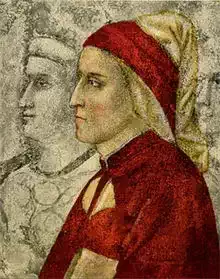
Dante Alighieri
Sonnet: Spirit Of Love
I felt a spirit of love begin to stir
Within my heart, long time unfelt till then;
And saw Love coming towards me fair and fain
(That I scarce knew him for his joyful cheer),
Saying, 'Be now indeed my worshipper!'
And in his speech he laughed and laughed again.
Then, while it was his pleasure to remain,
I chanced to look the way he had drawn near,
And saw the Ladies Joan and Beatrice
Approach me, this the other following,
One and a second marvel instantly.
And even as now my memory speaketh this,
Love spake it then: 'The first is christened Spring;
The second Love, she is so like to me.'
326

Robert Louis Stevenson
Ne Sit Ancillae Tibi Amor Pudor
THERE'S just a twinkle in your eye
That seems to say I MIGHT, if I
Were only bold enough to try
An arm about your waist.
I hear, too, as you come and go,
That pretty nervous laugh, you know;
And then your cap is always so
Coquettishly displaced.
Your cap! the word's profanely said.
That little top-knot, white and red,
That quaintly crowns your graceful head,
No bigger than a flower,
Is set with such a witching art,
Is so provocatively smart,
I'd like to wear it on my heart,
An order for an hour!
O graceful housemaid, tall and fair,
I love your shy imperial air,
And always loiter on the stair
When you are going by.
A strict reserve the fates demand;
But, when to let you pass I stand,
Sometimes by chance I touch your hand
And sometimes catch your eye.
327
William Shakespeare
Sonnet 153: Cupid laid by his brand and fell asleep
Cupid laid by his brand and fell asleep,
A maid of Dian's this advantage found,
And his love-kindling fire did quickly steep
In a cold valley-fountain of that ground;
Which borrowed from this holy fire of Love
A dateless lively heat still to endure,
And grew a seeting bath, which yet men prove
Against strange maladies a sovereign cure.
But at my mistress' eye Love's brand new-fired,
The boy for trial needs would touch my breast;
I, sick withal, the help of bath desired,
And thither hied a sad distempered guest,
But found no cure. The bath for my help lies
Where Cupid got new fire—my mistress' eyes.
323
Henry Wadsworth Longfellow
Voices Of The Night : Footsteps of Angels
When the hours of Day are numbered,
And the voices of the Night
Wake the better soul, that slumbered,
To a holy, calm delight;
Ere the evening lamps are lighted,
And, like phantoms grim and tall,
Shadows from the fitful firelight
Dance upon the parlor wall;
Then the forms of the departed
Enter at the open door;
The beloved, the true-hearted,
Come to visit me once more;
He, the young and strong, who cherished
Noble longings for the strife,
By the roadside fell and perished,
Weary with the march of life!
They, the holy ones and weakly,
Who the cross of suffering bore,
Folded their pale hands so meekly,
Spake with us on earth no more!
And with them the Being Beauteous,
Who unto my youth was given,
More than all things else to love me,
And is now a saint in heaven.
With a slow and noiseless footstep
Comes that messenger divine,
Takes the vacant chair beside me,
Lays her gentle hand in mine.
And she sits and gazes at me
With those deep and tender eyes,
Like the stars, so still and saint-like,
Looking downward from the skies.
Uttered not, yet comprehended,
Is the spirit's voiceless prayer,
Soft rebukes, in blessings ended,
Breathing from her lips of air.
Oh, though oft depressed and lonely,
All my fears are laid aside,
If I but remember only
Such as these have lived and died!
321

Emily Dickinson
I know where Wells grow—Droughtless Wells
I know where Wells grow—Droughtless Wells—
Deep dug—for Summer days—
Where Mosses go no more away—
And Pebble—safely plays—
It's made of Fathoms—and a Belt—
A Belt of jagged Stone—
Inlaid with Emerald—half way down—
And Diamonds—jumbled on—
It has no Bucket—Were I rich
A Bucket I would buy—
I'm often thirsty—but my lips
Are so high up—You see—
I read in an Old fashioned Book
That People "thirst no more"—
The Wells have Buckets to them there—
It must mean that—I'm sure—
Shall We remember Parching—then?
Those Waters sound so grand—
I think a little Well—like Mine—
Dearer to understand—
320