
Freedom

John Greenleaf Whittier
Randolph Of Roanoke
O Mother Earth! upon thy lap
Thy weary ones receiving,
And o'er them, silent as a dream,
Thy grassy mantle weaving,
Fold softly in thy long embrace
That heart so worn and broken,
And cool its pulse of fire beneath
Thy shadows old and oaken.
Shut out from him the bitter word
And serpent hiss of scorning;
Nor let the storms of yesterday
Disturb his quiet morning.
Breathe over him forgetfulness
Of all save deeds of kindness,
And, save to smiles of grateful eyes,
Press down his lids in blindness.
There, where with living ear and eye
He heard Potomac's flowing,
And, through his tall ancestral trees,
Saw autumn's sunset glowing,
He sleeps, still looking to the west,
Beneath the dark wood shadow,
As if he still would see the sun
Sink down on wave and meadow.
Bard, Sage, and Tribune! in himself
All moods of mind contrasting, The
tenderest wail of human woe,
The scorn like lightning blasting;
The pathos which from rival eyes
Unwilling tears could summon,
The stinging taunt, the fiery burst
Of hatred scarcely human!
Mirth, sparkling like a diamond shower,
From lips of life-long sadness;
Clear picturings of majestic thought
Upon a ground of madness;
And over all Romance and Song
A classic beauty throwing,
And laurelled Clio at his side
Her storied pages showing.
All parties feared him: each in turn
Beheld its schemes disjointed,
As right or left his fatal glance
And spectral finger pointed.
Sworn foe of Cant, he smote it down
With trenchant wit unsparing,
And, mocking, rent with ruthless hand
The robe Pretence was wearing.
Too honest or too proud to feign
A love he never cherished,
Beyond Virginia's border line
His patriotism perished.
While others hailed in distant skies
Our eagle's dusky pinion,
He only saw the mountain bird
Stoop o'er his Old Dominion!
Still through each change of fortune strange
Racked nerve, and brain all burning,
His loving faith in Mother-land
Knew never shade of turning;
By Britain's lakes, by Neva's tide,
Whatever sky was o'er him,
He heard her rivers' rushing sound,
Her blue peaks rose before him.
He held his slaves, yet made withal
No false and vain pretences,
Nor paid a lying priest to seek
For Scriptural defences.
His harshest words of proud rebuke,
His bitterest taunt and scorning,
Fell fire-like on the Northern brow
That bent to him in fawning.
He held his slaves; yet kept the while
His reverence for the Human;
In the dark vassals of his will
He saw but Man and Woman!
No hunter of God's outraged poor
His Roanoke valley entered;
No trader in the souls of men
Across his threshold ventured.
And when the old and wearied man
Lay down for his last sleeping,
And at his side, a slave no more,
His brother-man stood weeping,
His latest thought, his latest breath,
To Freedom's duty giving,
With failing tongue and trembling hand
The dying blest the living.
Oh, never bore his ancient State
A truer son or braver!
None trampling with a calmer scorn
On foreign hate or favor.
He knew her faults, yet never stooped
His proud and manly feeling
To poor excuses of the wrong
Or meanness of concealing.
But none beheld with clearer eye
The plague-spot o'er her spreading
None heard more sure the steps of Doom
Along her future treading.
For her as for himself he spake,
When, his gaunt frame upbracing,
He traced with dying hand 'Remorse!'
And perished in the tracing.
As from the grave where Henry sleeps,
From Vernon's weeping willow,
And from the grassy pall which hides
The Sage of Monticello,
So from the leaf-strewn burial-stone
Of Randolph's lowly dwelling,
Virginia! o'er thy land of slaves
A warning voice is swelling!
And hark! from thy deserted fields
Are sadder warnings spoken,
From quenched hearths, where thy exiled sons
Their household gods have broken.
The curse is on thee, - wolves for men,
And briers for corn-sheaves giving!
Oh, more than all thy dead renown
Were now one hero living!
299
John Greenleaf Whittier
Our Country
WE give thy natal day to hope,
O Country of our love and prayer!
Thy way is down no fatal slope,
But up to freer sun and air.
Tried as by furnace-fires, and yet
By God's grace only stronger made,
In future tasks before thee set
Thou shalt not lack the old-time aid.
The fathers sleep, but men remain
As wise, as true, and brave as they;
Why count the loss and not the gain?
The best is that we have to-day.
Whate'er of folly, shame, or crime,
Withhin thy mighty bounds transpires,
With speed defying space and time
Comes to us on the accusing wires;
While of thy wealth of noble deeds,
Thy homes of peace, thy votes unsold,
The love that pleads for human needs,
The wrong redressed, but half is told!
We read each felon's chronicle,
His acts, his words, his gallows-mood;
We know the single sinner well
And not the nine and ninety good.
Yet if, on daily scandals fed,
We seem at times to doubt thy worth,
We know thee still, when all is said,
The best and dearest spot on earth.
From the warm Mexic Gulf, or where
Belted with flowers Los Angeles
Basks in the semi-tropic air,
To where Katahdin's cedar trees
Are dwarfed and bent by Northern winds,
Thy plenty's horn is yearly filled;
Alone, the rounding century finds
Thy liberal soil by free hands tilled.
A refuge for the wronged and poor,
Thy generous heart has borne the blame
That, with them, through thy open door,
The old world's evil outcasts came.
But, with thy just and equal rule,
And labor's need and breadth of lands,
Free press and rostrum, church and school,
Thy sure, if slow, transforming hands
Shall mould even them to thy design,
Making a blessing of the ban;
And Freedom's chemistry combine
The alien elements of man.
The power that broke their prison bar
And set the dusky millions free,
And welded in the flame of war
The Union fast to Liberty,
Shall if not deal with other ills,
Redress the red man's grievance, break
The Circean cup which shames and kills
And Labor full requital make?
Alone to such as fitly bear
Thy civic honors bid them fall?
And call thy daughters forth to share
The rights and duties pledged to all?
Give every child his right of school,
Merge private greed in public good,
And spare a treasury overfull
The tax upon a poor man's food?
No lack was in thy primal stock,
No weakling founders builded here;
Thine were the men of Plymouth Rock,
The Huguenot and Cavalier;
And they whose firm endurance gained
The freedom of the souls of men,
Whose hands, unstained with blood, maintained
The swordless commonwealth of Penn.
And thine shall be the power of all
To do the work which duty bids,
And make the people's council hall
As lasting as the Pyramids!
Well have thy later years made good
Thy brave-said word a century back,
The pledge of human brotherhood,
The equal claim of white and black.
That word still echoes round the world,
And all who hear it turn to thee,
And read upon thy flag unfurled
The prophecies of destiny.
Thy great world-lesson all shall learn,
The nations in thy school shall sit,
Earth's farthest mountain-tops shall burn
With watch-fires from thy own uplit.
Great without seeking to be great
By fraud or conquest, rich in gold,
But richer in the large estate
Of virtue which thy children hold,
With peace that comes of purity
And strength to simple justice due,
So runs our loyal dream of thee;
God of our fathers! make it true.
O Land of lands! to thee we give
Our prayers, our hopes, our service free;
For thee thy sons shall nobly live,
And at thy need shall die for thee!
297

Emily Dickinson
They Shut Me Up in Prose
They shut me up in Prose --
As when a little Girl
They put me in the Closet --
Because they liked me "still" --
Still! Could themself have peeped --
And seen my Brain -- go round --
They might as wise have lodged a Bird
For Treason -- in the Pound --
Himself has but to will
And easy as a Star
Abolish his Captivity --
And laugh -- No more have I --
296

Robert W. Service
The Walkers
(He speaks.)
Walking, walking, oh, the joy of walking!
Swinging down the tawny lanes with head held high;
Striding up the green hills, through the heather stalking,
Swishing through the woodlands where the brown leaves lie;
Marveling at all things -- windmills gaily turning,
Apples for the cider-press, ruby-hued and gold;
Tails of rabbits twinkling, scarlet berries burning,
Wedge of geese high-flying in the sky's clear cold,
Light in little windows, field and furrow darkling;
Home again returning, hungry as a hawk;
Whistling up the garden, ruddy-cheeked and sparkling,
Oh, but I am happy as I walk, walk, walk!
(She speaks.)
Walking, walking, oh, the curse of walking!
Slouching round the grim square, shuffling up the street,
Slinking down the by-way, all my graces hawking,
Offering my body to each man I meet.
Peering in the gin-shop where the lads are drinking,
Trying to look gay-like, crazy with the blues;
Halting in a doorway, shuddering and shrinking
(Oh, my draggled feather and my thin, wet shoes).
Here's a drunken drover: "Hullo, there, old dearie!"
No, he only curses, can't be got to talk. . . .
On and on till daylight, famished, wet and weary,
God in Heaven help me as I walk, walk, walk!
297
John Greenleaf Whittier
The Kansas Emigrants
THE KANSAS EMIGRANTS.
WE cross the prairie as of old
The pilgrims crossed the sea,
To make the West, as they the East,
The homestead of the free!
We go to rear a wall of men
On Freedom's southern line,
And plant beside the cotton-tree
The rugged Northern pine!
We're flowing from our native hills
As our free rivers flow;
The blessing of our Mother-land
Is on us as we go.
We go to plant her common schools,
On distant prairie swells,
And give the Sabbaths of the wild
The music of her bells.
Upbearing, like the Ark of old,
The Bible in our van,
We go to test the truth of God
Against the fraud of man.
No pause, nor rest, save where the streams
That feed the Kansas run,
Save where our Pilgrim gonfalon
Shall flout the setting sun!
We'll tread the prairie as of old
Our fathers sailed the sea,
And make the West, as they the East,
The homestead of the free!
295
Robert W. Service
Afternoon Tea
As I was saying . . . (No, thank you; I never take cream with my tea;
Cows weren't allowed in the trenches -- got out of the habit, y'see.)
As I was saying, our Colonel leaped up like a youngster of ten:
"Come on, lads!" he shouts, "and we'll show 'em," and he sprang to the head of the
men.
Then some bally thing seemed to trip him, and he fell on his face with a slam. . . .
Oh, he died like a true British soldier, and the last word he uttered was "Damn!"
And hang it! I loved the old fellow, and something just burst in my brain,
And I cared no more for the bullets than I would for a shower of rain.
'Twas an awf'ly funny sensation (I say, this is jolly nice tea);
I felt as if something had broken; by gad! I was suddenly free.
Free for a glorified moment, beyond regulations and laws,
Free just to wallow in slaughter, as the chap of the Stone Age was.
So on I went joyously nursing a Berserker rage of my own,
And though all my chaps were behind me, feeling most frightf'ly alone;
With the bullets and shells ding-donging, and the "krock" and the swish of the shrap;
And I found myself humming "Ben Bolt" . . . (Will you pass me the sugar, old chap?
Two lumps, please). . . . What was I saying? Oh yes, the jolly old dash;
We simply ripped through the barrage, and on with a roar and a crash.
My fellows -- Old Nick couldn't stop 'em. On, on they went with a yell,
Till they tripped on the Boches' sand-bags, -- nothing much left to tell:
A trench so tattered and battered that even a rat couldn't live;
Some corpses tangled and mangled, wire you could pass through a sieve.
The jolly old guns had bilked us, cheated us out of our show,
And my fellows were simply yearning for a red mix-up with the foe.
So I shouted to them to follow, and on we went roaring again,
Battle-tuned and exultant, on in the leaden rain.
Then all at once a machine gun barks from a bit of a bank,
And our Major roars in a fury: "We've got to take it on flank."
He was running like fire to lead us, when down like a stone he comes,
As full of "typewriter" bullets as a pudding is full of plums.
So I took his job and we got 'em. . . . By gad! we got 'em like rats;
Down in a deep shell-crater we fought like Kilkenny cats.
'Twas pleasant just for a moment to be sheltered and out of range,
With someone you saw to go for -- it made an agreeable change.
And the Boches that missed my bullets, my chaps gave a bayonet jolt,
And all the time, I remember, I whistled and hummed "Ben Bolt".
Well, that little job was over, so hell for leather we ran,
On to the second line trenches, -- that's where the fun began.
For though we had strafed 'em like fury, there still were some Boches about,
And my fellows, teeth set and eyes glaring, like terriers routed 'em out.
Then I stumbled on one of their dug-outs, and I shouted: "Is anyone there?"
And a voice, "Yes, one; but I'm wounded," came faint up the narrow stair;
And my man was descending before me, when sudden a cry! a shot!
(I say, this cake is delicious. You make it yourself, do you not?)
My man? Oh, they killed the poor devil; for if there was one there was ten;
So after I'd bombed 'em sufficient I went down at the head of my men,
And four tried to sneak from a bunk-hole, but we cornered the rotters all right;
I'd rather not go into details, 'twas messy that bit of the fight.
But all of it's beastly messy; let's talk of pleasanter things:
The skirts that the girls are wearing, ridiculous fluffy things,
So short that they show. . . . Oh, hang it! Well, if I must, I must.
We cleaned out the second trench line, bomb and bayonet thrust;
And on we went to the third one, quite calloused to crumping by now;
And some of our fellows who'd passed us were making a deuce of a row;
And my chaps -- well, I just couldn't hold 'em; (It's strange how it is with gore;
In some ways it's just like whiskey: if you taste it you must have more.)
Their eyes were like beacons of battle; by gad, sir! they COULDN'T be calmed,
So I headed 'em bang for the bomb-belt, racing like billy-be-damned.
Oh, it didn't take long to arrive there, those who arrived at all;
The machine guns were certainly chronic, the shindy enough to appal.
Oh yes, I omitted to tell you, I'd wounds on the chest and the head,
And my shirt was torn to a gun-rag, and my face blood-gummy and red.
I'm thinking I looked like a madman; I fancy I felt one too,
Half naked and swinging a rifle. . . . God! what a glorious "do".
As I sit here in old Piccadilly, sipping my afternoon tea,
I see a blind, bullet-chipped devil, and it's hard to believe that it's me;
I see a wild, war-damaged demon, smashing out left and right,
And humming "Ben Bolt" rather loudly, and hugely enjoying the fight.
And as for my men, may God bless 'em! I've loved 'em ever since then:
They fought like the shining angels; they're the pick o' the land, my men.
And the trench was a reeking shambles, not a Boche to be seen alive --
So I thought; but on rounding a traverse I came on a covey of five;
And four of 'em threw up their flippers, but the fifth chap, a sergeant, was game,
And though I'd a bomb and revolver he came at me just the same.
A sporty thing that, I tell you; I just couldn't blow him to hell,
So I swung to the point of his jaw-bone, and down like a ninepin he fell.
And then when I'd brought him to reason, he wasn't half bad, that Hun;
He bandaged my head and my short-rib as well as the Doc could have done.
So back I went with my Boches, as gay as a two-year-old colt,
And it suddenly struck me as rummy, I still was a-humming "Ben Bolt".
And now, by Jove! how I've bored you. You've just let me babble away;
Let's talk of the things that matter -- your car or the newest play. . . .
294
John Greenleaf Whittier
Garibaldi
In trance and dream of old, God's prophet saw
The casting down of thrones. Thou, watching lone
The hot Sardinian coast-line, hazy-hilled,
Where, fringing round Caprera's rocky zone
With foam, the slow waves gather and withdraw,
Behold'st the vision of the seer fulfilled,
And hear'st the sea-winds burdened with a sound
Of falling chains, as, one by one, unbound,
The nations lift their right hands up and swear
Their oath of freedom. From the chalk-white wall
Of England, from the black Carpathian range,
Along the Danube and the Theiss, through all
The passes of the Spanish Pyrenees,
And from the Seine's thronged banks, a murmur strange
And glad floats to thee o'er thy summer seas
On the salt wind that stirs thy whitening hair,--
The song of freedom's bloodless victories!
Rejoice, O Garibaldi! Though thy sword
Failed at Rome's gates, and blood seemed vainly poured
Where, in Christ's name, the crowned infidel
Of France wrought murder with the arms of hell
On that sad mountain slope whose ghostly dead,
Unmindful of the gray exorcist's ban,
Walk, unappeased, the chambered Vatican,
And draw the curtains of Napoleon's bed!
God's providence is not blind, but, full of eyes,
It searches all the refuges of lies;
And in His time and way, the accursed things
Before whose evil feet thy battle-gage
Has clashed defiance from hot youth to age
Shall perish. All men shall be priests and kings,
One royal brotherhood, one church made free
By love, which is the law of liberty
295
John Greenleaf Whittier
To Pennsylvania
O STATE prayer-founded! never hung
Such choice upon a people's tongue,
Such power to bless or ban,
As that which makes thy whisper Fate,
For which on thee the centuries wait,
And destinies of man!
Across thy Alleghanian chain,
With groanings from a land in pain,
The west-wind finds its way:
Wild-wailing from Missouri's flood
The crying of thy children's blood
Is in thy ears to-day!
And unto thee in Freedom's hour
Of sorest need God gives the power
To ruin or to save;
To wound or heal, to blight or bless
With fertile field or wilderness,
A free home or a grave!
Then let thy virtue match the crime,
Rise to a level with the time;
And, if a son of thine
Betray or tempt thee, Brutus-like
For Fatherland and Freedom strike
As Justice gives the sign.
Wake, sleeper, from thy dream of ease,
The great occasion's forelock seize;
And let the north-wind strong,
And golden leaves of autumn, be
Thy coronal of Victory
And thy triumphal song.
292

Henry Lawson
Shadows Before
"Like clouds o'er the South are the nations who reign
On fair islands that we would command;
But clouds that are darker and denser than these
Have sailed from an Isle in the Northern Seas
And rest on our Southern Land.
Low in dust is our Goddess of Liberty hurled
At our feet, and the time is at hand,
When we, the proud sons of the southern world,
Beneath a proud banner of freedom unfurled
And true to each other shall stand.
If e'er in the ranks of the Right we advance;
Though our enemies come like a flood,
We'll meet them like lions, aroused from our trance,
And show that a streak of the Olden Romance
Still runs in our commonplace blood.
292
John Greenleaf Whittier
The Proclamation
SAINT PATRICK, slave to Milcho of the herds
Of Ballymena, wakened with these words:
'Arise, and flee
Out from the land of bondage, and be free!'
Glad as a soul in pain, who hears from heaven
The angels singing of his sins forgiven,
And, wondering, sees
His prison opening to their golden keys,
He rose a man who laid him down a slave,
Shook from his locks the ashes of the grave,
And outward trod
Into the glorious liberty of God.
He east the symbols of his shame away;
And, passing where the sleeping Milcho lay,
Though back and limb
Smarted with wrong, he prayed, 'God pardon him!'
So went he forth; but in God's time he came
To light on Uilline's hills a holy flame;
And, dying, gave
The land a saint that lost him as a slave.
O dark, sad millions, patiently and dumb
Waiting for God, your hour at last has come,
And freedom's song
Breaks the long silence of your night of wrong!
Arise and flee! shake off the vile restraint
Of ages; but, like Ballymena's saint,
The oppressor spare,
Heap only on his head the coals of prayer.
Go forth, like him! like him return again,
To bless the land whereon in bitter pain
Ye toiled at first,
And heal with freedom what your slavery cursed.
291
John Greenleaf Whittier
The Mantle Of St. John De Matha. A Legend Of
A STRONG and mighty Angel,
Calm, terrible, and bright,
The cross in blended red and blue
Upon his mantle white!
Two captives by him kneeling,
Each on his broken chain,
Sang praise to God who raiseth
The dead to life again!
Dropping his cross-wrought mantle,
'Wear this,' the Angel said;
'Take thou, O Freedom's priest, its sign, —
The white, the blue, and red.'
Then rose up John de Matha
In the strength the Lord Christ gave,
And begged through all the land of France
The ransom of the slave.
The gates of tower and castle
Before him open flew,
The drawbridge at his coming fell,
The door-bolt backward drew.
For all men owned his errand,
And paid his righteous tax;
And the hearts of lord and peasant
Were in his hands as wax.
At last, outbound from Tunis,
His bark her anchor weighed,
Freighted with seven-score Christian souls
Whose ransom he had paid.
But, torn by Paynim hatred,
Her sails in tatters hung;
And on the wild waves, rudderless,
A shattered hulk she swung.
'God save us!' cried the captain,
'For naught can man avail;
Oh, woe betide the ship that lacks
Her rudder and her sail!
'Behind us are the Moormen;
At sea we sink or strand:
There's death upon the water,
There's death upon the land!'
Then up spake John de Matha:
'God's errands never fail!
Take thou the mantle which I wear,
And make of it a sail.'
They raised the cross-wrought mantle,
The blue, the white, the red;
And straight before the wind off-shore
The ship of Freedom sped.
'God help us!' cried the seamen,
'For vain is mortal skill:
The good ship on a stormy sea
Is drifting at its will.'
Then up spake John de Matha:
'My mariners, never fear!
The Lord whose breath has filled her sail
May well our vessel steer!'
So on through storm and darkness
They drove for weary hours;
And lo! the third gray morning shone
On Ostia's friendly towers.
And on the walls the watchers
The ship of mercy knew, —
They knew far off its holy cross,
The red, the white, and blue.
And the bells in all the steeples
Rang out in glad accord,
To welcome home to Christian soil
The ransomed of the Lord.
So runs the ancient legend
By bard and painter told;
And lo! the cycle rounds again,
The new is as the old!
With rudder foully broken,
And sails by traitors torn,
Our country on a midnight sea
Is waiting for the morn.
Before her, nameless terror;
Behind, the pirate foe;
The clouds are black above her,
The sea is white below.
The hope of all who suffer,
The dread of all who wrong,
She drifts in darkness and in storm,
How long, O Lord! how long?
But courage, O my mariners!
Ye shall not suffer wreck,
While up to God the freedman's prayers
Are rising from your deck.
Is not your sail the banner
Which God hath blest anew,
The mantle that De Matha wore,
The red, the white, the blue?
Its hues are all of heaven, —
The red of sunset's dye,
The whiteness of the moon-lit cloud,
The blue of morning's sky.
Wait cheerily, then, O mariners,
For daylight and for land;
The breath of God is in your sail,
Your rudder is His hand.
Sail on, sail on, deep-freighted
With blessings and with hopes;
The saints of old with shadowy hands
Are pulling at your ropes.
Behind ye holy martyrs
Uplift the palm and crown;
Before ye unborn ages send
Their benedictions down.
Take heart from John de Matha! —
God's errands never fail!
Sweep on through storm and darkness,
The thunder and the hail!
Sail on! The morning cometh,
The port ye yet shall win;
And all the bells of God shall ring
The good ship bravely in!
290

Alice Walker
Be Nobody's Darling
Be nobody's darling;
Be an outcast.
Take the contradictions
Of your life
And wrap around
You like a shawl,
To parry stones
To keep you warm.
Watch the people succumb
To madness
With ample cheer;
Let them look askance at you
And you askance reply.
Be an outcast;
Be pleased to walk alone
(Uncool)
Or line the crowded
River beds
With other impetuous
Fools.
Make a merry gathering
On the bank
Where thousands perished
For brave hurt words
They said.
But be nobody's darling;
Be an outcast.
Qualified to live
Among your dead.
Be an outcast.
Take the contradictions
Of your life
And wrap around
You like a shawl,
To parry stones
To keep you warm.
Watch the people succumb
To madness
With ample cheer;
Let them look askance at you
And you askance reply.
Be an outcast;
Be pleased to walk alone
(Uncool)
Or line the crowded
River beds
With other impetuous
Fools.
Make a merry gathering
On the bank
Where thousands perished
For brave hurt words
They said.
But be nobody's darling;
Be an outcast.
Qualified to live
Among your dead.
289
John Greenleaf Whittier
To The Memory Of Charles B. Storrs
Thou hast fallen in thine armor,
Thou martyr of the Lord
With thy last breath crying 'Onward!'
And thy hand upon the sword.
The haughty heart derideth,
And the sinful lip reviles,
But the blessing of the perishing
Around thy pillow smiles!
When to our cup of trembling
The added drop is given,
And the long-suspended thunder
Falls terribly from Heaven,-When
a new and fearful freedom
Is proffered of the Lord
To the slow-consuming Famine,
The Pestilence and Sword!
When the refuges of Falsehood
Shall be swept away in wrath,
And the temple shall be shaken,
With its idol, to the earth,
Shall not thy words of warning
Be all remembered then?
And thy now unheeded message
Burn in the hearts of men?
Oppression's hand may scatter
Its nettles on thy tomb,
And even Christian bosoms
Deny thy memory room;
For lying lips shall torture
Thy mercy into crime,
And the slanderer shall flourish
As the bay-tree for a time.
But where the south-wind lingers
On Carolina's pines,
Or falls the careless sunbeam
Down Georgia's golden mines;
Where now beneath his burthen
The toiling slave is driven;
Where now a tyrant's mockery
Is offered unto Heaven;
Where Mammon hath its altars
Wet o'er with human blood,
And pride and lust debases
The workmanship of God,-There
shall thy praise be spoken,
Redeemed from Falsehood's ban,
When the fetters shall be broken,
And the slave shall be a man!
Joy to thy spirit, brother!
A thousand hearts are warm,
A thousand kindred bosoms
Are baring to the storm.
What though red-handed Violence
With secret Fraud combine?
The wall of fire is round us,
Our Present Help was thine.
Lo, the waking up of nations,
From Slavery's fatal sleep;
The murmur of a Universe,
Deep calling unto Deep!
Joy to thy spirit, brother!
On every wind of heaven
The onward cheer and summons
Of Freedom's voice is given!
Glory to God forever!
Beyond the despot's will
The soul of Freedom liveth
Imperishable still.
The words which thou hast uttered
Are of that soul a part,
And the good seed thou hast scattered
Is springing from the heart.
In the evil days before us,
And the trials yet to come,
In the shadow of the prison,
Or the cruel martyrdom,-We
will think of thee, O brother!
And thy sainted name shall be
In the blessing of the captive,
And the anthem of the free.
289

James Whitcomb Riley
The Drum
O the drum!
There is some
Intonation in thy grum
Monotony of utterance that strikes the spirit dumb,
As we hear
Through the clear
And unclouded atmosphere,
Thy palpitating syllables roll in upon the car!
There's a part
Of the art
Of thy music-throbbing heart
That thrills a something in us that awakens with a start,
And in rhyme
With the chime
And exactitude of time,
Goes marching on to glory to thy melody sublime.
And the guest
Of the breast
That thy rolling robs of rest
Is a patriotic spirit as a Continental dressed;
And he looms
From the glooms
Of a century of tombs,
And the blood he spilled at Lexington in living beauty blooms.
And his eyes
Wear the guise
Of a purpose pure and wise,
As the love of them is lifted to a something in the skies
That is bright
Red and white,
With a blur of starry light,
As it laughs in silken ripples to the breezes day and night.
There are deep
Hushes creep
O'er the pulses as they leap,
As thy tumult, fainter growing, on the silence falls asleep,
While the prayer
Rising there
Wills the sea and earth and air
As a heritage to Freedom's sons and daughters everywhere.
Then, with sound
As profound
As the thunderings resound,
Come thy wild reverberations in a throe that shakes the ground,
And a cry
Flung on high,
Like the flag it flutters by,
Wings rapturously upward till it nestles in the sky.
O the drum!
There is some
Intonation in thy grum
Monotony of utterance that strikes the spirit dumb,
As we hear
Through the clear
And unclouded atmosphere,
Thy palpitating syllables roll in upon the ear!
There is some
Intonation in thy grum
Monotony of utterance that strikes the spirit dumb,
As we hear
Through the clear
And unclouded atmosphere,
Thy palpitating syllables roll in upon the car!
There's a part
Of the art
Of thy music-throbbing heart
That thrills a something in us that awakens with a start,
And in rhyme
With the chime
And exactitude of time,
Goes marching on to glory to thy melody sublime.
And the guest
Of the breast
That thy rolling robs of rest
Is a patriotic spirit as a Continental dressed;
And he looms
From the glooms
Of a century of tombs,
And the blood he spilled at Lexington in living beauty blooms.
And his eyes
Wear the guise
Of a purpose pure and wise,
As the love of them is lifted to a something in the skies
That is bright
Red and white,
With a blur of starry light,
As it laughs in silken ripples to the breezes day and night.
There are deep
Hushes creep
O'er the pulses as they leap,
As thy tumult, fainter growing, on the silence falls asleep,
While the prayer
Rising there
Wills the sea and earth and air
As a heritage to Freedom's sons and daughters everywhere.
Then, with sound
As profound
As the thunderings resound,
Come thy wild reverberations in a throe that shakes the ground,
And a cry
Flung on high,
Like the flag it flutters by,
Wings rapturously upward till it nestles in the sky.
O the drum!
There is some
Intonation in thy grum
Monotony of utterance that strikes the spirit dumb,
As we hear
Through the clear
And unclouded atmosphere,
Thy palpitating syllables roll in upon the ear!
285
Robert W. Service
My Inner Life
'Tis true my garments threadbare are,
And sorry poor I seem;
But inly I am richer far
Than any poet's dream.
For I've a hidden life no one
Can ever hope to see;
A sacred sanctuary none
May share with me.
Aloof I stand from out the strife,
Within my heart a song;
By virtue of my inner life
I to myself belong.
Against man-ruling I rebel,
Yet do not fear defeat,
For to my secret citadel
I may retreat.
Oh you who have an inner life
Beyond this dismal day
With wars and evil rumours rife,
Go blessedly your way.
Your refuge hold inviolate;
Unto yourself be true,
And shield serene from sordid fate
The Real You.
287
John Greenleaf Whittier
The Birthday Wreath
Blossom and greenness, making all
The winter birthday tropical,
And the plain Quaker parlors gay,
Have gone from bracket, stand, and wall;
We saw them fade, and droop, and fall,
And laid them tenderly away.
White virgin lilies, mignonette,
Blown rose, and pink, and violet,
A breath of fragrance passing by;
Visions of beauty and decay,
Colors and shapes that could not stay,
The fairest, sweetest, first to die.
But still this rustic wreath of mine,
Of acorned oak and needled pine,
And lighter growths of forest lands,
Woven and wound with careful pains,
And tender thoughts, and prayers, remains,
As when it dropped from love's dear hands.
And not unfitly garlanded,
Is he, who, country-born and bred,
Welcomes the sylvan ring which gives
A feeling of old summer days,
The wild delight of woodland ways,
The glory of the autumn leaves.
And, if the flowery meed of song
To other bards may well belong,
Be his, who from the farm-field spoke
A word for Freedom when her need
Was not of dulcimer and reed.
This Isthmian wreath of pine and oak.
283
Robert W. Service
Finistere
Hurrah! I'm off to Finistere, to Finistere, to Finistere;
My satchel's swinging on my back, my staff is in my hand;
I've twenty louis in my purse, I know the sun and sea are there,
And so I'm starting out to-day to tramp the golden land.
I'll go alone and glorying, with on my lips a song of joy;
I'll leave behind the city with its canker and its care;
I'll swing along so sturdily -- oh, won't I be the happy boy!
A-singing on the rocky roads, the roads of Finistere.
Oh, have you been to Finistere, and do you know a whin-gray town
That echoes to the clatter of a thousand wooden shoes?
And have you seen the fisher-girls go gallivantin' up and down,
And watched the tawny boats go out, and heard the roaring crews?
Oh, would you sit with pipe and bowl, and dream upon some sunny quay,
Or would you walk the windy heath and drink the cooler air;
Oh, would you seek a cradled cove and tussle with the topaz sea! --
Pack up your kit to-morrow, lad, and haste to Finistere.
Oh, I will go to Finistere, there's nothing that can hold me back.
I'll laugh with Yves and Le/on, and I'll chaff with Rose and Jeanne;
I'll seek the little, quaint buvette that's kept by Mother Merdrinac,
Who wears a cap of many frills, and swears just like a man.
I'll yarn with hearty, hairy chaps who dance and leap and crack their heels;
Who swallow cupfuls of cognac and never turn a hair;
I'll watch the nut-brown boats come in with mullet, plaice and conger eels,
The jeweled harvest of the sea they reap in Finistere.
Yes, I'll come back from Finistere with memories of shining days,
Of scaly nets and salty men in overalls of brown;
Of ancient women knitting as they watch the tethered cattle graze
By little nestling beaches where the gorse goes blazing down;
Of headlands silvering the sea, of Calvarys against the sky,
Of scorn of angry sunsets, and of Carnac grim and bare;
Oh, won't I have the leaping veins, and tawny cheek and sparkling eye,
When I come back to Montparnasse and dream of Finistere.
281
Emily Dickinson
Out of sight? What of that?
Out of sight? What of that?
See the Bird-reach it!
Curve by Curve-Sweep by Sweep-
Round the Steep Air-
Danger! What is that to Her?
Better 'tis to fail-there-
Than debate-here-
Blue is Blue-the World through
Amber-
Amber-Dew-DewSeek-
Friend-and see-
Heaven is shy of Earth-that's all-
Bashful Heaven-thy Lovers small
Hide-
too-from thee-
280
Robert W. Service
The Land Of Beyond
Have ever you heard of the Land of Beyond,
That dreams at the gates of the day?
Alluring it lies at the skirts of the skies,
And ever so far away;
Alluring it calls: O ye the yoke galls,
And ye of the trail overfond,
With saddle and pack, by paddle and track,
Let's go to the Land of Beyond!
Have ever you stood where the silences brood,
And vast the horizons begin,
At the dawn of the day to behold far away
The goal you would strive for and win?
Yet ah! in the night when you gain to the height,
With the vast pool of heaven star-spawned,
Afar and agleam, like a valley of dream,
Still mocks you a Land of Beyond.
Thank God! there is always a Land of Beyond
For us who are true to the trail;
A vision to seek, a beckoning peak,
A farness that never will fail;
A pride in our soul that mocks at a goal,
A manhood that irks at a bond,
And try how we will, unattainable still,
Behold it, our Land of Beyond!
279
James Whitcomb Riley
Green Fields And Running Brooks
Ho! green fields and running brooks!
Knotted strings and fishing-hooks
Of the truant, stealing down
Weedy backways of the town.
Where the sunshine overlooks,
By green fields and running brooks,
All intruding guests of chance
With a golden tolerance,
Cooing doves, or pensive pair
Of picnickers, straying there--
By green fields and running brooks,
Sylvan shades and mossy nooks!
And--O Dreamer of the Days,
Murmurer of roundelays
All unsung of words or books,
Sing green fields and running brooks!
280
Henry Lawson
Otherside
Somewhere in the mystic future, on the road to Paradise,
There’s a very pleasant country that I’ve dreamed of once or twice,
It has inland towns, and cities by the ocean’s rocky shelves,
But the people of the country differ somewhat from ourselves;
It is many leagues beyond us, and they call it Otherside.
And there is among its people more Humanity than Pride.
Now, a social system never was complete, without a flaw,
And among the Othersiders there is love and gold and war.
But if one is fairly beaten he can turn upon the track,
For in such a case there isn’t any shame in going back;
And a broken-hearted mortal never thinks of suicide,
For he finds amongst his brothers more Humanity than Pride.
And the lords of that creation never scoff at simple things,
Never scorn the lad who’s tethered to his mother’s apron-strings.
He will speak of “home” and “mother” without shame when he’s inclined,
Yet the blow he strikes in battle mostly leaves a mark behind.
They are brave against invasion; they can die in Otherside,
Though there is among the people more Humanity than Pride.
Poets sing in simple language that a child might understand,
Yet their songs are sung for ages by the elders of the land;
And the people know that Freedom never shall be wanting guards,
For the foremost in the vanguard waves the banner of the Bards.
O the poets march together, and at home in peace abide,
For there is amongst the people more Humanity than Pride.
And when I am very weary, ’neath a load of “worldly care”,
There are times when I’ve a longing just to hump my bluey there;
But alone I could not reach it, for the track is barred to one—
I must take the nations with me—all mankind must go, or none—
And we’d trample one another on the way to Otherside,
For I find among my brothers less Humanity than Pride.
280
John Greenleaf Whittier
Naples – 1860
I GIVE thee joy!—I know to thee
The dearest spot on earth must be
Where sleeps thy loved one by the summer sea;
Where, near her sweetest poet’s tomb,
The land of Virgil gave thee room
To lay thy flower with her perpetual bloom.
I know that when the sky shut down
Behind thee on the gleaming town,
On Baiae’s baths and Posilippo’s crown;
And, through thy tears, the mocking day
Burned Ischia’s mountain lines away,
And Capri melted in its sunny bay;
Through thy great farewell sorrow shot
The sharp pang of a bitter thought
That slaves must tread around that holy spot.
Thou knewest not the land was blest
In giving thy beloved rest,
Holding the fond hope closer to her breast,
That every sweet and saintly grave
Was freedom’s prophecy, and gave
The pledge of Heaven to sanctify and save.
That pledge is answered. To thy ear
The unchained city sends its cheer,
And, tuned to joy, the muffled bells of fear
Ring Victor in. The land sits free
And happy by the summer sea,
And Bourbon Naples now is Italy!
She smiles above her broken chain
The languid smile that follows pain,
Stretching her cramped limbs to the sun again.
Oh, joy for all, who hear her call
From gray Camaldoli’s convent wall
And Elmo’s towers to freedom’s carnival!
A new life breathes among her vines
And olives, like the breath of pines
Blown downward from the breezy Apennines.
Lean, O my friend, to meet that breath,
Rejoice as one who witnesseth
Beauty from ashes rise, and life from death!
Thy sorrow shall no more be pain,
Its tears shall fall in sunlit rain,
Writing the grave with flowers: “Arisen again!”
280
John Greenleaf Whittier
The Hive At Gettysburg
IN the old Hebrew myth the lion's frame,
So terrible alive,
Bleached by the desert's sun and wind, became
The wandering wild bees' hive;
And he who, lone and naked-handed, tore
Those jaws of death apart,
In after time drew forth their honeyed store
To strengthen his strong heart.
Dead seemed the legend: but it only slept
To wake beneath our sky;
Just on the spot whence ravening Treason crept
Back to its lair to die,
Bleeding and torn from Freedom's mountain bounds,
A stained and shattered drum
Is now the hive where, on their flowery rounds,
The wild bees go and come.
Unchallenged by a ghostly sentinel,
They wander wide and far,
Along green hillsides, sown with shot and shell,
Through vales once choked with war.
The low reveille of their battle-drum
Disturbs no morning prayer;
With deeper peace in summer noons their hum
Fills all the drowsy air.
And Samson's riddle is our own to-day,
Of sweetness from the strong,
Of union, peace, and freedom plucked away
From the rent jaws of wrong.
From Treason's death we draw a purer life,
As, from the beast he slew,
A sweetness sweeter for his bitter strife
The old-time athlete drew!
277
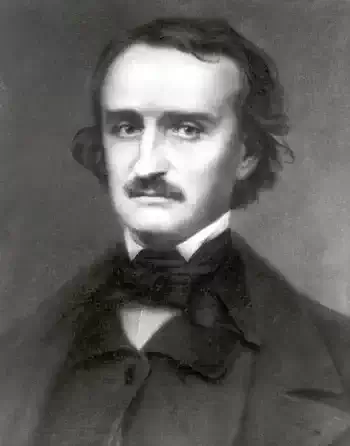
Edgar Allan Poe
Hymn to Aristogeiton and Harmodius
Wreathed in myrtle, my sword I'll conceal
Like those champions devoted and brave,
When they plunged in the tyrant their steel,
And to Athens deliverance gave.
Beloved heroes! your deathless souls roam
In the joy breathing isles of the blest;
Where the mighty of old have their home -
Where Achilles and Diomed rest.
In fresh myrtle my blade I'll entwine,
Like Harmodious, the gallant and good,
When he made at the tutelar shrine
A libation of Tyranny's blood.
Ye deliverers of Athens from shame!
Ye avengers of Liberty's wrongs!
Endless ages shall cherish your fame
Embalmed in their echoing songs!
277