
Animals and Nature

John Keats
Sonnet To The Nile
Son of the old Moon-mountains African!
Chief of the Pyramid and Crocodile!
We call thee fruitful, and that very while
A desert fills our seeing's inward span:
Nurse of swart nations since the world began,
Art thou so fruitful? or dost thou beguile
Such men to honour thee, who, worn with toil,
Rest for a space 'twixt Cairo and Decan?
O may dark fancies err! They surely do;
'Tis ignorance that makes a barren waste
Of all beyond itself. Thou dost bedew
Green rushes like our rivers, and dost taste
The pleasant sunrise. Green isles hast thou too,
And to the sea as happily dost haste.
459

William Butler Yeats
The Ballad Of The Foxhunter
'Lay me in a cushioned chair;
Carry me, ye four,
With cushions here and cushions there,
To see the world once more.
'To stable and to kennel go;
Bring what is there to bring;
Lead my Lollard to and fro,
Or gently in a ring.
'Put the chair upon the grass:
Bring Rody and his hounds,
That I may contented pass
From these earthly bounds.'
His eyelids droop, his head falls low,
His old eyes cloud with dreams;
The sun upon all things that grow
Falls in sleepy streams.
Brown Lollard treads upon the lawn,
And to the armchair goes,
And now the old man's dreams are gone,
He smooths the long brown nose.
And now moves many a pleasant tongue
Upon his wasted hands,
For leading aged hounds and young
The huntsman near him stands.
'Huntsmam Rody, blow the horn,
Make the hills reply.'
The huntsman loosens on the morn
A gay wandering cry.
Fire is in the old man's eyes,
His fingers move and sway,
And when the wandering music dies
They hear him feebly say,
'Huntsman Rody, blow the horn,
Make the hills reply.'
'I cannot blow upon my horn,
I can but weep and sigh.'
Servants round his cushioned place
Are with new sorrow wrung;
Hounds are gazing on his face,
Aged hounds and young.
One blind hound only lies apart
On the sun-smitten grass;
He holds deep commune with his heart:
The moments pass and pass:
The blind hound with a mournful din
Lifts slow his wintry head;
The servants bear the body in;
The hounds wail for the dead.
459
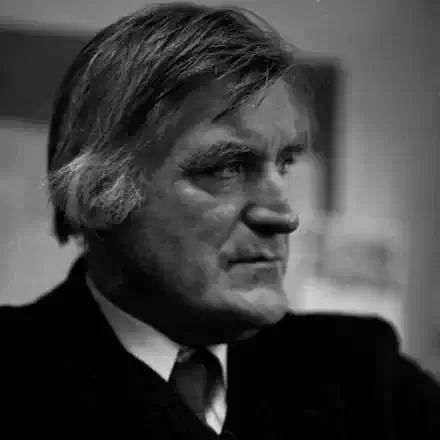
Ted Hughes
Tractor
The tractor stands frozen - an agony
To think of. All night
Snow packed its open entrails. Now a head-pincering gale,
A spill of molten ice, smoking snow,
Pours into its steel.
At white heat of numbness it stands
In the aimed hosing of ground-level fieriness.
It defied flesh and won't start.
Hands are like wounds already
Inside armour gloves, and feet are unbelievable
As if the toe-nails were all just torn off.
I stare at it in hatred. Beyond it
The copse hisses - capitulates miserably
In the fleeing, failing light. Starlings,
A dirtier sleetier snow, blow smokily, unendingly, over
Towards plantations Eastward.
All the time the tractor is sinking
Through the degrees, deepening
Into its hell of ice.
The starting lever
Cracks its action, like a snapping knuckle.
The battery is alive - but like a lamb
Trying to nudge its solid-frozen mother -
While the seat claims my buttock-bones, bites
With the space-cold of earth, which it has joined
In one solid lump.
I squirt commercial sure-fire
Down the black throat - it just coughs.
It ridicules me - a trap of iron stupidity
I've stepped into. I drive the battery
As if I were hammering and hammering
The frozen arrangement to pieces with a hammer
And it jabbers laughing pain-crying mockingly
Into happy life.
And stands
Shuddering itself full of heat, seeming to enlarge slowly
Like a demon demonstrating
A more-than-usually-complete materialization -
Suddenly it jerks from its solidarity
With the concrete, and lurches towards a stanchion
Bursting with superhuman well-being and abandon
Shouting Where Where?
Worse iron is waiting. Power-lift kneels
Levers awake imprisoned deadweight,
Shackle-pins bedded in cast-iron cow-shit.
The blind and vibrating condemned obedience
Of iron to the cruelty of iron,
Wheels screeched out of their night-locks -
Fingers
Among the tormented
Tonnage and burning of iron
Eyes
Weeping in the wind of chloroform
And the tractor, streaming with sweat,
Raging and trembling and rejoicing.
461

Rudyard Kipling
Angutivaun Taina
Our gloves are stiff with the frozen blood,
Our furs with the drifted snow,
As we come in with the seal--the seal!
In from the edge of the floe.
Au jana! Aua! Oha! Haq!
And the yelping dog-teams go;
And the long whips crack, and the men come back,
Back from the edge of the floe!
We tracked our seal to his secret place,
We heard him scratch below,
We made our mark, and we watched beside,
Out on the edge of the floe.
We raised our lance when he rose to breathe,
We drove it downward--so!
And we played him thus, and we killed him thus,
Out on the edge of the floe.
Our gloves are glued with the frozen blood,
Our eyes with the drifting snow;
But we come back to our wives again,
Back from the edge of the floe!
Au jana! Aua! Oha! Haq!
And the loaded dog-teams go;
And the wives ran hear their men come back,
Back from the edge of the floe!
457

John Clare
Badger
The badger grunting on his woodland track
With shaggy hide and sharp nose scrowed with black
Roots in the bushes and the woods, and makes
A great high burrow in the ferns and brakes.
With nose on ground he runs an awkward pace,
And anything will beat him in the race.
The shepherd's dog will run him to his den
Followed and hooted by the dogs and men.
The woodman when the hunting comes about
Goes round at night to stop the foxes out
And hurrying through the bushes to the chin
Breaks the old holes, and tumbles headlong in.
When midnight comes a host of dogs and men
Go out and track the badger to his den,
And put a sack within the hole, and lie
Till the old grunting badger passes bye.
He comes and hears—they let the strongest loose.
The old fox hears the noise and drops the goose.
The poacher shoots and hurries from the cry,
And the old hare half wounded buzzes bye.
They get a forked stick to bear him down
And clap the dogs and take him to the town,
And bait him all the day with many dogs,
And laugh and shout and fright the scampering hogs.
He runs along and bites at all he meets:
They shout and hollo down the noisy streets.
He turns about to face the loud uproar
And drives the rebels to their very door.
The frequent stone is hurled where e'er they go;
When badgers fight, then every one's a foe.
The dogs are clapt and urged to join the fray;
The badger turns and drives them all away.
Though scarcely half as big, demure and small,
He fights with dogs for bones and beats them all.
The heavy mastiff, savage in the fray,
Lies down and licks his feet and turns away.
The bulldog knows his match and waxes cold,
The badger grins and never leaves his hold.
He drives the crowd and follows at their heels
And bites them through—the drunkard swears and reels.
The frighted women take the boys away,
The blackguard laughs and hurries on the fray.
He tries to reach the woods, an awkward race,
But sticks and cudgels quickly stop the chase.
He turns again and drives the noisy crowd
And beats the many dogs in noises loud.
He drives away and beats them every one,
And then they loose them all and set them on.
He falls as dead and kicked by boys and men,
Then starts and grins and drives the crowd again;
Till kicked and torn and beaten out he lies
And leaves his hold and cackles, groans, and dies.
Some keep a baited badger tame as hog
And tame him till he follows like the dog.
They urge him on like dogs and show fair play.
He beats and scarcely wounded goes away.
Lapt up as if asleep, he scorns to fly
And seizes any dog that ventures nigh.
Clapt like a dog, he never bites the men
But worries dogs and hurries to his den.
They let him out and turn a harrow down
And there he fights the host of all the town.
He licks the patting hand, and tries to play
And never tries to bite or run away,
And runs away from the noise in hollow trees
Burnt by the boys to get a swarm of bees.
455
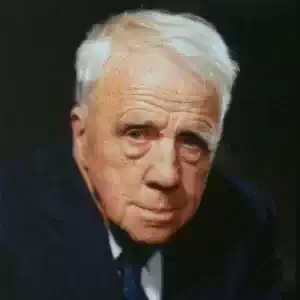
Robert Frost
Two Look at Two
Love and forgetting might have carried them
A little further up the mountain side
With night so near, but not much further up.
They must have halted soon in any case
With thoughts of a path back, how rough it was
With rock and washout, and unsafe in darkness;
When they were halted by a tumbled wall
With barbed-wire binding. They stood facing this,
Spending what onward impulse they still had
In One last look the way they must not go,
On up the failing path, where, if a stone
Or earthslide moved at night, it moved itself;
No footstep moved it. 'This is all,' they sighed,
Good-night to woods.' But not so; there was more.
A doe from round a spruce stood looking at them
Across the wall, as near the wall as they.
She saw them in their field, they her in hers.
The difficulty of seeing what stood still,
Like some up-ended boulder split in two,
Was in her clouded eyes; they saw no fear there.
She seemed to think that two thus they were safe.
Then, as if they were something that, though strange,
She could not trouble her mind with too long,
She sighed and passed unscared along the wall.
'This, then, is all. What more is there to ask?'
But no, not yet. A snort to bid them wait.
A buck from round the spruce stood looking at them
Across the wall as near the wall as they.
This was an antlered buck of lusty nostril,
Not the same doe come back into her place.
He viewed them quizzically with jerks of head,
As if to ask, 'Why don't you make some motion?
Or give some sign of life? Because you can't.
I doubt if you're as living as you look."
Thus till he had them almost feeling dared
To stretch a proffering hand -- and a spell-breaking.
Then he too passed unscared along the wall.
Two had seen two, whichever side you spoke from.
'This must be all.' It was all. Still they stood,
A great wave from it going over them,
As if the earth in one unlooked-for favour
Had made them certain earth returned their love.
458

Johann Wolfgang von Goethe
Legend
THERE lived in the desert a holy man
To whom a goat-footed Faun one day
Paid a visit, and thus began
To his surprise: 'I entreat thee to pray
That grace to me and my friends may be given,
That we may be able to mount to Heaven,
For great is our thirst for heav'nly bliss.'
The holy man made answer to this:
'Much danger is lurking in thy petition,
Nor will it be easy to gain admission;
Thou dost not come with an angel's salute;
For I see thou wearest a cloven foot.'
The wild man paused, and then answer'd he:
'What doth my goat's foot matter to thee?
Full many I've known into heaven to pass
Straight and with ease, with the head of an ass!'
457

Walt Whitman
Leaves Of Grass. A Carol Of Harvest For 1867
A SONG of the good green grass!
A song no more of the city streets;
A song of farms--a song of the soil of fields.
A song with the smell of sun-dried hay, where the nimble pitchers
handle the pitch-fork;
A song tasting of new wheat, and of fresh-husk'd maize.
For the lands, and for these passionate days, and for myself,
Now I awhile return to thee, O soil of Autumn fields,
Reclining on thy breast, giving myself to thee,
Answering the pulses of thy sane and equable heart,
Tuning a verse for thee.
O Earth, that hast no voice, confide to me a voice!
O harvest of my lands! O boundless summer growths!
O lavish, brown, parturient earth! O infinite, teeming womb!
A verse to seek, to see, to narrate thee.
Ever upon this stage,
Is acted God's calm, annual drama,
Gorgeous processions, songs of birds,
Sunrise, that fullest feeds and freshens most the soul,
The heaving sea, the waves upon the shore, the musical, strong waves,
The woods, the stalwart trees, the slender, tapering trees,
The flowers, the grass, the lilliput, countless armies of the grass,
The heat, the showers, the measureless pasturages,
The scenery of the snows, the winds' free orchestra,
The stretching, light-hung roof of clouds--the clear cerulean, and
the bulging, silvery fringes,
The high dilating stars, the placid, beckoning stars,
The moving flocks and herds, the plains and emerald meadows,
The shows of all the varied lands, and all the growths and products.
Fecund America! To-day,
Thou art all over set in births and joys!
Thou groan'st with riches! thy wealth clothes thee as with a swathing
garment!
Thou laughest loud with ache of great possessions!
A myriad-twining life, like interlacing vines, binds all thy vast
demesne!
As some huge ship, freighted to water's edge, thou ridest into port!
As rain falls from the heaven, and vapors rise from earth, so have
the precious values fallen upon thee, and risen out of thee!
Thou envy of the globe! thou miracle!
Thou, bathed, choked, swimming in plenty!
Thou lucky Mistress of the tranquil barns!
Thou Prairie Dame that sittest in the middle, and lookest out upon
thy world, and lookest East, and lookest West!
Dispensatress, that by a word givest a thousand miles--that giv'st a
million farms, and missest nothing!
Thou All-Acceptress--thou Hospitable--(thou only art hospitable, as
God is hospitable.)
When late I sang, sad was my voice;
Sad were the shows around me, with deafening noises of hatred, and
smoke of conflict;
In the midst of the armies, the Heroes, I stood,
Or pass'd with slow step through the wounded and dying.
But now I sing not War,
Nor the measur'd march of soldiers, nor the tents of camps,
Nor the regiments hastily coming up, deploying in line of battle.
No more the dead and wounded;
No more the sad, unnatural shows of War.
Ask'd room those flush'd immortal ranks? the first forth-stepping
armies?
Ask room, alas, the ghastly ranks--the armies dread that follow'd.
(Pass--pass, ye proud brigades!
So handsome, dress'd in blue--with your tramping, sinewy legs;
With your shoulders young and strong--with your knapsacks and your
muskets;
--How elate I stood and watch'd you, where, starting off, you
march'd!
Pass;--then rattle, drums, again!
Scream, you steamers on the river, out of whistles loud and shrill,
your salutes!
For an army heaves in sight--O another gathering army!
Swarming, trailing on the rear--O you dread, accruing army!
O you regiments so piteous, with your mortal diarrhoea! with your
fever!
O my land's maimed darlings! with the plenteous bloody bandage and
the crutch!
Lo! your pallid army follow'd!)
But on these days of brightness,
On the far-stretching beauteous landscape, the roads and lanes, the
high-piled farm-wagons, and the fruits and barns,
Shall the dead intrude?
Ah, the dead to me mar not--they fit well in Nature;
They fit very well in the landscape, under the trees and grass,
And along the edge of the sky, in the horizon's far margin.
Nor do I forget you, departed;
Nor in winter or summer, my lost ones;
But most, in the open air, as now, when my soul is rapt and at
peace--like pleasing phantoms,
Your dear memories, rising, glide silently by me.
I saw the day, the return of the Heroes;
(Yet the Heroes never surpass'd, shall never return;
Them, that day, I saw not.)
I saw the interminable Corps--I saw the processions of armies,
I saw them approaching, defiling by, with divisions,
Streaming northward, their work done, camping awhile in clusters of
mighty camps.
No holiday soldiers!--youthful, yet veterans;
Worn, swart, handsome, strong, of the stock of homestead and
workshop,
Harden'd of many a long campaign and sweaty march,
Inured on many a hard-fought, bloody field.
80
A pause--the armies wait;
A million flush'd, embattled conquerors wait;
The world, too, waits--then, soft as breaking night, and sure as
dawn,
They melt--they disappear.
Exult, indeed, O lands! victorious lands!
Not there your victory, on those red, shuddering fields;
But here and hence your victory.
Melt, melt away, ye armies! disperse, ye blue-clad soldiers!
Resolve ye back again--give up, for good, your deadly arms;
Other the arms, the fields henceforth for you, or South or North, or
East or West,
With saner wars--sweet wars--life-giving wars.
Loud, O my throat, and clear, O soul!
The season of thanks, and the voice of full-yielding;
The chant of joy and power for boundless fertility.
All till'd and untill'd fields expand before me;
I see the true arenas of my race--or first, or last,
Man's innocent and strong arenas.
I see the Heroes at other toils;
I see, well-wielded in their hands, the better weapons.
I see where America, Mother of All,
Well-pleased, with full-spanning eye, gazes forth, dwells long,
And counts the varied gathering of the products.
Busy the far, the sunlit panorama;
Prairie, orchard, and yellow grain of the North,
Cotton and rice of the South, and Louisianian cane;
Open, unseeded fallows, rich fields of clover and timothy,
Kine and horses feeding, and droves of sheep and swine,
And many a stately river flowing, and many a jocund brook,
And healthy uplands with their herby-perfumed breezes,
And the good green grass--that delicate miracle, the ever-recurring
grass.
Toil on, Heroes! harvest the products!
Not alone on those warlike fields, the Mother of All,
With dilated form and lambent eyes, watch'd you.
Toil on, Heroes! toil well! Handle the weapons well!
The Mother of All--yet here, as ever, she watches you.
Well-pleased, America, thou beholdest,
Over the fields of the West, those crawling monsters,
The human-divine inventions, the labor-saving implements:
Beholdest, moving in every direction, imbued as with life, the
revolving hay-rakes,
The steam-power reaping-machines, and the horse-power machines,
The engines, thrashers of grain, and cleaners of grain, well
separating the straw--the nimble work of the patent pitch-fork;
Beholdest the newer saw-mill, the southern cotton-gin, and the ricecleanser.
Beneath thy look, O Maternal,
With these, and else, and with their own strong hands, the Heroes
harvest.
All gather, and all harvest;
(Yet but for thee, O Powerful! not a scythe might swing, as now, in
security;
Not a maize-stalk dangle, as now, its silken tassels in peace.)
Under Thee only they harvest--even but a wisp of hay, under thy great
face, only;
Harvest the wheat of Ohio, Illinois, Wisconsin--every barbed spear,
under thee;
Harvest the maize of Missouri, Kentucky, Tennessee--each ear in its
light-green sheath,
Gather the hay to its myriad mows, in the odorous, tranquil barns,
Oats to their bins--the white potato, the buckwheat of Michigan, to
theirs;
Gather the cotton in Mississippi or Alabama--dig and hoard the
golden, the sweet potato of Georgia and the Carolinas,
Clip the wool of California or Pennsylvania,
Cut the flax in the Middle States, or hemp, or tobacco in the
Borders,
Pick the pea and the bean, or pull apples from the trees, or bunches
of grapes from the vines,
Or aught that ripens in all These States, or North or South,
Under the beaming sun, and under Thee.
456

Ezra Pound
Song in the Manner of Housman
O woe, woe,
People are born and die,
We also shall be dead pretty soon
Therefore let us act as if we were
dead already.
The bird sits on the hawthorn tree
But he dies also, presently.
Some lads get hung, and some get shot.
Woeful is this human lot.
Woe! woe, etcetera . . . .
London is a woeful place,
Shropshire is much pleasanter.
Then let us smile a little space
Upon fond nature's morbid grace.
Oh, Woe, woe, woe, etcetera . . .
452
John Clare
Stonepit
The passing traveller with wonder sees
A deep and ancient stonepit full of trees;
So deep and very deep the place has been,
The church might stand within and not be seen.
The passing stranger oft with wonder stops
And thinks he een could walk upon their tops,
And often stoops to see the busy crow,
And stands above and sees the eggs below;
And while the wild horse gives its head a toss,
The squirrel dances up and runs across.
The boy that stands and kills the black nosed bee
Dares down as soon as magpies' nests are found,
And wonders when he climbs the highest tree
To find it reaches scarce above the ground.
451

Henry Wadsworth Longfellow
Introduction To The Song Of Hiawatha
Should you ask me,
whence these stories?
Whence these legends and traditions,
With the odors of the forest
With the dew and damp of meadows,
With the curling smoke of wigwams,
With the rushing of great rivers,
With their frequent repetitions,
And their wild reverberations
As of thunder in the mountains?
I should answer, I should tell you,
"From the forests and the prairies,
From the great lakes of the Northland,
From the land of the Ojibways,
From the land of the Dacotahs,
From the mountains, moors, and fen-lands
Where the heron, the Shuh-shuh-gah,
Feeds among the reeds and rushes.
I repeat them as I heard them
From the lips of Nawadaha,
The musician, the sweet singer."
Should you ask where Nawadaha
Found these songs so wild and wayward,
Found these legends and traditions,
I should answer, I should tell you,
"In the bird's-nests of the forest,
In the lodges of the beaver,
In the hoofprint of the bison,
In the eyry of the eagle!
"All the wild-fowl sang them to him,
In the moorlands and the fen-lands,
In the melancholy marshes;
Chetowaik, the plover, sang them,
Mahng, the loon, the wild-goose, Wawa,
The blue heron, the Shuh-shuh-gah,
And the grouse, the Mushkodasa!"
If still further you should ask me,
Saying, "Who was Nawadaha?
Tell us of this Nawadaha,"
I should answer your inquiries
Straightway in such words as follow.
"In the vale of Tawasentha,
In the green and silent valley,
By the pleasant water-courses,
Dwelt the singer Nawadaha.
Round about the Indian village
Spread the meadows and the corn-fields,
And beyond them stood the forest,
Stood the groves of singing pine-trees,
Green in Summer, white in Winter,
Ever sighing, ever singing.
"And the pleasant water-courses,
You could trace them through the valley,
By the rushing in the Spring-time,
By the alders in the Summer,
By the white fog in the Autumn,
By the black line in the Winter;
And beside them dwelt the singer,
In the vale of Tawasentha,
In the green and silent valley.
"There he sang of Hiawatha,
Sang the Song of Hiawatha,
Sang his wondrous birth and being,
How he prayed and how be fasted,
How he lived, and toiled, and suffered,
That the tribes of men might prosper,
That he might advance his people!"
Ye who love the haunts of Nature,
Love the sunshine of the meadow,
Love the shadow of the forest,
Love the wind among the branches,
And the rain-shower and the snow-storm,
And the rushing of great rivers
Through their palisades of pine-trees,
And the thunder in the mountains,
Whose innumerable echoes
Flap like eagles in their eyries;-
Listen to these wild traditions,
To this Song of Hiawatha!
Ye who love a nation's legends,
Love the ballads of a people,
That like voices from afar off
Call to us to pause and listen,
Speak in tones so plain and childlike,
Scarcely can the ear distinguish
Whether they are sung or spoken;-
Listen to this Indian Legend,
To this Song of Hiawatha!
Ye whose hearts are fresh and simple,
Who have faith in God and Nature,
Who believe that in all ages
Every human heart is human,
That in even savage bosoms
There are longings, yearnings, strivings
For the good they comprehend not,
That the feeble hands and helpless,
Groping blindly in the darkness,
Touch God's right hand in that darkness
And are lifted up and strengthened;-
Listen to this simple story,
To this Song of Hiawatha!
Ye, who sometimes, in your rambles
Through the green lanes of the country,
Where the tangled barberry-bushes
Hang their tufts of crimson berries
Over stone walls gray with mosses,
Pause by some neglected graveyard,
For a while to muse, and ponder
On a half-effaced inscription,
Written with little skill of song-craft,
Homely phrases, but each letter
Full of hope and yet of heart-break,
Full of all the tender pathos
Of the Here and the Hereafter;
Stay and read this rude inscription,
Read this Song of Hiawatha!
453

Alexander Pope
An Essay on Man in Four Epistles: Epistle 1
To Henry St. John, Lord Bolingbroke
Awake, my St. John! leave all meaner things
To low ambition, and the pride of kings.
Let us (since life can little more supply
Than just to look about us and to die)
Expatiate free o'er all this scene of man;
A mighty maze! but not without a plan;
A wild, where weeds and flow'rs promiscuous shoot;
Or garden, tempting with forbidden fruit.
Together let us beat this ample field,
Try what the open, what the covert yield;
The latent tracts, the giddy heights explore
Of all who blindly creep, or sightless soar;
Eye Nature's walks, shoot folly as it flies,
And catch the manners living as they rise;
Laugh where we must, be candid where we can;
But vindicate the ways of God to man.I.
Say first, of God above, or man below,
What can we reason, but from what we know?
Of man what see we, but his station here,
From which to reason, or to which refer?
Through worlds unnumber'd though the God be known,
'Tis ours to trace him only in our own.
He, who through vast immensity can pierce,
See worlds on worlds compose one universe,
Observe how system into system runs,
What other planets circle other suns,
What varied being peoples ev'ry star,
May tell why Heav'n has made us as we are.
But of this frame the bearings, and the ties,
The strong connections, nice dependencies,
Gradations just, has thy pervading soul
Look'd through? or can a part contain the whole?
Is the great chain, that draws all to agree,
And drawn supports, upheld by God, or thee?II.
Presumptuous man! the reason wouldst thou find,
Why form'd so weak, so little, and so blind?
First, if thou canst, the harder reason guess,
Why form'd no weaker, blinder, and no less?
Ask of thy mother earth, why oaks are made
Taller or stronger than the weeds they shade?
Or ask of yonder argent fields above,
Why Jove's satellites are less than Jove?
Of systems possible, if 'tis confest
That Wisdom infinite must form the best,
Where all must full or not coherent be,
And all that rises, rise in due degree;
Then, in the scale of reas'ning life, 'tis plain
There must be somewhere, such a rank as man:
And all the question (wrangle e'er so long)
Is only this, if God has plac'd him wrong?
Respecting man, whatever wrong we call,
May, must be right, as relative to all.
In human works, though labour'd on with pain,
A thousand movements scarce one purpose gain;
In God's, one single can its end produce;
Yet serves to second too some other use.
So man, who here seems principal alone,
Perhaps acts second to some sphere unknown,
Touches some wheel, or verges to some goal;
'Tis but a part we see, and not a whole.
When the proud steed shall know why man restrains
His fiery course, or drives him o'er the plains:
When the dull ox, why now he breaks the clod,
Is now a victim, and now Egypt's God:
Then shall man's pride and dulness comprehend
His actions', passions', being's, use and end;
Why doing, suff'ring, check'd, impell'd; and why
This hour a slave, the next a deity.
Then say not man's imperfect, Heav'n in fault;
Say rather, man's as perfect as he ought:
His knowledge measur'd to his state and place;
His time a moment, and a point his space.
If to be perfect in a certain sphere,
What matter, soon or late, or here or there?
The blest today is as completely so,
As who began a thousand years ago.III.
Heav'n from all creatures hides the book of fate,
All but the page prescrib'd, their present state:
From brutes what men, from men what spirits know:
Or who could suffer being here below?
The lamb thy riot dooms to bleed today,
Had he thy reason, would he skip and play?
Pleas'd to the last, he crops the flow'ry food,
And licks the hand just rais'd to shed his blood.
Oh blindness to the future! kindly giv'n,
That each may fill the circle mark'd by Heav'n:
Who sees with equal eye, as God of all,
A hero perish, or a sparrow fall,
Atoms or systems into ruin hurl'd,
And now a bubble burst, and now a world.
Hope humbly then; with trembling pinions soar;
Wait the great teacher Death; and God adore.
What future bliss, he gives not thee to know,
But gives that hope to be thy blessing now.
Hope springs eternal in the human breast:
Man never is, but always to be blest:
The soul, uneasy and confin'd from home,
Rests and expatiates in a life to come.
Lo! the poor Indian, whose untutor'd mind
Sees God in clouds, or hears him in the wind;
His soul, proud science never taught to stray
Far as the solar walk, or milky way;
Yet simple nature to his hope has giv'n,
Behind the cloud topp'd hill, an humbler heav'n;
Some safer world in depth of woods embrac'd,
Some happier island in the wat'ry waste,
Where slaves once more their native land behold,
No fiends torment, no Christians thirst for gold.
To be, contents his natural desire,
He asks no angel's wing, no seraph's fire;
But thinks, admitted to that equal sky,
His faithful dog shall bear him company.IV.
Go, wiser thou! and, in thy scale of sense
Weigh thy opinion against Providence;
Call imperfection what thou fanciest such,
Say, here he gives too little, there too much:
Destroy all creatures for thy sport or gust,
Yet cry, if man's unhappy, God's unjust;
If man alone engross not Heav'n's high care,
Alone made perfect here, immortal there:
Snatch from his hand the balance and the rod,
Rejudge his justice, be the God of God.
In pride, in reas'ning pride, our error lies;
All quit their sphere, and rush into the skies.
Pride still is aiming at the blest abodes,
Men would be angels, angels would be gods.
Aspiring to be gods, if angels fell,
Aspiring to be angels, men rebel:
And who but wishes to invert the laws
Of order, sins against th' Eternal Cause.V.
Ask for what end the heav'nly bodies shine,
Earth for whose use? Pride answers, " 'Tis for mine:
For me kind Nature wakes her genial pow'r,
Suckles each herb, and spreads out ev'ry flow'r;
Annual for me, the grape, the rose renew,
The juice nectareous, and the balmy dew;
For me, the mine a thousand treasures brings;
For me, health gushes from a thousand springs;
Seas roll to waft me, suns to light me rise;
My foot-stool earth, my canopy the skies."
But errs not Nature from this gracious end,
From burning suns when livid deaths descend,
When earthquakes swallow, or when tempests sweep
Towns to one grave, whole nations to the deep?
"No, ('tis replied) the first Almighty Cause
Acts not by partial, but by gen'ral laws;
Th' exceptions few; some change since all began:
And what created perfect?"--Why then man?
If the great end be human happiness,
Then Nature deviates; and can man do less?
As much that end a constant course requires
Of show'rs and sunshine, as of man's desires;
As much eternal springs and cloudless skies,
As men for ever temp'rate, calm, and wise.
If plagues or earthquakes break not Heav'n's design,
Why then a Borgia, or a Catiline?
Who knows but he, whose hand the lightning forms,
Who heaves old ocean, and who wings the storms;
Pours fierce ambition in a Cæsar's mind,
Or turns young Ammon loose to scourge mankind?
From pride, from pride, our very reas'ning springs;
Account for moral, as for nat'ral things:
Why charge we Heav'n in those, in these acquit?
In both, to reason right is to submit.
Better for us, perhaps, it might appear,
Were there all harmony, all virtue here;
That never air or ocean felt the wind;
That never passion discompos'd the mind.
But ALL subsists by elemental strife;
And passions are the elements of life.
The gen'ral order, since the whole began,
Is kept in nature, and is kept in man.VI.
What would this man? Now upward will he soar,
And little less than angel, would be more;
Now looking downwards, just as griev'd appears
To want the strength of bulls, the fur of bears.
Made for his use all creatures if he call,
Say what their use, had he the pow'rs of all?
Nature to these, without profusion, kind,
The proper organs, proper pow'rs assign'd;
Each seeming want compensated of course,
Here with degrees of swiftness, there of force;
All in exact proportion to the state;
Nothing to add, and nothing to abate.
Each beast, each insect, happy in its own:
Is Heav'n unkind to man, and man alone?
Shall he alone, whom rational we call,
Be pleas'd with nothing, if not bless'd with all?
The bliss of man (could pride that blessing find)
Is not to act or think beyond mankind;
No pow'rs of body or of soul to share,
But what his nature and his state can bear.
Why has not man a microscopic eye?
For this plain reason, man is not a fly.
Say what the use, were finer optics giv'n,
T' inspect a mite, not comprehend the heav'n?
Or touch, if tremblingly alive all o'er,
To smart and agonize at ev'ry pore?
Or quick effluvia darting through the brain,
Die of a rose in aromatic pain?
If nature thunder'd in his op'ning ears,
And stunn'd him with the music of the spheres,
How would he wish that Heav'n had left him still
The whisp'ring zephyr, and the purling rill?
Who finds not Providence all good and wise,
Alike in what it gives, and what denies?VII.
Far as creation's ample range extends,
The scale of sensual, mental pow'rs ascends:
Mark how it mounts, to man's imperial race,
From the green myriads in the peopled grass:
What modes of sight betwixt each wide extreme,
The mole's dim curtain, and the lynx's beam:
Of smell, the headlong lioness between,
And hound sagacious on the tainted green:
Of hearing, from the life that fills the flood,
To that which warbles through the vernal wood:
The spider's touch, how exquisitely fine!
Feels at each thread, and lives along the line:
In the nice bee, what sense so subtly true
From pois'nous herbs extracts the healing dew?
How instinct varies in the grov'lling swine,
Compar'd, half-reas'ning elephant, with thine!
'Twixt that, and reason, what a nice barrier;
For ever sep'rate, yet for ever near!
Remembrance and reflection how allied;
What thin partitions sense from thought divide:
And middle natures, how they long to join,
Yet never pass th' insuperable line!
Without this just gradation, could they be
Subjected, these to those, or all to thee?
The pow'rs of all subdu'd by thee alone,
Is not thy reason all these pow'rs in one?VIII.
See, through this air, this ocean, and this earth,
All matter quick, and bursting into birth.
Above, how high, progressive life may go!
Around, how wide! how deep extend below!
Vast chain of being, which from God began,
Natures ethereal, human, angel, man,
Beast, bird, fish, insect! what no eye can see,
No glass can reach! from infinite to thee,
From thee to nothing!--On superior pow'rs
Were we to press, inferior might on ours:
Or in the full creation leave a void,
Where, one step broken, the great scale's destroy'd:
From nature's chain whatever link you strike,
Tenth or ten thousandth, breaks the chain alike.
And, if each system in gradation roll
Alike essential to th' amazing whole,
The least confusion but in one, not all
That system only, but the whole must fall.
Let earth unbalanc'd from her orbit fly,
Planets and suns run lawless through the sky;
Let ruling angels from their spheres be hurl'd,
Being on being wreck'd, and world on world;
Heav'n's whole foundations to their centre nod,
And nature trembles to the throne of God.
All this dread order break--for whom? for thee?
Vile worm!--Oh madness, pride, impiety!IX.
What if the foot ordain'd the dust to tread,
Or hand, to toil, aspir'd to be the head?
What if the head, the eye, or ear repin'd
To serve mere engines to the ruling mind?
Just as absurd for any part to claim
To be another, in this gen'ral frame:
Just as absurd, to mourn the tasks or pains,
The great directing Mind of All ordains.
All are but parts of one stupendous whole,
Whose body Nature is, and God the soul;
That, chang'd through all, and yet in all the same,
Great in the earth, as in th' ethereal frame,
Warms in the sun, refreshes in the breeze,
Glows in the stars, and blossoms in the trees,
Lives through all life, extends through all extent,
Spreads undivided, operates unspent,
Breathes in our soul, informs our mortal part,
As full, as perfect, in a hair as heart;
As full, as perfect, in vile man that mourns,
As the rapt seraph that adores and burns;
To him no high, no low, no great, no small;
He fills, he bounds, connects, and equals all.X.
Cease then, nor order imperfection name:
Our proper bliss depends on what we blame.
Know thy own point: This kind, this due degree
Of blindness, weakness, Heav'n bestows on thee.
Submit.--In this, or any other sphere,
Secure to be as blest as thou canst bear:
Safe in the hand of one disposing pow'r,
Or in the natal, or the mortal hour.
All nature is but art, unknown to thee;
All chance, direction, which thou canst not see;
All discord, harmony, not understood;
All partial evil, universal good:
And, spite of pride, in erring reason's spite,
One truth is clear, Whatever is, is right.
454
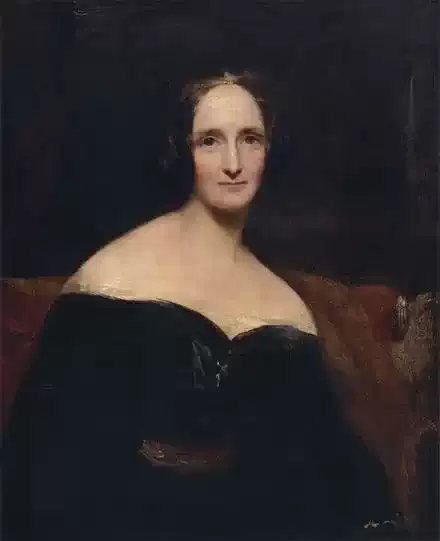
Percy Bysshe Shelley
Alastor: or, the Spirit of Solitude
Earth, Ocean, Air, belovèd brotherhood!
If our great Mother has imbued my soul
With aught of natural piety to feel
Your love, and recompense the boon with mine;
If dewy morn, and odorous noon, and even,
With sunset and its gorgeous ministers,
And solemn midnight's tingling silentness;
If Autumn's hollow sighs in the sere wood,
And Winter robing with pure snow and crowns
Of starry ice the gray grass and bare boughs;
If Spring's voluptuous pantings when she breathes
Her first sweet kisses,--have been dear to me;
If no bright bird, insect, or gentle beast
I consciously have injured, but still loved
And cherished these my kindred; then forgive
This boast, belovèd brethren, and withdraw
No portion of your wonted favor now!
Mother of this unfathomable world!
Favor my solemn song, for I have loved
Thee ever, and thee only; I have watched
Thy shadow, and the darkness of thy steps,
And my heart ever gazes on the depth
Of thy deep mysteries. I have made my bed
In charnels and on coffins, where black death
Keeps record of the trophies won from thee,
Hoping to still these obstinate questionings
Of thee and thine, by forcing some lone ghost,
Thy messenger, to render up the tale
Of what we are. In lone and silent hours,
When night makes a weird sound of its own stillness,
Like an inspired and desperate alchemist
Staking his very life on some dark hope,
Have I mixed awful talk and asking looks
With my most innocent love, until strange tears,
Uniting with those breathless kisses, made
Such magic as compels the charmèd night
To render up thy charge; and, though ne'er yet
Thou hast unveiled thy inmost sanctuary,
Enough from incommunicable dream,
And twilight phantasms, and deep noonday thought,
Has shone within me, that serenely now
And moveless, as a long-forgotten lyre
Suspended in the solitary dome
Of some mysterious and deserted fane,
I wait thy breath, Great Parent, that my strain
May modulate with murmurs of the air,
And motions of the forests and the sea,
And voice of living beings, and woven hymns
Of night and day, and the deep heart of man.
There was a Poet whose untimely tomb
No human hands with pious reverence reared,
But the charmed eddies of autumnal winds
Built o'er his mouldering bones a pyramid
Of mouldering leaves in the waste wilderness:
A lovely youth,--no mourning maiden decked
With weeping flowers, or votive cypress wreath,
The lone couch of his everlasting sleep:
Gentle, and brave, and generous,--no lorn bard
Breathed o'er his dark fate one melodious sigh:
He lived, he died, he sung in solitude.
Strangers have wept to hear his passionate notes,
And virgins, as unknown he passed, have pined
And wasted for fond love of his wild eyes.
The fire of those soft orbs has ceased to burn,
And Silence, too enamoured of that voice,
Locks its mute music in her rugged cell.
By solemn vision and bright silver dream
His infancy was nurtured. Every sight
And sound from the vast earth and ambient air
Sent to his heart its choicest impulses.
The fountains of divine philosophy
Fled not his thirsting lips, and all of great,
Or good, or lovely, which the sacred past
In truth or fable consecrates, he felt
And knew. When early youth had passed, he left
His cold fireside and alienated home
To seek strange truths in undiscovered lands.
Many a wide waste and tangled wilderness
Has lured his fearless steps; and he has bought
With his sweet voice and eyes, from savage men,
His rest and food. Nature's most secret steps
He like her shadow has pursued, where'er
The red volcano overcanopies
Its fields of snow and pinnacles of ice
With burning smoke, or where bitumen lakes
On black bare pointed islets ever beat
With sluggish surge, or where the secret caves,
Rugged and dark, winding among the springs
Of fire and poison, inaccessible
To avarice or pride, their starry domes
Of diamond and of gold expand above
Numberless and immeasurable halls,
Frequent with crystal column, and clear shrines
Of pearl, and thrones radiant with chrysolite.
Nor had that scene of ampler majesty
Than gems or gold, the varying roof of heaven
And the green earth, lost in his heart its claims
To love and wonder; he would linger long
In lonesome vales, making the wild his home,
Until the doves and squirrels would partake
From his innocuous band his bloodless food,
Lured by the gentle meaning of his looks,
And the wild antelope, that starts whene'er
The dry leaf rustles in the brake, suspend
Her timid steps, to gaze upon a form
More graceful than her own.
His wandering step,
Obedient to high thoughts, has visited
The awful ruins of the days of old:
Athens, and Tyre, and Balbec, and the waste
Where stood Jerusalem, the fallen towers
Of Babylon, the eternal pyramids,
Memphis and Thebes, and whatsoe'er of strange,
Sculptured on alabaster obelisk
Or jasper tomb or mutilated sphinx,
Dark Æthiopia in her desert hills
Conceals. Among the ruined temples there,
Stupendous columns, and wild images
Of more than man, where marble daemons watch
The Zodiac's brazen mystery, and dead men
Hang their mute thoughts on the mute walls around,
He lingered, poring on memorials
Of the world's youth: through the long burning day
Gazed on those speechless shapes; nor, when the moon
Filled the mysterious halls with floating shades
Suspended he that task, but ever gazed
And gazed, till meaning on his vacant mind
Flashed like strong inspiration, and he saw
The thrilling secrets of the birth of time.
Meanwhile an Arab maiden brought his food,
Her daily portion, from her father's tent,
And spread her matting for his couch, and stole
From duties and repose to tend his steps,
Enamoured, yet not daring for deep awe
To speak her love, and watched his nightly sleep,
Sleepless herself, to gaze upon his lips
Parted in slumber, whence the regular breath
Of innocent dreams arose; then, when red morn
Made paler the pale moon, to her cold home
Wildered, and wan, and panting, she returned.
The Poet, wandering on, through Arabie,
And Persia, and the wild Carmanian waste,
And o'er the aërial mountains which pour down
Indus and Oxus from their icy caves,
In joy and exultation held his way;
Till in the vale of Cashmire, far within
Its loneliest dell, where odorous plants entwine
Beneath the hollow rocks a natural bower,
Beside a sparkling rivulet he stretched
His languid limbs. A vision on his sleep
There came, a dream of hopes that never yet
Had flushed his cheek. He dreamed a veilèd maid
Sate near him, talking in low solemn tones.
Her voice was like the voice of his own soul
Heard in the calm of thought; its music long,
Like woven sounds of streams and breezes, held
His inmost sense suspended in its web
Of many-colored woof and shifting hues.
Knowledge and truth and virtue were her theme,
And lofty hopes of divine liberty,
Thoughts the most dear to him, and poesy,
Herself a poet. Soon the solemn mood
Of her pure mind kindled through all her frame
A permeating fire; wild numbers then
She raised, with voice stifled in tremulous sobs
Subdued by its own pathos; her fair hands
Were bare alone, sweeping from some strange harp
Strange symphony, and in their branching veins
The eloquent blood told an ineffable tale.
The beating of her heart was heard to fill
The pauses of her music, and her breath
Tumultuously accorded with those fits
Of intermitted song. Sudden she rose,
As if her heart impatiently endured
Its bursting burden; at the sound he turned,
And saw by the warm light of their own life
Her glowing limbs beneath the sinuous veil
Of woven wind, her outspread arms now bare,
Her dark locks floating in the breath of night,
Her beamy bending eyes, her parted lips
Outstretched, and pale, and quivering eagerly.
His strong heart sunk and sickened with excess
Of love. He reared his shuddering limbs, and quelled
His gasping breath, and spread his arms to meet
Her panting bosom:--she drew back awhile,
Then, yielding to the irresistible joy,
With frantic gesture and short breathless cry
Folded his frame in her dissolving arms.
Now blackness veiled his dizzy eyes, and night
Involved and swallowed up the vision; sleep,
Like a dark flood suspended in its course,
Rolled back its impulse on his vacant brain.
Roused by the shock, he started from his trance--
The cold white light of morning, the blue moon
Low in the west, the clear and garish hills,
The distinct valley and the vacant woods,
Spread round him where he stood. Whither have fled
The hues of heaven that canopied his bower
Of yesternight? The sounds that soothed his sleep,
The mystery and the majesty of Earth,
The joy, the exultation? His wan eyes
Gaze on the empty scene as vacantly
As ocean's moon looks on the moon in heaven.
The spirit of sweet human love has sent
A vision to the sleep of him who spurned
Her choicest gifts. He eagerly pursues
Beyond the realms of dream that fleeting shade;
He overleaps the bounds. Alas! alas!
Were limbs and breath and being intertwined
Thus treacherously? Lost, lost, forever lost
In the wide pathless desert of dim sleep,
That beautiful shape! Does the dark gate of death
Conduct to thy mysterious paradise,
O Sleep? Does the bright arch of rainbow clouds
And pendent mountains seen in the calm lake
Lead only to a black and watery depth,
While death's blue vault with loathliest vapors hung,
Where every shade which the foul grave exhales
Hides its dead eye from the detested day,
Conducts, O Sleep, to thy delightful realms?
This doubt with sudden tide flowed on his heart;
The insatiate hope which it awakened stung
His brain even like despair.
While daylight held
The sky, the Poet kept mute conference
With his still soul. At night the passion came,
Like the fierce fiend of a distempered dream,
And shook him from his rest, and led him forth
Into the darkness. As an eagle, grasped
In folds of the green serpent, feels her breast
Burn with the poison, and precipitates
Through night and day, tempest, and calm, and cloud,
Frantic with dizzying anguish, her blind flight
O'er the wide aëry wilderness: thus driven
By the bright shadow of that lovely dream,
Beneath the cold glare of the desolate night,
Through tangled swamps and deep precipitous dells,
Startling with careless step the moon-light snake,
He fled. Red morning dawned upon his flight,
Shedding the mockery of its vital hues
Upon his cheek of death. He wandered on
Till vast Aornos seen from Petra's steep
Hung o'er the low horizon like a cloud;
Through Balk, and where the desolated tombs
Of Parthian kings scatter to every wind
Their wasting dust, wildly he wandered on,
Day after day, a weary waste of hours,
Bearing within his life the brooding care
That ever fed on its decaying flame.
And now his limbs were lean; his scattered hair,
Sered by the autumn of strange suffering,
Sung dirges in the wind; his listless hand
Hung like dead bone within its withered skin;
Life, and the lustre that consumed it, shone,
As in a furnace burning secretly,
From his dark eyes alone. The cottagers,
Who ministered with human charity
His human wants, beheld with wondering awe
Their fleeting visitant. The mountaineer,
Encountering on some dizzy precipice
That spectral form, deemed that the Spirit of Wind,
With lightning eyes, and eager breath, and feet
Disturbing not the drifted snow, had paused
In its career; the infant would conceal
His troubled visage in his mother's robe
In terror at the glare of those wild eyes,
To remember their strange light in many a dream
Of after times; but youthful maidens, taught
By nature, would interpret half the woe
That wasted him, would call him with false names
Brother and friend, would press his pallid hand
At parting, and watch, dim through tears, the path
Of his departure from their father's door.
At length upon the lone Chorasmian shore
He paused, a wide and melancholy waste
Of putrid marshes. A strong impulse urged
His steps to the sea-shore. A swan was there,
Beside a sluggish stream among the reeds.
It rose as he approached, and, with strong wings
Scaling the upward sky, bent its bright course
High over the immeasurable main.
His eyes pursued its flight:--'Thou hast a home,
Beautiful bird! thou voyagest to thine home,
Where thy sweet mate will twine her downy neck
With thine, and welcome thy return with eyes
Bright in the lustre of their own fond joy.
And what am I that I should linger here,
With voice far sweeter than thy dying notes,
Spirit more vast than thine, frame more attuned
To beauty, wasting these surpassing powers
In the deaf air, to the blind earth, and heaven
That echoes not my thoughts?' A gloomy smile
Of desperate hope wrinkled his quivering lips.
For sleep, he knew, kept most relentlessly
Its precious charge, and silent death exposed,
Faithless perhaps as sleep, a shadowy lure,
With doubtful smile mocking its own strange charms.
Startled by his own thoughts, he looked around.
There was no fair fiend near him, not a sight
Or sound of awe but in his own deep mind.
A little shallop floating near the shore
Caught the impatient wandering of his gaze.
It had been long abandoned, for its sides
Gaped wide with many a rift, and its frail joints
Swayed with the undulations of the tide.
A restless impulse urged him to embark
And meet lone Death on the drear ocean's waste;
For well he knew that mighty Shadow loves
The slimy caverns of the populous deep.
The day was fair and sunny; sea and sky
Drank its inspiring radiance, and the wind
Swept strongly from the shore, blackening the waves.
Following his eager soul, the wanderer
Leaped in the boat; he spread his cloak aloft
On the bare mast, and took his lonely seat,
And felt the boat speed o'er the tranquil sea
Like a torn cloud before the hurricane.
As one that in a silver vision floats
Obedient to the sweep of odorous winds
Upon resplendent clouds, so rapidly
Along the dark and ruffled waters fled
The straining boat. A whirlwind swept it on,
With fierce gusts and precipitating force,
Through the white ridges of the chafèd sea.
The waves arose. Higher and higher still
Their fierce necks writhed beneath the tempest's scourge
Like serpents struggling in a vulture's grasp.
Calm and rejoicing in the fearful war
Of wave ruining on wave, and blast on blast
Descending, and black flood on whirlpool driven
With dark obliterating course, he sate:
As if their genii were the ministers
Appointed to conduct him to the light
Of those belovèd eyes, the Poet sate,
Holding the steady helm. Evening came on;
The beams of sunset hung their rainbow hues
High 'mid the shifting domes of sheeted spray
That canopied his path o'er the waste deep;
Twilight, ascending slowly from the east,
Entwined in duskier wreaths her braided locks
O'er the fair front and radiant eyes of Day;
Night followed, clad with stars. On every side
More horribly the multitudinous streams
Of ocean's mountainous waste to mutual war
Rushed in dark tumult thundering, as to mock
The calm and spangled sky. The little boat
Still fled before the storm; still fled, like foam
Down the steep cataract of a wintry river;
Now pausing on the edge of the riven wave;
Now leaving far behind the bursting mass
That fell, convulsing ocean; safely fled--
As if that frail and wasted human form
Had been an elemental god.
At midnight
The moon arose; and lo! the ethereal cliffs
Of Caucasus, whose icy summits shone
Among the stars like sunlight, and around
Whose caverned base the whirlpools and the waves
Bursting and eddying irresistibly
Rage and resound forever.--Who shall save?--
The boat fled on,--the boiling torrent drove,--
The crags closed round with black and jagged arms,
The shattered mountain overhung the sea,
And faster still, beyond all human speed,
Suspended on the sweep of the smooth wave,
The little boat was driven. A cavern there
Yawned, and amid its slant and winding depths
Ingulfed the rushing sea. The boat fled on
With unrelaxing speed.--'Vision and Love!'
The Poet cried aloud, 'I have beheld
The path of thy departure. Sleep and death
Shall not divide us long.'
The boat pursued
The windings of the cavern. Daylight shone
At length upon that gloomy river's flow;
Now, where the fiercest war among the waves
Is calm, on the unfathomable stream
The boat moved slowly. Where the mountain, riven,
Exposed those black depths to the azure sky,
Ere yet the flood's enormous volume fell
Even to the base of Caucasus, with sound
That shook the everlasting rocks, the mass
Filled with one whirlpool all that ample chasm;
Stair above stair the eddying waters rose,
Circling immeasurably fast, and laved
With alternating dash the gnarlèd roots
Of mighty trees, that stretched their giant arms
In darkness over it. I' the midst was left,
Reflecting yet distorting every cloud,
A pool of treacherous and tremendous calm.
Seized by the sway of the ascending stream,
With dizzy swiftness, round and round and round,
Ridge after ridge the straining boat arose,
Till on the verge of the extremest curve,
Where through an opening of the rocky bank
The waters overflow, and a smooth spot
Of glassy quiet 'mid those battling tides
Is left, the boat paused shuddering.--Shall it sink
Down the abyss? Shall the reverting stress
Of that resistless gulf embosom it?
Now shall it fall?--A wandering stream of wind
Breathed from the west, has caught the expanded sail,
And, lo! with gentle motion between banks
Of mossy slope, and on a placid stream,
Beneath a woven grove, it sails, and, hark!
The ghastly torrent mingles its far roar
With the breeze murmuring in the musical woods.
Where the embowering trees recede, and leave
A little space of green expanse, the cove
Is closed by meeting banks, whose yellow flowers
Forever gaze on their own drooping eyes,
Reflected in the crystal calm. The wave
Of the boat's motion marred their pensive task,
Which naught but vagrant bird, or wanton wind,
Or falling spear-grass, or their own decay
Had e'er disturbed before. The Poet longed
To deck with their bright hues his withered hair,
But on his heart its solitude returned,
And he forbore. Not the strong impulse hid
In those flushed cheeks, bent eyes, and shadowy frame,
Had yet performed its ministry; it hung
Upon his life, as lightning in a cloud
Gleams, hovering ere it vanish, ere the floods
Of night close over it.
The noonday sun
Now shone upon the forest, one vast mass
Of mingling shade, whose brown magnificence
A narrow vale embosoms. There, huge caves,
Scooped in the dark base of their aëry rocks,
Mocking its moans, respond and roar forever.
The meeting boughs and implicated leaves
Wove twilight o'er the Poet's path, as, led
By love, or dream, or god, or mightier Death,
He sought in Nature's dearest haunt some bank,
Her cradle and his sepulchre. More dark
And dark the shades accumulate. The oak,
Expanding its immense and knotty arms,
Embraces the light beech. The pyramids
Of the tall cedar overarching frame
Most solemn domes within, and far below,
Like clouds suspended in an emerald sky,
The ash and the acacia floating hang
Tremulous and pale. Like restless serpents, clothed
In rainbow and in fire, the parasites,
Starred with ten thousand blossoms, flow around
The gray trunks, and, as gamesome infants' eyes,
With gentle meanings, and most innocent wiles,
Fold their beams round the hearts of those that love,
These twine their tendrils with the wedded boughs,
Uniting their close union; the woven leaves
Make network of the dark blue light of day
And the night's noontide clearness, mutable
As shapes in the weird clouds. Soft mossy lawns
Beneath these canopies extend their swells,
Fragrant with perfumed herbs, and eyed with blooms
Minute yet beautiful. One darkest glen
Sends from its woods of musk-rose twined with jasmine
A soul-dissolving odor to invite
To some more lovely mystery. Through the dell
Silence and Twilight here, twin-sisters, keep
Their noonday watch, and sail among the shades,
Like vaporous shapes half-seen; beyond, a well,
Dark, gleaming, and of most translucent wave,
Images all the woven boughs above,
And each depending leaf, and every speck
Of azure sky darting between their chasms;
Nor aught else in the liquid mirror laves
Its portraiture, but some inconstant star,
Between one foliaged lattice twinkling fair,
Or painted bird, sleeping beneath the moon,
Or gorgeous insect floating motionless,
Unconscious of the day, ere yet his wings
Have spread their glories to the gaze of noon.
Hither the Poet came. His eyes beheld
Their own wan light through the reflected lines
Of his thin hair, distinct in the dark depth
Of that still fountain; as the human heart,
Gazing in dreams over the gloomy grave,
Sees its own treacherous likeness there. He heard
The motion of the leaves--the grass that sprung
Startled and glanced and trembled even to feel
An unaccustomed presence--and the sound
Of the sweet brook that from the secret springs
Of that dark fountain rose. A Spirit seemed
To stand beside him--clothed in no bright robes
Of shadowy silver or enshrining light,
Borrowed from aught the visible world affords
Of grace, or majesty, or mystery;
But undulating woods, and silent well,
And leaping rivulet, and evening gloom
Now deepening the dark shades, for speech assuming,
Held commune with him, as if he and it
Were all that was; only--when his regard
Was raised by intense pensiveness--two eyes,
Two starry eyes, hung in the gloom of thought,
And seemed with their serene and azure smiles
To beckon him.
Obedient to the light
That shone within his soul, he went, pursuing
The windings of the dell. The rivulet,
Wanton and wild, through many a green ravine
Beneath the forest flowed. Sometimes it fell
Among the moss with hollow harmony
Dark and profound. Now on the polished stones
It danced, like childhood laughing as it went;
Then, through the plain in tranquil wanderings crept,
Reflecting every herb and drooping bud
That overhung its quietness.--'O stream!
Whose source is inaccessibly profound,
Whither do thy mysterious waters tend?
Thou imagest my life. Thy darksome stillness,
Thy dazzling waves, thy loud and hollow gulfs,
Thy searchless fountain and invisible course,
Have each their type in me; and the wide sky
And measureless ocean may declare as soon
What oozy cavern or what wandering cloud
Contains thy waters, as the universe
Tell where these living thoughts reside, when stretched
Upon thy flowers my bloodless limbs shall waste
I' the passing wind!'
Beside the grassy shore
Of the small stream he went; he did impress
On the green moss his tremulous step, that caught
Strong shuddering from his burning limbs. As one
Roused by some joyous madness from the couch
Of fever, he did move; yet not like him
Forgetful of the grave, where, when the flame
Of his frail exultation shall be spent,
He must descend. With rapid steps he went
Beneath the shade of trees, beside the flow
Of the wild babbling rivulet; and now
The forest's solemn canopies were changed
For the uniform and lightsome evening sky.
Gray rocks did peep from the spare moss, and stemmed
The struggling brook; tall spires of windlestrae
Threw their thin shadows down the rugged slope,
And nought but gnarlèd roots of ancient pines
Branchless and blasted, clenched with grasping roots
The unwilling soil. A gradual change was here
Yet ghastly. For, as fast years flow away,
The smooth brow gathers, and the hair grows thin
And white, and where irradiate dewy eyes
Had shone, gleam stony orbs:--so from his steps
Bright flowers departed, and the beautiful shade
Of the green groves, with all their odorous winds
And musical motions. Calm he still pursued
The stream, that with a larger volume now
Rolled through the labyrinthine dell; and there
Fretted a path through its descending curves
With its wintry speed. On every side now rose
Rocks, which, in unimaginable forms,
Lifted their black and barren pinnacles
In the light of evening, and its precipice
Obscuring the ravine, disclosed above,
'Mid toppling stones, black gulfs and yawning caves,
Whose windings gave ten thousand various tongues
To the loud stream. Lo! where the pass expands
Its stony jaws, the abrupt mountain breaks,
And seems with its accumulated crags
To overhang the world; for wide expand
Beneath the wan stars and descending moon
Islanded seas, blue mountains, mighty streams,
Dim tracts and vast, robed in the lustrous gloom
Of leaden-colored even, and fiery hills
Mingling their flames with twilight, on the verge
Of the remote horizon. The near scene,
In naked and severe simplicity,
Made contrast with the universe. A pine,
Rock-rooted, stretched athwart the vacancy
Its swinging boughs, to each inconstant blast
Yielding one only response at each pause
In most familiar cadence, with the howl,
The thunder and the hiss of homeless streams
Mingling its solemn song, whilst the broad river
Foaming and hurrying o'er its rugged path,
Fell into that immeasurable void,
Scattering its waters to the passing winds.
Yet the gray precipice and solemn pine
And torrent were not all;--one silent nook
Was there. Even on the edge of that vast mountain,
Upheld by knotty roots and fallen rocks,
It overlooked in its serenity
The dark earth and the bending vault of stars.
It was a tranquil spot that seemed to smile
Even in the lap of horror. Ivy clasped
The fissured stones with its entwining arms,
And did embower with leaves forever green
And berries dark the smooth and even space
Of its inviolated floor; and here
The children of the autumnal whirlwind bore
In wanton sport those bright leaves whose decay,
Red, yellow, or ethereally pale,
Rivals the pride of summer. 'T is the haunt
Of every gentle wind whose breath can teach
The wilds to love tranquillity. One step,
One human step alone, has ever broken
The stillness of its solitude; one voice
Alone inspired its echoes;--even that voice
Which hither came, floating among the winds,
And led the loveliest among human forms
To make their wild haunts the depository
Of all the grace and beauty that endued
Its motions, render up its majesty,
Scatter its music on the unfeeling storm,
And to the damp leaves and blue cavern mould,
Nurses of rainbow flowers and branching moss,
Commit the colors of that varying cheek,
That snowy breast, those dark and drooping eyes.
The dim and hornèd moon hung low, and poured
A sea of lustre on the horizon's verge
That overflowed its mountains. Yellow mist
Filled the unbounded atmosphere, and drank
Wan moonlight even to fulness; not a star
Shone, not a sound was heard; the very winds,
Danger's grim playmates, on that precipice
Slept, clasped in his embrace.--O storm of death,
Whose sightless speed divides this sullen night!
And thou, colossal Skeleton, that, still
Guiding its irresistible career
In thy devastating omnipotence,
Art king of this frail world! from the red field
Of slaughter, from the reeking hospital,
The patriot's sacred couch, the snowy bed
Of innocence, the scaffold and the throne,
A mighty voice invokes thee! Ruin calls
His brother Death! A rare and regal prey
He hath prepared, prowling around the world;
Glutted with which thou mayst repose, and men
Go to their graves like flowers or creeping worms,
Nor ever more offer at thy dark shrine
The unheeded tribute of a broken heart.
When on the threshold of the green recess
The wanderer's footsteps fell, he knew that death
Was on him. Yet a little, ere it fled,
Did he resign his high and holy soul
To images of the majestic past,
That paused within his passive being now,
Like winds that bear sweet music, when they breathe
Through some dim latticed chamber. He did place
His pale lean hand upon the rugged trunk
Of the old pine; upon an ivied stone
Reclined his languid head; his limbs did rest,
Diffused and motionless, on the smooth brink
Of that obscurest chasm;--and thus he lay,
Surrendering to their final impulses
The hovering powers of life. Hope and Despair,
The torturers, slept; no mortal pain or fear
Marred his repose; the influxes of sense
And his own being, unalloyed by pain,
Yet feebler and more feeble, calmly fed
The stream of thought, till he lay breathing there
At peace, and faintly smiling. His last sight
Was the great moon, which o'er the western line
Of the wide world her mighty horn suspended,
With whose dun beams inwoven darkness seemed
To mingle. Now upon the jagged hills
It rests; and still as the divided frame
Of the vast meteor sunk, the Poet's blood,
That ever beat in mystic sympathy
With Nature's ebb and flow, grew feebler still;
And when two lessening points of light alone
Gleamed through the darkness, the alternate gasp
Of his faint respiration scarce did stir
The stagnate night:--till the minutest ray
Was quenched, the pulse yet lingered in his heart.
It paused--it fluttered. But when heaven remained
Utterly black, the murky shades involved
An image silent, cold, and motionless,
As their own voiceless earth and vacant air.
Even as a vapor fed with golden beams
That ministered on sunlight, ere the west
Eclipses it, was now that wondrous frame--
No sense, no motion, no divinity--
A fragile lute, on whose harmonious strings
The breath of heaven did wander--a bright stream
Once fed with many-voicèd waves--a dream
Of youth, which night and time have quenched forever--
Still, dark, and dry, and unremembered now.
Oh, for Medea's wondrous alchemy,
Which wheresoe'er it fell made the earth gleam
With bright flowers, and the wintry boughs exhale
From vernal blooms fresh fragrance! Oh, that God,
Profuse of poisons, would concede the chalice
Which but one living man has drained, who now,
Vessel of deathless wrath, a slave that feels
No proud exemption in the blighting curse
He bears, over the world wanders forever,
Lone as incarnate death! Oh, that the dream
Of dark magician in his visioned cave,
Raking the cinders of a crucible
For life and power, even when his feeble hand
Shakes in its last decay, were the true law
Of this so lovely world! But thou art fled,
Like some frail exhalation, which the dawn
Robes in its golden beams,--ah! thou hast fled!
The brave, the gentle and the beautiful,
The child of grace and genius. Heartless things
Are done and said i' the world, and many worms
And beasts and men live on, and mighty Earth
From sea and mountain, city and wilderness,
In vesper low or joyous orison,
Lifts still its solemn voice:--but thou art fled--
Thou canst no longer know or love the shapes
Of this phantasmal scene, who have to thee
Been purest ministers, who are, alas!
Now thou art not! Upon those pallid lips
So sweet even in their silence, on those eyes
That image sleep in death, upon that form
Yet safe from the worm's outrage, let no tear
Be shed--not even in thought. Nor, when those hues
Are gone, and those divinest lineaments,
Worn by the senseless wind, shall live alone
In the frail pauses of this simple strain,
Let not high verse, mourning the memory
Of that which is no more, or painting's woe
Or sculpture, speak in feeble imagery
Their own cold powers. Art and eloquence,
And all the shows o' the world, are frail and vain
To weep a loss that turns their lights to shade.
It is a woe "too deep for tears," when all
Is reft at once, when some surpassing Spirit,
Whose light adorned the world around it, leaves
Those who remain behind, not sobs or groans,
The passionate tumult of a clinging hope;
But pale despair and cold tranquillity,
Nature's vast frame, the web of human things,
Birth and the grave, that are not as they were.
451
John Clare
Wild Bees
These children of the sun which summer brings
As pastoral minstrels in her merry train
Pipe rustic ballads upon busy wings
And glad the cotters' quiet toils again.
The white-nosed bee that bores its little hole
In mortared walls and pipes its symphonies,
And never absent couzen, black as coal,
That Indian-like bepaints its little thighs,
With white and red bedight for holiday,
Right earlily a-morn do pipe and play
And with their legs stroke slumber from their eyes.
And aye so fond they of their singing seem
That in their holes abed at close of day
They still keep piping in their honey dreams,
And larger ones that thrum on ruder pipe
Round the sweet smelling closen and rich woods
Where tawny white and red flush clover buds
Shine bonnily and bean fields blossom ripe,
Shed dainty perfumes and give honey food
To these sweet poets of the summer fields;
Me much delighting as I stroll along
The narrow path that hay laid meadow yields,
Catching the windings of their wandering song.
The black and yellow bumble first on wing
To buzz among the sallow's early flowers,
Hiding its nest in holes from fickle spring
Who stints his rambles with her frequent showers;
And one that may for wiser piper pass,
In livery dress half sables and half red,
Who laps a moss ball in the meadow grass
And hoards her stores when April showers have fled;
And russet commoner who knows the face
Of every blossom that the meadow brings,
Starting the traveller to a quicker pace
By threatening round his head in many rings:
These sweeten summer in their happy glee
By giving for her honey melody.
445
Rudyard Kipling
Outsong in the Jungle
Baloo
For the sake of him who showed
One wise Frog the Jungle-Road,
Keep the Law the Man-Pack make
For thy blind old Baloo's sake!
Clean or tainted, hot or stale,
Hold it as it were the Trail,
Through the day and through the night,
Questing neither left nor right.
For the sake of him who loves
Thee beyond all else that moves,
When thy Pack would make thee pain,
Say: " Tabaqui sings again."
When thy Pack would work thee ill,
Say: "Shere Khan is yet to kill."
When the knife is drawn to slay,
Keep the Law and go thy way.
(Root and honey, palm and spathe,
Guard a cub from harm and scathe!)
Wood and Water, Wind and Tree,
Jungle-Favour go with thee!
Kaa
Anger is the egg of Fear--
Only lidless eyes see clear.
Cobra-poison none may leech--
Even so with Cobra-speech.
Open talk shall call to thee
Strength, whose mate is Courtesy.
Send no lunge beyond thy length.
Lend no rotten bough thy strength.
Gauge thy gape with buck or goat,
Lest thine eye should choke thy throat.
After gorging, wouldst thou sleep ?
Look thy den be hid and deep,
Lest a wrong, by thee forgot,
Draw thy killer to the spot.
East and West and North and South,
Wash thy hide and close thy mouth.
(Pit and rift and blue pool-brim,
Middle-Jungle follow him!)
Wood and Water, Wind and Tree,
Jungle-Favour go with thee!
Bagheera
In the cage my life began;
Well I know the worth of Man.
By the Broken Lock that freed--
Man-cub, ware the Man-cub's breed!
Scenting-dew or starlight pale,
Choose no tangled tree-cat trail.
Pack or council, hunt or den,
Cry no truce with Jackal-Men.
Feed them silence when they say:
"Come with us an easy way."
Feed them silence when they seek
Help of thine to hurt the weak.
Make no bandar's boast of skill;
Hold thy peace above the kill.
Let nor call nor song nor sign
Turn thee from thy hunting-line.
(Morning mist or twilight clear,
Serve him, Wardens of the Deer!)
Wood and Water, Wind and Tree,
Jungle-Favour go with thee!
The Three
On the trail that thou must tread
To the threshold of our dread,
Where the Flower blossoms red;
Through the nights when thou shalt lie
Prisoned from our Mother-sky,
Hearing us, thy loves, go by;
In the dawns when thou. shalt wake
To the toil thou canst not break,
Heartsick for the Jungle's sake;
Wood and Water, Wind air Tree,
Wisdom, Strength, and Courtesy,
Jungle-Favour go with thee!
446
Anne Brontë
Lines Composed in a Wood on a Windy Day
My soul is awakened, my spirit is soaring
And carried aloft on the wings of the breeze;
For above and around me the wild wind is roaring,
Arousing to rapture the earth and the seas.
The long withered grass in the sunshine is glancing,
The bare trees are tossing their branches on high;
The dead leaves, beneath them, are merrily dancing,
The white clouds are scudding across the blue sky.
I wish I could see how the ocean is lashing
The foam of its billows to whirlwinds of spray;
I wish I could see how its proud waves are dashing,
And hear the wild roar of their thunder today!
Acton
444
Johann Wolfgang von Goethe
Gipsy Song
IN the drizzling mist, with the snow high-pil'd,
In the Winter night, in the forest wild,
I heard the wolves with their ravenous howl,
I heard the screaming note of the owl:
Wille wau wau wau!
Wille wo wo wo!
Wito hu!
I shot, one day, a cat in a ditch--
The dear black cat of Anna the witch;
Upon me, at night, seven were-wolves came down,
Seven women they were, from out of the town.
Wille wau wau wau!
Wille wo wo wo!
Wito hu!
I knew them all; ay, I knew them straight;
First, Anna, then Ursula, Eve, and Kate,
And Barbara, Lizzy, and Bet as well;
And forming a ring, they began to yell:
Wille wau wau wau!
Wille wo wo wo!
Wito hu!
Then call'd I their names with angry threat:
"What wouldst thou, Anna? What wouldst thou, Bet?"
At hearing my voice, themselves they shook,
And howling and yelling, to flight they took.
Wille wau wau wau!
Wille wo wo wo!
Wito hu!
445
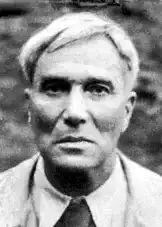
Boris Pasternak
March
The sun is hotter than the top ledge in a steam bath;
The ravine, crazed, is rampaging below.
Spring -- that corn-fed, husky milkmaid --
Is busy at her chores with never a letup.
The snow is wasting (pernicious anemia --
See those branching veinlets of impotent blue?)
Yet in the cowbarn life is burbling, steaming,
And the tines of pitchforks simply glow with health.
These days -- these days, and these nights also!
With eavesdrop thrumming its tattoos at noon,
With icicles (cachectic!) hanging on to gables,
And with the chattering of rills that never sleep!
All doors are flung open -- in stable and in cowbarn;
Pigeons peck at oats fallen in the snow;
And the culprit of all this and its life-begetter--
The pile of manure -- is pungent with ozone.
441

Matsuo Bashō
What fish feel
What fish feel,
birds feel, I don't know--
the year ending.
Translated by Robert Hass
birds feel, I don't know--
the year ending.
Translated by Robert Hass
444
Henry Wadsworth Longfellow
Daybreak. (Birds Of Passage. Flight The First)
A wind came up out of the sea,
And said, 'O mists, make room for me.'
It hailed the ships, and cried, 'Sail on,
Ye mariners, the night is gone.'
And hurried landward far away,
Crying, 'Awake! it is the day.'
It said unto the forest, 'Shout!
Hang all your leafy banners out!'
It touched the wood-bird's folded wing,
And said, 'O bird, awake and sing.'
And o'er the farms, 'O chanticleer,
Your clarion blow; the day is near.'
It whispered to the fields of corn,
'Bow down, and hail the coming morn.'
It shouted through the belfry-tower,
'Awake, O bell! proclaim the hour.'
It crossed the churchyard with a sigh,
And said, 'Not yet! in quiet lie.'
442
Walt Whitman
As A Strong Bird On Pinious Free
AS a strong bird on pinions free,
Joyous, the amplest spaces heavenward cleaving,
Such be the thought I'd think to-day of thee, America,
Such be the recitative I'd bring to-day for thee.
The conceits of the poets of other lands I bring thee not,
Nor the compliments that have served their turn so long,
Nor rhyme--nor the classics--nor perfume of foreign court, or indoor
library;
But an odor I'd bring to-day as from forests of pine in the north, in
Maine--or breath of an Illinois prairie,
With open airs of Virginia, or Georgia, or Tennessee--or from Texas
uplands, or Florida's glades,
With presentment of Yellowstone's scenes, or Yosemite;
And murmuring under, pervading all, I'd bring the rustling sea-sound,
That endlessly sounds from the two great seas of the world.
And for thy subtler sense, subtler refrains, O Union!
Preludes of intellect tallying these and thee--mind-formulas fitted
for thee--real, and sane, and large as these and thee;
Thou, mounting higher, diving deeper than we knew--thou
transcendental Union!
By thee Fact to be justified--blended with Thought;
Thought of Man justified--blended with God:
Through thy Idea--lo! the immortal Reality!
Through thy Reality--lo! the immortal Idea!
Brain of the New World! what a task is thine!
To formulate the Modern.....Out of the peerless grandeur of the
modern,
Out of Thyself--comprising Science--to recast Poems, Churches, Art,
(Recast--may-be discard them, end them--May-be their work is done-
who knows?)
By vision, hand, conception, on the background of the mighty past,
the dead,
To limn, with absolute faith, the mighty living present.
(And yet, thou living, present brain! heir of the dead, the Old World
brain!
Thou that lay folded, like an unborn babe, within its folds so long!
Thou carefully prepared by it so long!--haply thou but unfoldest it-
only maturest it;
It to eventuate in thee--the essence of the by-gone time contain'd in
thee;
Its poems, churches, arts, unwitting to themselves, destined with
reference to thee,
The fruit of all the Old, ripening to-day in thee.)
Sail--sail thy best, ship of Democracy!
Of value is thy freight--'tis not the Present only,
The Past is also stored in thee!
Thou holdest not the venture of thyself alone--not of thy western
continent alone;
Earth's résumé entire floats on thy keel, O ship--is steadied by thy
spars;
With thee Time voyages in trust--the antecedent nations sink or swim
with thee;
With all their ancient struggles, martyrs, heroes, epics, wars, thou
bear'st the other continents;
Theirs, theirs as much as thine, the destination-port triumphant:
--Steer, steer with good strong hand and wary eye, O helmsman--thou
carryest great companions,
Venerable, priestly Asia sails this day with thee,
And royal, feudal Europe sails with thee.
Beautiful World of new, superber Birth, that rises to my eyes,
Like a limitless golden cloud, filling the western sky;
Emblem of general Maternity, lifted above all;
Sacred shape of the bearer of daughters and sons;
Out of thy teeming womb, thy giant babes in ceaseless procession
issuing,
Acceding from such gestation, taking and giving continual strength
and life;
World of the Real! world of the twain in one!
World of the Soul--born by the world of the real alone--led to
identity, body, by it alone;
Yet in beginning only--incalculable masses of composite, precious
materials,
By history's cycles forwarded--by every nation, language, hither
sent,
Ready, collected here--a freer, vast, electric World, to be
constructed here,
(The true New World--the world of orbic Science, Morals, Literatures
to come,)
Thou Wonder World, yet undefined, unform'd--neither do I define thee;
How can I pierce the impenetrable blank of the future?
I feel thy ominous greatness, evil as well as good;
I watch thee, advancing, absorbing the present, transcending the
past;
I see thy light lighting and thy shadow shadowing, as if the entire
globe;
But I do not undertake to define thee--hardly to comprehend thee;
I but thee name--thee prophecy--as now!
I merely thee ejaculate!
Thee in thy future;
Thee in thy only permanent life, career--thy own unloosen'd mind--thy
soaring spirit;
Thee as another equally needed sun, America--radiant, ablaze, swiftmoving,
fructifying all;
Thee! risen in thy potent cheerfulness and joy--thy endless, great
hilarity!
(Scattering for good the cloud that hung so long--that weigh'd so
long upon the mind of man,
The doubt, suspicion, dread, of gradual, certain decadence of man;)
Thee in thy larger, saner breeds of Female, Male--thee in thy
athletes, moral, spiritual, South, North, West, East,
(To thy immortal breasts, Mother of All, thy every daughter, son,
endear'd alike, forever equal;)
Thee in thy own musicians, singers, artists, unborn yet, but certain;
Thee in thy moral wealth and civilization (until which thy proudest
material wealth and civilization must remain in vain;)
Thee in thy all-supplying, all-enclosing Worship--thee in no single
bible, saviour, merely,
Thy saviours countless, latent within thyself--thy bibles incessant,
within thyself, equal to any, divine as any;
Thee in an education grown of thee--in teachers, studies, students,
born of thee;
Thee in thy democratic fetes, en masse--thy high original festivals,
operas, lecturers, preachers;
Thee in thy ultimata, (the preparations only now completed--the
edifice on sure foundations tied,)
Thee in thy pinnacles, intellect, thought--thy topmost rational
joys--thy love, and godlike aspiration,
In thy resplendent coming literati--thy full-lung'd orators--thy
sacerdotal bards--kosmic savans,
These! these in thee, (certain to come,) to-day I prophecy.
Land tolerating all--accepting all--not for the good alone--all good
for thee;
Land in the realms of God to be a realm unto thyself;
Under the rule of God to be a rule unto thyself.
(Lo! where arise three peerless stars,
To be thy natal stars, my country--Ensemble--Evolution--Freedom,
Set in the sky of Law.)
Land of unprecedented faith--God's faith!
Thy soil, thy very subsoil, all upheav'd;
The general inner earth, so long, so sedulously draped over, now and
hence for what it is, boldly laid bare,
Open'd by thee to heaven's light, for benefit or bale.
Not for success alone;
Not to fair-sail unintermitted always;
The storm shall dash thy face--the murk of war, and worse than war,
shall cover thee all over;
(Wert capable of war--its tug and trials? Be capable of peace, its
trials;
For the tug and mortal strain of nations come at last in peace--not
war;)
In many a smiling mask death shall approach, beguiling thee--thou in
disease shalt swelter;
The livid cancer spread its hideous claws, clinging upon thy breasts,
seeking to strike thee deep within;
Consumption of the worst--moral consumption--shall rouge thy face
with hectic:
But thou shalt face thy fortunes, thy diseases, and surmount them
all,
Whatever they are to-day, and whatever through time they may be,
They each and all shall lift, and pass away, and cease from thee;
While thou, Time's spirals rounding--out of thyself, thyself still
extricating, fusing,
Equable, natural, mystical Union thou--(the mortal with immortal
blent,)
Shalt soar toward the fulfilment of the future--the spirit of the
body and the mind,
The Soul--its destinies.
The Soul, its destinies--the real real,
(Purport of all these apparitions of the real;)
In thee, America, the Soul, its destinies;
Thou globe of globes! thou wonder nebulous!
By many a throe of heat and cold convuls'd--(by these thyself
solidifying;)
Thou mental, moral orb! thou New, indeed new, Spiritual World!
The Present holds thee not--for such vast growth as thine--for such
unparallel'd flight as thine,
The Future only holds thee, and can hold thee.
444

Robert Louis Stevenson
The Wind
I saw you toss the kites on high
And blow the birds about the sky;
And all around I heard you pass,
Like ladies' skirts across the grass--
O wind, a-blowing all day long,
O wind, that sings so loud a song!
I saw the different things you did,
But always you yourself you hid.
I felt you push, I heard you call,
I could not see yourself at all--
O wind, a-blowing all day long,
O wind, that sings so loud a song!
O you that are so strong and cold,
O blower, are you young or old?
Are you a beast of field and tree,
Or just a stronger child than me?
O wind, a-blowing all day long,
O wind, that sings so loud a song!
444
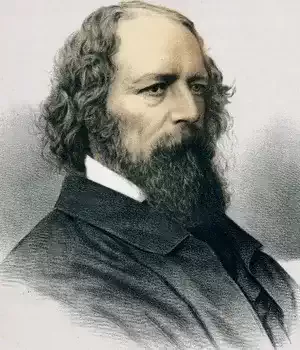
Alfred Lord Tennyson
Claribel
Where Claribel low-lieth
The breezes pause and die,
Letting the rose-leaves fall:
But the solemn oak-tree sigheth,
Thick-leaved, ambrosial,
With an ancient melody
Of an inward agony,
Where Claribel low-lieth.
At eve the beetle boometh
Athwart the thicket lone:
At noon the wild bee hummeth
About the moss'd headstone:
At midnight the moon cometh,
And looketh down alone.
Her song the lintwhite swelleth,
The clear-voiced mavis dwelleth,
The callow throstle lispeth,
The slumbrous wave outwelleth,
The babbling runnel crispeth,
The hollow grot replieth
Where Claribel low-lieth.
441