
Animals and Nature

Walter de la Mare
Tartary
If I were Lord of Tartary,
Myself, and me alone,
My bed should be of ivory,
Of beaten gold my throne;
And in my court should peacocks flaunt,
And in my forests tigers haunt,
And in my pools great fishes slant
Their fins athwart the sun.
If I were Lord of Tartary,
Trumpeters every day
To all my meals should summon me,
And in my courtyards bray;
And in the evening lamps should shine,
Yellow as honey, red as wine,
While harp, and flute, and mandoline
Made music sweet and gay.
If I were Lord of Tartary,
I'd wear a robe of beads,
White, and gold, and green they'd be --
And small and thick as seeds;
And ere should wane the morning star,
I'd don my robe and scimitar.
And zebras seven should draw my car
Through Tartary's dark gleades.
Lord of the fruits of Tartary.
Her rivers silver-pale!
Lord of the hills of Tartary.
Glen, thicket, wood, and dale!
Her flashing stars, her scented breeze,
Her trembling lakes, like foamless seas,
Her bird-delighting citron-trees,
In every purple vale!
396
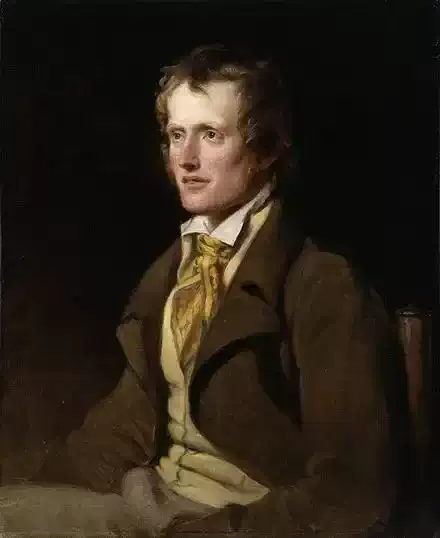
John Clare
Dewdrops
The dewdrops on every blade of grass are so much like silver drops
that I am obliged to stoop down as I walk to see if they are pearls,
and those sprinkled on the ivy-woven beds of primroses underneath the
hazels, whitethorns and maples are so like gold beads that I stooped
down to feel if they were hard, but they melted from my finger. And
where the dew lies on the primrose, the violet and whitethorn leaves
they are emerald and beryl, yet nothing more than the dews of the
morning on the budding leaves; nay, the road grasses are covered with
gold and silver beads, and the further we go the brighter they seem to
shine, like solid gold and silver. It is nothing more than the sun's
light and shade upon them in the dewy morning; every thorn-point and
every bramble-spear has its trembling ornament: till the wind gets
a little brisker, and then all is shaken off, and all the shining
jewelry passes away into a common spring morning full of budding
leaves, primroses, violets, vernal speedwell, bluebell and orchis, and
commonplace objects.
396

James Whitcomb Riley
Dusk
The frightened herds of clouds across the sky
Trample the sunshine down, and chase the day
Into the dusky forest-lands of gray
And sombre twilight. Far and faint, and high,
The wild goose trails his harrow, with a cry
Sad as the wail of some poor castaway
Who sees a vessel drifting far astray
Of his last hope, and lays him down to die.
The children, riotous from school, grow bold
And quarrel with the wind whose angry gust
Plucks off the summer-hat, and flaps the fold
Of many a crimson cloak, and twirls the dust
In spiral shapes grotesque, and dims the gold
Of gleaming tresses with the blur of rust.
397
John Clare
In Hilly-Wood
How sweet to be thus nestling deep in boughs,
Upon an ashen stoven pillowing me;
Faintly are heard the ploughmen at their ploughs,
But not an eye can find its way to see.
The sunbeams scarce molest me with a smile,
So thick the leafy armies gather round;
And where they do, the breeze blows cool the while,
Their leafy shadows dancing on the ground.
Full many a flower, too, wishing to be seen,
Perks up its head the hiding grass between.-
In mid-wood silence, thus, how sweet to be;
Where all the noises, that on peace intrude,
Come from the chittering cricket, bird, and bee,
Whose songs have charms to sweeten solitude.
394

Carl Sandburg
Horses and Men in Rain
Let us sit by a hissing steam radiator a winter's day, gray wind pattering frozen
raindrops on the window,
And let us talk about milk wagon drivers and grocery delivery boys.
Let us keep our feet in wool slippers and mix hot punches--and talk about mail carriers
and
messenger boys slipping along the icy sidewalks.
Let us write of olden, golden days and hunters of the
Holy Grail and men called "knights" riding horses in the rain, in the cold frozen rain for
ladies they loved.
A roustabout hunched on a coal wagon goes by, icicles drip on his hat rim, sheets of ice
wrapping
the hunks of coal, the caravanserai a gray blur in slant of rain.
Let us nudge the steam radiator with our wool slippers and write poems of Launcelot,
the hero, and
Roland, the hero, and all the olden golden men who rode horses in the rain.
394

Johann Wolfgang von Goethe
Book Of Suleika - Suleika 02
WHAT is by this stir reveal'd?
Doth the East glad tidings bring?
For my heart's deep wounds are heal'd
By his mild and cooling wing.
He the dust with sports doth meet,
And in gentle cloudlets chase;
To the vineleaf's safe retreat
Drives the insects' happy race,
Cools these burning cheeks of mine,
Checks the sun's fierce glow Adam,
Kisses, as he flies, the vine,
Flaunting over hill and plain.
And his whispers soft convey
Thousand greetings from my friend;
Ere these hills own night's dark sway,
Kisses greet me, without end.
Thus canst thou still onward go,
Serving friend and mourner too!
There, where lofty ramparts glow,
Soon the loved one shall I view.
Ah, what makes the heart's truth known,-Love's
sweet breath,--a newborn life,--
Learn I from his mouth alone,
In his breath alone is rife!
395
Carl Sandburg
Fog
The fog comes
on little cat feet.
It sits looking
over harbor and city
on silent haunches
and then moves on.
on little cat feet.
It sits looking
over harbor and city
on silent haunches
and then moves on.
394

Henry Wadsworth Longfellow
The Song Of Hiawatha V: Hiawatha's Fasting
You shall hear how Hiawatha
Prayed and fasted in the forest,
Not for greater skill in hunting,
Not for greater craft in fishing,
Not for triumphs in the battle,
And renown among the warriors,
But for profit of the people,
For advantage of the nations.
First he built a lodge for fasting,
Built a wigwam in the forest,
By the shining Big-Sea-Water,
In the blithe and pleasant Spring-time,
In the Moon of Leaves he built it,
And, with dreams and visions many,
Seven whole days and nights he fasted.
On the first day of his fasting
Through the leafy woods he wandered;
Saw the deer start from the thicket,
Saw the rabbit in his burrow,
Heard the pheasant, Bena, drumming,
Heard the squirrel, Adjidaumo,
Rattling in his hoard of acorns,
Saw the pigeon, the Omeme,
Building nests among the pinetrees,
And in flocks the wild-goose, Wawa,
Flying to the fen-lands northward,
Whirring, wailing far above him.
'Master of Life!' he cried, desponding,
'Must our lives depend on these things?'
On the next day of his fasting
By the river's brink he wandered,
Through the Muskoday, the meadow,
Saw the wild rice, Mahnomonee,
Saw the blueberry, Meenahga,
And the strawberry, Odahmin,
And the gooseberry, Shahbomin,
And the grape.vine, the Bemahgut,
Trailing o'er the alder-branches,
Filling all the air with fragrance!
'Master of Life!' he cried, desponding,
'Must our lives depend on these things?'
On the third day of his fasting
By the lake he sat and pondered,
By the still, transparent water;
Saw the sturgeon, Nahma, leaping,
Scattering drops like beads of wampum,
Saw the yellow perch, the Sahwa,
Like a sunbeam in the water,
Saw the pike, the Maskenozha,
And the herring, Okahahwis,
And the Shawgashee, the crawfish!
'Master of Life!' he cried, desponding,
'Must our lives depend on these things?'
On the fourth day of his fasting
In his lodge he lay exhausted;
From his couch of leaves and branches
Gazing with half-open eyelids,
Full of shadowy dreams and visions,
On the dizzy, swimming landscape,
On the gleaming of the water,
On the splendor of the sunset.
And he saw a youth approaching,
Dressed in garments green and yellow,
Coming through the purple twilight,
Through the splendor of the sunset;
Plumes of green bent o'er his forehead,
And his hair was soft and golden.
Standing at the open doorway,
Long he looked at Hiawatha,
Looked with pity and compassion
On his wasted form and features,
And, in accents like the sighing
Of the South-Wind in the tree-tops,
Said he, 'O my Hiawatha!
All your prayers are heard in heaven,
For you pray not like the others;
Not for greater skill in hunting,
Not for greater craft in fishing,
Not for triumph in the battle,
Nor renown among the warriors,
But for profit of the people,
For advantage of the nations.
'From the Master of Life descending,
I, the friend of man, Mondamin,
Come to warn you and instruct you,
How by struggle and by labor
You shall gain what you have prayed for.
Rise up from your bed of branches,
Rise, O youth, and wrestle with me!'
Faint with famine, Hiawatha
Started from his bed of branches,
From the twilight of his wigwam
Forth into the flush of sunset
Came, and wrestled with Mondamin;
At his touch he felt new courage
Throbbing in his brain and bosom,
Felt new life and hope and vigor
Run through every nerve and fibre.
So they wrestled there together
In the glory of the sunset,
And the more they strove and struggled,
Stronger still grew Hiawatha;
Till the darkness fell around them,
And the heron, the Shuh-shuh-gah,
From her nest among the pine-trees,
Gave a cry of lamentation,
Gave a scream of pain and famine.
''T Is enough!' then said Mondamin,
Smiling upon Hiawatha,
'But tomorrow, when the sun sets,
I will come again to try you.'
And he vanished, and was seen not;
Whether sinking as the rain sinks,
Whether rising as the mists rise,
Hiawatha saw not, knew not,
Only saw that he had vanished,
Leaving him alone and fainting,
With the misty lake below him,
And the reeling stars above him.
On the morrow and the next day,
When the sun through heaven descending,
Like a red and burning cinder
From the hearth of the Great Spirit,
Fell into the western waters,
Came Mondamin for the trial,
For the strife with Hiawatha;
Came as silent as the dew comes,
From the empty air appearing,
Into empty air returning,
Taking shape when earth it touches,
But invisible to all men
In its coming and its going.
Thrice they wrestled there together
In the glory of the sunset,
Till the darkness fell around them,
Till the heron, the Shuh-shuh-gah,
From her nest among the pine-trees,
Uttered her loud cry of famine,
And Mondamin paused to listen.
Tall and beautiful he stood there,
In his garments green and yellow;
To and fro his plumes above him,
Waved and nodded with his breathing,
And the sweat of the encounter
Stood like drops of dew upon him.
And he cried, 'O Hiawatha!
Bravely have you wrestled with me,
Thrice have wrestled stoutly with me,
And the Master of Life, who sees us,
He will give to you the triumph!'
Then he smiled, and said: 'To-morrow
Is the last day of your conflict,
Is the last day of your fasting.
You will conquer and o'ercome me;
Make a bed for me to lie in,
Where the rain may fall upon me,
Where the sun may come and warm me;
Strip these garments, green and yellow,
Strip this nodding plumage from me,
Lay me in the earth, and make it
Soft and loose and light above me.
'Let no hand disturb my slumber,
Let no weed nor worm molest me,
Let not Kahgahgee, the raven,
Come to haunt me and molest me,
Only come yourself to watch me,
Till I wake, and start, and quicken,
Till I leap into the sunshine'
And thus saying, he departed;
Peacefully slept Hiawatha,
But he heard the Wawonaissa,
Heard the whippoorwill complaining,
Perched upon his lonely wigwam;
Heard the rushing Sebowisha,
Heard the rivulet rippling near him,
Talking to the darksome forest;
Heard the sighing of the branches,
As they lifted and subsided
At the passing of the night-wind,
Heard them, as one hears in slumber
Far-off murmurs, dreamy whispers:
Peacefully slept Hiawatha.
On the morrow came Nokomis,
On the seventh day of his fasting,
Came with food for Hiawatha,
Came imploring and bewailing,
Lest his hunger should o'ercome him,
Lest his fasting should be fatal.
But he tasted not, and touched not,
Only said to her, 'Nokomis,
Wait until the sun is setting,
Till the darkness falls around us,
Till the heron, the Shuh-shuh-gah,
Crying from the desolate marshes,
Tells us that the day is ended.'
Homeward weeping went Nokomis,
Sorrowing for her Hiawatha,
Fearing lest his strength should fail him,
Lest his fasting should be fatal.
He meanwhile sat weary waiting
For the coming of Mondamin,
Till the shadows, pointing eastward,
Lengthened over field and forest,
Till the sun dropped from the heaven,
Floating on the waters westward,
As a red leaf in the Autumn
Falls and floats upon the water,
Falls and sinks into its bosom.
And behold! the young Mondamin,
With his soft and shining tresses,
With his garments green and yellow,
With his long and glossy plumage,
Stood and beckoned at the doorway.
And as one in slumber walking,
Pale and haggard, but undaunted,
From the wigwam Hiawatha
Came and wrestled with Mondamin.
Round about him spun the landscape,
Sky and forest reeled together,
And his strong heart leaped within him,
As the sturgeon leaps and struggles
In a net to break its meshes.
Like a ring of fire around him
Blazed and flared the red horizon,
And a hundred suns seemed looking
At the combat of the wrestlers.
Suddenly upon the greensward
All alone stood Hiawatha,
Panting with his wild exertion,
Palpitating with the struggle;
And before him breathless, lifeless,
Lay the youth, with hair dishevelled,
Plumage torn, and garments tattered,
Dead he lay there in the sunset.
And victorious Hiawatha
Made the grave as he commanded,
Stripped the garments from Mondamin,
Stripped his tattered plumage from him,
Laid him in the earth, and made it
Soft and loose and light above him;
And the heron, the Shuh-shuh-gah,
From the melancholy moorlands,
Gave a cry of lamentation,
Gave a cry of pain and anguish!
Homeward then went Hiawatha
To the lodge of old Nokomis,
And the seven days of his fasting
Were accomplished and completed.
But the place was not forgotten
Where he wrestled with Mondamin;
Nor forgotten nor neglected
Was the grave where lay Mondamin,
Sleeping in the rain and sunshine,
Where his scattered plumes and garments
Faded in the rain and sunshine.
Day by day did Hiawatha
Go to wait and watch beside it;
Kept the dark mould soft above it,
Kept it clean from weeds and insects,
Drove away, with scoffs and shoutings,
Kahgahgee, the king of ravens.
Till at length a small green feather
From the earth shot slowly upward,
Then another and another,
And before the Summer ended
Stood the maize in all its beauty,
With its shining robes about it,
And its long, soft, yellow tresses;
And in rapture Hiawatha
Cried aloud, 'It is Mondamin!
Yes, the friend of man, Mondamin!'
Then he called to old Nokomis
And Iagoo, the great boaster,
Showed them where the maize was growing,
Told them of his wondrous vision,
Of his wrestling and his triumph,
Of this new gift to the nations,
Which should be their food forever.
And still later, when the Autumn
Changed the long, green leaves to yellow,
And the soft and juicy kernels
Grew like wampum hard and yellow,
Then the ripened ears he gathered,
Stripped the withered husks from off them,
As he once had stripped the wrestler,
Gave the first Feast of Mondamin,
And made known unto the people
This new gift of the Great Spirit.
395

Edward Lear
There was an Old Man of Calcutta
There was an old man of Calcutta,
Who perpetually ate bread & butter;
Till a great bit of muffin on which he was stuffing,
Choked that horrid old man of Calcutta.
Who perpetually ate bread & butter;
Till a great bit of muffin on which he was stuffing,
Choked that horrid old man of Calcutta.
394

Ella Wheeler Wilcox
The Needle and Thread
The Needle and Thread one day were wed,
The Thimble acted as priest,
A paper of Pins, and the Scissors twins
Were among the guests at the feast.
That dandy trim the Bodkin slim
Danced with Miss Tape-measure,
But he stepped on her trail, and she called him 'a whale,'
And that put an end to their pleasure.
Wrinkled and fat the Beeswax sat
And talked with the Needle-case.
'I am glad,' she said, 'that my niece, the Thread,
Has married into this race.
'Her mother, the Spool, was a dull old fool,
And the Needle and Thread were shy;
The result you see came all through me,
I taught her to catch his eye.'
The Emery-ball just there had a fall-
She had danced too long at one time,
And that put a stop to the merry hop,
And that brings an end to my rhyme.
The groom and the bride took their wedding ride
Down a long white-seam to the shore,
And the guests all said there never was wed
So fair a couple before.
390

Rudyard Kipling
Rikki-Tikki-Tavi
At the hole where he went in
Red-Eye called to Wrinkle-Skin.
Hear what little Red-Eye saith:
"Nag, come up and dance with death! "
Eye to eye and head to head,
(Keep the measure, Nag.)
This shall end when one is dead;
(At thy pleasure, Nag.)
Turn for turn and twist for twist--
(Run and hide thee, Nag.)
Hah! The hooded Death has missed!
( Woe betide thee, Nag!)
390

Henry Van Dyke
Peace
I
IN EXCELSIS
Two dwellings, Peace, are thine.
One is the mountain-height,
Uplifted in the loneliness of light
Beyond the realm of shadows,--fine,
And far, and clear,--where advent of the night
Means only glorious nearness of the stars,
And dawn, unhindered, breaks above the bars
That long the lower world in twilight keep.
Thou sleepest not, and hast no need of sleep,
For all thy cares and fears have dropped away;
The night's fatigue, the fever-fret of day,
Are far below thee; and earth's weary wars,
In vain expense of passion, pass
Before thy sight like visions in a glass,
Or like the wrinkles of the storm that creep
Across the sea and leave no trace
Of trouble on that immemorial face,--
So brief appear the conflicts, and so slight
The wounds men give, the things for which they fight.
Here hangs a fortress on the distant steep,--
A lichen clinging to the rock:
There sails a fleet upon the deep,--
A wandering flock
Of snow-winged gulls: and yonder, in the plain,
A marble palace shines,--a grain
Of mica glittering in the rain.
Beneath thy feet the clouds are rolled
By voiceless winds: and far between
The rolling clouds new shores and peaks are seen,
In shimmering robes of green and gold,
And faint aerial hue
That silent fades into the silent blue.
Thou, from thy mountain-hold,
All day, in tranquil wisdom, looking down
On distant scenes of human toil and strife,
All night, with eyes aware of loftier life,
Uplooking to the sky, where stars are sown,
Dost watch the everlasting fields grow white
Unto the harvest of the sons of light,
And welcome to thy dwelling-place sublime
The few strong souls that dare to climb
The slippery crags and find thee on the height.
II
DE PROFUNDIS
But in the depth thou hast another home,
For hearts less daring, or more frail.
Thou dwellest also in the shadowy vale;
And pilgrim-souls that roam
With weary feet o'er hill and dale,
Bearing the burden and the heat
Of toilful days,
Turn from the dusty ways
To find thee in thy green and still retreat.
Here is no vision wide outspread
Before the lonely and exalted seat
Of all-embracing knowledge. Here, instead,
A little garden, and a sheltered nook,
With outlooks brief and sweet
Across the meadows, and along the brook,--
A little stream that little knows
Of the great sea towards which it gladly flows,--
A little field that bears a little wheat
To make a portion of earth's daily bread.
The vast cloud-armies overhead
Are marshalled, and the wild wind blows
Its trumpet, but thou canst not tell
Whence the storm comes nor where it goes.
Nor dost thou greatly care, since all is well;
Thy daily task is done,
And though a lowly one,
Thou gavest it of thy best,
And art content to rest
In patience till its slow reward is won.
Not far thou lookest, but thy sight is clear;
Not much thou knowest, but thy faith is dear;
For life is love, and love is always near.
Here friendship lights the fire, and every heart,
Sure of itself and sure of all the rest,
Dares to be true, and gladly takes its part
In open converse, bringing forth its best:
Here is Sweet music, melting every chain
Of lassitude and pain:
And here, at last, is sleep, the gift of gifts,
The tender nurse, who lifts
The soul grown weary of the waking world,
And lays it, with its thoughts all furled,
Its fears forgotten, and its passions still,
On the deep bosom of the Eternal Will.
391

Jack Kerouac
Bus East
Society has good intentions Bureaucracy is like a friend
5 years ago - other furies other losses
America's
trying to control the uncontrollable Forest fires, Vice
The essential smile In the essential sleep Of the children Of the essential mind
I'm
all thru playing the American
Now I'm going to live a good quiet life
The
world should be built for foot walkers
Oily
rivers Of spiney Nevady
I
am Jake Cake
Rake
Write like Blake
The
horse is not pleased Sight of his
gorgeous finery
in the dust Its silken
nostrils
did disgust
Cats
arent kind Kiddies anent sweet
April
in Nevada - Investigating Dismal Cheyenne Where the war parties
In fields
of straw
Aimed over oxen At Indian Chiefs
In wild headdress Pouring thru
the gap
In Wyoming plain
To make the settlers
Eat more dust than dust
was eaten In the States From East at Seacoast Where wagons made up To dreadful
Plains
Of clazer vup
Saltry
settlers
Anxious to masturbate The Mongol Sea (I'm too tired in Cheyenne -
No sleep in 4 nights now, & 2 to go)
392
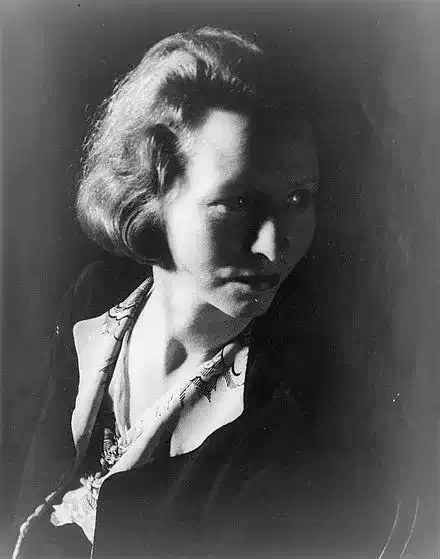
Edna St. Vincent Millay
The Fawn
There it was I saw what I shall never forget
And never retrieve.
Monstrous and beautiful to human eyes, hard to
believe,
He lay, yet there he lay,
Asleep on the moss, his head on his polished cleft
small ebony hoves,
The child of the doe, the dappled child of the deer.
Surely his mother had never said, "Lie here
Till I return," so spotty and plain to see
On the green moss lay he.
His eyes had opened; he considered me.
I would have given more than I care to say
To thrifty ears, might I have had him for my friend
One moment only of that forest day:
Might I have had the acceptance, not the love
Of those clear eyes;
Might I have been for him in the bough above
Or the root beneath his forest bed,
A part of the forest, seen without surprise.
Was it alarm, or was it the wind of my fear lest he
depart
That jerked him to his jointy knees,
And sent him crashing off, leaping and stumbling
On his new legs, between the stems of the white
trees?
390

Matsuo Bashō
The squid seller's call
The squid seller's call
mingles with the voice
of the cuckoo.
Translated by Robert Hass
mingles with the voice
of the cuckoo.
Translated by Robert Hass
391

William Butler Yeats
Two Songs of a Fool
I
A speckled cat and a tame hare
Eat at my hearthstone
And seep there;
And both look up to me alone
For learning and defence
As I look up to Providence.
I start out of my sleep to think
Some day I may forget
Their food and drink;
Or, the house door left unshut,
The hare may run till it's found
The horn's sweet note and the tooth of the hound.
I bear a burden that might well try
Men that do all by rule,
And what can I
That am a wandering-witted fool
But pray to God that He ease
My great responsibilities?
II
I slept on my three-leged stool by the fire,
The speckled cat slept on my knee;
We never thought to enquire
Where the brown hare might be,
And whether the door were shut.
Who knows how she drank the wind
Stretched up on two legs from the mat,
Before she had settled her mind
To drum with her heel and to leap?
Had I but awakened from sleep
And called her name, she had heard,
It may be, and not have stirred,
That now, it may be, has found
The horn's sweet note and the tooth of the hound.
390
Wallace Stevens
Continual Conversation With A Silent Man
The old brown hen and the old blue sky,
Between the two we live and die--
The broken cartwheel on the hill.
As if, in the presence of the sea,
We dried our nets and mended sail
And talked of never-ending things,
Of the never-ending storm of will,
One will and many wills, and the wind,
Of many meanings in the leaves,
Brought down to one below the eaves,
Link, of that tempest, to the farm,
The chain of the turquoise hen and sky
And the wheel that broke as the cart went by.
It is not a voice that is under the eaves.
It is not speech, the sound we hear
In this conversation, but the sound
Of things and their motion: the other man,
A turquoise monster moving round.
388
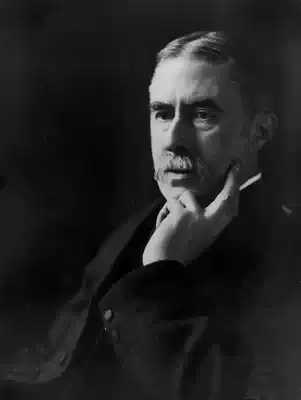
Alfred Edward Housman
The Grizzly Bear
The Grizzly Bear is huge and wild
It has devoured the little child.
The little child is unaware
It has been eaten by the bear.
It has devoured the little child.
The little child is unaware
It has been eaten by the bear.
389
Henry Wadsworth Longfellow
Moods
Oh that a Song would sing itself to me
Out of the heart of Nature, or the heart
Of man, the child of Nature, not of Art,
Fresh as the morning, salt as the salt sea,
With just enough of bitterness to be
A medicine to this sluggish mood, and start
The life-blood in my veins, and so impart
Healing and help in this dull lethargy!
Alas! not always doth the breath of song
Breathe on us. It is like the wind that bloweth
At its own will, not ours, nor tarrieth long;
We hear the sound thereof, but no man knoweth
From whence it comes, so sudden and swift and strong,
Nor whither in its wayward course it goeth.
385
Johann Wolfgang von Goethe
The Same
HUSH'D on the hill
Is the breeze;
Scarce by the zephyr
The trees
Softly are press'd;
The woodbird's asleep on the bough.
Wait, then, and thou
Soon wilt find rest.
Is the breeze;
Scarce by the zephyr
The trees
Softly are press'd;
The woodbird's asleep on the bough.
Wait, then, and thou
Soon wilt find rest.
385

Robert Frost
The Span Of Life
The old dog barks backwards without getting up.
I can remember when he was a pup.
Anonymous submission.
I can remember when he was a pup.
Anonymous submission.
386
Carl Sandburg
Haunts
There are places I go when I am strong.
One is a marsh pool where I used to go
with a long-ear hound-dog.
One is a wild crabapple tree; I was there
a moonlight night with a girl.
The dog is gone; the girl is gone; I go to these
places when there is no other place to go.
One is a marsh pool where I used to go
with a long-ear hound-dog.
One is a wild crabapple tree; I was there
a moonlight night with a girl.
The dog is gone; the girl is gone; I go to these
places when there is no other place to go.
385

Emily Dickinson
Of all the Sounds despatched abroad
Of all the Sounds despatched abroad,
There's not a Charge to me
Like that old measure in the Boughs-
That phraseless Melody-
The Wind does-working like a Hand,
Whose fingers Comb the Sky-
Then quiver down-with tufts of Tune-
Permitted Gods, and me-
Inheritance, it is, to us-
Beyond the Art to Earn-
Beyond the trait to take away
By Robber, since the Gain
Is gotten not of fingers-
And inner than the Bone-
Hid golden, for the whole of Days,
And even in the Urn,
I cannot vouch the merry Dust
Do not arise and play
In some odd fashion of its own,
Some quainter Holiday,
When Winds go round and round in Bands-
And thrum upon the door,
And Birds take places, overhead,
To bear them Orchestra.
I crave Him grace of Summer Boughs,
If such an Outcast be-
Who never heard that fleshless ChantRise-
solemn-on the Tree,
As if some Caravan of Sound
Off Deserts, in the Sky,
Had parted Rank,
Then knit, and swept-
In Seamless Company-
384
John Clare
The Fox
The shepherd on his journey heard when nigh
His dog among the bushes barking high;
The ploughman ran and gave a hearty shout,
He found a weary fox and beat him out.
The ploughman laughed and would have ploughed him in
But the old shepherd took him for the skin.
He lay upon the furrow stretched for dead,
The old dog lay and licked the wounds that bled,
The ploughman beat him till his ribs would crack,
And then the shepherd slung him at his back;
And when he rested, to his dog's surprise,
The old fox started from his dead disguise;
And while the dog lay panting in the sedge
He up and snapt and bolted through the hedge.
He scampered to the bushes far away;
The shepherd called the ploughman to the fray;
The ploughman wished he had a gun to shoot.
The old dog barked and followed the pursuit.
The shepherd threw his hook and tottered past;
The ploughman ran but none could go so fast;
The woodman threw his faggot from the way
And ceased to chop and wondered at the fray.
But when he saw the dog and heard the cry
He threw his hatchet--but the fox was bye.
The shepherd broke his hook and lost the skin;
He found a badger hole and bolted in.
They tried to dig, but, safe from danger's way,
He lived to chase the hounds another day.
386