
Animals and Nature

Robert W. Service
The Parson's Son
This is the song of the parson's son, as he squats in his shack alone,
On the wild, weird nights, when the Northern Lights shoot up from the frozen zone,
And it's sixty below, and couched in the snow the hungry huskies moan:
"I'm one of the Arctic brotherhood, I'm an old-time pioneer.
I came with the first -- O God! how I've cursed this Yukon -- but still I'm here.
I've sweated athirst in its summer heat, I've frozen and starved in its cold;
I've followed my dreams by its thousand streams, I've toiled and moiled for its gold.
"Look at my eyes -- been snow-blind twice; look where my foot's half gone;
And that gruesome scar on my left cheek, where the frost-fiend bit to the bone.
Each one a brand of this devil's land, where I've played and I've lost the game,
A broken wreck with a craze for `hooch', and never a cent to my name.
"This mining is only a gamble; the worst is as good as the best;
I was in with the bunch and I might have come out right on top with the rest;
With Cormack, Ladue and Macdonald -- O God! but it's hell to think
Of the thousands and thousands I've squandered on cards and women and drink.
"In the early days we were just a few, and we hunted and fished around,
Nor dreamt by our lonely camp-fires of the wealth that lay under the ground.
We traded in skins and whiskey, and I've often slept under the shade
Of that lone birch tree on Bonanza, where the first big find was made.
"We were just like a great big family, and every man had his squaw,
And we lived such a wild, free, fearless life beyond the pale of the law;
Till sudden there came a whisper, and it maddened us every man,
And I got in on Bonanza before the big rush began.
"Oh, those Dawson days, and the sin and the blaze, and the town all open wide!
(If God made me in His likeness, sure He let the devil inside.)
But we all were mad, both the good and the bad, and as for the women, well --
No spot on the map in so short a space has hustled more souls to hell.
"Money was just like dirt there, easy to get and to spend.
I was all caked in on a dance-hall jade, but she shook me in the end.
It put me queer, and for near a year I never drew sober breath,
Till I found myself in the bughouse ward with a claim staked out on death.
"Twenty years in the Yukon, struggling along its creeks;
Roaming its giant valleys, scaling its god-like peaks;
Bathed in its fiery sunsets, fighting its fiendish cold --
Twenty years in the Yukon . . . twenty years -- and I'm old.
"Old and weak, but no matter, there's `hooch' in the bottle still.
I'll hitch up the dogs to-morrow, and mush down the trail to Bill.
It's so long dark, and I'm lonesome -- I'll just lay down on the bed;
To-morrow I'll go . . . to-morrow . . . I guess I'll play on the red.
". . . Come, Kit, your pony is saddled. I'm waiting, dear, in the court . . .
. . . Minnie, you devil, I'll kill you if you skip with that flossy sport . . .
. . . How much does it go to the pan, Bill? . . . play up, School, and play the game . . .
. . . Our Father, which art in heaven, hallowed be Thy name . . ."
This was the song of the parson's son, as he lay in his bunk alone,
Ere the fire went out and the cold crept in, and his blue lips ceased to moan,
And the hunger-maddened malamutes had torn him flesh from bone.
244

Emily Dickinson
Morning—is the place for Dew
Morning—is the place for Dew—
Corn—is made at Noon—
After dinner light—for flowers—
Dukes—for Setting Sun!
Corn—is made at Noon—
After dinner light—for flowers—
Dukes—for Setting Sun!
243
Robert W. Service
Allouette
Singing larks I saw for sale (
Ah! the pain of it)
Plucked and ready to impale
On a roasting spit;
Happy larks that summer-long
Stormed the radiant sky,
Adoration in their song . . .
Packed to make a pie.>
Hark! from springs of joy unseen
Spray their jewelled notes.
Tangle them in nets of green,
Twist their lyric throats;
Clip their wings and string them tight,
Stab them with a skewer,
All to tempt the apptite
Of the epicure.
Shade of Shelley! Come not nigh
This accursèd spot,
Where for sixpence one can buy
Skylarks for the pot;
Dante, paint a blacker hell,
Plunge in deeper darks
Wretches who can slay and sell
Sunny-hearted larks.
You who eat, you are the worst:
By internal pains,
May you ever be accurst
Who pluck these poor remains.
But for you wingèd joy would soar
To heaven from the sod:
In ecstasy a lark would pour
Its gratitude to God.
243

Thomas Hardy
Postponement
SNOW-BOUND in woodland, a mournful word,
Dropt now and then from the bill of a bird,
Reached me on wind-wafts; and thus I heard,
Wearily waiting:--
"I planned her a nest in a leafless tree,
But the passers eyed and twitted me,
And said: 'How reckless a bird is he,
Cheerily mating!'
"Fear-filled, I stayed me till summer-tide,
In lewth of leaves to throne her bride;
But alas! her love for me waned and died,
Wearily waiting.
"Ah, had I been like some I see,
Born to an evergreen nesting-tree,
None had eyed and twitted me,
Cheerily mating!"
245

Jonathan Swift
Elegy Upon Tiger
Her dead lady's joy and comfort,
Who departed this life
The last day of March, 1727:
To the great joy of Bryan
That his antagonist is gone.
And is poor Tiger laid at last so low?
O day of sorrow! -Day of dismal woe!
Bloodhounds, or spaniels, lap-dogs, 'tis all one,
When Death once whistles -snap! -away they're gone.
See how she lies, and hangs her lifeless ears,
Bathed in her mournful lady's tears!
Dumb is her throat, and wagless is her tail,
Doomed to the grave, to Death's eternal jail!
In a few days this lovely creature must
First turn to clay, and then be changed to dust.
That mouth which used its lady's mouth to lick
Must yield its jaw-bones to the worms to pick.
That mouth which used the partridge-wing to eat
Must give its palate to the worms to eat.
Methinks I see her now in Charon's boat
Bark at the Stygian fish which round it float;
While Cerberus, alarmed to hear the sound,
Makes Hell's wide concave bellow all around.
She sees him not, but hears him through the dark,
And valiantly returns him bark for bark.
But now she trembles -though a ghost, she dreads
To see a dog with three large yawning heads.
Spare her, you hell-hounds, case your frightful paws,
And let poor Tiger 'scape your furious jaws.
Let her go safe to the Elysian plains,
Where Hylax barks among the Mantuan swains;
There let her frisk about her new-found love:
She loved a dog when she was here above.
The Epitaph
Here lies beneath this marble
An animal could bark, or warble:
Sometimes a bitch, sometimes a bird,
Could eat a tart, or eat a t -.
245

Anonymous
May in the Green-Wood
IN somer when the shawes be sheyne,
And leves be large and long,
Hit is full merry in feyre foreste
To here the foulys song.
To se the dere draw to the dale
And leve the hilles hee,
And shadow him in the leves grene
Under the green-wode tree.
Hit befell on Whitsontide
Early in a May mornyng,
The Sonne up faire can shyne,
And the briddis mery can syng.
'This is a mery mornyng,' said Litulle Johne,
'Be Hym that dyed on tre;
A more mery man than I am one
Lyves not in Christiante.
'Pluk up thi hert, my dere mayster,'
Litulle Johne can say,
'And thynk hit is a fulle fayre tyme
In a mornynge of May.'
244

James Whitcomb Riley
Knee-Deep in June
Tell you what I like the best -'
Long about knee-deep in June,
'Bout the time strawberries melts
On the vine, -- some afternoon
Like to jes' git out and rest,
And not work at nothin' else!
Orchard's where I'd ruther be -Needn't
fence it in fer me! --
Jes' the whole sky overhead,
And the whole airth underneath --
Sort o' so's a man kin breathe
Like he ort, and kind o' has
Elbow-room to keerlessly
Sprawl out len'thways on the grass
Where the shadders thick and soft
As the kivvers on the bed
Mother fixes in the loft
Allus, when they's company!
Jes' a-sort o' lazin there S'lazy,
'at you peek and peer
Through the wavin' leaves above,
Like a feller 'ats in love
And don't know it, ner don't keer!
Ever'thing you hear and see
Got some sort o' interest -
Maybe find a bluebird's nest
Tucked up there conveenently
Fer the boy 'at's ap' to be
Up some other apple tree!
Watch the swallers skootin' past
Bout as peert as you could ast;
Er the Bob-white raise and whiz
Where some other's whistle is.
Ketch a shadder down below,
And look up to find the crow --
Er a hawk, - away up there,
'Pearantly froze in the air! --
Hear the old hen squawk, and squat
Over ever' chick she's got,
Suddent-like! - and she knows where
That-air hawk is, well as you! --
You jes' bet yer life she do! --
Eyes a-glitterin' like glass,
Waitin' till he makes a pass!
Pee-wees wingin', to express
My opinion, 's second-class,
Yit you'll hear 'em more er less;
Sapsucks gittin' down to biz,
Weedin' out the lonesomeness;
Mr. Bluejay, full o' sass,
In them baseball clothes o' his,
Sportin' round the orchad jes'
Like he owned the premises!
Sun out in the fields kin sizz,
But flat on yer back, I guess,
In the shade's where glory is!
That's jes' what I'd like to do
Stiddy fer a year er two!
Plague! Ef they ain't somepin' in
Work 'at kind o' goes ag'in'
My convictions! - 'long about
Here in June especially! --
Under some ole apple tree,
Jes' a-restin through and through,
I could git along without
Nothin' else at all to do
Only jes' a-wishin' you
Wuz a-gittin' there like me,
And June wuz eternity!
Lay out there and try to see
Jes' how lazy you kin be! --
Tumble round and souse yer head
In the clover-bloom, er pull
Yer straw hat acrost yer eyes
And peek through it at the skies,
Thinkin' of old chums 'ats dead,
Maybe, smilin' back at you
In betwixt the beautiful
Clouds o'gold and white and blue! --
Month a man kin railly love --
June, you know, I'm talkin' of!
March ain't never nothin' new! -April's
altogether too
Brash fer me! and May -- I jes'
'Bominate its promises, --
Little hints o' sunshine and
Green around the timber-land --
A few blossoms, and a few
Chip-birds, and a sprout er two, --
Drap asleep, and it turns in
Fore daylight and snows ag'in! --
But when June comes - Clear my th'oat
With wild honey! -- Rench my hair
In the dew! And hold my coat!
Whoop out loud! And th'ow my hat! --
June wants me, and I'm to spare!
Spread them shadders anywhere,
I'll get down and waller there,
And obleeged to you at that!
241

Christina Rossetti
I Caught A Little Ladybird
I caught a little ladybird
That flies far away;
I caught a little lady wife
That is both staid and gay.
Come back, my scarlet ladybird,
Back from far away;
I weary of my dolly wife,
My wife that cannot play.
That flies far away;
I caught a little lady wife
That is both staid and gay.
Come back, my scarlet ladybird,
Back from far away;
I weary of my dolly wife,
My wife that cannot play.
242
Thomas Hardy
No Buyers
A Load of brushes and baskets and cradles and chairs
Labours along the street in the rain:
With it a man, a woman, a pony with whiteybrown hairs. --
The man foots in front of the horse with a shambling sway
At a slower tread than a funeral train,
While to a dirge-like tune he chants his wares,
Swinging a Turk's-head brush (in a drum-major's way
When the bandsmen march and play).
A yard from the back of the man is the whiteybrown pony's nose:
He mirrors his master in every item of pace and pose:
He stops when the man stops, without being told,
And seems to be eased by a pause; too plainly he's old,
Indeed, not strength enough shows
To steer the disjointed waggon straight,
Which wriggles left and right in a rambling line,
Deflected thus by its own warp and weight,
And pushing the pony with it in each incline.
The woman walks on the pavement verge,
Parallel to the man:
She wears an apron white and wide in span,
And carries a like Turk's-head, but more in nursing-wise:
Now and then she joins in his dirge,
But as if her thoughts were on distant things,
The rain clams her apron till it clings. --
So, step by step, they move with their merchandize,
And nobody buys.
243
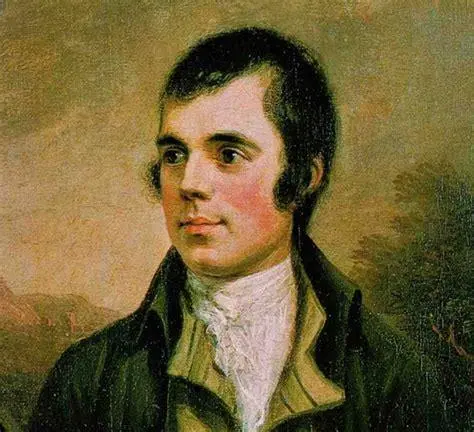
Robert Burns
Poor Mailie's Elegy
Lament in rhyme, lament in prose,
Wi' saut tears tricklin down your nose;
Our bardie's fate is at a close,
Past a' remead!
The last, sad cape-stane o' his woes;
Poor Mailie's dead!
It's no the loss o' warl's gear,
That could sae bitter draw the tear,
Or mak our bardie, dowie, wear
The mourning weed:
He's lost a friend an' neebor dear
In Mailie dead.
Thro' a' the town she trotted by him;
A lang half-mile she could descry him;
Wi kindly bleat, when she did spy him,
She ran wi' speed:
A friend mair faithfu' ne'er cam nigh him,
Than Mailie dead.
I wat she was a sheep o' sense,
An' could behave hersel' wi' mense:
I'll say't, she never brak a fence,
Thro' thievish greed.
Our bardie, lanely, keeps the spence
Sin' Mailie's dead.
Or, if he wanders up the howe,
Her livin image in her yowe
Comes bleating till him, owre the knowe,
For bits o' bread;
An' down the briny pearls rowe
For Mailie dead.
She was nae get o' moorland tips,
Wi' tauted ket, an' hairy hips;
For her forbears were brought in ships,
Frae 'yont the Tweed.
A bonier fleesh ne'er cross'd the clips
Than Mailie's dead.
Wae worth the man wha first did shape
That vile, wanchancie thing - a raip!
It maks guid fellows girn an' gape,
Wi' chokin dread;
An' Robin's bonnet wave wi' crape
For Mailie dead.
O, a' ye bards on bonie Doon!
An' wha on Ayr your chanters tune!
Come, join the melancholious croon
O' Robin's reed!
His heart will never get aboon -
His Mailie's dead!
242

Billy Collins
Walking Across The Atlantic
I wait for the holiday crowd to clear the beach
before stepping onto the first wave.
Soon I am walking across the Atlantic
thinking about Spain,
checking for whales, waterspouts.
I feel the water holding up my shifting weight.
Tonight I will sleep on its rocking surface.
But for now I try to imagine what
this must look like to the fish below,
the bottoms of my feet appearing, disappearing.
240

D.H. Lawrence
Baby Tortoise
You know what it is to be born alone,
Baby tortoise!
The first day to heave your feet little by little from the shell,
Not yet awake,
And remain lapsed on earth,
Not quite alive.
A tiny, fragile, half-animate bean.
To open your tiny beak-mouth, that looks as if it would never open,
Like some iron door;
To lift the upper hawk-beak from the lower base
And reach your skinny little neck
And take your first bite at some dim bit of herbage,
Alone, small insect,
Tiny bright-eye,
Slow one.
To take your first solitary bite
And move on your slow, solitary hunt.
Your bright, dark little eye,
Your eye of a dark disturbed night,
Under its slow lid, tiny baby tortoise,
So indomitable.
No one ever heard you complain.
You draw your head forward, slowly, from your little wimple
And set forward, slow-dragging, on your four-pinned toes, Rowing slowly forward.
Whither away, small bird?
Rather like a baby working its limbs,
Except that you make slow, ageless progress
And a baby makes none.
The touch of sun excites you,
And the long ages, and the lingering chill
Make you pause to yawn,
Opening your impervious mouth,
Suddenly beak-shaped, and very wide, like some suddenly gaping pincers;
Soft red tongue, and hard thin gums,
Then close the wedge of your little mountain front,
Your face, baby tortoise.
Do you wonder at the world, as slowly you turn your head in its wimple
And look with laconic, black eyes?
Or is sleep coming over you again,
The non-life?
You are so hard to wake.
Are you able to wonder?
Or is it just your indomitable will and pride of the first life
Looking round
And slowly pitching itself against the inertia
Which had seemed invincible?
The vast inanimate,
And the fine brilliance of your so tiny eye,
Challenger.
Nay, tiny shell-bird,
What a huge vast inanimate it is, that you must row against,
What an incalculable inertia.
Challenger,
Little Ulysses, fore-runner,
No bigger than my thumb-nail,
Buon viaggio.
All animate creation on your shoulder,
Set forth, little Titan, under your battle-shield.
The ponderous, preponderate,
Inanimate universe;
And you are slowly moving, pioneer, you alone.
How vivid your travelling seems now, in the troubled sunshine,
Stoic, Ulyssean atom;
Suddenly hasty, reckless, on high toes.
Voiceless little bird,
Resting your head half out of your wimple
In the slow dignity of your eternal pause.
Alone, with no sense of being alone,
And hence six times more solitary;
Fulfilled of the slow passion of pitching through immemorial ages
Your little round house in the midst of chaos.
Over the garden earth,
Small bird,
Over the edge of all things.
Traveller,
With your tail tucked a little on one side
Like a gentleman in a long-skirted coat.
All life carried on your shoulder,
Invincible fore-runner.
240
Horácio
BkI:XVII The Delights of the Country
Swift Faunus, the god, will quite often exchange
Arcady for my sweet Mount Lucretilis,
and while he stays he protects my goats
from the midday heat and the driving rain.
The wandering wives of the rank he-goats search,
with impunity, through the safe woodland groves,
for the hidden arbutus, and thyme,
and their kids don’t fear green poisonous snakes,
or the wolf of Mars, my lovely Tyndaris,
once my Mount Ustica’s long sloping valleys,
and its smooth worn rocks, have re-echoed
to the music of sweet divine piping.
The gods protect me: my love and devotion,
and my Muse, are dear to the gods. Here the rich
wealth of the countryside’s beauties will
flow for you, now, from the horn of plenty.
Here you’ll escape from the heat of the dog-star,
in secluded valleys, sing of bright Circe,
labouring over the Teian lyre,
and of Penelope: both loved one man.
Here you’ll bring cups of innocent Lesbian
wine, under the shade, nor will Semele’s son,
that Bacchus, battle it out with Mars,
nor shall you fear the intemperate hands
of insolent Cyrus, jealously watching,
to possess you, girl, unequal to evil,
to tear off the garland that clings to
your hair, or tear off your innocent clothes.
239
Christina Rossetti
A Summer Wish
Live all thy sweet life through,
Sweet Rose, dew-sprent,
Drop down thine evening dew
To gather it anew
When day is bright:
I fancy thou wast meant
Chiefly to give delight.
Sing in the silent sky,
Glad soaring bird;
Sing out thy notes on high
To sunbeam straying by
Or passing cloud;
Heedless if thou art heard
Sing thy full song aloud.
Oh that it were with me
As with the flower;
Blooming on its own tree
For butterfly and bee
Its summer morns:
That I might bloom mine hour
A rose in spite of thorns.
Oh that my work were done
As birds' that soar
Rejoicing in the sun:
That when my time is run
And daylight too,
I so might rest once more
Cool with refreshing dew.
240
Robert W. Service
Mike
My lead dog Mike was like a bear;
I reckon he was grizzly bred,
For when he reared up in the air
Ho over-topped me by a head.
He'd cuff me with his hefty paws,
Jest like a puppy actin' cute,
And I would swear: by Gosh! he was
The world's most mighty malemute.
But oh the grub that dog could eat!
Yet he was never belly-tight;
It almost broke me buying meat
To satisfy his appetite.
Then came a change I wondered at:
Returning when the dawn was dim,
He seemed mysteriously fat,
And scorned the bones I'd saved for him.
My shack was near the hospital,
Wherein there laboured Nurse Louise,
Who was to me a little pal
I planned in every way to please.
As books and sweets for her I bought,
My mug she seemed to kindo' like;
But Mike - he loved her quite a lot,
And she was very fond of Mike.
Strolling with her as moonlight gleamed,
I saw a strand of cotton trail
From Mike, the which unseemly seemed
To have its source behind his tail.
I trod on it with chagrin grim,
And with a kick his absence urged;
But as he ran, from out of him
Such yards and yards of lint emerged.
And then on me the truth did dawn
Beyond the shadow of a doubt:
That poor dam dog was gorged upon
The poultices threw out. . . .
So "love my dog love me," I thought,
And seized the moment to propose . . .
Mike's dead, but in our garden lot
He's manure for a big dog-rose.
241
Christina Rossetti
O Sailor, Come Ashore
O sailor, come ashore,
What have you brought for me?
Red coral, white coral,
Coral from the sea.
I did not dig it from the ground,
Nor pluck it from a tree;
Feeble insects made it
In the stormy sea.
What have you brought for me?
Red coral, white coral,
Coral from the sea.
I did not dig it from the ground,
Nor pluck it from a tree;
Feeble insects made it
In the stormy sea.
238
D.H. Lawrence
A Passing Bell
Mournfully to and fro, to and fro the trees are waving;
What did you say, my dear?
The rain-bruised leaves are suddenly shaken, as a child
Asleep still shakes in the clutch of a sob—
Yes, my love, I hear.
One lonely bell, one only, the storm-tossed afternoon is braving,
Why not let it ring?
The roses lean down when they hear it, the tender, mild
Flowers of the bleeding-heart fall to the throb—
It is such a little thing!
A wet bird walks on the lawn, call to the boy to come and look,
Yes, it is over now.
Call to him out of the silence, call him to see
The starling shaking its head as it walks in the grass—
Ah, who knows how?
He cannot see it, I can never show it him, how it shook—
Don’t disturb him, darling.
—Its head as it walked: I can never call him to me,
Never, he is not, whatever shall come to pass.
No, look at the wet starling.
237

Mao Tsé-Tung
Winter clouds
Winter clouds snow-laden, cotton fluff flying,
None or few the unfallen flowers.
Chill waves sweep through steep skies,
Yet earth's gentle breath grows warm.
Only heroes can quell tigers and leopards
And wild bears never daunt the brave.
Plum blossoms welcome the whirling snow;
Small wonder flies freeze and perish.
None or few the unfallen flowers.
Chill waves sweep through steep skies,
Yet earth's gentle breath grows warm.
Only heroes can quell tigers and leopards
And wild bears never daunt the brave.
Plum blossoms welcome the whirling snow;
Small wonder flies freeze and perish.
238
Robert W. Service
Trixie
Dogs have a sense beyond our ken -
At least my little Trixie had:
Tail-wagging when I laughed, and when
I sighed, eyes luminously sad.
And if I planned to go away,
She'd know, oh, days and days before:
Aye, dogs I think are sometimes fey,
They seem to sense our fate in store.
Now take the case of old Tome Low;
With flowers each week he'd call on me.
Dear Trixie used to love him so,
With joyous jump upon his knee.
Yet when he wandered in one day,
Her hair grew sudden stark with dread;
She growled, she howled, she ran away . . .
Well, ten hours later Tom was dead.
Aye, dogs hear sounds we cannot hear,
And dogs see sights we cannot see;
And that is why I took the fear
That one day she would glare at me
As if a Shape cowered on my bead,
And with each hair on end she'd creep
Beneath the couch and whine with dread . . .
And so I've had her put to sleep.
Now Trixie's gone, the only one
Who loved me in my lonely life,
And here I wait, my race nigh run,
My ill too grievous for the knife.
My hand of ice she'll never lick,
My heedless mask she'll never see:
No heartbreak - just a needle prick. . . .
Oh, Doctor, do the same for me!
239
Horácio
BkIII:XXV Bacchanalian Song
Where are you taking me, Bacchus,
now I’m full of you? To what caves or groves, driven,
swiftly, by new inspiration?
In what caverns will I be heard planning to set
illustrious Caesar’s lasting
glory among the stars, in the councils of Jove?
I’ll sing a recent achievement,
not yet sung by other lips. So does the sleepless
Bacchante, stand in amazement
on a mountain-ridge, gazing at Hebrus, at Thrace,
shining with snow, at Rhodope,
trodden by barbarous feet, even as I like
to wander gazing, at river
banks, and echoing groves. O master of Naiads,
of Bacchae owning the power
to uproot the tallest ash-trees, with their bare hands,
I’ll sing nothing trivial, no
humble measure, nothing that dies. O, Lenaeus,
the danger of following a god
is sweet, wreathing my brow with green leaves of the vine.
237
Anonymous
Bah, Bah, Black Sheep
Bah, bah, black sheep,
Have you any wool?
Yes, marry have I,
Three bags full;
One for my master,
One for my dame,
But none for the little boy
Who cries in the lane.
Have you any wool?
Yes, marry have I,
Three bags full;
One for my master,
One for my dame,
But none for the little boy
Who cries in the lane.
237
Robert W. Service
Pantheist
Lolling on a bank of thyme
Drunk with Spring I made this rhyme. . . .
Though peoples perish in defeat,
And races suffer to survive,
The sunshine never was so sweet,
So vast he joy to be alive;
The laughing leaves, the glowing grass
Proclaim how good it is to be;
The pines are lyric as I pass,
The hills hosannas sing to me.
Pink roses ring yon placid palm,
Soft shines the blossom of the peach;
The sapphire sea is satin calm,
With bell-like tinkle on the beach;
A lizard lazes in the sun,
A bee is bumbling to my hand;
Shy breezes whisper: "You are one
With us because you understand."
Yea, I am one with all I see,
With wind and wave, with pine and palm;
Their very elements in me
Are fused to make me what I am.
Through me their common life-stream flows,
And when I yield this human breath,
In leaf and blossom, bud and rose,
Live on I will . . . There is no Death.
Oh, let me flee from woeful things,
And listen to the linnet's song;
To solitude my spirit clings,
To sunny woodlands I belong.
O foolish men! Yourselves destroy.
But I from pain would win surcease. . . .
O Earth, grant me eternal joy!
O Nature - everlasting peace!
Amen.
235

Henry Lawson
Reedy River
Ten miles down Reedy River
A pool of water lies,
And all the year it mirrors
The changes in the skies,
And in that pool's broad bosom
Is room for all the stars;
Its bed of sand has drifted
O'er countless rocky bars.
Around the lower edges
There waves a bed of reeds,
Where water rats are hidden
And where the wild duck breeds;
And grassy slopes rise gently
To ridges long and low,
Where groves of wattle flourish
And native bluebells grow.
Beneath the granite ridges
The eye may just discern
Where Rocky Creek emerges
From deep green banks of fern;
And standing tall between them,
The grassy she-oaks cool
The hard, blue-tinted waters
Before they reach the pool.
Ten miles down Reedy River
One Sunday afternoon,
I rode with Mary Campbell
To that broad, bright lagoon;
We left our horses grazing
Till shadows climbed the peak,
And strolled beneath the she-oaks
On the banks of Rocky Creek.
Then home along the river
That night we rode a race,
And the moonlight lent a glory
To Mary Campbell's face;
And I pleaded for our future
All through that moonlight ride,
Until our weary horses
Drew closer side by side.
Ten miles from Ryan's Crossing
And five miles below the peak,
I built a little homestead
On the banks of Rocky Creek;
I cleared the land and fenced it
And ploughed the rich, red loam,
And my first crop was golden
When I brought my Mary home.
Now still down Reedy River
The grassy she-oaks sigh,
And the water-holes still mirror
The pictures in the sky;
And over all for ever
Go sun and moon and stars,
While the golden sand is drifting
Across the rocky bars
But of the hut I builded
There are no traces now.
And many rains have levelled
The furrows of the plough;
And my bright days are olden,
For the twisted branches wave
And the wattle blossoms golden
On the hill by Mary's grave.
233
Thomas Hardy
Winter in Durnover Field
Scene.--A wide stretch of fallow ground recently sown with wheat, and
frozen to iron hardness. Three large birds walking about thereon,
and wistfully eyeing the surface. Wind keen from north-east: sky a
dull grey.
(Triolet)
Rook.--Throughout the field I find no grain;
The cruel frost encrusts the cornland!
Starling.--Aye: patient pecking now is vain
Throughout the field, I find . . .
Rook.--No grain!
Pigeon.--Nor will be, comrade, till it rain,
Or genial thawings loose the lorn land
Throughout the field.
Rook.--I find no grain:
The cruel frost encrusts the cornland!
233