
Work and Profession

Carl Sandburg
'Boes
I waited today for a freight train to pass.
Cattle cars with steers butting their horns against the
bars, went by.
And a half a dozen hoboes stood on bumpers between
cars.
Well, the cattle are respectable, I thought.
Every steer has its transportation paid for by the farmer
sending it to market,
While the hoboes are law-breakers in riding a railroad
train without a ticket.
It reminded me of ten days I spent in the Allegheny
County jail in Pittsburgh.
I got ten days even though I was a veteran of the
Spanish-American war.
Cooped in the same cell with me was an old man, a
bricklayer and a booze-fighter.
But it just happened he, too, was a veteran soldier, and
he had fought to preserve the Union and free the
niggers.
We were three in all, the other being a Lithuanian who
got drunk on pay day at the steel works and got to
fighting a policeman;
All the clothes he had was a shirt, pants and shoes-somebody
got his hat and coat and what money he
had left over when he got drunk.
383

Ella Wheeler Wilcox
Idler's Song
I sit in the twilight dim
At the close of an idle day,
And I list to the soft sweet hymn,
That rises far away,
And dies on the evening air.
Oh, all day long,
They sing their song,
Who toil in the valley there.
But never a song sing I,
Sitting with folded hands,
The hours pass me by Dropping
their golden sands -
And I list, from day to day,
To the 'tick, tick, tock'
Of the old brown clock,
Ticking my life away.
And I see the twilight fade,
And I see the night come on,
And then, in the gloom and shade,
I weep for the day that's gone -
Weep and wail in pain,
For the misspent day
That has flown away,
And will not come again.
Another morning beams,
And I forget the last,
And I sit in idle dreams
Till the day over - past.
Oh, the toiler's heart is glad!
When the day is gone
And the night comes on,
But mine is sore and sad.
For I dare not look behind!
No shining, golden sheaves
Can I ever hope to find:
Nothing but withered leaves.
Ah! dreams are very sweet!
But will not please
If only these
I lay at the Master's feet.
And what will the Master say
To dreams and nothing more?
Oh, idler, all the day!
Think, ere thy life is o'er!
And when the day grows late,
Oh, soul of sin!
Will He let you in,
There at the pearly gate?
Oh, idle heart, beware!
On, to the field of strife!
On, to the valley there!
And live a useful life!
Up, do not wait a day!
For the old brown clock,
With its 'tick, tick, tock, '
Is ticking your life away.
382

John Clare
Merry Maid
Bonny and stout and brown, without a hat,
She frowns offended when they call her fat--
Yet fat she is, the merriest in the place,
And all can know she wears a pretty face.
But still she never heeds what praise can say,
But does the work, and oft runs out to play,
To run about the yard and ramp and noise
And spring the mop upon the servant boys.
When old hens noise and cackle every where
She hurries eager if the eggs are dear,
And runs to seek them when they lay away
To get them ready for the market day.
She gambols with the men and laughs aloud
And only quarrels when they call her proud.
377
Ella Wheeler Wilcox
Where Are The Temperance People? In Reply To A Query
Where are the temperance people?
Well, scattered here and there:
Some gathering in their produce
To show at the autumn fair;
Some threshing wheat for market,
And others threshing rye,
That will go to the fat distiller
For whiskey by-and-by.
And some are selling their hop crops
At a first-rate price, this year,
And the seller pockets the money,
While the drunkard swallows the beer.
And some 'staunch temperance workers'(?)
Who'd do anything for the cause,
Save to give it a dime or a moment,
Or work for temperance laws,
May be seen from now to election,
Near any tavern stand
Where liquor flows in plenty,
With a voter on either hand.
And these temperance office-seekers
That we hear of far and near
Are the ones who furnish the money
That buys the lager-beer.
But these are only the black sheep
Who want the temperance name
Without living up to the precepts,
And so bring themselves to shame.
And the true, brave temperance people,
Who have the cause at heart,
Are doing the work that's nearest,
Each his allotted part:
Some lifting the fallen drunkard,
Some preaching unto men,
Some aiding the cause with money,
And others with the pen.
Each has a different mission,
Each works in a different way,
But their works shall melt together
In one grand result, some day.
And one, our chief (God bless him),
Is working day and night:
With his sword of burning eloquence,
He is fighting the noble fight.
Whether in lodge or convention,
Whether at home or abroad,
He is reaping a golden harvest
To lay at the feet of God.
Where are the temperance people?
All scattered here and there,
Sowing the seeds of righteous deeds,
That the harvest may be fair.
379

Nazim Hikmet
Our Eyes
Our eyes
are limpid
drops of water.
In each drop exists
a tiny sign
of our genius
which has given life to cold iron.
Our eyes
are limpid
drops of water
merged absolutely in the Ocean
that you could hardly recognize
the drop in a block of ice
in a boiling pan.
The masterpiece of these eyes
the fulfillment of their genius
the living iron.
In these eyes
filled with limpid
pure tears
had failed to emerge
from the infinite Ocean
if the strength
had dispersed,
we could never have mated
the dynamo with the turbine,
never have moved
those steel mountains in water
easily
as if made of hollow wood.
The masterpiece of these eyes
the fulfillment of their genius
of our unified labour
the living iron.
Translated by Taner Baybars
are limpid
drops of water.
In each drop exists
a tiny sign
of our genius
which has given life to cold iron.
Our eyes
are limpid
drops of water
merged absolutely in the Ocean
that you could hardly recognize
the drop in a block of ice
in a boiling pan.
The masterpiece of these eyes
the fulfillment of their genius
the living iron.
In these eyes
filled with limpid
pure tears
had failed to emerge
from the infinite Ocean
if the strength
had dispersed,
we could never have mated
the dynamo with the turbine,
never have moved
those steel mountains in water
easily
as if made of hollow wood.
The masterpiece of these eyes
the fulfillment of their genius
of our unified labour
the living iron.
Translated by Taner Baybars
377
Ella Wheeler Wilcox
Death Of Labour
Methought a great wind swept across the earth,
And all the toilers perished. Then I saw
Pale terror blanch the rosy face of mirth,
And careless eyes grow full of fear and awe.
The sounds of pleasure ceased; the laughing song
On folly's lip changed to an angry cures:
A nameless horror seized the idle throng,
And death and ruin filled the universe.
378
Carl Sandburg
The Noon Hour
She sits in the dust at the walls
And makes cigars,
Bending at the bench
With fingers wage-anxious,
Changing her sweat for the day’s pay.
Now the noon hour has come,
And she leans with her bare arms
On the window-sill over the river,
Leans and feels at her throat
Cool-moving things out of the free open ways:
At her throat and eyes and nostrils
The touch and the blowing cool
Of great free ways beyond the walls.
373
Carl Sandburg
The Shovel Man
On the street
Slung on his shoulder is a handle half way across,
Tied in a big knot on the scoop of cast iron
Are the overalls faded from sun and rain in the ditches;
Spatter of dry clay sticking yellow on his left sleeve
And a flimsy shirt open at the throat,
I know him for a shovel man,
A dago working for a dollar six bits a day
And a dark-eyed woman in the old country dreams of
him for one of the world's ready men with a pair
of fresh lips and a kiss better than all the wild
grapes that ever grew in Tuscany.
373
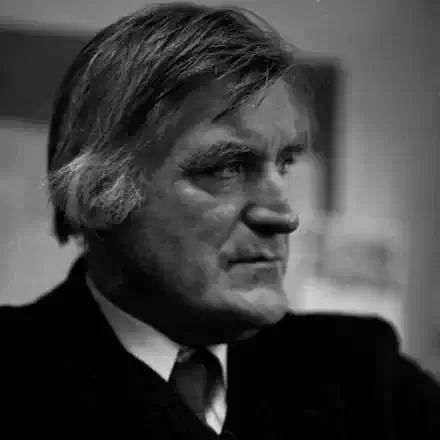
Ted Hughes
Work and Play
The swallow of summer, she toils all the summer,
A blue-dark knot of glittering voltage,
A whiplash swimmer, a fish of the air.
But the serpent of cars that crawls through the dust
In shimmering exhaust
Searching to slake
Its fever in ocean
Will play and be idle or else it will bust.
The swallow of summer, the barbed harpoon,
She flings from the furnace, a rainbow of purples,
Dips her glow in the pond and is perfect.
But the serpent of cars that collapsed on the beach
Disgorges its organs
A scamper of colours
Which roll like tomatoes
Nude as tomatoes
With sand in their creases
To cringe in the sparkle of rollers and screech.
The swallow of summer, the seamstress of summer,
She scissors the blue into shapes and she sews it,
She draws a long thread and she knots it at the corners.
But the holiday people
Are laid out like wounded
Flat as in ovens
Roasting and basting
With faces of torment as space burns them blue
Their heads are transistors
Their teeth grit on sand grains
Their lost kids are squalling
While man-eating flies
Jab electric shock needles but what can they do?
They can climb in their cars with raw bodies, raw faces
And start up the serpent
And headache it homeward
A car full of squabbles
And sobbing and stickiness
With sand in their crannies
Inhaling petroleum
That pours from the foxgloves
While the evening swallow
The swallow of summer, cartwheeling through crimson,
Touches the honey-slow river and turning
Returns to the hand stretched from under the eaves -
A boomerang of rejoicing shadow.
374

Johann Wolfgang von Goethe
Hermann And Dorothea - III. Thalia
THE BURGHERS.
THUS did the prudent son escape from the hot conversation,
But the father continued precisely as he had begun it
What is not in a man can never come out of him, surely!
Never, I fear, shall I see fulfill'd my dearest of wishes,
That my son should be unlike his father, but better.
What would be the fate of a house or a town, if its inmates
Did not all take pride in preserving, renewing, improving,
As we are taught by the age, and by the wisdom of strangers?
Man is not born to spring out of the ground, just like a mere mushroom,
And to rot away soon in the very place that produced him!
Leaving behind him no trace of what he has done in his lifetime.
One can judge by the look of a house of the taste of its master,
As on ent'ring a town, one can judge the authorities' fitness.
For where the towers and walls are falling, where in the ditches
Dirt is collected, and dirt in every street is seen lying,
Where the stones come out of their groove, and are not replaced there,
Where the beams are rotting, and vainly the houses are waiting
New supports; that town is sure to be wretchedly managed.
For where order and cleanliness reign not supreme in high places,
Then to dirt and delay the citizens soon get accustom'd,
Just as the beggar's accustom'd to wear his cloths full of tatters.
Therefore I often have wish'd that Hermann would start on his travels
Ere he's much older, and visit at any rate Strasburg and Frankfort,
And that pleasant town, Mannheim, so evenly built and so cheerful.
He who has seen such large and cleanly cities rests never
Till his own native town, however small, he sees better'd.
Do not all strangers who visit us praise our well-mended gateways,
And the well-whited tower, the church so neatly repair'd too?
Do not all praise our pavements? Our well-arranged cover'd-in conduits,
Always well furnish'd with water, utility blending with safety,
So that a fire, whenever it happens, is straightway extinguish'd,--
Is not this the result of that conflagration so dreadful?
Six times in Council I superintended the town's works, receiving
Hearty thanks and assistance from every well-disposed burgher.
How I design'd, follow'd up, and ensured the completion of measures
Worthy men had projected, and afterwards left all unfinish'd!
Finally, every man in the Council took pleasure in working.
All put forth their exertions, and now they have finally settled
That new highway to make, which will join our town with the main road.
But I am greatly afraid that the young generation won't act thus;
Some on the one hand think only of pleasure and trumpery dresses,
Others wont stir out of doors, and pass all their time by the fireside,
And our Hermann, I fear, will always be one of this last sort.'
Forthwith to him replied the excellent sensible mother
'Father, you're always unjust whenever you speak of your son, and
That is the least likely way to obtain your wishes' fulfillment,
For we cannot fashion our children after our fancy.
We must have them and love them, as God has given them to us,
Bring them up for the best, and let each do as he listeth.
One has one kind of gift, another possesses another,
Each one employs them, and each in turn in his separate fashion
Good and happy becomes. My Hermann shall not be upbraided,
For I know that he well deserves the wealth he'll inherit;
He'll be an excellent landlord, a pattern to burghers and peasants,
And, as I clearly foresee, by no means the last in the Council.
But with your blame and reproaches, you daily dishearten him sadly,
As you have done just now, and make the poor fellow unhappy.'
Then she left the apartment, and after her son hasten'd quickly,
Hoping somewhere to find him, and with her words of affection
Gladden his heart, for he, the excellent son, well deserved it.
Smilingly, when she had closed the door, continued the father
'What a wonderful race of people are women and children.
All of them fain would do whatever pleases their fancy,
And we're only alow'd to praise them and flatter them freely.
Once for all there's truth in the ancient proverb which tells us:
He who moves not forward, goes backward! a capital saying!'
Speaking with much circumspection, the druggist made answer as follows
'What you say, good neighbour, is certainly true, and my plan is
Always to think of improvement, provided tho' new, 'tis not costly.
But what avails it in truth, unless one has plenty of money,
Active and fussy to he, improving both inside and outside?
Sadly confined are the means of a burgher; e'en when he knows it,
Little that's good he is able to do, his purse is too narrow,
And the sum wanted too great; and so he is always prevented.
I have had plenty of schemes! but then I was terribly frighten'd
At the expense, especially during a time of such danger.
Long had my house smiled upon me, decked out in modish exterior,
Long had my windows with large panes of glass resplendently glitterd.
Who can compete with a merchant, however, who, rolling in riches,
Also knows the manner in which what is best can be purchased?
Only look at the house up yonder, the new one: how handsome
Looks the stucco of those white scrolls on the green-colour'd panels!
Large are the plates of the windows--how shining and brilliant the panes are,
Quite eclipsing the rest of the houses that stand in the market!
Yet at the time of the fire, our two were by far the most handsome,
Mine at the sign of the Angel, and yours at the old Golden Lion.
Then my garden was famous throughout the whole country, and strangers
Used to stop as they pass'd and peep through my red-colourd palings
At my beggars of stone, and at my dwarfs, which were painted,
He to whom I gave coffee inside my beautiful grotto,
Which, alas! is now cover'd with dust and tumbling to pieces,
Used to rejoice in the colour'd glimmering light of the mussels,
Ranged in natural order around it, and connoisseurs even
Used with dazzled eyes to gaze at the spars and the coral.
Then, in the drawing-room, people look'd with delight on the painting,
Where the prim ladies and gentlemen walked in the garden demurely,
And with pointed fingers presented the flowers, and held them.
Ah, if only such things were now to be seen! Little care I
Now to go out; for everything needs to be alter'd and tasteful,
As it is call'd; and white are the benches of wood and the palings;
All things are simple and plain; and neither carving not gilding
Now are employ'd, and foreign timber is now all the fashion.
I should be only too pleased to possess some novelty also,
So as to march with the times, and my household furniture alter.
But we all are afraid to make the least alteration,
For who is able to pay the present charges of workmen?
Lately a fancy possess'd me, the angel Michael, whose figure
Hangs up over my shop, to treat to a new coat of gilding,
And the terrible Dragon, who round his feet is entwining;
But I have left him all brown; as he is; for the cost quite alarm'd me.'
370
Carl Sandburg
Manual System
Mary has a thingamajig clamped on her ears
And sits all day taking plugs out and sticking plugs in.
Flashes and flashes--voies and voices
calling for ears to put words in
Faces at the ends of wires asking for other faces
at the ends of other wires:
All day taking plugs out and sticking plugs in,
Mary has a thingamajig clamped on her ears.
And sits all day taking plugs out and sticking plugs in.
Flashes and flashes--voies and voices
calling for ears to put words in
Faces at the ends of wires asking for other faces
at the ends of other wires:
All day taking plugs out and sticking plugs in,
Mary has a thingamajig clamped on her ears.
370
Carl Sandburg
To Certain Journeymen
Undertakers, hearse drivers, grave diggers,
I speak to you as one not afraid of your business.
You handle dust going to a long country,
You know the secret behind your job is the same whether
you lower the coffin with modern, automatic machinery,
well-oiled and noiseless, or whether the
body is laid in by naked hands and then covered
by the shovels.
Your day's work is done with laughter many days of the year,
And you earn a living by those who say good-by today
in thin whispers.
367
John Clare
From The Parish: A Satire
I
In politics and politicians' lies
The modern farmer waxes wondrous wise;
Opinionates with wisdom all compact,
And een could tell a nation how to act;
Throws light on darkness with excessive skill,
Knows who acts well and whose designs are ill,
Proves half the members nought but bribery's tools,
And calls the past a dull dark age of fools.
As wise as Solomon they read the news,
Not with their blind forefathers' simple views,
Who read of wars, and wished that wars would cease,
And blessed the King, and wished his country peace;
Who marked the weight of each fat sheep and ox,
The price of grain and rise and fall of stocks;
Who thought it learning how to buy and sell,
And him a wise man who could manage well.
No, not with such old-fashioned, idle views
Do these newsmongers traffic with the news.
They read of politics and not of grain,
And speechify and comment and explain,
And know so much of Parliament and state
You'd think they're members when you heard them prate;
And know so little of their farms the while
They can but urge a wiser man to smile.
II
A thing all consequence here takes the lead,
Reigning knight-errant oer this dirty breed--
A bailiff he, and who so great to brag
Of law and all its terrors as Bumtagg;
Fawning a puppy at his master's side
And frowning like a wolf on all beside;
Who fattens best where sorrow worst appears
And feeds on sad misfortune's bitterest tears?
Such is Bumtagg the bailiff to a hair,
The worshipper and demon of despair,
Who waits and hopes and wishes for success
At every nod and signal of distress,
Happy at heart, when storms begin to boil,
To seek the shipwreck and to share the spoil.
Brave is this Bumtagg, match him if you can;
For there's none like him living--save his man.
As every animal assists his kind
Just so are these in blood and business joined;
Yet both in different colours hide their art,
And each as suits his ends transacts his part.
One keeps the heart-bred villain full in sight,
The other cants and acts the hypocrite,
Smoothing the deed where law sharks set their gin
Like a coy dog to draw misfortune in.
But both will chuckle oer their prisoners' sighs
And are as blest as spiders over flies.
Such is Bumtagg, whose history I resign,
As other knaves wait room to stink and shine;
And, as the meanest knave a dog can brag,
Such is the lurcher that assists Bumtagg.
366
Carl Sandburg
Bricklayer Love
I thought of killing myself because I am only a bricklayer
and you a woman who loves the man who runs a drug store.
I don't care like I used to; I lay bricks straighter than I
used to and I sing slower handling the trowel afternoons.
When the sun is in my eyes and the ladders are shaky and the
mortar boards go wrong, I think of you.
and you a woman who loves the man who runs a drug store.
I don't care like I used to; I lay bricks straighter than I
used to and I sing slower handling the trowel afternoons.
When the sun is in my eyes and the ladders are shaky and the
mortar boards go wrong, I think of you.
366

John Greenleaf Whittier
The Shoemakers
Ho! workers of the old time styled
The Gentle Craft of Leather!
Young brothers of the ancient guild,
Stand forth once more together!
Call out again your long array,
In the olden merry manner!
Once more, on gay St. Crispin's day,
Fling out your blazoned banner!
Rap, rap! upon the well-worn stone
How falls the polished hammer!
Rap, rap! the measured sound has grown
A quick and merry clamor.
Now shape the sole! now deftly curl
The glossy vamp around it,
And bless the while the bright-eyed girl
Whose gentle fingers bound it!
For you, along the Spanish main
A hundred keels are ploughing;
For you, the Indian on the plain
His lasso-coil is throwing;
For you, deep glens with hemlock dark
The woodman's fire is lighting;
For you, upon the oak's gray bark,
The woodman's axe is smiting.
For you, from Carolina's pine
The rosin-gum is stealing;
For you, the dark-eyed Florentine
Her silken skein is reeling;
For you, the dizzy goatherd roams
His rugged Alpine ledges;
For you, round all her shepherd homes,
Bloom England's thorny hedges.
The foremost still, by day or night,
On moated mound or heather,
Whete'er the need of trampled right
Brought toiling men together;
Where the free burghers from the wall
Defied the mail-clad master,
Than yours, at Freedom's trumpet-call,
No craftsmen rallied faster.
Let foplings sneer, let fools deride,
Ye heed no idle scorner;
Free hands and hearts are still your pride,
And duty done, your honor.
Ye dare to trust, for honest fame,
The jury Time empanels,
And leave to truth each noble name
Which glorifies your annals.
Thy songs, Han Sachs, are living yet,
In strong and hearty German;
And Bloomfield's lay, and Gifford's wit,
And patriot fame of Sherman;
Still from his book, a mystic seer,
The soul of Behmen teaches,
And England's priestcraft shakes to hear
Of Fox's leathern breeches.
The foot is yours; where'er it falls,
It treads your well-wrought leather,
On earthen floor, in marble halls,
On carpet, or on heather.
Still there the sweetest charm is found
Of matron grace or vestal's,
As Hebe's foot bore nectar round
Among the old celestials!
Rap, rap! — your stout and bluff brogan,
With footsteps slow and weary,
May wander where the sky's blue span
Shuts down upon the prairie.
On Beauty's foot your slippers glance,
By Saratoga's fountains,
Or twinkle down the summer dance
Beneath the Crystal Mountains!
The red brick to the mason's hand,
The brown earth to the tiller's,
The shoe in yours shall wealth command,
Like fairy Cinderella's!
As they who shunned the household maid
Beheld the crown upon her,
So all shall see your toil repaid
With hearth and home and honor.
Then let the toast be freely quaffed,
In water cool and brimming,
'All honor to the good old Craft,
Its merry men and women!'
Call out again your long array,
In the old time's pleasant manner:
Once more, on gay St. Crispin's day,
Fling out his blazoned banner!
358

Ogden Nash
Introspective Reflection
I would live all my life in nonchalance and insouciance
Were it not for making a living, which is rather a nouciance.
Were it not for making a living, which is rather a nouciance.
356
Carl Sandburg
Plowboy
After the last red sunset glimmer,
Black on the line of a low hill rise,
Formed into moving shadows, I saw
A plowboy and two horses lined against the gray,
Plowing in the dusk the last furrow.
The turf had a gleam of brown,
And smell of soil was in the air,
And, cool and moist, a haze of April.
I shall remember you long,
Plowboy and horses against the sky in shadow.
I shall remember you and the picture
You made for me,
Turning the turf in the dusk
And haze of an April gloaming.
355
Carl Sandburg
Ice Handler
I know an ice handler who wears a flannel shirt with pearl buttons the size of a dollar,
And he lugs a hundred-pound hunk into a saloon ice-box, helps himself to cold ham
and rye bread,
Tells the bartender it’s hotter than yesterday and will be hotter yet to-morrow, by
Jesus,
And is on his way with his head in the air and a hard pair of fists.
He spends a dollar or so every Saturday night on a two hundred pound woman who
washes dishes in the Hotel Morrison.
He remembers when the union was organized he broke the noses of two scabs and
loosened the nuts so the wheels came off six different wagons one morning, and he
came around and watched the ice melt in the street.
All he was sorry for was one of the scabs bit him on the knuckles of the right hand so
they bled when he came around to the saloon to tell the boys about it.
350

Jonathan Swift
The Author Upon Himself
By an old ——pursued,
A crazy prelate, and a royal prude;
By dull divines, who look with envious eyes
On ev'ry genius that attempts to rise;
And pausing o'er a pipe, with doubtful nod,
Give hints, that poets ne'er believe in God.
So clowns on scholars as on wizards look,
And take a folio for a conj'ring book.
Swift had the sin of wit, no venial crime:
Nay, 'twas affirm'd, he sometimes dealt in rhyme;
Humour and mirth had place in all he writ;
He reconcil'd divinity and wit:
He moved and bow'd, and talk'd with too much grace;
Nor show'd the parson in his gait or face;
Despised luxurious wines and costly meat;
Yet still was at the tables of the great;
Frequented lords; saw those that saw the queen;
At Child's or Truby's, never once had been;
Where town and country vicars flock in tribes,
Secured by numbers from the laymen's gibes;
And deal in vices of the graver sort,
Tobacco, censure, coffee, pride, and port.
But, after sage monitions from his friends,
His talents to employ for nobler ends;
To better judgments willing to submit,
He turns to politics his dang'rous wit.
And now, the public Int'rest to support,
By Harley Swift invited, comes to court;
In favour grows with ministers of state;
Admitted private, when superiors wait:
And Harley, not ashamed his choice to own,
Takes him to Windsor in his coach alone.
At Windsor Swift no sooner can appear,
But St. John comes, and whispers in his ear:
The waiters stand in ranks: the yeomen cry,
Make room, as if a duke were passing by.
Now Finch alarms the lords: he hears for certain
This dang'rous priest is got behind the curtain.
Finch, famed for tedious elocution, proves
That Swift oils many a spring which Harley moves.
Walpole and Aislaby, to clear the doubt,
Inform the Commons, that the secret's out:
'A certain doctor is observed of late
To haunt a certain minister of state:
From whence with half an eye we may discover
The peace is made, and Perkin must come over.'
York is from Lambeth sent, to show the queen
A dang'rous treatise writ against the spleen;
Which, by the style, the matter, and the drift,
'Tis thought could be the work of none but Swift.
Poor York! the harmless tool of others' hate;
He sues for pardon, and repents too late.
Now angry Somerset her vengeance vows
On Swift's reproaches for her ******* spouse:
From her red locks her mouth with venom fills,
And thence into the royal ear instils.
The queen incensed, his services forgot,
Leaves him a victim to the vengeful Scot.
Now through the realm a proclamation spread,
To fix a price on his devoted head.
While innocent, he scorns ignoble flight;
His watchful friends preserve him by a sleight.
By Harley's favour once again he shines;
Is now caress'd by candidate divines,
Who change opinions with the changing scene:
Lord! how were they mistaken in the dean!
Now Delawar again familiar grows;
And in Swift's ear thrusts half his powder'd nose.
The Scottish nation, whom he durst offend,
Again apply that Swift would be their friend.
By faction tired, with grief he waits awhile,
His great contending friends to reconcile;
Performs what friendship, justice, truth require:
What could he more, but decently retire?
351

Henry Wadsworth Longfellow
The Village Blacksmith
Under a spreading chestnut tree
The village smithy stands;
The smith, a might man is he,
With large and sinewy hands;
And the muscles of his brawney arms
Are strong as iron bands.
His hair is crisp, and black, and long,
His face is like the tan;
His brow is wet with honest sweat,
He earns what'er he can,
And looks the whole word in the face,
For he owes not any man.
Week in, week out, from morn till night,
You can hear the bellows blow;
You can hear him swing his might sledge,
With measure beat and slow,
Like a sexton ringing the village bell,
When the evening sun is low.
And children coming home from school
Look in the open door;
They love to see the flaming forge,
And hear the bellows roar.
And catch the flaming sparks that fly
Like chaff from a threshing floor.
He goes on Sunday to the church,
And sits among his boys;
He hears the parson pray and preach,
He hears his daughter's voice,
Singing in the choir,
And it makes his heart rejoice.
It sounds to him like his mother's voice,
Singing in Paradise!
He needs must think of her once more,
How in the grave she lies;
And with his hard, rough hands he wipes
A tear out of his eyes.
Toiing, -- rejoicing, -- sorrowing,
Onward in life he goes;
Each morning sees some task begin,
Each evening sees it close;
Something attempted, something done,
Has earned his night's repose.
Thanks, thanks to thee, my worthy friend,
For the lesson thou has taught!
Thus at the flaming forge of life
Our fortunes must be wrought;
Thus on its sounding anvil shaped
Each burning deed and thought.
349

Robert Louis Stevenson
Come, Here Is Adieu To The City
COME, here is adieu to the city
And hurrah for the country again.
The broad road lies before me
Watered with last night's rain.
The timbered country woos me
With many a high and bough;
And again in the shining fallows
The ploughman follows the plough.
The whole year's sweat and study,
And the whole year's sowing time,
Comes now to the perfect harvest,
And ripens now into rhyme.
For we that sow in the Autumn,
We reap our grain in the Spring,
And we that go sowing and weeping
Return to reap and sing.
348
John Clare
The Shepherd's Calendar - October
Nature now spreads around in dreary hue
A pall to cover all that summer knew
Yet in the poets solitary way
Some pleasing objects for his praise delay
Somthing that makes him pause and turn again
As every trifle will his eye detain
The free horse rustling through the stubble land
And bawling herd boy with his motly band
Of hogs and sheep and cows who feed their fill
Oer cleard fields rambling where so ere they will
The geese flock gabbling in the splashy fields
And quaking ducks in pondweeds half conseald
Or seeking worms along the homclose sward
Right glad of freedom from the prison yard
While every cart rut dribbles its low tide
And every hollow splashing sports provide
The hedger stopping gaps wi pointed bough
Made by intruding horse and blundering cow
The milk maid tripping on her morning way
And fodderers oft tho early cutting hay
Dropping the littering forkfulls from his back
Side where the thorn fence circles round the stack
The cotter journying wi his noisev swine
Along the wood side where the brambles twine
Shaking from dinted cups the acorns brown
And from the hedges red awes dashing down
And nutters rustling in the yellow woods
Scaring from their snug lairs the pheasant broods
And squirrels secret toils oer winter dreams
Picking the brown nuts from the yellow beams
And hunters from the thickets avenue
In scarlet jackets startling on the view
Skiming a moment oer the russet plain
Then hiding in the colord woods again
The ploping guns sharp momentary shock
Which eccho bustles from her cave to mock
The sticking groups in many a ragged set
Brushing the woods their harmless loads to get
And gipseys camps in some snug shelterd nook
Where old lane hedges like the pasture brook
Run crooking as they will by wood and dell
In such lone spots these wild wood roamers dwell
On commons where no farmers claims appear
Nor tyrant justice rides to interfere
Such the abodes neath hedge or spreading oak
And but discovered by its curling smoak
Puffing and peeping up as wills the breeze
Between the branches of the colord trees
Such are the pictures that october yields
To please the poet as he walks the fields
Oft dames in faded cloak of red or grey
Loiters along the mornings dripping way
Wi wicker basket on their witherd arms
Searching the hedges of home close or farms
Where brashy elder trees to autum fade
Each cotters mossy hut and garden shade
Whose glossy berrys picturesquly weaves
Their swathy bunches mid the yellow leaves
Where the pert sparrow stains his little bill
And tutling robin picks his meals at will
Black ripening to the wan suns misty ray
Here the industrious huswives wend their way
Pulling the brittle branches carefull down
And hawking loads of berrys to the town
Wi unpretending skill yet half divine
To press and make their eldern berry wine
That bottld up becomes a rousing charm
To kindle winters icy bosom warm
That wi its merry partner nut brown beer
Makes up the peasants christmass keeping cheer
While nature like fair woman in decay
Which pale consumption hourly wastes away
Upon her waining features pale and chill
Wears dreams of beauty that seem lovely still
Among the heath furze still delights to dwell
Quaking as if with cold the harvest bell
The mushroom buttons each moist morning brings
Like spots of snow in the green tawney rings
And fuzz balls swelld like bladders in the grass
Which oft the merry laughing milking lass
Will stoop to gather in her sportive airs
And slive in mimickd fondness unawares
To smut the brown cheek of the teazing swain
Wi the black powder which their balls contain
Who feigns offence at first that love may speed
Then charms a kiss to recompence the deed
The flying clouds urged on in swiftest pace
Like living things as if they runned a race
The winds that oer each coming tempest broods
Waking like spirits in their startling moods
Fluttering the sear leaves on the blasting lea
That litters under every fading tree
And pausing oft as falls the pattering rain
Then gathering strength and twirling them again
The startld stockdove hurried wizzing bye
As the still hawk hangs oer him in the sky
Crows from the oak trees qawking as they spring
Dashing the acorns down wi beating wing
Waking the woodlands sleep in noises low
Pattring on crimpt brakes withering brown below
While from their hollow nest the squirrels (pop)
Adown the tree to pick them as they drop
The starnel crowds that dim the muddy light
The crows and jackdaws flapping home at night
And puddock circling round its lazy flight
Round the wild sweeing wood in motion slow
Before it perches on the oaks below
And hugh black beetles revelling alone
In the dull evening with their heavy drone
Buzzing from barn door straw and hovel sides
Where fodderd cattle from the night abides
These pictures linger thro the shortning day
And cheer the lone bards mellancholy way
And now and then a solitary boy
Journeying and muttering oer his dreams of joy
346

Claude Mckay
Dawn in New York
The Dawn! The Dawn! The crimson-tinted, comes
Out of the low still skies, over the hills,
Manhattan's roofs and spires and cheerless domes!
The Dawn! My spirit to its spirit thrills.
Almost the mighty city is asleep,
No pushing crowd, no tramping, tramping feet.
But here and there a few cars groaning creep
Along, above, and underneath the street,
Bearing their strangely-ghostly burdens by,
The women and the men of garish nights,
Their eyes wine-weakened and their clothes awry,
Grotesques beneath the strong electric lights.
The shadows wane. The Dawn comes to New York.
And I go darkly-rebel to my work.
338
Carl Sandburg
The Hangman at Home
What does a hangman think about
When he goes home at night from work?
When he sits down with his wife and
Children for a cup of coffee and a
Plate of ham and eggs, do they ask
Him if it was a good day's work
And everything went well or do they
Stay off some topics and kill about
The weather, baseball, politics
And the comic strips in the papers
And the movies? Do they look at his
Hands when he reaches for the coffee
Or the ham and eggs? If the little
Ones say, Daddy, play horse, here's
A rope--does he answer like a joke:
I seen enough rope for today?
Or does his face light up like a
Bonfire of joy and does he say:
It's a good and dandy world we live
'In. And if a white face moon looks
In through a window where a baby girl
Sleeps and the moon-gleams mix with
Baby ears and baby hair--the hangman--
How does he act then? It must be easy
For him. Anything is easy for a hangman,
I guess.
340