Poems List

Goliath Of Gath

Goliath Of Gath
SAMUEL, Chap. xvii.
YE martial pow'rs, and all ye tuneful nine,
Inspire my song, and aid my high design.
The dreadful scenes and toils of war I write,
The ardent warriors, and the fields of fight:
You best remember, and you best can sing
The acts of heroes to the vocal string:
Resume the lays with which your sacred lyre,
Did then the poet and the sage inspire.
Now front to front the armies were display'd,
Here Israel rang'd, and there the foes array'd;
The hosts on two opposing mountains stood,
Thick as the foliage of the waving wood;
Between them an extensive valley lay,
O'er which the gleaming armour pour'd the day,
When from the camp of the Philistine foes,
Dreadful to view, a mighty warrior rose;
In the dire deeds of bleeding battle skill'd,
The monster stalks the terror of the field.
From Gath he sprung, Goliath was his name,
Of fierce deportment, and gigantic frame:
A brazen helmet on his head was plac'd,
A coat of mail his form terrific grac'd,
The greaves his legs, the targe his shoulders prest:
Dreadful in arms high-tow'ring o'er the rest
A spear he proudly wav'd, whose iron head,
Strange to relate, six hundred shekels weigh'd;
He strode along, and shook the ample field,
While Phoebus blaz'd refulgent on his shield:
Through Jacob's race a chilling horror ran,
When thus the huge, enormous chief began:
"Say, what the cause that in this proud array
"You set your battle in the face of day?
"One hero find in all your vaunting train,
"Then see who loses, and who wins the plain;
"For he who wins, in triumph may demand
"Perpetual service from the vanquish'd land:
"Your armies I defy, your force despise,
"By far inferior in Philistia's eyes:
"Produce a man, and let us try the fight,
"Decide the contest, and the victor's right."
Thus challeng'd he: all Israel stood amaz'd,
And ev'ry chief in consternation gaz'd;
But Jesse's son in youthful bloom appears,
And warlike courage far beyond his years:
He left the folds, he left the flow'ry meads,
And soft recesses of the sylvan shades.
Now Israel's monarch, and his troops arise,
With peals of shouts ascending to the skies;
In Elah's vale the scene of combat lies.
When the fair morning blush'd with orient red,


What David's fire enjoin'd the son obey'd,
And swift of foot towards the trench he came,
Where glow'd each bosom with the martial flame.
He leaves his carriage to another's care,
And runs to greet his brethren of the war.
While yet they spake the giant-chief arose,
Repeats the challenge, and insults his foes:
Struck with the sound, and trembling at the view,
Affrighted Israel from its post withdrew.
"Observe ye this tremendous foe, they cry'd,
"Who in proud vaunts our armies hath defy'd:
"Whoever lays him prostrate on the plain,
"Freedom in Israel for his house shall gain;
"And on him wealth unknown the king will pour,
"And give his royal daughter for his dow'r."
Then Jesse's youngest hope: "My brethren say,
"What shall be done for him who takes away
"Reproach from Jacob, who destroys the chief.
"And puts a period to his country's grief.
"He vaunts the honours of his arms abroad,
"And scorns the armies of the living God."
Thus spoke the youth, th' attentive people ey'd
The wond'rous hero, and again reply'd:
"Such the rewards our monarch will bestow,
"On him who conquers, and destroys his foe."
Eliab heard, and kindled into ire
To hear his shepherd brother thus inquire,
And thus begun: "What errand brought thee? say
"Who keeps thy flock? or does it go astray?
"I know the base ambition of thine heart,
"But back in safety from the field depart."
Eliab thus to Jesse's youngest heir,
Express'd his wrath in accents most severe.
When to his brother mildly he reply'd.
"What have I done? or what the cause to chide?
The words were told before the king, who sent
For the young hero to his royal tent:
Before the monarch dauntless he began,
"For this Philistine fail no heart of man:
"I'll take the vale, and with the giant fight:
"I dread not all his boasts, nor all his might."
When thus the king: "Dar'st thou a stripling go,
"And venture combat with so great a foe?
"Who all his days has been inur'd to fight,
"And made its deeds his study and delight:
"Battles and bloodshed brought the monster forth,
"And clouds and whirlwinds usher'd in his birth."
When David thus: "I kept the fleecy care,
"And out there rush'd a lion and a bear;
"A tender lamb the hungry lion took,
"And with no other weapon than my crook
"Bold I pursu'd, and chas d him o'er the field,


"The prey deliver'd, and the felon kill'd:
"As thus the lion and the bear I slew,
"So shall Goliath fall, and all his crew:
"The God, who sav'd me from these beasts of prey,
"By me this monster in the dust shall lay."
So David spoke. The wond'ring king reply'd;
"Go thou with heav'n and victory on thy side:
"This coat of mail, this sword gird on," he said,
And plac'd a mighty helmet on his head:
The coat, the sword, the helm he laid aside,
Nor chose to venture with those arms untry'd,
Then took his staff, and to the neighb'ring brook
Instant he ran, and thence five pebbles took.
Mean time descended to Philistia's son
A radiant cherub, and he thus begun:
"Goliath, well thou know'st thou hast defy'd
"Yon Hebrew armies, and their God deny'd:
"Rebellious wretch! audacious worm! forbear,
"Nor tempt the vengeance of their God too far:
"Them, who with his Omnipotence contend,
"No eye shall pity, and no arm defend:
"Proud as thou art, in short liv'd glory great,
"I come to tell thee thine approaching fate.
"Regard my words. The Judge of all the gods,
"Beneath whose steps the tow'ring mountain nods,
"Will give thine armies to the savage brood,
"That cut the liquid air, or range the wood.
"Thee too a well-aim'd pebble shall destroy,
"And thou shalt perish by a beardless boy:
"Such is the mandate from the realms above,
"And should I try the vengeance to remove,
"Myself a rebel to my king would prove.
"Goliath say, shall grace to him be shown,
"Who dares heav'ns Monarch, and insults his throne?"
"Your words are lost on me," the giant cries,
While fear and wrath contended in his eyes,
When thus the messenger from heav'n replies:
"Provoke no more Jehovah's awful hand
"To hurl its vengeance on thy guilty land:
"He grasps the thunder, and, he wings the storm,
"Servants their sov'reign's orders to perform."
The angel spoke, and turn'd his eyes away,
Adding new radiance to the rising day.
Now David comes: the fatal stones demand
His left, the staff engag'd his better hand:
The giant mov'd, and from his tow'ring height
Survey'd the stripling, and disdain'd the fight,
And thus began: "Am I a dog with thee?
"Bring'st thou no armour, but a staff to me?
"The gods on thee their vollied curses pour,
"And beasts and birds of prey thy flesh devour."
David undaunted thus, "Thy spear and shield


"Shall no protection to thy body yield:
"Jehovah's name------no other arms I bear,
"I ask no other in this glorious war.
"To-day the Lord of Hosts to me will give
"Vict'ry, to-day thy doom thou shalt receive;
"The fate you threaten shall your own become,
"And beasts shall be your animated tomb,
"That all the earth's inhabitants may know
"That there's a God, who governs all below:
"This great assembly too shall witness stand,
"That needs nor sword, nor spear, th' Almighty's
hand:
"The battle his, the conquest he bestows,
"And to our pow'r consigns our hated foes."
Thus David spoke; Goliath heard and came
To meet the hero in the field of fame.
Ah! fatal meeting to thy troops and thee,
But thou wast deaf to the divine decree;
Young David meets thee, meets thee not in vain;
'Tis thine to perish on th' ensanguin'd plain.
And now the youth the forceful pebble slung
Philistia trembled as it whizz'd along:
In his dread forehead, where the helmet ends,
Just o'er the brows the well-aim'd stone descends,
It pierc'd the skull, and shatter'd all the brain,
Prone on his face he tumbled to the plain:
Goliath's fall no smaller terror yields
Than riving thunders in aerial fields:
The soul still ling'red in its lov'd abode,
Till conq'ring David o'er the giant strode:
Goliath's sword then laid its master dead,
And from the body hew'd the ghastly head;
The blood in gushing torrents drench'd the plains,
The soul found passage through the spouting veins.
And now aloud th' illustrious victor said,
"Where are your boastings now your champion's
"dead?"
Scarce had he spoke, when the Philistines fled:
But fled in vain; the conqu'ror swift pursu'd:
What scenes of slaughter! and what seas of blood!
There Saul thy thousands grasp'd th' impurpled sand
In pangs of death the conquest of thine hand;
And David there were thy ten thousands laid:
Thus Israel's damsels musically play'd.
Near Gath and Edron many an hero lay,
Breath'd out their souls, and curs'd the light of day:
Their fury, quench'd by death, no longer burns,
And David with Goliath's head returns,
To Salem brought, but in his tent he plac'd
The load of armour which the giant grac'd.
His monarch saw him coming from the war,
And thus demanded of the son of Ner.


"Say, who is this amazing youth?" he cry'd,
When thus the leader of the host reply'd;
"As lives thy soul I know not whence he sprung,
"So great in prowess though in years so young:"
"Inquire whose son is he," the sov'reign said,
"Before whose conq'ring arm Philistia fled."
Before the king behold the stripling stand,
Goliath's head depending from his hand:
To him the king: "Say of what martial line
"Art thou, young hero, and what sire was thine?"
He humbly thus; "The son of Jesse I:
"I came the glories of the field to try.
"Small is my tribe, but valiant in the fight;
"Small is my city, but thy royal right."
"Then take the promis'd gifts," the monarch cry'd,
Conferring riches and the royal bride:
"Knit to my soul for ever thou remain
"With me, nor quit my regal roof again."
284

An Hymn To The Evening

An Hymn To The Evening
SOON as the sun forsook the eastern main
The pealing thunder shook the heav'nly plain;
Majestic grandeur! From the zephyr's wing,
Exhales the incense of the blooming spring.
Soft purl the streams, the birds renew their notes,
And through the air their mingled music floats.
Through all the heav'ns what beauteous dies are
spread!
But the west glories in the deepest red:
So may our breasts with ev'ry virtue glow,
The living temples of our God below!
Fill'd with the praise of him who gives the light,
And draws the sable curtains of the night,
Let placid slumbers sooth each weary mind,
At morn to wake more heav'nly, more refin'd;
So shall the labours of the day begin
More pure, more guarded from the snares of sin.
Night's leaden sceptre seals my drowsy eyes,
339

An Hymn to Humanity

An Hymn to Humanity
I.
Lo! for this dark terrestrial ball
Forsakes his azure-paved hall
A prince of heav'nly birth!
Divine Humanity behold,
What wonders rise, what charms unfold
At his descent to earth!
II.
The bosoms of the great and good
With wonder and delight he view'd,
And fix'd his empire there:
Him, close compressing to his breast,
The sire of gods and men address'd,
"My son, my heav'nly fair!
III.
"Descend to earth, there place thy throne;
"To succour man's afflicted son
"Each human heart inspire:
"To act in bounties unconfin'd
"Enlarge the close contracted mind,
"And fill it with thy fire."
IV.
Quick as the word, with swift career
He wings his course from star to star,
And leaves the bright abode.
The Virtue did his charms impart;
Their G-----! then thy raptur'd heart
Perceiv'd the rushing God:
V.
For when thy pitying eye did see
The languid muse in low degree,
Then, then at thy desire
Descended the celestial nine;
O'er me methought they deign'd to shine,
And deign'd to string my lyre.
VI.
Can Afric's muse forgetful prove?
Or can such friendship fail to move
A tender human heart?
Immortal Friendship laurel-crown'd
The smiling Graces all surround


With ev'ry heav'nly Art.
326

An Answer to the Rebus

An Answer to the Rebus
The poet asks, and Phillis can't refuse
To show th' obedience of the Infant muse.
She knows the Quail of most inviting taste
Fed Israel's army in the dreary waste;
And what's on Britain's royal standard borne,
But the tall, graceful, rampant Unicorn?
The Emerald with a vivid verdure glows
Among the gems which regal crowns compose;
Boston's a town, polite and debonair,
To which the beaux and beauteous nymphs repair,
Each Helen strikes the mind with sweet surprise,
While living lightning flashes from her eyes,
See young Euphorbus of the Dardan line
By Manelaus' hand to death resign:
The well known peer of popular applause
Is C----m zealous to support our laws.
Quebec now vanquish'd must obey,
She too much annual tribute pay
To Britain of immortal fame.
And add new glory to her name.
283

A Rebus

A Rebus
I.
A bird delicious to the taste,
On which an army once did feast,
Sent by an hand unseen;
A creature of the horned race,
Which Britain's royal standards grace;
A gem of vivid green;
II.
A town of gaiety and sport,
Where beaux and beauteous nymphs resort,
And gallantry doth reign;
A Dardan hero fam'd of old
For youth and beauty, as we're told,
And by a monarch slain;
III.
A peer of popular applause,
Who doth our violated laws,
And grievances proclaim.
Th' initials show a vanquish'd town,
That adds fresh glory and renown
To old Britannia's fame.
200

A Funeral Poem On The Death Of C. E. An Infant Of Twelve Months

A Funeral Poem On The Death Of C. E. An Infant Of Twelve Months
THROUGH airy roads he wings his instant flight
To purer regions of celestial light;
Enlarg'd he sees unnumber'd systems roll,
Beneath him sees the universal whole,
Planets on planets run their destin'd round,
And circling wonders fill the vast profound.
Th' ethereal now, and now th' empyreal skies
With growing splendors strike his wond'ring eyes:
The angels view him with delight unknown,
Press his soft hand, and seat him on his throne;
Then smilling thus: "To this divine abode,
"The seat of saints, of seraphs, and of God,
"Thrice welcome thou." The raptur'd babe replies,
"Thanks to my God, who snatch'd me to the skies,
"E'er vice triumphant had possess'd my heart,
"E'er yet the tempter had beguil d my heart,
"E'er yet on sin's base actions I was bent,
"E'er yet I knew temptation's dire intent;
"E'er yet the lash for horrid crimes I felt,
"E'er vanity had led my way to guilt,
"But, soon arriv'd at my celestial goal,
"Full glories rush on my expanding soul."
Joyful he spoke: exulting cherubs round
Clapt their glad wings, the heav'nly vaults resound.
Say, parents, why this unavailing moan?
Why heave your pensive bosoms with the groan?
To Charles, the happy subject of my song,
A brighter world, and nobler strains belong.
Say would you tear him from the realms above
By thoughtless wishes, and prepost'rous love?
Doth his felicity increase your pain?
Or could you welcome to this world again
The heir of bliss? with a superior air
Methinks he answers with a smile severe,
"Thrones and dominions cannot tempt me there."
But still you cry, "Can we the sigh borbear,
"And still and still must we not pour the tear?
"Our only hope, more dear than vital breath,
"Twelve moons revolv'd, becomes the prey of death;
"Delightful infant, nightly visions give
"Thee to our arms, and we with joy receive,
"We fain would clasp the Phantom to our breast,
"The Phantom flies, and leaves the soul unblest."
To yon bright regions let your faith ascend,
Prepare to join your dearest infant friend
In pleasures without measure, without end.
237

A Farewell to America

A Farewell to America
I.
Adieu, New-England's smiling meads,
Adieu, the flow'ry plain:
I leave thine op'ning charms, O spring,
And tempt the roaring main.
II.
In vain for me the flow'rets rise,
And boast their gaudy pride,
While here beneath the northern skies
I mourn for health deny'd.
III.
Celestial maid of rosy hue,
O let me feel thy reign!
I languish till thy face I view,
Thy vanish'd joys regain.
IV.
Susanna mourns, nor can I bear
To see the crystal show'r,
Or mark the tender falling tear
At sad departure's hour;
V.
Not unregarding can I see
Her soul with grief opprest:
But let no sighs, no groans for me,
Steal from her pensive breast.
VI.
In vain the feather'd warblers sing,
In vain the garden blooms,
And on the bosom of the spring
Breathes out her sweet perfumes.
VII.
While for Britannia's distant shore
We sweep the liquid plain,
And with astonish'd eyes explore
The wide-extended main.
VIII.
Lo! Health appears! celestial dame!


Complacent and serene,
With Hebe's mantle o'er her Frame,
With soul-delighting mien.
IX.
To mark the vale where London lies
With misty vapours crown'd,
Which cloud Aurora's thousand dyes,
And veil her charms around.
X.
Why, Phoebus, moves thy car so slow?
So slow thy rising ray?
Give us the famous town to view,
Thou glorious king of day!
XI.
For thee, Britannia, I resign
New-England's smiling fields;
To view again her charms divine,
What joy the prospect yields!
XII.
But thou! Temptation hence away,
With all thy fatal train,
Nor once seduce my soul away,
By thine enchanting strain.
XIII.
Thrice happy they, whose heav'nly shield
Secures their souls from harms,
And fell Temptation on the field
Of all its pow'r disarms!
387

And veil her charms around.

And veil her charms around.
X.
Why, Phoebus, moves thy car so slow?
So slow thy rising ray?
Give us the famous town to view,
Thou glorious king of day!
XI.
For thee, Britannia, I resign
New-England's smiling fields;
To view again her charms divine,
What joy the prospect yields!
XII.
But thou! Temptation hence away,
With all thy fatal train,
Nor once seduce my soul away,
By thine enchanting strain.
XIII.
Thrice happy they, whose heav'nly shield
Secures their souls from harms,
And fell Temptation on the field
Of all its pow'r disarms!
186

Comments (0)

Log in to post a comment.

NoComments

Identification and basic context

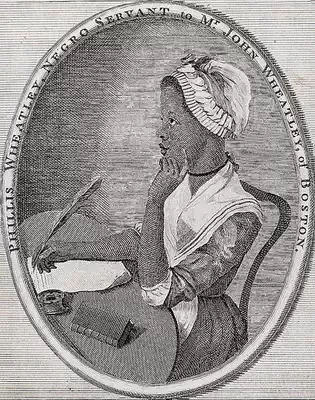
Phillis Wheatley Peters, commonly known as Phillis Wheatley, was an American poet of African descent. She was born in West Africa, likely in the Gambia region, around 1753. She was brought to America as a slave and purchased by the Wheatley family of Boston. She died in Boston on December 5, 1784. Her family background is unknown due to her enslavement, but she was of Senegambian origin. She was enslaved for most of her life and wrote in English. Her life and work took place during the pre-Revolutionary and Revolutionary periods of American history, a time of intense debate over liberty and enslavement.

Childhood and education

Wheatley was kidnapped from her home in West Africa at a young age, likely around seven years old. She was transported across the Atlantic in the Middle Passage and sold into slavery to John Wheatley in Boston. The Wheatley family, particularly Susanna Wheatley, recognized her intelligence and provided her with an exceptional education, including Latin and Greek, literature, and the Bible. This education was highly unusual for an enslaved person at the time. Her early influences were the classical texts she studied and the religious teachings of her enslavers.

Literary trajectory

Wheatley began writing poetry at a young age. Her first published poem appeared in the *Newport Mercury* in 1767. Her literary success culminated in the publication of 'Poems on Various Subjects, Religious and Moral' in London in 1773, making her the first African American to publish a book of poetry. This achievement was extraordinary, as she had to prove her authorship to skeptical white audiences. She also contributed poems to newspapers and other publications. She did not engage significantly in literary criticism or translation.

Works, style, and literary characteristics

Her major work is 'Poems on Various Subjects, Religious and Moral' (1773). Dominant themes include religious faith, virtue, liberty, the African experience, and reflections on life and death. Her style is largely neoclassical, characterized by rhyming couplets, iambic pentameter, and formal diction, reflecting her classical education. Her poetic voice is often eloquent and reasoned, though it carries the implicit critique of slavery through its very existence and intellectual merit. Her language is refined and elevated. Wheatley's innovation lay in her existence as a Black poet in America, challenging racial stereotypes through her literary accomplishments.

Cultural and historical context

Wheatley's life and work are inextricably linked to the context of colonial America and the growing abolitionist sentiment. She lived during a period when the hypocrisy of fighting for American liberty while upholding slavery was becoming increasingly apparent. Her ability to publish a book of poetry was a significant event that drew attention to the intellectual capabilities of enslaved people. She was a contemporary of figures like Benjamin Franklin and George Washington, with whom she corresponded. She belonged to no specific literary movement but operated within the broader Neoclassical tradition.

Personal life

Wheatley's personal life was defined by her enslaved status, though she experienced a degree of freedom and intellectual engagement within the Wheatley household. She formed a close bond with Susanna Wheatley. After gaining her freedom, she married John Peters, a free Black man. Her later life was marked by hardship, including financial struggles and the loss of her children. Her personal experiences of enslavement, the yearning for freedom, and her religious convictions profoundly shaped her poetry.

Recognition and reception

Wheatley received considerable recognition during her lifetime, both in America and Great Britain. Her trip to London was facilitated by the Wheatleys to promote her book. She received praise from prominent figures, including Benjamin Franklin and the Earl of Dartmouth. However, she also faced skepticism about her authorship, necessitating a document signed by prominent Bostonians attesting to her abilities. Her place in American literature is foundational as the first African American poet. Her reception has evolved from an anomaly to a celebrated literary figure.

Influences and legacy

Wheatley was influenced by classical poets like Homer and Virgil, as well as Enlightenment thinkers and the Bible. Her legacy is immense as a pioneering figure who broke racial barriers in American literature. She inspired subsequent generations of African American writers and poets, proving that Black individuals possessed intellectual and artistic capabilities. Her work continues to be studied for its literary merit and its historical significance.

Interpretation and critical analysis

Wheatley's poetry is often analyzed for its subtle critiques of slavery, its exploration of religious themes, and its engagement with the ideals of the American Revolution. Critical debates sometimes focus on the extent to which her work directly challenged the institution of slavery versus her more restrained expressions.

Curiosities and lesser-known aspects

A curious aspect of Wheatley's life is the extraordinary educational opportunities afforded to her while enslaved. Her journey to London to publish her book was a significant undertaking. Despite gaining freedom, her later years were marked by poverty, a stark contrast to the intellectual acclaim she had received earlier.

Death and memory

Phillis Wheatley died in poverty in Boston in 1784, shortly after giving birth to her third child, who also died. Her memory is honored through her enduring literary work, which has been revived and celebrated, ensuring her place as a crucial figure in American literary history.