Poems List

The End

The End

It is time for me to go, mother; I am going.

When in the paling darkness of the lonely dawn you stretch out
your arms for your baby in the bed, I shall say, "Baby is not
here!"-mother, I am going.

I shall become a delicate draught of air and caress you and
I shall be ripples in the water when you bathe, and kiss you and
kiss you again.

In the gusty night when the rain patters on the leaves you
will hear my whisper in your bed, and my laughter will flash with
the lightning through the open window into your room.

If you lie awake, thinking of your baby till late into the
night, I shall sing to you from the stars, "Sleep, mother, sleep."

One the straying moonbeams I shall steal over your bed, and
lie upon your bosom while you sleep.

I shall become a dream, and through the little opening of your
eyelids I shall slip into the depths of your sleep; and when you
wake up and look round startled, like a twinkling firefly I shall
flit out into the darkness.

When, on the great festival of puja, the neighbours' children
come and play about the house, I shall melt into the music of the
flute and throb in your heart all day.

Dear auntie will come with puja-presents and will ask,"Where
is our baby, sister?" Mother, you will tell her softly, "He is in
the pupils of my eyes, he is in my body and in my soul."
523

The Astronomer

The Astronomer

I only said, "When in the evening the round full moon gets
entangled among the beaches of that Dadam tree, couldn't somebody
catch it?"

But dada laughed at me and said, "Baby, you are the silliest
child I have ever known. The moon is ever so far from us, how could
anybody catch it?"

I said, "Dada, how foolish you are! When mother looks out of
her window and smiles down at us playing, would you call her far
away?"

Still dada said, "You are a stupid child! But, baby where
could you find a net big enough to catch the moon with?"

I said, "Surely you could catch it with your hands."

But dada laughed and said, "You are the silliest child I have
known. If it came nearer, you would see how big the moon is."

I said, "Dada, what nonsense they teach at your school! When
mother bends her face down to kiss us, does her face look very
big?"

But still dada says, "You are a stupid child."
499

The Beginning

The Beginning

"Where have I come from, where did you pick me up?" the baby asked
its mother.

She answered, half crying, half laughing, and clasping the
baby to her breast


"You were hidden in my heart as its desire, my darling.

You were in the dolls of my childhood's games; and when with
clay I made the image of my god every morning, I made the unmade
you then.

You were enshrined with our household deity, in his worship
I worshipped you.

In all my hopes and my loves, in my life, in the life of my
mother you have lived.

In the lap of the deathless Spirit who rules our home you have
been nursed for ages.

When in girlhood my heart was opening its petals, you hovered
as a fragrance about it.

Your tender softness bloomed in my youthful limbs, like a glow
in the sky before the sunrise.

Heaven's first darling, twain-born with the morning light, you
have floated down the stream of the world's life, and at last you
have stranded on my heart.

As I gaze on your face, mystery overwhelms me; you who belong
to all have become mine.

For fear of losing you I hold you tight to my breast. What
magic has snared the world's treasure in these slender arms of
mine?"
607

Superior

Superior


Mother, your baby is silly! She is so absurdly childish!

She does not know the difference between the lights in the
streets and the stars.

When we play at eating with pebbles, she thinks they are real
food, and tries to put them into her mouth.

When I open a book before her and ask her to learn her a, b,
c, she tears the leaves with her hands and roars for joy at
nothing; this is your baby's way of doing her lesson.

When I shake my head at her in anger and scold her and call
her naughty, she laughs and thinks it great fun.

Everybody knows that father is away, but if in play I call
aloud "Father," she looks about her in excitement and thinks that
father is near.

When I hold my class with the donkeys that our washer man
brings to carry away the clothes and I warn her that I am the
schoolmaster, she will scream for no reason and call me dada.

Your baby wants to catch the moon. She is so funny; she calls
Ganesh Ganush.

Mother, your baby is silly! She is so absurdly childish!
551

Stream Of Life

Stream Of Life

The same stream of life that runs through my veins night and day
runs through the world and dances in rhythmic measures.


It is the same life that shoots in joy through the dust of the earth
in numberless blades of grass
and breaks into tumultuous waves of leaves and flowers.


It is the same life that is rocked in the ocean-cradle of birth
and of death, in ebb and in flow.


I feel my limbs are made glorious by the touch of this world of life.
And my pride is from the life-throb of ages dancing in my blood this moment.
845

Stray Birds 81 - 90

Stray Birds 81 - 90

81

WHAT is this unseen flame of darkness
whose sparks are the stars?
82
LET life be beautiful like summer flowers


and death like autumn leaves.
88
HE who wants to do good knocks at the gate;


he who loves


finds the gate open.


84
IN death the many becomes one;
in life the one becomes many.
Religion will be one
when God is dead.


85


THE artist is the lover of Nature,


therefore he is her slave
and her master.
86
'HOW far are you from me, O Fruit?'


'I am hidden in your heart, O Flower.'
87
THIS longing is for the one who is felt in the dark,


but not seen in the day.
88
'YOU are the big drop of dew under the lotus leaf,


I am the smaller one on its upper side,


' said the dewdrop to the lake.

89
THE scabbard is content to be dull
when it protects the keenness of the sword.

90


IN darkness
the One appears as uniform;
in the light
the One appears as manifold.
522

Stray Birds 71 - 80

Stray Birds 71 - 80

71

THE woodcutter's axe begged for its handle from the tree.
The tree gave it.
72
IN my solitude of heart


I feel the sigh of this widowed evening
veiled with mist and rain.

73
CHASTITY
is a wealth that comes from
abundance of love.

74
THE mist,
like love,

plays upon the heart of the hills
and brings out surprises of beauty.
75
WE read the world wrong

and say that it deceives us.
76
THE poet wind is out over the sea

and the forest to seek his own voice.
77
EVERY child

comes with the message
that God is not yet discouraged
of man.

78

THE grass seeks her crowd in the earth.
The tree seeks his solitude of the sky.
79
MAN barricades against himself.
80


YOUR voice, my friend,
wanders in my heart,
like the muffled sound of the sea
among these listening pines.
611

Stray Birds 51 - 60

Stray Birds 51 - 60

51
YOUR idol is shattered in the dust


to prove that God's dust is greater than
your idol.
52
MAN does not reveal himself in his history,


he struggles up through it.
53
WHILE the glass lamp rebukes the earthen for calling it cousin,


the moon rises, and the glass lamp,


with a bland smile, calls her,


'My dear, dear sister.'

54
LIKE the meeting of the seagulls
and the waves we meet and come near.


The seagulls fly off,
the waves roll away and we depart.
55
MY day is done,


and I am like a boat drawn on the beach,


listening to the dance-music of t


he tide in the evening.

56

LIFE is given to us,
we earn it by giving it.
57
WE come nearest to the great


when we are great in humility.
58
THE sparrow is sorry for the peacock


at the burden of its tail.
59
NEVER be afraid of the moments-


thus sings the voice of the everlasting.


60


THE hurricane seeks the shortest road
by the no-road,
and suddenly ends its search in the Nowhere.
517

Stray Birds 31 - 40

Stray Birds 31 - 40

31

THE trees come up to my window
like the yearning voice of the dumb earth.
32
HIS own mornings are new surprises to God.
33
LIFE finds its wealth by the claims of the world,


and its worth by the claims of love.
34
THE dry river-bed finds no thanks for its past.
35
THE bird wishes it were a cloud.


The cloud wishes it were a bird.
36
THE waterfall sings,


'I find my song,
when I find my freedom.'


37
I CANNOT tell why this heart languishes in silence.
It is for small needs it never asks,
or knows or remembers.


38
WOMAN,


when you move about in your household service
your limbs sing like a hill stream among its pebbles.
39
THE sun goes to cross the Western sea,


leaving its last salutation to the East.
40
DO not blame your food because you have no appetite.
554

Still Heart

Still Heart

When I give up the helm
I know that the time has come for thee to take it.
What there is to do will be instantly done.
Vain is this struggle.


Then take away your hands
and silently put up with your defeat, my heart,
and think it your good fortune to sit perfectly still
where you are placed.


These my lamps are blown out at every little puff of wind,
and trying to light them I forget all else again and again.


But I shall be wise this time and wait in the dark,
spreading my mat on the floor;
and whenever it is thy pleasure, my lord,
come silently and take thy seat here.
509

Comments (0)

Log in to post a comment.

NoComments

Identification and basic context

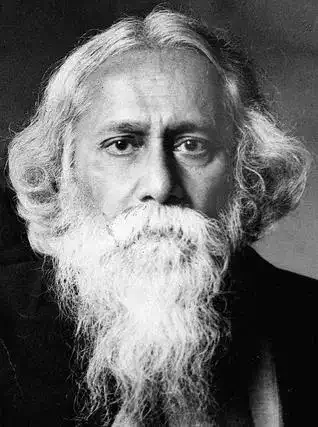
Rabindranath Tagore was a Bengali poet, writer, composer, playwright, philosopher, and painter. He is celebrated as the most significant literary figure of modern India. Born into a prominent Bengali Hindu family deeply involved in the Indian Renaissance, he inherited a rich cultural and intellectual legacy. His nationality was Indian, and he wrote primarily in Bengali, though many of his works were translated into English by himself and others. Tagore lived during a period of intense nationalistic fervor and social change in British India, contributing significantly to the intellectual and artistic landscape of his time.

Childhood and education

Tagore's childhood was privileged, growing up in a large, cultured family in Calcutta. His father, Debendranath Tagore, was a leader of the Brahmo Samaj, a monotheistic reformist movement. Rabindranath received a home-based education, with tutors instructing him in literature, music, and languages. He briefly attended a local school but found the formal system stifling. His education was largely shaped by his immersion in Bengali literature, Sanskrit classics, and his father's spiritual teachings. He began composing poetry at a young age, showing an early aptitude for creative expression. His youthful experiences instilled in him a deep appreciation for nature and a critical perspective on rigid social structures.

Literary trajectory

Tagore's literary career began in his youth with the publication of his first collection of poems, 'Sandhya Sangeet' (Evening Songs), in 1875. He gained significant recognition with his lyrical work 'Gitanjali' (Song Offerings), the English translation of which earned him the Nobel Prize in Literature in 1913. This marked a turning point in his career, bringing him international acclaim. He was incredibly prolific, producing a vast body of work that included novels like 'Gora' (1910) and 'Ghare-Baire' (The Home and the World, 1916), short stories such as those collected in 'Galpaguchchha' (A Collection of Stories), and numerous dramas, essays, and thousands of songs. He also founded Visva-Bharati University in Santiniketan, an institution dedicated to the synthesis of Eastern and Western cultures and a nurturing ground for creative arts.

Works, style, and literary characteristics

Tagore's major works are too numerous to list comprehensively, but include 'Gitanjali', 'Gora', 'Chokher Bali', 'Kabuliwala', and the Rabindra Sangeet (songs composed by him). His dominant themes are profound and diverse: the beauty and spiritual significance of nature, the complexities of human love and relationships, the joys and sorrows of life, nationalism and internationalism, social justice, and the spiritual quest for truth. His style is characterized by its lyrical beauty, musicality, and profound emotional depth. He mastered various forms, from intricate metrical verse to free verse, and his songs are known for their exquisite blend of poetry and music. His poetic voice is often tender, introspective, and philosophical, embracing both the personal and the universal. His language is rich, evocative, and infused with imagery drawn from nature and human experience. Tagore's work is deeply rooted in Bengali culture but possesses a universal resonance.

Cultural and historical context

Tagore was a product of and a significant contributor to the Bengal Renaissance, a period of artistic and intellectual awakening in the 19th and early 20th centuries. He lived through the era of British colonial rule in India and was a vocal critic of its oppressive aspects, yet he also advocated for a synthesis of Indian and Western values, rather than outright rejection of the West. He was associated with intellectuals and artists of his time, both in India and internationally, and his founding of Visva-Bharati University aimed to foster cross-cultural understanding. His work reflects the tensions and aspirations of a nation grappling with identity, tradition, and modernity.

Personal life

Tagore's personal life was marked by deep familial ties and personal losses that often found expression in his work. He married Mrinalini Devi in 1883, and they had two surviving children. His wife's death in 1902 was a profound grief that influenced his poetry. He maintained close relationships with his children, particularly his son Rathindranath, who helped him in establishing Visva-Bharati. His spiritual inclinations were shaped by his father and the Brahmo Samaj, but he developed his own unique philosophy emphasizing the divine in humanity and nature. His later years were dedicated to his university and his literary pursuits.

Recognition and reception

Tagore achieved unparalleled recognition during his lifetime, most notably with the Nobel Prize in Literature in 1913 for 'Gitanjali'. This award brought him immense international fame and established him as a global literary figure. He was celebrated in India as a national poet and cultural icon. His works have been translated into numerous languages, and he received honorary doctorates from various universities worldwide. While his literary genius was widely acknowledged, his philosophical and social ideas also garnered considerable attention and sometimes debate.

Influences and legacy

Tagore was influenced by ancient Indian scriptures (Upanishads), classical Sanskrit literature, and the devotional poetry of the Bhakti movement. He was also open to Western influences, particularly Romantic poetry and the ideas of thinkers like Emerson. His legacy is immense and multifaceted. He is credited with modernizing Bengali literature and art. His songs (Rabindra Sangeet) remain an integral part of Bengali culture. His philosophy of education, humanism, and internationalism continues to be influential. He inspired numerous artists, writers, and thinkers across India and the world.

Interpretation and critical analysis

Tagore's work is often praised for its lyrical beauty, spiritual depth, and humanistic outlook. Critics have explored his engagement with themes of nationalism versus cosmopolitanism, the sacredness of nature, and the complexities of human experience. His writings are seen as a bridge between the East and the West, offering universal insights into the human condition. While celebrated, some interpretations have also focused on the potential for his universalism to sometimes abstract or overlook specific socio-political realities.

Curiosities and lesser-known aspects

Tagore was also an accomplished painter, beginning his artistic career in his late sixties, producing a distinctive body of work characterized by its surreal and expressive quality. He was known for his long, flowing beard and simple attire, which contributed to his iconic image. He had a deep connection with nature, often finding inspiration in his surroundings at Santiniketan. He was a prolific letter-writer, maintaining correspondence with prominent figures globally.

Death and memory

Rabindranath Tagore died on August 7, 1941, at the age of 80, in his ancestral home in Jorasanko, Calcutta. His death was a profound loss for India and the world. His memory is kept alive through his vast literary and artistic legacy, the continued performance and study of his songs, and the enduring influence of his philosophical and educational ideals. Visva-Bharati University remains a living testament to his vision.