Poems List

The Gardener XXVII: Trust Love

The Gardener XXVII: Trust Love

"Trust love even if it brings sorrow.
Do not close up your heart."

"Ah no, my friend, your words are
dark, I cannot understand them."

"Pleasure is frail like a dewdrop,
while it laughs it dies. But sorrow is
strong and abiding. Let sorrowful
love wake in your eyes."

"Ah no, my friend, your words are
dark, I cannot understand them."

"The lotus blooms in the sight of
the sun, and loses all that it has. It
would not remain in bud in the
eternal winter mist."

"Ah no, my friend, your words are
dark, I cannot understand them."
499

The Gardener XX: Day After Day He Comes

The Gardener XX: Day After Day He Comes

Day after day he comes and goes
away.

Go, and give him a flower from my
hair, my friend.

If he asks who was it that sent it, I
entreat you do not tell him my name-for
he only comes and goes away.

He sits on the dust under the tree.

Spread there a seat with flowers and
leaves, my friend.

His eyes are sad, and they bring
sadness to my heart.

He does not speak what he has in
mind; he only comes and goes away.
471

The Gardener XXII: When She Passed by Me

The Gardener XXII: When She Passed by Me

When she passed by me with quick
steps, the end of her skirt touched
me.

From the unknown island of a
heart came a sudden warm breath of
spring.

A flutter of a flitting touch brushed
me and vanished in a moment, like a
torn flower petal blown in the breeze.

It fell upon my heart like a sigh of
her body and whisper of her heart.
500

The Gardener XLVI: You Left Me

The Gardener XLVI: You Left Me

You left me and went on your way.

I thought I should mourn for you
and set your solitary image in my
heart wrought in a golden song.

But ah, my evil fortune, time is
short.

Youth wanes year after year; the
spring days are fugitive; the frail
flowers die for nothing, and the wise
man warns me that life is but a
dewdrop on the lotus leaf.

Should I neglect all this to gaze after
one who has turned her back on me?

That would be rude and foolish,
for time is short.

Then, come, my rainy nights with
pattering feet; smile, my golden
autumn; come, careless April, scattering
your kisses abroad.

You come, and you, and you also!

My loves, you know we are mortals.
Is it wise to break one's heart for the
one who takes her heart away? For
time is short.

It is sweet to sit in a corner to muse
and write in rhymes that you are all
my world.

It is heroic to hug one's sorrow and
determine not to be consoled.

But a fresh face peeps across my
door and raise its eyes to my eyes.

I cannot but wipe away my tears
and change the tune of my song.

For time is short.
485

The Gardener XVI: Hands Cling to Eyes

The Gardener XVI: Hands Cling to Eyes

Hands cling to hands and eyes linger
on eyes: thus begins the record of our
hearts.

It is the moonlit night of March;
the sweet smell of henna is in the air;
my flute lies on the earth neglected
and your garland of flowers is
unfinished.

This love between you and me is
simple as a song.

Your veil of the saffron colour
makes my eyes drunk.

The jasmine wreath that you wove
me thrills to my heart like praise.

It is a game of giving and withholding,
revealing and screening again;
some smiles and some little shyness,
and some sweet useless struggles.

This love between you and me is
simple as a song.

No mystery beyond the present;
no striving for the impossible; no
shadow behind the charm; no groping
in the depth of the dark.

This love between you and me is
simple as a song.

We do not stray out of all words
into the ever silent; we do not raise
our hands to the void for things
beyond hope.

It is enough what we give and we
get.

We have not crushed the joy to
the utmost to wring from it the wine
of pain.

This love between you and me is
simple as a song.
444

The Gardener XLIV: Reverend Sir, Forgive

The Gardener XLIV: Reverend Sir, Forgive

Reverend sir, forgive this pair of
sinners. Spring winds to-day are
blowing in wild eddies, driving dust
and dead leaves away, and with them
your lessons are all lost.

Do not say, father, that life is a
vanity.

For we have made truce with death
for once, and only for a few fragrant
hours we two have been made immortal.

Even if the king's army came and
fiercely fell upon us we should sadly
shake our heads and say, Brothers,
you are disturbing us. If you must
have this noisy game, go and clatter
your arms elsewhere. Since only for
a few fleeting moments we have been
made immortal.

If friendly people came and flocked
around us, we should humbly bow to
them and say, This extravagant good
fortune is an embarrassment to us.
Room is scarce in the infinite sky
where we dwell. For in the springtime
flowers come in crowds, and the
busy wings of bees jostle each other.
Our little heaven, where dwell only
we two immortals, is too absurdly
narrow.
477

The Gardener XLII: O Mad, Superbly Drunk

The Gardener XLII: O Mad, Superbly Drunk

O mad, superbly drunk;

If you kick open your doors and
play the fool in public;

If you empty your bag in a night,
and snap your fingers at prudence;

If you walk in curious paths and
play with useless things;

Reck not rhyme or reason;

If unfurling your sails before the
storm you snap the rudder in two,

Then I will follow you, comrade,
and be drunken and go to the dogs.

I have wasted my days and nights
in the company of steady wise neighbours.

Much knowing has turned my hair
grey, and much watching has made
my sight dim.

For years I have gathered and
heaped up scraps and fragments of
things:

Crush them and dance upon them,
and scatter them all to the winds.

For I know 'tis the height of wisdom
to be drunken and go the dogs.

Let all crooked scruples vanish,
let me hopelessly lose my way.

Let a gust of wild giddiness come
and sweep me away from my anchors.

The world is peopled with worthies,
and workers, useful and clever.

There are men who are easily first,
and men who come decently after.

Let them be happy and prosper,
and let me be foolishly futile.

For I know 'tis the end of all works
to be drunken and go to the dogs.

I swear to surrender this moment
all claims to the ranks of the decent.

I let go my pride of learning and
judgment of right and of wrong.

I'll shatter memory's vessel, scattering
the last drop of tears.

With the foam of the berry-red
wine I will bathe and brighten my
laughter.

The badge of the civil and staid
I'll tear into shreds for the nonce.

I'll take the holy vow to be worthless,
to be drunken and go to the dogs.
560

The Gardener XIX: You Walked

The Gardener XIX: You Walked

You walked by the riverside path
with the full pitcher upon your hip.

Why did you swiftly turn your face
and peep at me through your fluttering
veil?

That gleaming look from the dark
came upon me like a breeze that sends
a shiver through the rippling water
and sweeps away to the shadowy
shore.

It came to me like the bird of the
evening that hurriedly flies across the
lampless room from the one open
window to the other, and disappears
in the night.

You are hidden as a star behind the
hills, and I am a passer-by upon the
road.

But why did you stop for a moment
and glance at my face through your
veil while you walked by the riverside
path with the full pitcher upon
your hip?
475

The Gardener XIII: I Asked Nothing

The Gardener XIII: I Asked Nothing

I asked nothing, only stood at the
edge of the wood behind the tree.

Languor was still upon the eyes
of the dawn, and the dew in the air.

The lazy smell of the damp grass
hung in the thin mist above the earth.

Under the banyan tree you were
milking the cow with your hands,
tender and fresh as butter.

And I was standing still.

I did not say a word. It was the
bird that sang unseen from the thicket.

The mango tree was shedding its
flowers upon the village road, and the
bees came humming one by one.

On the side of the pond the gate of
Shiva's temple was opened and the
worshipper had begun his chants.

With the vessel on your lap you
were milking the cow.

I stood with my empty can.

I did not come near you.

The sky woke with the sound of
the gong at the temple.

The dust was raised in the road
from the hoofs of the driven cattle.

With the gurgling pitchers at their
hips, women came from the river.

Your bracelets were jingling, and
foam brimming over the jar.

The morning wore on and I did not
come near you.
458

The Gardener LXXXIII: She Dwelt on the Hillside

The Gardener LXXXIII: She Dwelt on the Hillside

She dwelt on the hillside by edge
of a maize-field, near the spring that
flows in laughing rills through the
solemn shadows of ancient trees. The
women came there to fill their jars,
and travellers would sit there to rest
and talk. She worked and dreamed
daily to the tune of the bubbling
stream.

One evening the stranger came down
from the cloud-hidden peak; his locks
were tangled like drowsy snakes. We
asked in wonder, "Who are you?"
He answered not but sat by the
garrulous stream and silently gazed at
the hut where she dwelt. Our hearts
quaked in fear and we came back home
when it was night.

Next morning when the women
came to fetch water at the spring by
the deodar trees, they found the doors
open in her hut, but her voice was gone
and where was her smiling face?
The empty jar lay on the floor and her
lamp had burnt itself out in the
corner. No one knew where she had
fled to before it was morning--and the
stranger had gone.

In the month of May the sun grew
strong and the snow melted, and we
sat by the spring and wept. We
wondered in our mind, "Is there a
spring in the land where she has gone
and where she can fill her vessel in
these hot thirsty days?" And we
asked each other in dismay, "Is there
a land beyond these hills where we
live?"

It was a summer night; the breeze
blew from the south; and I sat in her
deserted room where the lamp stood
still unlit. When suddenly from
before my eyes the hills vanished like
curtains drawn aside. "Ah, it is
she who comes. How are you, my
child? Are you happy? But where
can you shelter under this open sky?
And, alas! our spring is not here to
allay your thirst."

"Here is the same sky," she said,
"only free from the fencing hills,-this
is the same stream grown into a


river,--the same earth widened into
a plain." "Everything is here," I
sighed, "only we are not." She
smiled sadly and said, "You are in
my heart." I woke up and heard the
babbling of the stream and the rustling
of the deodars at night.
497

Comments (0)

Log in to post a comment.

NoComments

Identification and basic context

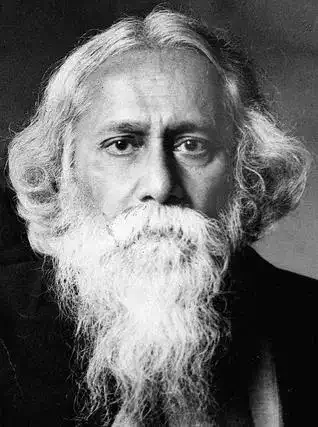
Rabindranath Tagore was a Bengali poet, writer, composer, playwright, philosopher, and painter. He is celebrated as the most significant literary figure of modern India. Born into a prominent Bengali Hindu family deeply involved in the Indian Renaissance, he inherited a rich cultural and intellectual legacy. His nationality was Indian, and he wrote primarily in Bengali, though many of his works were translated into English by himself and others. Tagore lived during a period of intense nationalistic fervor and social change in British India, contributing significantly to the intellectual and artistic landscape of his time.

Childhood and education

Tagore's childhood was privileged, growing up in a large, cultured family in Calcutta. His father, Debendranath Tagore, was a leader of the Brahmo Samaj, a monotheistic reformist movement. Rabindranath received a home-based education, with tutors instructing him in literature, music, and languages. He briefly attended a local school but found the formal system stifling. His education was largely shaped by his immersion in Bengali literature, Sanskrit classics, and his father's spiritual teachings. He began composing poetry at a young age, showing an early aptitude for creative expression. His youthful experiences instilled in him a deep appreciation for nature and a critical perspective on rigid social structures.

Literary trajectory

Tagore's literary career began in his youth with the publication of his first collection of poems, 'Sandhya Sangeet' (Evening Songs), in 1875. He gained significant recognition with his lyrical work 'Gitanjali' (Song Offerings), the English translation of which earned him the Nobel Prize in Literature in 1913. This marked a turning point in his career, bringing him international acclaim. He was incredibly prolific, producing a vast body of work that included novels like 'Gora' (1910) and 'Ghare-Baire' (The Home and the World, 1916), short stories such as those collected in 'Galpaguchchha' (A Collection of Stories), and numerous dramas, essays, and thousands of songs. He also founded Visva-Bharati University in Santiniketan, an institution dedicated to the synthesis of Eastern and Western cultures and a nurturing ground for creative arts.

Works, style, and literary characteristics

Tagore's major works are too numerous to list comprehensively, but include 'Gitanjali', 'Gora', 'Chokher Bali', 'Kabuliwala', and the Rabindra Sangeet (songs composed by him). His dominant themes are profound and diverse: the beauty and spiritual significance of nature, the complexities of human love and relationships, the joys and sorrows of life, nationalism and internationalism, social justice, and the spiritual quest for truth. His style is characterized by its lyrical beauty, musicality, and profound emotional depth. He mastered various forms, from intricate metrical verse to free verse, and his songs are known for their exquisite blend of poetry and music. His poetic voice is often tender, introspective, and philosophical, embracing both the personal and the universal. His language is rich, evocative, and infused with imagery drawn from nature and human experience. Tagore's work is deeply rooted in Bengali culture but possesses a universal resonance.

Cultural and historical context

Tagore was a product of and a significant contributor to the Bengal Renaissance, a period of artistic and intellectual awakening in the 19th and early 20th centuries. He lived through the era of British colonial rule in India and was a vocal critic of its oppressive aspects, yet he also advocated for a synthesis of Indian and Western values, rather than outright rejection of the West. He was associated with intellectuals and artists of his time, both in India and internationally, and his founding of Visva-Bharati University aimed to foster cross-cultural understanding. His work reflects the tensions and aspirations of a nation grappling with identity, tradition, and modernity.

Personal life

Tagore's personal life was marked by deep familial ties and personal losses that often found expression in his work. He married Mrinalini Devi in 1883, and they had two surviving children. His wife's death in 1902 was a profound grief that influenced his poetry. He maintained close relationships with his children, particularly his son Rathindranath, who helped him in establishing Visva-Bharati. His spiritual inclinations were shaped by his father and the Brahmo Samaj, but he developed his own unique philosophy emphasizing the divine in humanity and nature. His later years were dedicated to his university and his literary pursuits.

Recognition and reception

Tagore achieved unparalleled recognition during his lifetime, most notably with the Nobel Prize in Literature in 1913 for 'Gitanjali'. This award brought him immense international fame and established him as a global literary figure. He was celebrated in India as a national poet and cultural icon. His works have been translated into numerous languages, and he received honorary doctorates from various universities worldwide. While his literary genius was widely acknowledged, his philosophical and social ideas also garnered considerable attention and sometimes debate.

Influences and legacy

Tagore was influenced by ancient Indian scriptures (Upanishads), classical Sanskrit literature, and the devotional poetry of the Bhakti movement. He was also open to Western influences, particularly Romantic poetry and the ideas of thinkers like Emerson. His legacy is immense and multifaceted. He is credited with modernizing Bengali literature and art. His songs (Rabindra Sangeet) remain an integral part of Bengali culture. His philosophy of education, humanism, and internationalism continues to be influential. He inspired numerous artists, writers, and thinkers across India and the world.

Interpretation and critical analysis

Tagore's work is often praised for its lyrical beauty, spiritual depth, and humanistic outlook. Critics have explored his engagement with themes of nationalism versus cosmopolitanism, the sacredness of nature, and the complexities of human experience. His writings are seen as a bridge between the East and the West, offering universal insights into the human condition. While celebrated, some interpretations have also focused on the potential for his universalism to sometimes abstract or overlook specific socio-political realities.

Curiosities and lesser-known aspects

Tagore was also an accomplished painter, beginning his artistic career in his late sixties, producing a distinctive body of work characterized by its surreal and expressive quality. He was known for his long, flowing beard and simple attire, which contributed to his iconic image. He had a deep connection with nature, often finding inspiration in his surroundings at Santiniketan. He was a prolific letter-writer, maintaining correspondence with prominent figures globally.

Death and memory

Rabindranath Tagore died on August 7, 1941, at the age of 80, in his ancestral home in Jorasanko, Calcutta. His death was a profound loss for India and the world. His memory is kept alive through his vast literary and artistic legacy, the continued performance and study of his songs, and the enduring influence of his philosophical and educational ideals. Visva-Bharati University remains a living testament to his vision.