Poems List

The Sailor

The Sailor

The boat of the boatman Madhu is moored at the wharf of Rajgunj.

It is uselessly laden with jute, and has been lying there idle
for ever so long.

If he would only lend me his boat, I should man her with a
hundred oars, and hoist sails, five or six or seven.

I should never steer her to stupid markets.

I should sail the seven seas and the thirteen rivers of
fairyland.

But, mother, you won't weep for me in a corner.

I am not going into the forest like Ramachandra to come back
only after fourteen years.

I shall become the prince of the story, and fill my boat with
whatever I like.

I shall take my friend Ashu with me. We shall sail merrily
across the ever seas and the thirteen rivers of fairyland.

We shall set sail in the early morning light.

When at noontide you are bathing at the pond, we shall be in
the land of a strange king.

We shall pass the ford of Tirpurni, and leave behind us the
desert of Tepantar.

When we come back it will be getting dark, and I shall tell
you of all that we have seen.

I shall cross the seven seas and the thirteen rivers of
fairyland.
612

The Lotus

The Lotus

On the day when the lotus bloomed, alas, my mind was straying,
and I knew it not. My basket was empty and the flower remained unheeded.

Only now and again a sadness fell upon me, and I started up from my
dream and felt a sweet trace of a strange fragrance in the south wind.

That vague sweetness made my heart ache with longing and it seemed to
me that is was the eager breath of the summer seeking for its completion.

I knew not then that it was so near, that it was mine, and that this
perfect sweetness had blossomed in the depth of my own heart.
551

The Rainy Day

The Rainy Day

Sullen clouds are gathering fast over the black fringe of the

forest.

O child, do not go out!

The palm trees in a row by the lake are smiting their heads
against the dismal sky; the crows with their dragged wings are
silent on the tamarind branches, and the eastern bank of the river
is haunted by a deepening gloom.

Our cow is lowing loud, ties at the fence.

O child, wait here till I bring her into the stall.

Men have crowded into the flooded field to catch the fishes
as they escape from the overflowing ponds; the rain-water is
running in rills through the narrow lanes like a laughing boy who
has run away from his mother to tease her.

Listen, someone is shouting for the boatman at the ford.

O child, the daylight is dim, and the crossing at the ferry
is closed.

The sky seems to ride fast upon the madly rushing rain; the
water in the river is loud and impatient; women have hastened home
early from the Ganges with their filled pitchers.

The evening lamps must be made ready.

O child, do not go out!

The road to the market is desolate, the lane to the river is
slippery. The wind is roaring and struggling among the bamboo
branches like a wild beast tangled in a net.
617

The Kiss

The Kiss

Lips' language to lips' ears.
Two drinking each other's heart, it seems.
Two roving loves who have left home,
pilgrims to the confluence of lips.
Two waves rise by the law of love
to break and die on two sets of lips.
Two wild desires craving each other
meet at last at the body's limits.
Love's writing a song in dainty letters,
layers of kiss-calligraphy on lips.
Plucking flowers from two sets of lips
perhaps to thread them into a chain later.
This sweet union of lips
is the red marriage-bed of a pair of smiles.
557

The Last Bargain

The Last Bargain

"Come and hire me," I cried, while in the morning I was walking on the stone-paved

road.
Sword in hand, the King came in his chariot.
He held my hand and said, "I will hire you with my power."
But his power counted for nought, and he went away in his chariot.

In the heat of the midday the houses stood with shut doors.
I wandered along the crooked lane.
An old man came out with his bag of gold.
He pondered and said, "I will hire you with my money."
He weighed his coins one by one, but I turned away.


It was evening. The garden hedge was all aflower.
The fair maid came out and said, "I will hire you with a smile."
Her smile paled and melted into tears, and she went back alone into the dark.


The sun glistened on the sand, and the sea waves broke waywardly.
A child sat playing with shells.
He raised his head and seemed to know me, and said, "I hire you with nothing."
From thenceforward that bargain struck in child's play made me a free man.
788

The Hero

The Hero

Mother, let us imagine we are travelling, and passing through a
strange and dangerous country.

You are riding in a palanquin and I am trotting by you on a
red horse.

It is evening and the sun goes down. The waste of Joradighi
lies wan and grey before us. The land is desolate and barren.

You are frightened and thinking-"I know not where we have come
to."

I say to you, "Mother, do not be afraid."

The meadow is prickly with spiky grass, and through it runs
a narrow broken path.

There are no cattle to be seen in the wide field; they have
gone to their village stalls.

It grows dark and dim on the land and sky, and we cannot tell
where we are going.

Suddenly you call me and ask me in a whisper, "What light is
that near the bank?"

Just then there bursts out a fearful yell, and figures come
running towards us.

You sit crouched in your palanquin and repeat the names of the
gods in prayer.

The bearers, shaking in terror, hide themselves in the thorny
bush.

I shout to you, "Don't be afraid, mother. I am here."

With long sticks in their hands and hair all wild about their
heads, they come nearer and nearer.

I shout, "Have a care, you villains! One step more and you are
dead men."

They give another terrible yell and rush forward.

You clutch my hand and say, "Dear boy, for heaven's sake, keep
away from them."

I say, "Mother, just you watch me."

Then I spur my horse for a wild gallop, and my sword and
buckler clash against each other.

The fight becomes so fearful, mother, that it would give you
a cold shudder could you see it from your palanquin.

Many of them fly, and a great number are cut to pieces.

I know you are thinking, sitting all by yourself, that your
boy must be dead by this time.

But I come to you all stained with blood, and say,"Mother, the
fight is over now."

You come out and kiss me, pressing me to your heart, and you
say to yourself,

"I don't know what I should do if I hadn't my boy to escort
me."

A thousand useless things happen day after day, and why
couldn't such a thing come true by chance?

It would be like a story in a book.

My brother would say, "Is it possible? I always thought he was
so delicate!"

Our village people would all say in amazement, "Was it not
lucky that the boy was with his mother?"
524

The Journey

The Journey

The morning sea of silence broke into ripples of bird songs;
and the flowers were all merry by the roadside;
and the wealth of gold was scattered through the rift of the clouds
while we busily went on our way and paid no heed.


We sang no glad songs nor played;
we went not to the village for barter;
we spoke not a word nor smiled;
we lingered not on the way.
We quickened our pace more and more as the time sped by.


The sun rose to the mid sky and doves cooed in the shade.
Withered leaves danced and whirled in the hot air of noon.
The shepherd boy drowsed and dreamed in the shadow of the banyan tree,
and I laid myself down by the water
and stretched my tired limbs on the grass.


My companions laughed at me in scorn;
they held their heads high and hurried on;
they never looked back nor rested;
they vanished in the distant blue haze.


They crossed many meadows and hills,
and passed through strange, far-away countries.
All honor to you, heroic host of the interminable path!
Mockery and reproach pricked me to rise,
but found no response in me.


I gave myself up for lost
in the depth of a glad humiliation
---in the shadow of a dim delight.


The repose of the sun-embroidered green gloom
slowly spread over my heart.
I forgot for what I had traveled,
and I surrendered my mind without struggle
to the maze of shadows and songs.


At last, when I woke from my slumber and opened my eyes,
I saw thee standing by me, flooding my sleep with thy smile.
How I had feared that the path was long and wearisome,
and the struggle to reach thee was hard!
528

The Gift

The Gift

I want to give you something, my child, for we are drifting in the

stream of the world.

Our lives will be carried apart, and our love forgotten.

But I am not so foolish as to hope that I could buy your heart
with my gifts.

Young is your life, your path long, and you drink the love we
bring you at one draught and turn and run away from us.

You have your play and your playmates. What harm is there if
you have no time or thought for us!

We, indeed, have leisure enough in old age to count the days
that are past, to cherish in our hearts what our hands have lost
for ever.

The river runs swift with a song, breaking through all
barriers. But the mountain stays and remembers, and follows her
with his love.
579

The Gardener XXXIV: Do Not Go, My Love

The Gardener XXXIV: Do Not Go, My Love

Do not go, my love, without asking
my leave.

I have watched all night, and now
my eyes are heavy with sleep.

I fear lest I lose you when I'm
sleeping.

Do not go, my love, without asking
my leave.

I start up and stretch my hands to
touch you. I ask myself, "Is it a
dream?"

Could I but entangle your feet with
my heart and hold them fast to my
breast!

Do not go, my love, without asking
my leave.
528

The Gardener XXIX: Speak To Me My Love

The Gardener XXIX: Speak To Me My Love

Speak to me, my love! Tell me in
words what you sang.
The night is dark. The stars are
lost in clouds. The wind is sighing
through the leaves.
I will let loose my hair. My blue
cloak will cling round me like night. I
will clasp your head to my bosom; and
there in the sweet loneliness murmur
on your heart. I will shut my eyes
and listen. I will not look in your face.
When your words are ended, we will
sit still and silent. Only the trees will
whisper in the dark.
The night will pale. The day will
dawn. We shall look at each other's
eyes and go on our different paths.
Speak to me, my love! Tell me in
words what you sang.
454

Comments (0)

Log in to post a comment.

NoComments

Identification and basic context

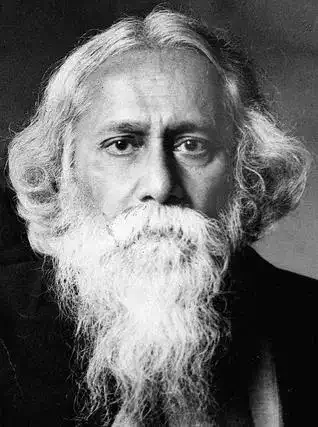
Rabindranath Tagore was a Bengali poet, writer, composer, playwright, philosopher, and painter. He is celebrated as the most significant literary figure of modern India. Born into a prominent Bengali Hindu family deeply involved in the Indian Renaissance, he inherited a rich cultural and intellectual legacy. His nationality was Indian, and he wrote primarily in Bengali, though many of his works were translated into English by himself and others. Tagore lived during a period of intense nationalistic fervor and social change in British India, contributing significantly to the intellectual and artistic landscape of his time.

Childhood and education

Tagore's childhood was privileged, growing up in a large, cultured family in Calcutta. His father, Debendranath Tagore, was a leader of the Brahmo Samaj, a monotheistic reformist movement. Rabindranath received a home-based education, with tutors instructing him in literature, music, and languages. He briefly attended a local school but found the formal system stifling. His education was largely shaped by his immersion in Bengali literature, Sanskrit classics, and his father's spiritual teachings. He began composing poetry at a young age, showing an early aptitude for creative expression. His youthful experiences instilled in him a deep appreciation for nature and a critical perspective on rigid social structures.

Literary trajectory

Tagore's literary career began in his youth with the publication of his first collection of poems, 'Sandhya Sangeet' (Evening Songs), in 1875. He gained significant recognition with his lyrical work 'Gitanjali' (Song Offerings), the English translation of which earned him the Nobel Prize in Literature in 1913. This marked a turning point in his career, bringing him international acclaim. He was incredibly prolific, producing a vast body of work that included novels like 'Gora' (1910) and 'Ghare-Baire' (The Home and the World, 1916), short stories such as those collected in 'Galpaguchchha' (A Collection of Stories), and numerous dramas, essays, and thousands of songs. He also founded Visva-Bharati University in Santiniketan, an institution dedicated to the synthesis of Eastern and Western cultures and a nurturing ground for creative arts.

Works, style, and literary characteristics

Tagore's major works are too numerous to list comprehensively, but include 'Gitanjali', 'Gora', 'Chokher Bali', 'Kabuliwala', and the Rabindra Sangeet (songs composed by him). His dominant themes are profound and diverse: the beauty and spiritual significance of nature, the complexities of human love and relationships, the joys and sorrows of life, nationalism and internationalism, social justice, and the spiritual quest for truth. His style is characterized by its lyrical beauty, musicality, and profound emotional depth. He mastered various forms, from intricate metrical verse to free verse, and his songs are known for their exquisite blend of poetry and music. His poetic voice is often tender, introspective, and philosophical, embracing both the personal and the universal. His language is rich, evocative, and infused with imagery drawn from nature and human experience. Tagore's work is deeply rooted in Bengali culture but possesses a universal resonance.

Cultural and historical context

Tagore was a product of and a significant contributor to the Bengal Renaissance, a period of artistic and intellectual awakening in the 19th and early 20th centuries. He lived through the era of British colonial rule in India and was a vocal critic of its oppressive aspects, yet he also advocated for a synthesis of Indian and Western values, rather than outright rejection of the West. He was associated with intellectuals and artists of his time, both in India and internationally, and his founding of Visva-Bharati University aimed to foster cross-cultural understanding. His work reflects the tensions and aspirations of a nation grappling with identity, tradition, and modernity.

Personal life

Tagore's personal life was marked by deep familial ties and personal losses that often found expression in his work. He married Mrinalini Devi in 1883, and they had two surviving children. His wife's death in 1902 was a profound grief that influenced his poetry. He maintained close relationships with his children, particularly his son Rathindranath, who helped him in establishing Visva-Bharati. His spiritual inclinations were shaped by his father and the Brahmo Samaj, but he developed his own unique philosophy emphasizing the divine in humanity and nature. His later years were dedicated to his university and his literary pursuits.

Recognition and reception

Tagore achieved unparalleled recognition during his lifetime, most notably with the Nobel Prize in Literature in 1913 for 'Gitanjali'. This award brought him immense international fame and established him as a global literary figure. He was celebrated in India as a national poet and cultural icon. His works have been translated into numerous languages, and he received honorary doctorates from various universities worldwide. While his literary genius was widely acknowledged, his philosophical and social ideas also garnered considerable attention and sometimes debate.

Influences and legacy

Tagore was influenced by ancient Indian scriptures (Upanishads), classical Sanskrit literature, and the devotional poetry of the Bhakti movement. He was also open to Western influences, particularly Romantic poetry and the ideas of thinkers like Emerson. His legacy is immense and multifaceted. He is credited with modernizing Bengali literature and art. His songs (Rabindra Sangeet) remain an integral part of Bengali culture. His philosophy of education, humanism, and internationalism continues to be influential. He inspired numerous artists, writers, and thinkers across India and the world.

Interpretation and critical analysis

Tagore's work is often praised for its lyrical beauty, spiritual depth, and humanistic outlook. Critics have explored his engagement with themes of nationalism versus cosmopolitanism, the sacredness of nature, and the complexities of human experience. His writings are seen as a bridge between the East and the West, offering universal insights into the human condition. While celebrated, some interpretations have also focused on the potential for his universalism to sometimes abstract or overlook specific socio-political realities.

Curiosities and lesser-known aspects

Tagore was also an accomplished painter, beginning his artistic career in his late sixties, producing a distinctive body of work characterized by its surreal and expressive quality. He was known for his long, flowing beard and simple attire, which contributed to his iconic image. He had a deep connection with nature, often finding inspiration in his surroundings at Santiniketan. He was a prolific letter-writer, maintaining correspondence with prominent figures globally.

Death and memory

Rabindranath Tagore died on August 7, 1941, at the age of 80, in his ancestral home in Jorasanko, Calcutta. His death was a profound loss for India and the world. His memory is kept alive through his vast literary and artistic legacy, the continued performance and study of his songs, and the enduring influence of his philosophical and educational ideals. Visva-Bharati University remains a living testament to his vision.