Poems List

At my dying hour, and over my long life, A clock strikes somewhere at the city’s edge.

Poem [1941]

1

When The Two Sisters Go To Fetch Water

When The Two Sisters Go To Fetch Water

WHEN the two sisters go to fetch water, they come to this spot and they smile.
They must be aware of somebody who stands behind the trees whenever they go to
fetch water.


The two sisters whisper to each other when they pass this spot.
They must have guessed the secret of that somebody who stands behind the trees
whenever they go to fetch water.


Their pitchers lurch suddenly, and water spills when they reach this spot.
They must have found out that somebody's heart is beating who stands behind the
trees whenever they go to fetch water.


The two sisters glance at each other when they come to this spot, and they smile.
There is a laughter in their swift-stepping feet, which makes confusion in somebody's
mind who stands behind the trees whenever they go to fetch water.
605

Where The Mind Is Without Fear

Where The Mind Is Without Fear

Where the mind is without fear and the head is held high
Where knowledge is free
Where the world has not been broken up into fragments
By narrow domestic walls
Where words come out from the depth of truth
Where tireless striving stretches its arms towards perfection
Where the clear stream of reason has not lost its way
Into the dreary desert sand of dead habit
Where the mind is led forward by thee
Into ever-widening thought and action
Into that heaven of freedom, my Father, let my country awake
517

When Day Is Done

When Day Is Done

If the day is done,
if birds sing no more,
if the wind has flagged tired,
then draw the veil of darkness thick upon me,
even as thou hast wrapt the earth with the coverlet of sleep
and tenderly closed the petals of the drooping lotus at dusk.


From the traveler,
whose sack of provisions is empty before the voyage is ended,
whose garment is torn and dust-laden,
whose strength is exhausted,
remove shame and poverty,
and renew his life like a flower under the cover of thy kindly night.
625

We Are To Play The Game Of Death

We Are To Play The Game Of Death

WE are to play the game of death to-night, my bride and I.
The night is black, the clouds in the sky are capricious, and the waves are raving at
sea.
We have left our bed of dreams, flung open the door and come out, my bride and I.
We sit upon a swing, and the storm winds give us a wild push from behind.
My bride starts up with fear and delight, she trembles and clings to my breast.
Long have I served her tenderly.
I made for her a bed of flowers and I closed the doors to shut out the rude light from
her eyes.
I kissed her gently on her lips and whispered softly in her ears till she half swooned in
languor.
She was lost in the endless mist of vague sweetness.
She answered not to my touch, my songs failed to arouse her.
To-night has come to us the call of the storm from the wild.
My bride has shivered and stood up, she has clasped my hand and come out.
Her hair is flying in the wind, her veil is fluttering, her garland rustles over her breast.
The push of death has swung her into life.
We are face to face and heart to heart, my bride and I.
479

Vocation

Vocation


When the gong sounds ten in the morning and I walk to school by our
lane.
Every day I meet the hawker crying, "Bangles, crystal
bangles!"
There is nothing to hurry him on, there is no road he must
take, no place he must go to, no time when he must come home.
I wish I were a hawker, spending my day in the road, crying,

"Bangles, crystal bangles!"
When at four in the afternoon I come back from the school,
I can see through the gate of that house the gardener digging

the ground.

He does what he likes with his spade, he soils his clothes
with dust, nobody takes him to task if he gets baked in the sun or
gets wet.

I wish I were a gardener digging away at the garden with
nobody to stop me from digging.
Just as it gets dark in the evening and my mother sends me to
bed,
I can see through my open window the watchman walking up and
down.
The lane is dark and lonely, and the street-lamp stands like
a giant with one red eye in its head.
The watchman swings his lantern and walks with his shadow at
his side, and never once goes to bed in his life.
I wish I were a watchman walking the streets all night,
chasing the shadows with my lantern.
600

Untimely Leave

Untimely Leave

No more noisy, loud words from me---such is my master's will.
Henceforth I deal in whispers.
The speech of my heart will be carried on in murmurings of a song.


Men hasten to the King's market. All the buyers and sellers are there.
But I have my untimely leave in the middle of the day, in the thick of work.


Let then the flowers come out in my garden, though it is not their time;
and let the midday bees strike up their lazy hum.


Full many an hour have I spent in the strife of the good and the evil,
but now it is the pleasure of my playmate of the empty days to draw my heart on to
him;
and I know not why is this sudden call to what useless inconsequence!
479

Threshold

Threshold


I was not aware of the moment
when I first crossed the threshold of this life.


What was the power that made me open out into this vast mystery
like a bud in the forest at midnight!


When in the morning I looked upon the light
I felt in a moment that I was no stranger in this world,
that the inscrutable without name and form
had taken me in its arms in the form of my own mother.


Even so, in death the same unknown will appear as ever known to me.
And because I love this life,
I know I shall love death as well.


The child cries out
when from the right breast the mother takes it away,
in the very next moment to find in the left one its consolation.
555

Unending Love

Unending Love

I seem to have loved you in numberless forms, numberless times…
In life after life, in age after age, forever.
My spellbound heart has made and remade the necklace of songs,
That you take as a gift, wear round your neck in your many forms,
In life after life, in age after age, forever.


Whenever I hear old chronicles of love, it's age-old pain,
It's ancient tale of being apart or together.
As I stare on and on into the past, in the end you emerge,
Clad in the light of a pole-star piercing the darkness of time:
You become an image of what is remembered forever.


You and I have floated here on the stream that brings from the fount.
At the heart of time, love of one for another.
We have played along side millions of lovers, shared in the same
Shy sweetness of meeting, the same distressful tears of farewell-
Old love but in shapes that renew and renew forever.


Today it is heaped at your feet, it has found its end in you
The love of all man’s days both past and forever:
Universal joy, universal sorrow, universal life.
The memories of all loves merging with this one love of ours –
And the songs of every poet past and forever.
1,115

The Unheeded Pageant

The Unheeded Pageant

Ah, who was it coloured that little frock, my child, and covered
your sweet limbs with that little red tunic?

You have come out in the morning to play in the courtyard,
tottering and tumbling as you run.

But who was it coloured that little frock, my child?

What is it makes you laugh, my little life-bud?

Mother smiles at you standing on the threshold.

She claps her hands and her bracelets jingle, and you dance
with your bamboo stick in your hand like a tiny little shepherd.

But what is it makes you laugh, my little life-bud?

O beggar, what do you bed for, clinging to your mother's neck
with both your hands?

O greedy heart, shall I pluck the world like a fruit from the
sky to place it on your little rosy palm?

O beggar, what are you begging for?

The wind carries away in glee the tinkling of your anklet
bells.

The sun smiles and watches your toilet.

The sky watches over you when you sleep in your mother's arms,
and the morning comes tiptoe to your bed and kisses your eyes.

The wind carried away in glee the tinkling of your anklet
bells.

The fairy mistress of dreams is coming towards you, flying
through the twilight sky.

The world-mother keeps her seat by you in your mother's heart.

He who plays his music to the stars is standing at your window
with his flute.

And the fairy mistress of dreams is coming towards you, flying
through the twilight sky.
539

Comments (0)

Log in to post a comment.

NoComments

Identification and basic context

Rabindranath Tagore was a Bengali poet, writer, composer, playwright, philosopher, and painter. He is celebrated as the most significant literary figure of modern India. Born into a prominent Bengali Hindu family deeply involved in the Indian Renaissance, he inherited a rich cultural and intellectual legacy. His nationality was Indian, and he wrote primarily in Bengali, though many of his works were translated into English by himself and others. Tagore lived during a period of intense nationalistic fervor and social change in British India, contributing significantly to the intellectual and artistic landscape of his time.

Childhood and education

Tagore's childhood was privileged, growing up in a large, cultured family in Calcutta. His father, Debendranath Tagore, was a leader of the Brahmo Samaj, a monotheistic reformist movement. Rabindranath received a home-based education, with tutors instructing him in literature, music, and languages. He briefly attended a local school but found the formal system stifling. His education was largely shaped by his immersion in Bengali literature, Sanskrit classics, and his father's spiritual teachings. He began composing poetry at a young age, showing an early aptitude for creative expression. His youthful experiences instilled in him a deep appreciation for nature and a critical perspective on rigid social structures.

Literary trajectory

Tagore's literary career began in his youth with the publication of his first collection of poems, 'Sandhya Sangeet' (Evening Songs), in 1875. He gained significant recognition with his lyrical work 'Gitanjali' (Song Offerings), the English translation of which earned him the Nobel Prize in Literature in 1913. This marked a turning point in his career, bringing him international acclaim. He was incredibly prolific, producing a vast body of work that included novels like 'Gora' (1910) and 'Ghare-Baire' (The Home and the World, 1916), short stories such as those collected in 'Galpaguchchha' (A Collection of Stories), and numerous dramas, essays, and thousands of songs. He also founded Visva-Bharati University in Santiniketan, an institution dedicated to the synthesis of Eastern and Western cultures and a nurturing ground for creative arts.

Works, style, and literary characteristics

Tagore's major works are too numerous to list comprehensively, but include 'Gitanjali', 'Gora', 'Chokher Bali', 'Kabuliwala', and the Rabindra Sangeet (songs composed by him). His dominant themes are profound and diverse: the beauty and spiritual significance of nature, the complexities of human love and relationships, the joys and sorrows of life, nationalism and internationalism, social justice, and the spiritual quest for truth. His style is characterized by its lyrical beauty, musicality, and profound emotional depth. He mastered various forms, from intricate metrical verse to free verse, and his songs are known for their exquisite blend of poetry and music. His poetic voice is often tender, introspective, and philosophical, embracing both the personal and the universal. His language is rich, evocative, and infused with imagery drawn from nature and human experience. Tagore's work is deeply rooted in Bengali culture but possesses a universal resonance.

Cultural and historical context

Tagore was a product of and a significant contributor to the Bengal Renaissance, a period of artistic and intellectual awakening in the 19th and early 20th centuries. He lived through the era of British colonial rule in India and was a vocal critic of its oppressive aspects, yet he also advocated for a synthesis of Indian and Western values, rather than outright rejection of the West. He was associated with intellectuals and artists of his time, both in India and internationally, and his founding of Visva-Bharati University aimed to foster cross-cultural understanding. His work reflects the tensions and aspirations of a nation grappling with identity, tradition, and modernity.

Personal life

Tagore's personal life was marked by deep familial ties and personal losses that often found expression in his work. He married Mrinalini Devi in 1883, and they had two surviving children. His wife's death in 1902 was a profound grief that influenced his poetry. He maintained close relationships with his children, particularly his son Rathindranath, who helped him in establishing Visva-Bharati. His spiritual inclinations were shaped by his father and the Brahmo Samaj, but he developed his own unique philosophy emphasizing the divine in humanity and nature. His later years were dedicated to his university and his literary pursuits.

Recognition and reception

Tagore achieved unparalleled recognition during his lifetime, most notably with the Nobel Prize in Literature in 1913 for 'Gitanjali'. This award brought him immense international fame and established him as a global literary figure. He was celebrated in India as a national poet and cultural icon. His works have been translated into numerous languages, and he received honorary doctorates from various universities worldwide. While his literary genius was widely acknowledged, his philosophical and social ideas also garnered considerable attention and sometimes debate.

Influences and legacy

Tagore was influenced by ancient Indian scriptures (Upanishads), classical Sanskrit literature, and the devotional poetry of the Bhakti movement. He was also open to Western influences, particularly Romantic poetry and the ideas of thinkers like Emerson. His legacy is immense and multifaceted. He is credited with modernizing Bengali literature and art. His songs (Rabindra Sangeet) remain an integral part of Bengali culture. His philosophy of education, humanism, and internationalism continues to be influential. He inspired numerous artists, writers, and thinkers across India and the world.

Interpretation and critical analysis

Tagore's work is often praised for its lyrical beauty, spiritual depth, and humanistic outlook. Critics have explored his engagement with themes of nationalism versus cosmopolitanism, the sacredness of nature, and the complexities of human experience. His writings are seen as a bridge between the East and the West, offering universal insights into the human condition. While celebrated, some interpretations have also focused on the potential for his universalism to sometimes abstract or overlook specific socio-political realities.

Curiosities and lesser-known aspects

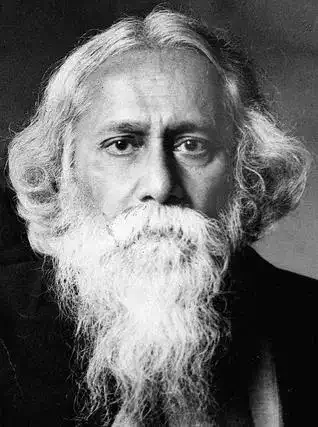
Tagore was also an accomplished painter, beginning his artistic career in his late sixties, producing a distinctive body of work characterized by its surreal and expressive quality. He was known for his long, flowing beard and simple attire, which contributed to his iconic image. He had a deep connection with nature, often finding inspiration in his surroundings at Santiniketan. He was a prolific letter-writer, maintaining correspondence with prominent figures globally.

Death and memory

Rabindranath Tagore died on August 7, 1941, at the age of 80, in his ancestral home in Jorasanko, Calcutta. His death was a profound loss for India and the world. His memory is kept alive through his vast literary and artistic legacy, the continued performance and study of his songs, and the enduring influence of his philosophical and educational ideals. Visva-Bharati University remains a living testament to his vision.