Identification and basic context
Rabindranath Tagore was a Bengali poet, writer, composer, playwright, philosopher, and painter. He is celebrated as the most significant literary figure of modern India. Born into a prominent Bengali Hindu family deeply involved in the Indian Renaissance, he inherited a rich cultural and intellectual legacy. His nationality was Indian, and he wrote primarily in Bengali, though many of his works were translated into English by himself and others. Tagore lived during a period of intense nationalistic fervor and social change in British India, contributing significantly to the intellectual and artistic landscape of his time.
Childhood and education
Tagore's childhood was privileged, growing up in a large, cultured family in Calcutta. His father, Debendranath Tagore, was a leader of the Brahmo Samaj, a monotheistic reformist movement. Rabindranath received a home-based education, with tutors instructing him in literature, music, and languages. He briefly attended a local school but found the formal system stifling. His education was largely shaped by his immersion in Bengali literature, Sanskrit classics, and his father's spiritual teachings. He began composing poetry at a young age, showing an early aptitude for creative expression. His youthful experiences instilled in him a deep appreciation for nature and a critical perspective on rigid social structures.
Literary trajectory
Tagore's literary career began in his youth with the publication of his first collection of poems, 'Sandhya Sangeet' (Evening Songs), in 1875. He gained significant recognition with his lyrical work 'Gitanjali' (Song Offerings), the English translation of which earned him the Nobel Prize in Literature in 1913. This marked a turning point in his career, bringing him international acclaim. He was incredibly prolific, producing a vast body of work that included novels like 'Gora' (1910) and 'Ghare-Baire' (The Home and the World, 1916), short stories such as those collected in 'Galpaguchchha' (A Collection of Stories), and numerous dramas, essays, and thousands of songs. He also founded Visva-Bharati University in Santiniketan, an institution dedicated to the synthesis of Eastern and Western cultures and a nurturing ground for creative arts.
Works, style, and literary characteristics
Tagore's major works are too numerous to list comprehensively, but include 'Gitanjali', 'Gora', 'Chokher Bali', 'Kabuliwala', and the Rabindra Sangeet (songs composed by him). His dominant themes are profound and diverse: the beauty and spiritual significance of nature, the complexities of human love and relationships, the joys and sorrows of life, nationalism and internationalism, social justice, and the spiritual quest for truth. His style is characterized by its lyrical beauty, musicality, and profound emotional depth. He mastered various forms, from intricate metrical verse to free verse, and his songs are known for their exquisite blend of poetry and music. His poetic voice is often tender, introspective, and philosophical, embracing both the personal and the universal. His language is rich, evocative, and infused with imagery drawn from nature and human experience. Tagore's work is deeply rooted in Bengali culture but possesses a universal resonance.
Cultural and historical context
Tagore was a product of and a significant contributor to the Bengal Renaissance, a period of artistic and intellectual awakening in the 19th and early 20th centuries. He lived through the era of British colonial rule in India and was a vocal critic of its oppressive aspects, yet he also advocated for a synthesis of Indian and Western values, rather than outright rejection of the West. He was associated with intellectuals and artists of his time, both in India and internationally, and his founding of Visva-Bharati University aimed to foster cross-cultural understanding. His work reflects the tensions and aspirations of a nation grappling with identity, tradition, and modernity.
Personal life
Tagore's personal life was marked by deep familial ties and personal losses that often found expression in his work. He married Mrinalini Devi in 1883, and they had two surviving children. His wife's death in 1902 was a profound grief that influenced his poetry. He maintained close relationships with his children, particularly his son Rathindranath, who helped him in establishing Visva-Bharati. His spiritual inclinations were shaped by his father and the Brahmo Samaj, but he developed his own unique philosophy emphasizing the divine in humanity and nature. His later years were dedicated to his university and his literary pursuits.
Recognition and reception
Tagore achieved unparalleled recognition during his lifetime, most notably with the Nobel Prize in Literature in 1913 for 'Gitanjali'. This award brought him immense international fame and established him as a global literary figure. He was celebrated in India as a national poet and cultural icon. His works have been translated into numerous languages, and he received honorary doctorates from various universities worldwide. While his literary genius was widely acknowledged, his philosophical and social ideas also garnered considerable attention and sometimes debate.
Influences and legacy
Tagore was influenced by ancient Indian scriptures (Upanishads), classical Sanskrit literature, and the devotional poetry of the Bhakti movement. He was also open to Western influences, particularly Romantic poetry and the ideas of thinkers like Emerson. His legacy is immense and multifaceted. He is credited with modernizing Bengali literature and art. His songs (Rabindra Sangeet) remain an integral part of Bengali culture. His philosophy of education, humanism, and internationalism continues to be influential. He inspired numerous artists, writers, and thinkers across India and the world.
Interpretation and critical analysis
Tagore's work is often praised for its lyrical beauty, spiritual depth, and humanistic outlook. Critics have explored his engagement with themes of nationalism versus cosmopolitanism, the sacredness of nature, and the complexities of human experience. His writings are seen as a bridge between the East and the West, offering universal insights into the human condition. While celebrated, some interpretations have also focused on the potential for his universalism to sometimes abstract or overlook specific socio-political realities.
Curiosities and lesser-known aspects
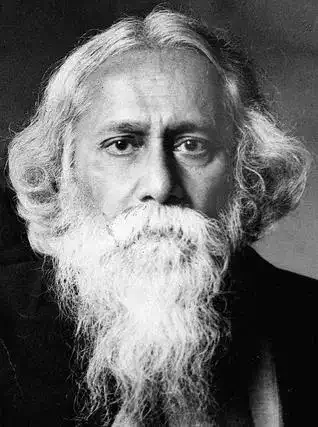
Tagore was also an accomplished painter, beginning his artistic career in his late sixties, producing a distinctive body of work characterized by its surreal and expressive quality. He was known for his long, flowing beard and simple attire, which contributed to his iconic image. He had a deep connection with nature, often finding inspiration in his surroundings at Santiniketan. He was a prolific letter-writer, maintaining correspondence with prominent figures globally.
Death and memory
Rabindranath Tagore died on August 7, 1941, at the age of 80, in his ancestral home in Jorasanko, Calcutta. His death was a profound loss for India and the world. His memory is kept alive through his vast literary and artistic legacy, the continued performance and study of his songs, and the enduring influence of his philosophical and educational ideals. Visva-Bharati University remains a living testament to his vision.