
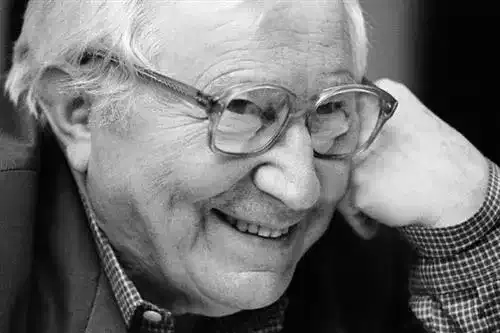
Tadeusz Rózewicz
1921–2014
· lived 92 years
 PL
PL
PL
Tadeusz Rózewicz was a prominent Polish poet, playwright, and essayist, whose work profoundly marked 20th-century literature. After experiencing the horrors of World War II, his poetry became a testament to the fragility of the human condition, questioning language itself and the possibility of expressing the ineffable. His writing is characterized by apparent simplicity, an ironic tone, and a deep reflection on morality and existence.
n. 1921-10-09, Radomsko · m. 2014-04-24, Breslávia
61
Views
Bio
Identification and basic context
Tadeusz Rózewicz was a Polish poet, playwright, and writer, one of the most important figures in 20th-century Polish literature and one of the greatest post-war European poets. He was born in Radomsko, Poland, in 1921, and died in Wrocław, Poland, in 2014. His family background and social class placed him in a Polish context that would be profoundly marked by the tragic events of World War II. His nationality is Polish, and his written language is Polish. The historical context in which he lived was dominated by the Nazi and Soviet occupation of Poland, the subsequent communist era, and finally, the transition to democracy.Childhood and education
Rózewicz's childhood was marked by the atmosphere of interwar Poland, with a family environment that likely instilled in him values and cultural sensitivity. His education was interrupted by World War II; he and his brother, also a poet Janusz Rózewicz, joined the Polish resistance (the Home Army) in 1943, actively participating in the fight against the Nazi occupiers. This traumatic experience had an indelible impact on his worldview and his writing. After the war, he managed to complete his university studies in Art History at the Jagiellonian University of Krakow.Literary career
Rózewicz began writing poetry at a young age, but it was after the war that his poetic voice consolidated, marked by the need to bear witness and rethink values and language. His work evolved over time, passing through different phases, but maintaining a constant search for truth and the overcoming of trauma. He published his first collection of poems, 'Niepokój' (Anxiety), in 1947, which was a landmark in post-war Polish poetry. He was a prolific poet, but also worked as a playwright, essayist, and translator. He collaborated with various literary magazines and was an editor.Work, style, and literary characteristics
Rózewicz's main works include poetry collections such as 'Niepokój' (1947), 'Czerwone rękawiczki' (Red Gloves, 1948), 'Pięć wierszy' (Five Poems, 1956), 'Nic w płaszczu Adama' (Nothing in Adam's Coat, 1968), and 'Poezja' (Poetry, 1969). In theater, notable plays include 'Kartoteka' (The Card Index, 1960), which became an icon of the theater of the absurd. The dominant themes in his work are death, war, human suffering, guilt, morality, the search for meaning, the banality of evil, and the need to reinvent language after the collapse of traditional values. His style is often characterized by apparent simplicity, a colloquial tone, dark humor, and sharp irony, contrasting with the gravity of the themes. He frequently uses free verse and a structure that may seem fragmented or narrative, but is meticulously constructed. The poetic voice is sometimes personal and confessional, but often assumes universality, speaking on behalf of a generation marked by trauma. His language is dense and imagistic, but stripped of ornamental excess, focusing on the expressive power of the word.Work, style, and literary characteristics
Cultural and historical context Tadeusz Rózewicz lived and wrote under the communist regime in Poland, an experience that profoundly shaped his critical view of society and the human condition. World War II was the defining event of his generation, and his work reflects the attempt to cope with collective and individual trauma. He engaged with, and sometimes clashed with, other contemporary Polish writers and the cultural directives of the regime. He was one of the poets who helped redefine Polish poetry after the war, moving away from previous aesthetics and seeking new forms of expression that could account for devastation and moral collapse.Work, style, and literary characteristics
Personal life The war experiences had a profound impact on Rózewicz's personal life. His participation in the resistance and the loss of loved ones marked his youth. His relationship with literature was intense, and his life revolved around writing and reflection. His philosophical and moral beliefs were shaped by his experience of absolute evil, leading him to question human nature and the need for rigorous ethics. His stance was often that of a critical and sometimes disillusioned observer, but always in search of fundamental truth.Work, style, and literary characteristics
Recognition and reception Rózewicz achieved significant recognition in Poland and internationally. He won numerous literary awards, including the Nike Award (the most important Polish literary award) in 2000. His work has been widely translated into various languages and is studied in universities worldwide. His critical reception was generally very positive, being recognized for his originality, depth, and his ability to address universal themes in an innovative way.Work, style, and literary characteristics
Influences and legacy Tadeusz Rózewicz was influenced by poets such as T.S. Eliot and by a Polish literary tradition that already explored realism and social criticism. In turn, he influenced generations of Polish and European poets, especially those seeking more direct, ethical poetry devoid of easy sentimentality. His legacy lies in his ability to question language and the very nature of art in the face of tragedy, and in his unmistakable voice that became a symbol of human resilience and reflection.Work, style, and literary characteristics
Interpretation and critical analysis Rózewicz's work is rich in interpretations, with his poetry frequently addressing moral dilemmas, the banality of evil, and the search for authenticity in a massified society. Critical analyses explore his relationship with existentialism, the theater of the absurd, and his critique of modernity. His work is seen as a testament to the human capacity to rebuild values and find meaning even in the darkest circumstances.Work, style, and literary characteristics
Curiosities and lesser-known aspects A curiosity about Rózewicz is his reluctance to accept literary awards, often considering his participation in ceremonies a waste of time for creation. His simple lifestyle and dedication to writing contrasted with the complexity and depth of the themes he addressed. There are accounts of his close relationship with his brother Janusz, also a poet, who shared many of his life and literary experiences.Work, style, and literary characteristics
Death and memory Tadeusz Rózewicz passed away peacefully at his home in Wrocław in 2014. After his death, his memory was honored through posthumous publications, critical editions of his work, and tributes at literary events. His legacy as one of the great poets of the 20th century continues to be celebrated and studied, ensuring his permanence in the history of literature.Poems
0No poems found
Videos
50
Comments (0)
Log in
to post a comment.
No comments yet. Be the first to comment.