
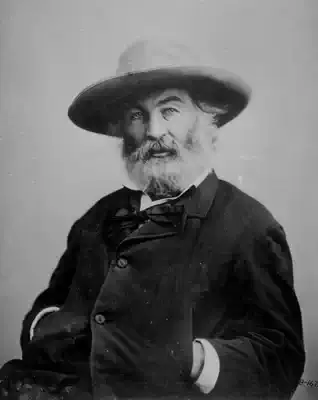
Walt Whitman

Walt Whitman

1819–1892 · lived 72 years US US

Walt Whitman was an American poet, essayist, journalist, and a deliberate humanist who became one of the most influential figures in American poetry. He is often called the "father of free verse." His seminal work, "Leaves of Grass," was a radical departure from the conventional poetry of its time, celebrating the individual, democracy, the body, and the spirit in expansive, cataloging lines. Whitman's poetry embraced a wide range of subjects, from the natural world and urban life to the experiences of laborers and soldiers. His work is characterized by its inclusive spirit, its celebration of the sensual and the spiritual, and its democratic vision. He sought to capture the diverse American experience in all its complexity and vitality, making him a truly unique voice in literature.

n. 1819-05-31, West Hills · m. 1892-03-26, Camden

77,335 Views

Year Of Meteors, 1859 '60

Year Of Meteors, 1859 '60

YEAR of meteors! brooding year!
I would bind in words retrospective, some of your deeds and signs;
I would sing your contest for the 19th Presidentiad;
I would sing how an old man, tall, with white hair, mounted the


scaffold in Virginia;
(I was at hand--silent I stood, with teeth shut close--I watch'd;
I stood very near you, old man, when cool and indifferent, but


trembling with age and your unheal'd wounds, you mounted the

scaffold;)
--I would sing in my copious song your census returns of The States,
The tables of population and products--I would sing of your ships and


their cargoes,
The proud black ships of Manhattan, arriving, some fill'd with
immigrants, some from the isthmus with cargoes of gold;
Songs thereof would I sing--to all that hitherward comes would I
welcome give; 10
And you would I sing, fair stripling! welcome to you from me, sweet
boy of England!
Remember you surging Manhattan's crowds, as you pass'd with your


cortege of nobles?
There in the crowds stood I, and singled you out with attachment;
I know not why, but I loved you... (and so go forth little song,
Far over sea speed like an arrow, carrying my love all folded,
And find in his palace the youth I love, and drop these lines at his


feet;)
--Nor forget I to sing of the wonder, the ship as she swam up my bay,
Well-shaped and stately the Great Eastern swam up my bay, she was 600

feet long,
Her, moving swiftly, surrounded by myriads of small craft, I forget
not to sing;
--Nor the comet that came unannounced out of the north, flaring in
heaven; 20
Nor the strange huge meteor procession, dazzling and clear, shooting
over our heads,
(A moment, a moment long, it sail'd its balls of unearthly light over


our heads,
Then departed, dropt in the night, and was gone;)
--Of such, and fitful as they, I sing--with gleams from them would I


gleam and patch these chants;
Your chants, O year all mottled with evil and good! year of
forebodings! year of the youth I love!
Year of comets and meteors transient and strange!--lo! even here, one
equally transient and strange!
As I flit through you hastily, soon to fall and be gone, what is this
book,
What am I myself but one of your meteors?
Read full poem
Bio

Identification and basic context

Walt Whitman was an American poet, essayist, journalist, and humanist. Born on Long Island, New York, he is considered one of the most influential figures in American literature. He wrote in English.

Childhood and education

Whitman's formal schooling was limited; he left school at the age of eleven to work. He became a printer and later worked as a journalist, editor, and teacher. This practical experience exposed him to a wide range of society and ideas, which deeply informed his writing. He was largely self-educated, voraciously reading literature, philosophy, and the Bible, and absorbing the democratic ideals of his time.

Literary trajectory

Whitman began his literary career as a journalist and editor, writing essays, short stories, and editorials. His major turning point was the publication of the first edition of 'Leaves of Grass' in 1855, a collection of poems that he would revise and expand throughout his life. This work was controversial but also groundbreaking, establishing his unique voice and style. He continued to write and publish new poems and editions of 'Leaves of Grass' for the rest of his life, self-publishing some editions and revising extensively.

Works, style, and literary characteristics

Whitman's magnum opus is 'Leaves of Grass,' first published in 1855 and issued in numerous expanded editions until his death. Other notable works include 'Democratic Vistas' (prose essays) and 'Specimen Days' (autobiographical sketches). Whitman's poetry is characterized by its radical use of free verse, lengthy, incantatory lines, and an expansive, catalogues approach to imagery. He celebrated the "self" as a microcosm of humanity and the cosmos, championing democracy, equality, the physical body, sensuality, nature, and the spiritual interconnectedness of all things. His tone is often prophetic, embracing, and deeply democratic. His language is robust, colloquial, and American, incorporating a vast vocabulary and a direct, unadorned style that sought to capture the essence of American experience.

Cultural and historical context

Whitman lived and wrote during a period of immense national transformation in the United States, including westward expansion, industrialization, and the tumultuous lead-up to and aftermath of the Civil War. He was a staunch advocate for democracy and envisioned a uniquely American poetry that reflected the diverse peoples and landscapes of the nation. His work was informed by Transcendentalist ideas, particularly the writings of Emerson, and he engaged with the social and political issues of his day, notably abolitionism.

Personal life

Whitman's personal life was complex and somewhat elusive. He never married and had no children. He served as a volunteer nurse in army hospitals during the Civil War, an experience that deeply affected him and led to poems like "The Wound-Dresser." His intense friendships, often with men, were significant, and he celebrated physical and spiritual connection. He lived a relatively simple life, often in poverty, but remained committed to his poetic vision.

Recognition and reception

Whitman's work was met with both fierce criticism and enthusiastic praise during his lifetime. While initially seen as scandalous and incomprehensible by many, he gradually gained recognition from literary figures like Emerson and was eventually hailed as a major American poet. His reputation grew posthumously, and he is now considered a cornerstone of American literature.

Influences and legacy

Whitman was influenced by Emerson, the Bible, and classical literature, but he forged a completely new poetic voice. He profoundly influenced the development of American poetry, paving the way for free verse and modern poetic sensibilities. His celebration of the individual, democracy, and the body continues to inspire poets and thinkers worldwide.

Interpretation and critical analysis

Critical interpretations of Whitman's poetry often center on his innovative use of free verse, his democratic ideals, his embrace of the body and sexuality, and his complex exploration of American identity. Debates have occurred regarding the sincerity of his democratic vision and the autobiographical elements within his work.

Curiosities and lesser-known aspects

Whitman was known for his distinctive appearance, often sporting a beard and informal clothing. He was also a skilled carpenter and builder in his youth. His extensive revisions of 'Leaves of Grass' show his meticulous attention to craft, despite his unconventional style.

Death and memory

Whitman died in Camden, New Jersey. He is remembered as one of America's most important and original poets, a visionary voice who captured the spirit of a nation in transformation and celebrated the inherent dignity of all human beings.

Poems

168

O Me! O Life!

O Me! O Life!

O ME! O life!... of the questions of these recurring;
Of the endless trains of the faithless--of cities fill'd with the
foolish;
Of myself forever reproaching myself, (for who more foolish than I,
and who more faithless?)
Of eyes that vainly crave the light--of the objects mean--of the
struggle ever renew'd;
Of the poor results of all--of the plodding and sordid crowds I see
around me;
Of the empty and useless years of the rest--with the rest me
intertwined;
The question, O me! so sad, recurring--What good amid these, O me, O
life?

Answer.

That you are here--that life exists, and identity;
That the powerful play goes on, and you will contribute a verse.
482

O Hymen! O Hymenee!

O Hymen! O Hymenee!

O HYMEN! O hymenee!

Why do you tantalize me thus?

O why sting me for a swift moment only?

Why can you not continue? O why do you now cease?

Is it because, if you continued beyond the swift moment, you would

soon certainly kill me?
325

Now Finale To The Shore

Now Finale To The Shore

NOW finale to the shore!

Now, land and life, finale, and farewell!

Now Voyager depart! (much, much for thee is yet in store;)

Often enough hast thou adventur'd o'er the seas,

Cautiously cruising, studying the charts,

Duly again to port, and hawser's tie, returning:

--But now obey, thy cherish'd, secret wish,

Embrace thy friends--leave all in order;

To port, and hawser's tie, no more returning,

Depart upon thy endless cruise, old Sailor! 10
312

O Bitter Sprig! Confession Sprig!

O Bitter Sprig! Confession Sprig!

O BITTER sprig! Confession sprig!
In the bouquet I give you place also--I bind you in,
Proceeding no further till, humbled publicly,
I give fair warning, once for all.

I own that I have been sly, thievish, mean, a prevaricator, greedy,
derelict,
And I own that I remain so yet.

What foul thought but I think it--or have in me the stuff out of
which it is thought?
What in darkness in bed at night, alone or with a companion?
368

Not The Pilot

Not The Pilot

NOT the pilot has charged himself to bring his ship into port, though

beaten back, and many times baffled;
Not the path-finder, penetrating inland, weary and long,
By deserts parch'd, snows-chill'd, rivers wet, perseveres till he


reaches his destination,
More than I have charged myself, heeded or unheeded, to compose a
free march for These States,
To be exhilarating music to them--a battle-call, rousing to arms, if
need be--years, centuries hence.
455

Not Heaving From My Ribb'd Breast Only

Not Heaving From My Ribb'd Breast Only

NOT heaving from my ribb'd breast only;

Not in sighs at night, in rage, dissatisfied with myself;

Not in those long-drawn, ill-supprest sighs;

Not in many an oath and promise broken;

Not in my wilful and savage soul's volition;

Not in the subtle nourishment of the air;

Not in this beating and pounding at my temples and wrists;

Not in the curious systole and diastole within, which will one day

cease;

Not in many a hungry wish, told to the skies only;

Not in cries, laughter, defiances, thrown from me when alone, far in

the wilds; 10

Not in husky pantings through clench'd teeth;

Not in sounded and resounded words--chattering words, echoes, dead

words;

Not in the murmurs of my dreams while I sleep,

Nor the other murmurs of these incredible dreams of every day;

Nor in the limbs and senses of my body, that take you and dismiss you

continually--Not there;

Not in any or all of them, O adhesiveness! O pulse of my life!

Need I that you exist and show yourself, any more than in these

songs.
368

No Labor-Saving Machine

No Labor-Saving Machine

NO labor-saving machine,
Nor discovery have I made;
Nor will I be able to leave behind me any wealthy bequest to found a


hospital or library,
Nor reminiscence of any deed of courage, for America,
Nor literary success, nor intellect--nor book for the book-shelf;
Only a few carols, vibrating through the air, I leave,
For comrades and lovers.
339

Native Moments

Native Moments

NATIVE moments! when you come upon me--Ah you are here now! Give me now
libidinous joys only! Give me the drench of my passions! Give me life
coarse and rank! To-day, I go consort with nature's darlings--to-night too;
I am for those who believe in loose delights--I share the midnight orgies
of young men; I dance with the dancers, and drink with the drinkers; The
echoes ring with our indecent calls; I take for my love some prostitute--I
pick out some low person for my dearest friend, He shall be lawless, rude,
illiterate--he shall be one condemn'd by others for deeds done; I will play
a part no longer--Why should I exile myself from my companions? 10 O you
shunn'd persons! I at least do not shun you, I come forthwith in your
midst--I will be your poet, I will be more to you than to any of the rest.
390

My Picture-Callery

My Picture-Callery

IN a little house keep I pictures suspended, it is not a fix'd house,

It is round, it is only a few inches from one side to the other;

Yet behold, it has room for all the shows of the world, all memories?

Here the tableaus of life, and here the groupings of death;

Here, do you know this? this is cicerone himself,

With finger rais'd he points to the prodigal pictures.
373

Miracles

Miracles

WHY! who makes much of a miracle?
As to me, I know of nothing else but miracles,
Whether I walk the streets of Manhattan,
Or dart my sight over the roofs of houses toward the sky,
Or wade with naked feet along the beach, just in the edge of the


water,
Or stand under trees in the woods,
Or talk by day with any one I love--or sleep in the bed at night with


any one I love,
Or sit at table at dinner with my mother,
Or look at strangers opposite me riding in the car,
Or watch honey-bees busy around the hive, of a summer forenoon, 10
Or animals feeding in the fields,
Or birds--or the wonderfulness of insects in the air,
Or the wonderfulness of the sun-down--or of stars shining so quiet

and bright,
Or the exquisite, delicate, thin curve of the new moon in spring;
Or whether I go among those I like best, and that like me best-


mechanics, boatmen, farmers,
Or among the savans--or to the soiree--or to the opera,
Or stand a long while looking at the movements of machinery,
Or behold children at their sports,
Or the admirable sight of the perfect old man, or the perfect old


woman,
Or the sick in hospitals, or the dead carried to burial, 20
Or my own eyes and figure in the glass;
These, with the rest, one and all, are to me miracles,
The whole referring--yet each distinct, and in its place.


To me, every hour of the light and dark is a miracle,
Every cubic inch of space is a miracle,
Every square yard of the surface of the earth is spread with the


same,
Every foot of the interior swarms with the same;
Every spear of grass--the frames, limbs, organs, of men and women,

and all that concerns them,
All these to me are unspeakably perfect miracles.


To me the sea is a continual miracle; 30
The fishes that swim--the rocks--the motion of the waves--the ships,
with men in them,
What stranger miracles are there?
733

Quotes

40

Videos

50

Comments (0)

Share
Log in to post a comment.

No comments yet. Be the first to comment.