
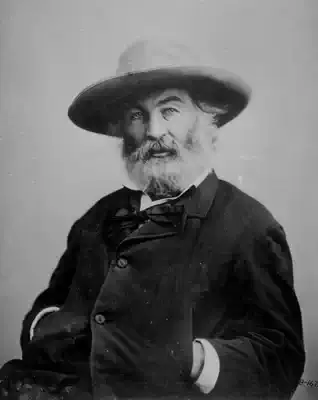
Walt Whitman

Walt Whitman

1819–1892 · lived 72 years US US

Walt Whitman was an American poet, essayist, journalist, and a deliberate humanist who became one of the most influential figures in American poetry. He is often called the "father of free verse." His seminal work, "Leaves of Grass," was a radical departure from the conventional poetry of its time, celebrating the individual, democracy, the body, and the spirit in expansive, cataloging lines. Whitman's poetry embraced a wide range of subjects, from the natural world and urban life to the experiences of laborers and soldiers. His work is characterized by its inclusive spirit, its celebration of the sensual and the spiritual, and its democratic vision. He sought to capture the diverse American experience in all its complexity and vitality, making him a truly unique voice in literature.

n. 1819-05-31, West Hills · m. 1892-03-26, Camden

77,335 Views

Year Of Meteors, 1859 '60

Year Of Meteors, 1859 '60

YEAR of meteors! brooding year!
I would bind in words retrospective, some of your deeds and signs;
I would sing your contest for the 19th Presidentiad;
I would sing how an old man, tall, with white hair, mounted the


scaffold in Virginia;
(I was at hand--silent I stood, with teeth shut close--I watch'd;
I stood very near you, old man, when cool and indifferent, but


trembling with age and your unheal'd wounds, you mounted the

scaffold;)
--I would sing in my copious song your census returns of The States,
The tables of population and products--I would sing of your ships and


their cargoes,
The proud black ships of Manhattan, arriving, some fill'd with
immigrants, some from the isthmus with cargoes of gold;
Songs thereof would I sing--to all that hitherward comes would I
welcome give; 10
And you would I sing, fair stripling! welcome to you from me, sweet
boy of England!
Remember you surging Manhattan's crowds, as you pass'd with your


cortege of nobles?
There in the crowds stood I, and singled you out with attachment;
I know not why, but I loved you... (and so go forth little song,
Far over sea speed like an arrow, carrying my love all folded,
And find in his palace the youth I love, and drop these lines at his


feet;)
--Nor forget I to sing of the wonder, the ship as she swam up my bay,
Well-shaped and stately the Great Eastern swam up my bay, she was 600

feet long,
Her, moving swiftly, surrounded by myriads of small craft, I forget
not to sing;
--Nor the comet that came unannounced out of the north, flaring in
heaven; 20
Nor the strange huge meteor procession, dazzling and clear, shooting
over our heads,
(A moment, a moment long, it sail'd its balls of unearthly light over


our heads,
Then departed, dropt in the night, and was gone;)
--Of such, and fitful as they, I sing--with gleams from them would I


gleam and patch these chants;
Your chants, O year all mottled with evil and good! year of
forebodings! year of the youth I love!
Year of comets and meteors transient and strange!--lo! even here, one
equally transient and strange!
As I flit through you hastily, soon to fall and be gone, what is this
book,
What am I myself but one of your meteors?
Read full poem
Bio

Identification and basic context

Walt Whitman was an American poet, essayist, journalist, and humanist. Born on Long Island, New York, he is considered one of the most influential figures in American literature. He wrote in English.

Childhood and education

Whitman's formal schooling was limited; he left school at the age of eleven to work. He became a printer and later worked as a journalist, editor, and teacher. This practical experience exposed him to a wide range of society and ideas, which deeply informed his writing. He was largely self-educated, voraciously reading literature, philosophy, and the Bible, and absorbing the democratic ideals of his time.

Literary trajectory

Whitman began his literary career as a journalist and editor, writing essays, short stories, and editorials. His major turning point was the publication of the first edition of 'Leaves of Grass' in 1855, a collection of poems that he would revise and expand throughout his life. This work was controversial but also groundbreaking, establishing his unique voice and style. He continued to write and publish new poems and editions of 'Leaves of Grass' for the rest of his life, self-publishing some editions and revising extensively.

Works, style, and literary characteristics

Whitman's magnum opus is 'Leaves of Grass,' first published in 1855 and issued in numerous expanded editions until his death. Other notable works include 'Democratic Vistas' (prose essays) and 'Specimen Days' (autobiographical sketches). Whitman's poetry is characterized by its radical use of free verse, lengthy, incantatory lines, and an expansive, catalogues approach to imagery. He celebrated the "self" as a microcosm of humanity and the cosmos, championing democracy, equality, the physical body, sensuality, nature, and the spiritual interconnectedness of all things. His tone is often prophetic, embracing, and deeply democratic. His language is robust, colloquial, and American, incorporating a vast vocabulary and a direct, unadorned style that sought to capture the essence of American experience.

Cultural and historical context

Whitman lived and wrote during a period of immense national transformation in the United States, including westward expansion, industrialization, and the tumultuous lead-up to and aftermath of the Civil War. He was a staunch advocate for democracy and envisioned a uniquely American poetry that reflected the diverse peoples and landscapes of the nation. His work was informed by Transcendentalist ideas, particularly the writings of Emerson, and he engaged with the social and political issues of his day, notably abolitionism.

Personal life

Whitman's personal life was complex and somewhat elusive. He never married and had no children. He served as a volunteer nurse in army hospitals during the Civil War, an experience that deeply affected him and led to poems like "The Wound-Dresser." His intense friendships, often with men, were significant, and he celebrated physical and spiritual connection. He lived a relatively simple life, often in poverty, but remained committed to his poetic vision.

Recognition and reception

Whitman's work was met with both fierce criticism and enthusiastic praise during his lifetime. While initially seen as scandalous and incomprehensible by many, he gradually gained recognition from literary figures like Emerson and was eventually hailed as a major American poet. His reputation grew posthumously, and he is now considered a cornerstone of American literature.

Influences and legacy

Whitman was influenced by Emerson, the Bible, and classical literature, but he forged a completely new poetic voice. He profoundly influenced the development of American poetry, paving the way for free verse and modern poetic sensibilities. His celebration of the individual, democracy, and the body continues to inspire poets and thinkers worldwide.

Interpretation and critical analysis

Critical interpretations of Whitman's poetry often center on his innovative use of free verse, his democratic ideals, his embrace of the body and sexuality, and his complex exploration of American identity. Debates have occurred regarding the sincerity of his democratic vision and the autobiographical elements within his work.

Curiosities and lesser-known aspects

Whitman was known for his distinctive appearance, often sporting a beard and informal clothing. He was also a skilled carpenter and builder in his youth. His extensive revisions of 'Leaves of Grass' show his meticulous attention to craft, despite his unconventional style.

Death and memory

Whitman died in Camden, New Jersey. He is remembered as one of America's most important and original poets, a visionary voice who captured the spirit of a nation in transformation and celebrated the inherent dignity of all human beings.

Poems

168

In Cabin'd Ships At Sea

In Cabin'd Ships At Sea

IN cabin'd ships, at sea,
The boundless blue on every side expanding,
With whistling winds and music of the waves--the large imperious


waves--In such,
Or some lone bark, buoy'd on the dense marine,
Where, joyous, full of faith, spreading white sails,
She cleaves the ether, mid the sparkle and the foam of day, or under

many a star at night,
By sailors young and old, haply will I, a reminiscence of the land,
be read,
In full rapport at last.


Here are our thoughts--voyagers' thoughts,
Here not the land, firm land, alone appears, may then by them be
said; 10
The sky o'erarches here--we feel the undulating deck beneath our

feet,
We feel the long pulsation--ebb and flow of endless motion;
The tones of unseen mystery--the vague and vast suggestions of the

briny world--the liquid-flowing syllables,
The perfume, the faint creaking of the cordage, the melancholy


rhythm,
The boundless vista, and the horizon far and dim, are all here,
And this is Ocean's poem.


Then falter not, O book! fulfil your destiny!
You, not a reminiscence of the land alone,
You too, as a lone bark, cleaving the ether--purpos'd I know
not whither--yet ever full of faith, 20
Consort to every ship that sails--sail you!
Bear forth to them, folded, my love--(Dear mariners! for you I fold


it here, in every leaf;)
Speed on, my Book! spread your white sails, my little bark, athwart
the imperious waves!
Chant on--sail on--bear o'er the boundless blue, from me, to every
shore,
This song for mariners and all their ships.
449

I Was Looking A Long While

I Was Looking A Long While

I WAS looking a long while for a clue to the history of the past for
myself, and for these chants--and now I have found it;
It is not in those paged fables in the libraries, (them I neither

accept nor reject;)
It is no more in the legends than in all else;
It is in the present--it is this earth to-day;
It is in Democracy--(the purport and aim of all the past;)
It is the life of one man or one woman to-day--the average man of

to-day;
It is in languages, social customs, literatures, arts;
It is in the broad show of artificial things, ships, machinery,


politics, creeds, modern improvements, and the interchange of
nations,
All for the average man of to-day.
452

I Saw Old General At Bay

I Saw Old General At Bay

I SAW old General at bay;
(Old as he was, his grey eyes yet shone out in battle like stars;)
His small force was now completely hemm'd in, in his works;
He call'd for volunteers to run the enemy's lines--a desperate


emergency;
I saw a hundred and more step forth from the ranks--but two or three
were selected;
I saw them receive their orders aside--they listen'd with care--the
adjutant was very grave;
I saw them depart with cheerfulness, freely risking their lives.
411

I Sit And Look Out

I Sit And Look Out

I SIT and look out upon all the sorrows of the world, and upon all
oppression and shame;
I hear secret convulsive sobs from young men, at anguish with
themselves, remorseful after deeds done;
I see, in low life, the mother misused by her children, dying,
neglected, gaunt, desperate;
I see the wife misused by her husband--I see the treacherous seducer
of young women;
I mark the ranklings of jealousy and unrequited love, attempted to be
hid--I see these sights on the earth;
I see the workings of battle, pestilence, tyranny--I see martyrs and
prisoners;
I observe a famine at sea--I observe the sailors casting lots who
shall be kill'd, to preserve the lives of the rest;
I observe the slights and degradations cast by arrogant persons upon
laborers, the poor, and upon negroes, and the like;
All these--All the meanness and agony without end, I sitting, look
out upon,
See, hear, and am silent. 10
632

I Hear America Singing

I Hear America Singing

I Hear America singing, the varied carols I hear;

Those of mechanics--each one singing his, as it should be, blithe and strong;

The carpenter singing his, as he measures his plank or beam,

The mason singing his, as he makes ready for work, or leaves off work;

The boatman singing what belongs to him in his boat--the deckhand singing on the
steamboat deck;

The shoemaker singing as he sits on his bench--the hatter singing as he stands;

The wood-cutter's song--the ploughboy's, on his way in the morning, or at the noon
intermission, or at sundown;

The delicious singing of the mother--or of the young wife at work--or of the girl
sewing or washing--Each singing what belongs to her, and to none else;

The day what belongs to the day--At night, the party of young fellows, robust,
friendly,

Singing, with open mouths, their strong melodious songs.
561

I Heard You, Solemn-sweep Pipes Of The Organ

I Heard You, Solemn-sweep Pipes Of The Organ

I HEARD you, solemn-sweet pipes of the organ, as last Sunday morn I
pass'd the church;
Winds of autumn!--as I walk'd the woods at dusk, I heard your longstretch'd
sighs, up above, so mournful;
I heard the perfect Italian tenor, singing at the opera--I heard the
soprano in the midst of the quartet singing;
... Heart of my love!--you too I heard, murmuring low, through one of
the wrists around my head;
Heard the pulse of you, when all was still, ringing little bells last
night under my ear.
328

I Am He That Aches With Love

I Am He That Aches With Love

I AM he that aches with amorous love;
Does the earth gravitate? Does not all matter, aching, attract all
matter?
So the Body of me, to all I meet, or know.
486

Hush'd Be the Camps Today

Hush'd Be the Camps Today

Hush'd be the camps today,
And soldiers let us drape our war-worn weapons,
And each with musing soul retire to celebrate,
Our dear commander's death.


No more for him life's stormy conflicts,
Nor victory, nor defeat--no more time's dark events,
Charging like ceaseless clouds across the sky.


But sing poet in our name,
Sing of the love we bore him--because you, dweller in camps, know it truly.


As they invault the coffin there,
Sing--as they close the doors of earth upon him--one verse,
For the heavy hearts of soldiers.
459

Hours Continuing Long

Hours Continuing Long

HOURS continuing long, sore and heavy-hearted,
Hours of the dusk, when I withdraw to a lonesome and unfrequented
spot, seating myself, leaning my face in my hands;
Hours sleepless, deep in the night, when I go forth, speeding swiftly
the country roads, or through the city streets, or pacing miles
and miles, stifling plaintive cries;
Hours discouraged, distracted--for the one I cannot content myself
without, soon I saw him content himself without me;
Hours when I am forgotten, (O weeks and months are passing, but I
believe I am never to forget!)
Sullen and suffering hours! (I am ashamed--but it is useless--I am
what I am;)
Hours of my torment--I wonder if other men ever have the like, out of
the like feelings?
Is there even one other like me--distracted--his friend, his lover,
lost to him?
Is he too as I am now? Does he still rise in the morning, dejected,
thinking who is lost to him? and at night, awaking, think who
is lost?
Does he too harbor his friendship silent and endless? harbor his
anguish and passion? 10
Does some stray reminder, or the casual mention of a name, bring the
fit back upon him, taciturn and deprest?
Does he see himself reflected in me? In these hours, does he see the
face of his hours reflected?
599

Here The Frailest Leaves Of Me

Here The Frailest Leaves Of Me

HERE the frailest leaves of me, and yet my strongest-lasting:
Here I shade and hide my thoughts--I myself do not expose them,
And yet they expose me more than all my other poems.
310

Quotes

40

Videos

50

Comments (0)

Share
Log in to post a comment.

No comments yet. Be the first to comment.