
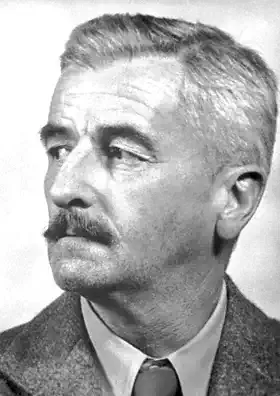
William Faulkner
1897–1962
· lived 64 years
 US
US
US
William Faulkner (1897-1962) was an American novelist and short-story writer, awarded the Nobel Prize in Literature in 1949. He is widely recognized for his works that explore the complex history and society of the American South, often set in his fictional Yoknapatawpha County. His writing is known for its stylistic complexity, including the use of stream of consciousness, multiple perspectives, and non-linear timelines.
n. 1897-09-25, New Albany · m. 1962-07-06, Byhalia
11,482
Views
Bio
William Faulkner was born on September 25, 1897, in New Albany, Mississippi. Considered one of the greatest writers in 20th-century American literature, Faulkner is celebrated for his profound and often dark depictions of the American South. His work is dominated by the creation of the fictional Yoknapatawpha County, Mississippi, where the stories of various families, their tragedies, and racial and social conflicts unfold. Faulkner is known for his innovative and experimental literary style, which includes the use of stream of consciousness, non-linear narratives, and multiple narrative voices, challenging readers to piece together events. Among his most acclaimed novels are "The Sound and the Fury" (1929), "Light in August" (1932), and "Absalom, Absalom!" (1936). He received the Nobel Prize in Literature in 1949, in recognition of his "singular and unprecedented contribution to modern American fiction." Faulkner also won the Pulitzer Prize for Fiction for "A Fable" (1955). His exploration of human nature, the legacy of slavery, and the decay of the South has left an indelible mark on world literature. He passed away on July 6, 1962, in Byhalia, Mississippi.
Poems
0No poems found
Quotes
40No poems found
Videos
50
Comments (0)
Log in
to post a comment.
No comments yet. Be the first to comment.