
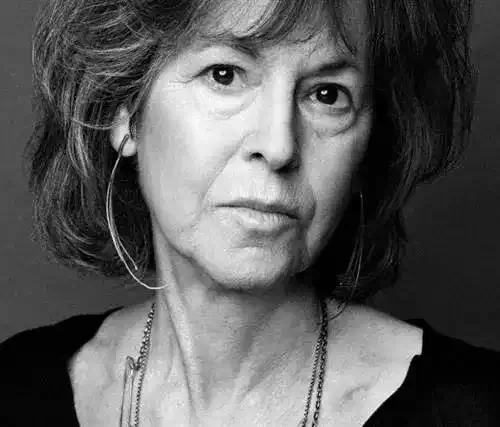
Louise Glück
 US
US
Louise Glück was an American poet known for her lyrical and introspective writing, which frequently explored themes of loss, desire, family, and nature. Her work is marked by raw emotional intensity, direct language, and careful structure, often revisiting classical myths and fairy tales to explore the human psyche. Throughout her career, Glück received widespread acclaim, culminating in the Nobel Prize in Literature in 2020, solidifying her place as one of the most significant voices in contemporary American poetry.
n. 1943-04-22, Nova Iorque · m. 2023-10-13, Cambridge
Bio
Identification and Basic Context
Louise Glück was an American poet. She was born in New York and lived much of her life in Massachusetts. Her work is written in English. The historical context in which she lived spanned the second half of the 20th century and the beginning of the 21st century, a period of profound social, cultural, and political transformations in the United States and the world.Childhood and Education
The daughter of Jewish parents, Glück's childhood was marked by a complex relationship with her family, especially her mother, and by fragile health. This family experience, with its tensions and conflicts, would become a recurring theme in her work. Her academic education included studies in liberal arts, where she encountered literature and poetry, but her poetic vein also manifested through a process of self-taught discovery and intense personal exploration.Literary Career
Glück began writing in her youth, driven by a deep need for expression. Her literary evolution was marked by a constant search for authenticity and rigor, exploring different ways of approaching the human experience. Her work progressed from confessional lyricism to a voice that engages with myths and literary tradition, always with a unique perspective.Work, Style, and Literary Characteristics
Louise Glück's major works include "The Triumph of Achilles" (1985), "The Wild Iris" (1992), "Vita Nova" (1999), and "Faithful and Virtuous Night" (2014). The dominant themes in her poetry are pain, loss, memory, the relationship with nature, sexuality, family, and mortality. She frequently explored Greek mythology, revisiting its tales from a contemporary and feminist perspective. Her style is characterized by clarity, conciseness, and the absence of unnecessary ornamentation. She often uses free verse, but with controlled musicality and rhythm, lending a sense of solemnity to her compositions. Her poetic voice is often confessional, but transcends the personal to achieve universality, addressing existential pains and yearnings in a profound and moving way. Glück sought a direct and unadorned language, but one loaded with potent imagery. Her work, although rooted in the American lyrical tradition, introduced an emotional intensity and a feminist perspective that distinguished her. She has been associated with postmodernism and realism, but her work resists easy categorization, maintaining a striking individuality.Work, Style, and Literary Characteristics
Cultural and Historical Context Louise Glück lived and wrote during a period of great cultural and social effervescence in the United States. Although her work is predominantly introspective, it implicitly reflects the anxieties and questions of contemporary American society, particularly regarding interpersonal relationships, the role of women, and the search for meaning in a constantly changing world.Work, Style, and Literary Characteristics
Personal Life Glück's personal life was profoundly marked by her family relationships, which served as material for her poetry. Her marriage, divorce, and relationships with her children were explored with brutal honesty. Her sometimes fragile health also influenced her perception of existence and mortality.Work, Style, and Literary Characteristics
Recognition and Reception Louise Glück achieved considerable recognition throughout her career, being awarded important literary prizes such as the Pulitzer Prize for Poetry in 1993 and, most notably, the Nobel Prize in Literature in 2020. Her work is studied in academic circles, and her poetry has been widely disseminated internationally.Work, Style, and Literary Characteristics
Influences and Legacy Glück was influenced by poets such as H.D. and poets from the Bible. Her legacy lies in her ability to renew lyrical poetry through uncompromising honesty and a profound exploration of the human condition. Her work has influenced generations of poets who seek an authentic voice and a courageous exploration of emotional and existential complexities.Work, Style, and Literary Characteristics
Interpretation and Critical Analysis Glück's work has been interpreted as an exploration of the fragility of existence, the nature of love and pain, and the complexity of family relationships. Her mythical approach and confessional voice invite multiple readings, revealing layers of meaning that resonate with universal experiences.Work, Style, and Literary Characteristics
Curiosities and Lesser-Known Aspects Glück was known for her perfectionism regarding writing, dedicating herself intensely to revising her poems. Her poetry, despite its emotional intensity, was produced with remarkable formal rigor and economy of language.Work, Style, and Literary Characteristics
Death and Memory Louise Glück passed away in October 2023. Her works continue to be celebrated, and her influence on modern poetry endures, with posthumous publications keeping her memory and literary voice alive.Poems
0No poems found
Quotes
3
Videos
50
Comments (0)
No comments yet. Be the first to comment.