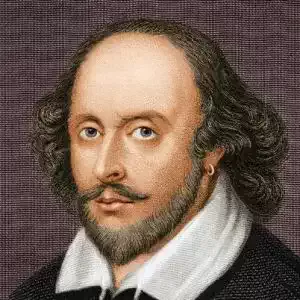
William Shakespeare

William Shakespeare

1564–1616 · lived 52 years GB GB

William Shakespeare is widely regarded as the greatest writer in the English language and the world's pre-eminent dramatist. His vast body of work, including tragedies, comedies, histories, and sonnets, explores the complexities of human nature with unparalleled depth and linguistic richness. His plays continue to be performed and studied globally, making him a timeless figure in literature and theatre.

n. 1564-04-23, Stratford-upon-Avon · m. 1616-04-23, Stratford-upon-Avon

130,417 Views

Shall I compare thee to a summer's day? (Sonnet 18)

Shall I compare thee to a summer's day? (Sonnet 18)

Shall I compare thee to a summer's day?
Thou art more lovely and more temperate.
Rough winds do shake the darling buds of May,
And summer's lease hath all too short a date.
Sometime too hot the eye of heaven shines,
And often is his gold complexion dimmed;
And every fair from fair sometime declines,
By chance, or nature's changing course, untrimmed;
But thy eternal summer shall not fade,
Nor lose possession of that fair thou ow'st,
Nor shall death brag thou wand'rest in his shade,
When in eternal lines to Time thou grow'st.


So long as men can breathe, or eyes can see,
So long lives this, and this gives life to thee.
Read full poem
Bio

Identification and basic context

William Shakespeare is the most celebrated playwright and poet in the English language. He is often referred to by his pseudonyms, though none were widely adopted during his lifetime. He was born and died in Stratford-upon-Avon, England. His father was a glover and alderman, placing him in a respectable social standing within the town. Shakespeare was an English national and wrote exclusively in English.

Childhood and education

Details of Shakespeare's childhood are scarce, but it is generally assumed he attended the Stratford grammar school, where he would have received a solid grounding in Latin and classical literature. This formal education, supplemented by his keen observation of life and his prodigious reading, laid the foundation for his literary genius. He did not pursue higher education at university.

Literary trajectory

Shakespeare began his career in London in the late 1580s or early 1590s, likely as an actor and adapter of plays before establishing himself as a playwright. His career spanned roughly two decades, during which he wrote approximately 39 plays, 154 sonnets, and several longer poems. His work evolved over time, moving from early comedies and historical plays to his great tragedies and later romances. He was a key member of the acting company the Lord Chamberlain's Men (later the King's Men) and a shareholder in the Globe Theatre.

Works, style, and literary characteristics

Shakespeare's major works encompass tragedies ('Hamlet', 'Othello', 'King Lear', 'Macbeth', 'Romeo and Juliet'), comedies ('A Midsummer Night's Dream', 'Twelfth Night', 'As You Like It'), history plays ('Richard III', 'Henry V'), and his sonnets. His dominant themes are universal and enduring: love, death, ambition, jealousy, revenge, fate, appearance versus reality, and the nature of power. He masterfully employed various forms, including blank verse (iambic pentameter) and rhyming couplets, experimenting with structure and pacing. His poetic devices are legendary, utilizing metaphor, simile, personification, and wordplay with extraordinary skill to create rich imagery and profound meaning. His tone varies dramatically, from the profound despair of tragedy to the lighthearted wit of comedy. His poetic voice is multifaceted, capable of capturing the inner lives of kings, commoners, lovers, and fools. His language is renowned for its richness, inventiveness, and rhetorical power, coining countless words and phrases that have entered common usage.

Cultural and historical context

Shakespeare lived during the Elizabethan and Jacobean eras, a period of significant cultural, political, and economic change in England. His plays reflect the political machinations of the court, the exploration of new territories, and the prevailing religious and social anxieties of the time. He was part of a vibrant London theatre scene, interacting with contemporaries like Christopher Marlowe and Ben Jonson. His work engages with Renaissance humanism, the concept of divine right of kings, and evolving ideas about psychology and human nature.

Personal life

While much of Shakespeare's personal life remains private, he married Anne Hathaway and had three children: Susanna, and twins Hamnet and Judith. The death of his son Hamnet at a young age is speculated to have influenced themes in plays like 'Hamlet'. His friendships within the theatre world were crucial to his career. He maintained strong ties to his hometown of Stratford-upon-Avon, where he eventually retired and purchased property. His religious beliefs are a subject of scholarly debate, but his works often engage with Christian morality and theology.

Recognition and reception

Shakespeare achieved considerable fame and financial success during his lifetime, though perhaps not the same level of academic reverence as he enjoys today. His plays were popular with audiences across social classes. Posthumously, his reputation grew exponentially, and he came to be recognized as the pre-eminent figure in English literature. His works are continuously performed, studied, and celebrated worldwide, solidifying his place in the global literary canon.

Influences and legacy

Shakespeare drew inspiration from classical Roman and Greek literature (Plutarch, Ovid, Seneca), medieval morality plays, and earlier English chronicles and romances. His influence on subsequent literature, theatre, and language is immeasurable. He has inspired countless playwrights, poets, novelists, and artists across centuries and cultures. His works have been translated into virtually every major language and continue to be a cornerstone of literary education and theatrical production. His inventive use of language has permanently enriched the English lexicon.

Interpretation and critical analysis

Shakespeare's plays have been subjected to endless critical interpretation, exploring themes of political power, social justice, gender roles, psychology, and existentialism. Scholars and critics continue to debate character motivations, historical accuracy, and the philosophical underpinnings of his works. His texts are constantly re-examined through new critical lenses, including feminist, post-colonial, and psychoanalytic approaches.

Curiosities and lesser-known aspects

Shakespeare's handwriting is notoriously difficult to decipher, with only a few authenticated signatures surviving. His acting career is less documented than his playwriting. The authorship question, suggesting someone else wrote the plays attributed to him, persists despite overwhelming scholarly consensus supporting Shakespeare of Stratford. His knowledge of legal matters and Italian settings in his plays has also been a subject of curiosity.

Death and memory

William Shakespeare died on April 23, 1616, in Stratford-upon-Avon. He was buried in the chancel of Holy Trinity Church. His will famously leaves his 'second-best bed' to his wife. His enduring memory is primarily preserved through the continuous performance and study of his plays and poems, the preservation of his birthplace and home, and his monumental impact on the English language and global culture.

Poems

206

Sonnet CXVI

Sonnet CXVI

Let me not to the marriage of true minds
Admit impediments. Love is not love
Which alters when it alteration finds,
Or bends with the remover to remove:
O no! it is an ever-fixed mark
That looks on tempests and is never shaken;
It is the star to every wandering bark,
Whose worth's unknown, although his height be taken.
Love's not Time's fool, though rosy lips and cheeks
Within his bending sickle's compass come:
Love alters not with his brief hours and weeks,
But bears it out even to the edge of doom.
If this be error and upon me proved,
I never writ, nor no man ever loved.
376

Sonnet CXLVI

Sonnet CXLVI

Poor soul, the centre of my sinful earth,

[ ] these rebel powers that thee array;

Why dost thou pine within and suffer dearth,

Painting thy outward walls so costly gay?

Why so large cost, having so short a lease,

Dost thou upon thy fading mansion spend?

Shall worms, inheritors of this excess,

Eat up thy charge? is this thy body's end?

Then soul, live thou upon thy servant's loss,

And let that pine to aggravate thy store;

Buy terms divine in selling hours of dross;

Within be fed, without be rich no more:

So shalt thou feed on Death, that feeds on men,

And Death once dead, there's no more dying then.
279

Sonnet CXLIX

Sonnet CXLIX

Canst thou, O cruel! say I love thee not,
When I against myself with thee partake?
Do I not think on thee, when I forgot
Am of myself, all tyrant, for thy sake?
Who hateth thee that I do call my friend?
On whom frown'st thou that I do fawn upon?
Nay, if thou lour'st on me, do I not spend
Revenge upon myself with present moan?
What merit do I in myself respect,
That is so proud thy service to despise,
When all my best doth worship thy defect,
Commanded by the motion of thine eyes?
But, love, hate on, for now I know thy mind;
Those that can see thou lovest, and I am blind.
284

Sonnet CXLIII

Sonnet CXLIII

Lo! as a careful housewife runs to catch
One of her feather'd creatures broke away,
Sets down her babe and makes an swift dispatch
In pursuit of the thing she would have stay,
Whilst her neglected child holds her in chase,
Cries to catch her whose busy care is bent
To follow that which flies before her face,
Not prizing her poor infant's discontent;
So runn'st thou after that which flies from thee,
Whilst I thy babe chase thee afar behind;
But if thou catch thy hope, turn back to me,
And play the mother's part, kiss me, be kind:
So will I pray that thou mayst have thy 'Will,'
If thou turn back, and my loud crying still.
235

Sonnet CXLI

Sonnet CXLI

In faith, I do not love thee with mine eyes,
For they in thee a thousand errors note;
But 'tis my heart that loves what they despise,
Who in despite of view is pleased to dote;
339

Sonnet CXIX

Sonnet CXIX

What potions have I drunk of Siren tears,
Distill'd from limbecks foul as hell within,
Applying fears to hopes and hopes to fears,
Still losing when I saw myself to win!
What wretched errors hath my heart committed,
Whilst it hath thought itself so blessed never!
How have mine eyes out of their spheres been fitted
In the distraction of this madding fever!
O benefit of ill! now I find true
That better is by evil still made better;
And ruin'd love, when it is built anew,
Grows fairer than at first, more strong, far greater.
So I return rebuked to my content
And gain by ill thrice more than I have spent.
351

Sonnet CXIII

Sonnet CXIII

Since I left you, mine eye is in my mind;
And that which governs me to go about
Doth part his function and is partly blind,
Seems seeing, but effectually is out;
For it no form delivers to the heart
Of bird of flower, or shape, which it doth latch:
Of his quick objects hath the mind no part,
Nor his own vision holds what it doth catch:
For if it see the rudest or gentlest sight,
The most sweet favour or deformed'st creature,
The mountain or the sea, the day or night,
The crow or dove, it shapes them to your feature:
Incapable of more, replete with you,
My most true mind thus makes mine eye untrue.
305

Sonnet CXI: O, for my sake do you with Fortune chide

Sonnet CXI: O, for my sake do you with Fortune chide

O, for my sake do you with Fortune chide,
The guilty goddess of my harmful deeds,
That did not better for my life provide
Than public means which public manners breeds.
Thence comes it that my name receives a brand,
And almost thence my nature is subdu'd
To what it works in, like the dyer's hand.
Pity me then and wish I were renew'd;
Whilst, like a willing patient, I will drink
Potions of eisel 'gainst my strong infection;
No bitterness that I will bitter think,
Nor double penance, to correct correction.
Pity me then, dear friend, and I assure ye
Even that your pity is enough to cure me.
267

Sonnet CX

Sonnet CX

Alas, 'tis true I have gone here and there
And made myself a motley to the view,
Gored mine own thoughts, sold cheap what is most dear,
Made old offences of affections new;
Most true it is that I have look'd on truth
Askance and strangely: but, by all above,
These blenches gave my heart another youth,
And worse essays proved thee my best of love.
Now all is done, have what shall have no end:
Mine appetite I never more will grind
On newer proof, to try an older friend,
A god in love, to whom I am confined.
Then give me welcome, next my heaven the best,
Even to thy pure and most most loving breast.
293

Sonnet CVII: Not Mine Own Fears, Nor the Prophetic Soul

Sonnet CVII: Not Mine Own Fears, Nor the Prophetic Soul

Not mine own fears, nor the prophetic soul
Of the wide world dreaming on things to come,
Can yet the lease of my true love control,
Suppos'd as forfeit to a confin'd doom.
The mortal moon hath her eclipse endur'd
And the sad augurs mock their own presage;
Incertainties now crown themselves assur'd
And peace proclaims olives of endless age.
Now with the drops of this most balmy time
My love looks fresh, and Death to me subscribes,
Since, spite of him, I'll live in this poor rhyme,
While he insults o'er dull and speechless tribes;
And thou in this shalt find thy monument,
When tyrants' crests and tombs of brass are spent.
291

Quotes

40

Videos

50

Comments (0)

Share
Log in to post a comment.

No comments yet. Be the first to comment.